
Building a net worth plan Canada beginners can follow is one of the simplest ways to measure whether your finances are actually improving.
Income is important, but income alone doesn’t tell you how much wealth you’re building. Someone earning $120,000 per year while spending nearly everything could have a lower net worth than someone earning $70,000 who consistently saves, invests, and avoids expensive debt.
Your net worth gives you a bigger picture. It shows what you own, what you owe, and whether the gap between the two is growing.
This guide will show you how to create a simple net worth plan Canada residents can use to reduce debt, build assets, and track their financial progress over time.
Quick Answer
A beginner net worth plan helps you grow the difference between what you own and what you owe.
The simple plan is:
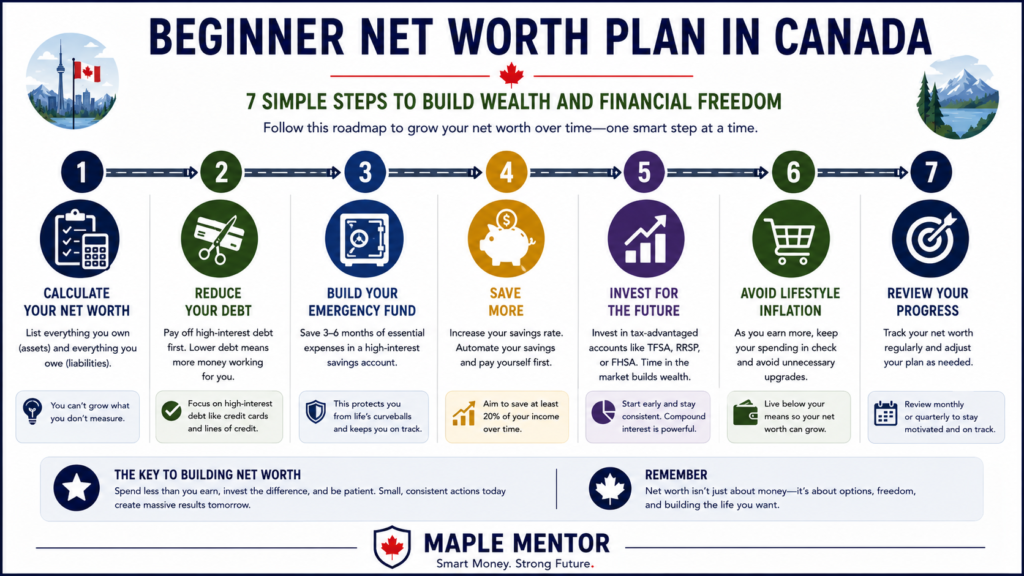
- Calculate your current net worth.
- Reduce high-interest debt.
- Build emergency savings.
- Increase your savings rate.
- Invest consistently.
- Avoid lifestyle inflation.
- Review your progress monthly.
You don’t need to become debt-free or wealthy immediately. The goal is simply to make your net worth move in the right direction over time.
What Is Net Worth?
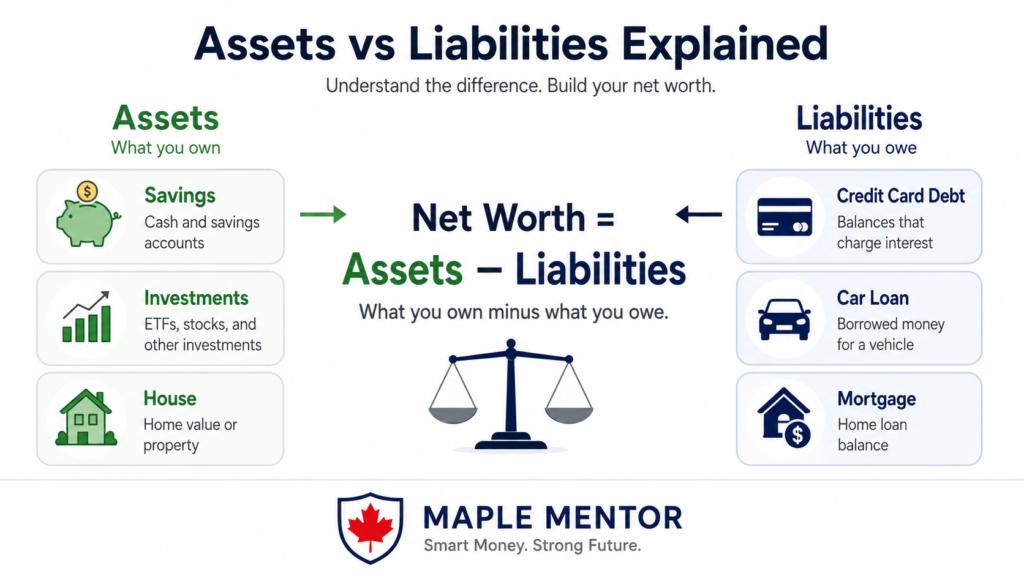
Net worth is the difference between your assets and liabilities.
The basic formula is:
Net Worth = Assets − Liabilities
Assets are things you own that have financial value.
Examples include:
- Chequing accounts
- Savings accounts
- TFSA investments
- RRSP investments
- FHSA investments
- Non-registered investments
- Home equity
- Other valuable assets
Liabilities are debts you owe.
Examples include:
- Credit card balances
- Lines of credit
- Personal loans
- Car loans
- Student loans
- Mortgage debt
Suppose you have:
Assets: $75,000
and:
Liabilities: $40,000
Your net worth would be:
$75,000 − $40,000 = $35,000
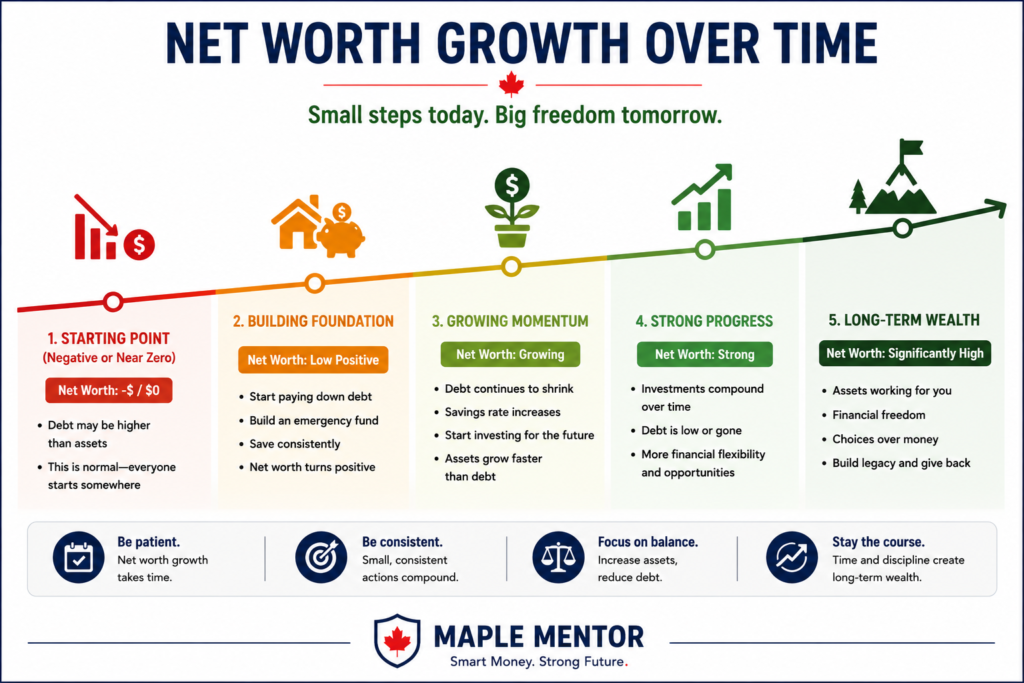
Your net worth can also be negative.
For example, if you have $10,000 in assets and $25,000 in debt:
$10,000 − $25,000 = −$15,000
That doesn’t mean your financial situation can’t improve. It simply gives you a starting point.
Why Your Net Worth Matters
Income tells you how much money you’re earning.
Net worth tells you how much wealth you’re actually building.
That’s an important difference.
Imagine two Canadians who both earn $80,000 per year.
Person A spends almost everything, carries credit card debt, and rarely invests.
Person B keeps expenses lower, avoids expensive debt, and invests every month.
Their incomes are identical, but their financial trajectories could look completely different after 10 or 20 years.
Tracking net worth helps you see whether your financial decisions are moving you forward.
A rising net worth generally means you’re doing some combination of:
- Saving money
- Paying down debt
- Investing
- Building home equity
- Growing financial assets
That’s why a net worth plan Canada beginners can consistently follow can be more useful than focusing only on salary.
Step 1 Calculate Your Starting Net Worth
Before trying to improve your net worth, calculate where you stand today.
Start by listing your assets.
Assets
Include balances from:
- Chequing accounts
- Savings accounts
- TFSA
- RRSP
- FHSA
- Non-registered investments
- Other investments
- Home equity, if applicable
You can include other significant assets, but avoid obsessing over every small possession you own.
For example, you probably don’t need to calculate the resale value of your television, couch, and kitchen appliances.
Next, list your liabilities.
Liabilities
Include:
- Credit cards
- Lines of credit
- Personal loans
- Student loans
- Car loans
- Mortgage
- Other debts
Subtract your total liabilities from your total assets.
That’s your starting net worth.
For a complete tracking system, read How to Track Your Net Worth in Canada.
Once you know your starting number, your net worth plan Canada strategy becomes much easier because you can identify what’s holding you back.
Step 2 Pay Down High-Interest Debt
Reducing debt increases your net worth.
However, some debts deserve more attention than others.
High-interest credit card debt can be particularly damaging because interest continuously works against your financial progress.
Suppose you owe $5,000 on a credit card charging a high interest rate.
Even while you’re saving money elsewhere, interest charges can make it difficult to move forward.
That’s why high-interest debts such as these usually deserve priority:
- Credit cards
- Payday loans
- High-interest personal loans
- Expensive financing balances
Start by making all required minimum payments. Then direct additional money toward the debt you’ve chosen to eliminate first.
You could use the debt avalanche method, which prioritizes the highest interest rate, or the debt snowball method, which prioritizes the smallest balance.
Learn both approaches in How to Pay Off Credit Card Debt Faster in Canada.
If you’re deciding whether extra money should go toward your portfolio or debt, read Should You Pay Off Debt or Invest in Canada?
Paying down debt may not feel as exciting as watching an investment portfolio grow, but every dollar of debt eliminated improves your net worth by reducing your liabilities.
Step 3 Build Emergency Savings
Emergency savings may not produce exciting returns, but they serve an important role in protecting your financial progress.
Without cash available, an unexpected $800 car repair might go onto a credit card.
Now your liabilities have increased.
An emergency fund provides a buffer between unexpected expenses and new debt.
If you’re starting from zero, consider working toward:
First goal: $500
Then:
Starter goal: $1,000
After that, you can gradually build toward a larger emergency fund based on your expenses, income stability, and responsibilities.
Follow the starter plan in How to Build a $1,000 Emergency Fund in Canada.
Once you’re building a larger fund, see Where to Keep Your Emergency Fund in Canada.
The Financial Consumer Agency of Canada recommends keeping emergency savings in a separate account that is easy to access, has low or no transaction fees, and allows withdrawals without penalty.
Emergency savings don’t just increase your assets. They can also help prevent your liabilities from increasing when something goes wrong.
Step 4 Increase Your Savings Rate
Your savings rate measures how much of your income you’re keeping instead of spending.
For example, if you take home $4,000 per month and save $800:
$800 ÷ $4,000 × 100 = 20% savings rate
Increasing that percentage can significantly accelerate your net worth plan Canada strategy.
You can improve your savings rate in two main ways:
Reduce Expenses
You could lower:
- Housing costs
- Transportation costs
- Subscriptions
- Banking fees
- Restaurant spending
- Impulse purchases
Increase Income Without Increasing Spending Equally
If your income increases by $500 per month, you don’t necessarily need to increase your lifestyle by $500.
You might spend an additional $100 while saving or investing the remaining $400.
That allows you to enjoy some of the raise while still accelerating your financial progress.
Learn how to increase the percentage you’re keeping in How to Increase Your Savings Rate in Canada.
Your savings rate is powerful because the money you don’t spend can eventually be directed toward debt repayment, emergency savings, investing, or other assets.
Step 5 Start Investing Consistently
Once you have some financial stability and expensive debt is under control, investing can become one of the main engines behind long-term net worth growth.
Canadian investors have several account options.
TFSA
A TFSA can hold investments while generally allowing investment growth and withdrawals to remain tax-free.
Start with TFSA Investing Strategy for Beginners.
The Canada Revenue Agency provides current TFSA rules, contribution information, and withdrawal guidance here:
RRSP
RRSP contributions can reduce taxable income in appropriate circumstances, while withdrawals are generally taxable.
Read RRSP Investing Strategy Canada.
FHSA
Eligible first-time home buyers can also consider an FHSA, which provides tax advantages specifically designed around saving for a qualifying first home.
What Should You Invest In?
Beginner investment options can include:
- Broad-market ETFs
- All-in-one ETFs
- Index funds
- Robo-advisors
- Diversified portfolios
Build your strategy with How to Build a Starter Investment Plan in Canada.
You can also compare beginner-friendly options in Best ETFs for Beginners in Canada.
The goal isn’t to constantly find the highest-performing investment.
For long-term investors, consistency, diversification, fees, risk tolerance, and time in the market can matter far more than constantly switching investments.
Even relatively small contributions can build meaningful assets when repeated for years.
Step 6 Avoid Lifestyle Inflation
Increasing your income doesn’t automatically increase your net worth.
What matters is what happens to the additional money.
Suppose your monthly take-home income increases from $4,000 to $4,500.
If your spending immediately increases by $500, your ability to build wealth hasn’t improved much.
This is lifestyle inflation.
It can happen through:
- A more expensive car
- A larger apartment or home
- More restaurant spending
- Frequent travel
- New subscriptions
- More expensive hobbies
- Regular technology upgrades
There’s nothing wrong with enjoying more of your money as your income grows.
The problem occurs when every raise automatically becomes another expense.
Instead, consider dividing raises between lifestyle improvements and financial goals.
For example, from an additional $500 per month:
$150 → lifestyle
$200 → investing
$100 → savings
$50 → extra debt repayment
Now your lifestyle improves while your net worth grows faster.
Learn how to control this in How to Avoid Lifestyle Inflation in Canada.
Avoiding lifestyle inflation can become one of the most powerful parts of a long-term net worth plan Canada because your ability to save and invest can increase alongside your income.
Step 7 Review Your Net Worth Regularly
Once your system is running, track your progress.
For many people, once per month is enough.
Update:
- Bank balances
- Investment balances
- TFSA
- RRSP
- FHSA
- Credit cards
- Loans
- Mortgage balance
- Other major assets and debts
Then calculate your new net worth.
Don’t expect it to increase every month.
Investment markets fluctuate. Large annual expenses happen. Cars need repairs. Vacations cost money.
Instead, watch the longer-term trend.
Ask:
Is my net worth generally higher than six months ago?
Is it higher than one year ago?
That’s more useful than worrying about small monthly fluctuations.
Beginner Net Worth Plan Example
Here’s what a simple plan might look like:
| Step | Example Action |
|---|---|
| Calculate net worth | Add assets and subtract debts |
| Reduce debt | Pay extra on credit cards |
| Build savings | Save first $1,000 |
| Increase savings rate | Redirect more income toward goals |
| Invest monthly | Contribute $200/month |
| Avoid lifestyle inflation | Save part of every raise |
| Review progress | Update net worth monthly |
You can adjust the order depending on your circumstances.
For example, someone receiving an employer RRSP match might contribute enough to receive the match while simultaneously paying down debt.
Someone with unstable income might prioritize a larger emergency fund.
The purpose of the plan is direction—not rigid rules.
How Your Net Worth Can Grow Over Time
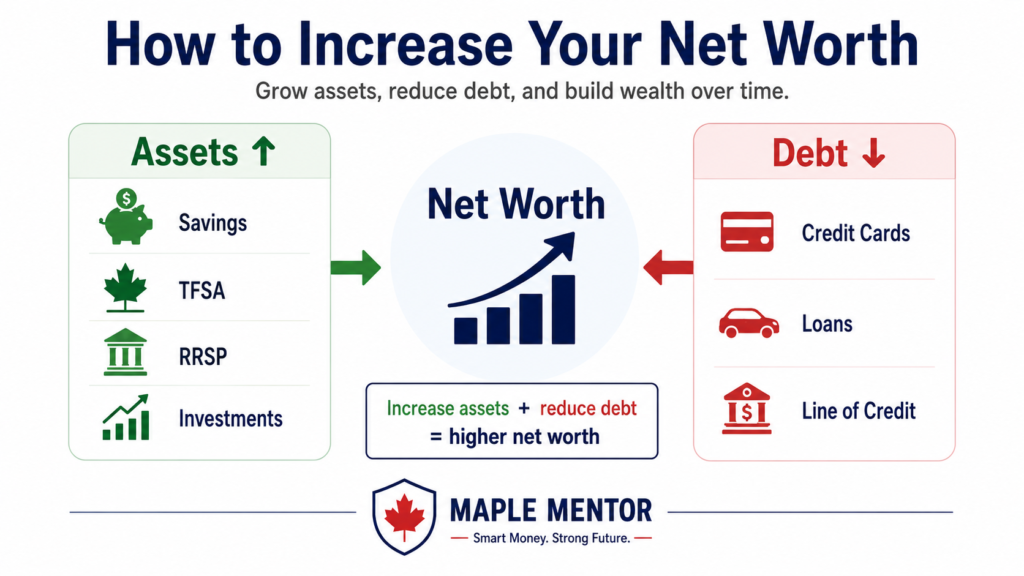
There are essentially two sides to the equation:
Assets ↑
and
Liabilities ↓
Both increase net worth.
Suppose you begin the year with:
$20,000 assets
$15,000 debt
Your net worth is:
$5,000
During the year, you save and invest another $6,000 while paying $4,000 off your debt.
Ignoring investment returns and other changes for simplicity:
Assets: $26,000
Debt: $11,000
Your new net worth becomes:
$15,000
You didn’t need a massive salary increase or a winning stock.
You simply increased assets and reduced liabilities.
That’s the basic engine behind wealth building.
Common Mistakes to Avoid
Only Focusing on Income
A higher salary helps, but only if some of that income becomes savings, investments, or debt reduction.
Focus on how much wealth you’re keeping.
Ignoring Debt Balances
Your investment portfolio isn’t your net worth.
If you have $50,000 invested and $40,000 in debt, both sides belong in the calculation.
Not Investing at All
Cash is important for emergencies and short-term goals.
However, keeping all long-term wealth in cash can reduce your potential for long-term growth and expose purchasing power to inflation.
Upgrading Your Lifestyle Too Quickly
Raises can dramatically increase your ability to build wealth—unless your expenses rise equally fast.
Give part of every income increase to your future.
Comparing Your Net Worth to Others
Someone else’s net worth doesn’t tell you much about your own financial progress.
Age, income, inheritance, housing, family responsibilities, location, debt, and life circumstances can all be different.
Compare your current financial position with your previous one.
Not Tracking Progress
If you never calculate your net worth, it becomes difficult to know whether you’re actually improving.
A monthly update takes only a few minutes once your system is established.
Keeping Too Much Money Idle Long Term
Emergency funds and short-term savings should generally remain safe and accessible.
However, money intended for goals decades away may have greater growth potential when appropriately invested rather than permanently sitting in cash.
Final Answer
A beginner net worth plan Canada residents can follow is ultimately about doing two things:
Build assets and reduce liabilities.
Start by calculating your current net worth so you know exactly where you stand.
Then build a small emergency fund, attack high-interest debt, increase your savings rate, and begin investing consistently when your financial foundation allows it.
As your income increases, resist automatically increasing your expenses at the same rate. Redirect part of that additional income toward investments and other assets.
Finally, review your progress regularly.
A strong net worth plan Canada doesn’t require your finances to improve perfectly every month. What matters is that, over years, your assets generally rise, your expensive debts decline, and the difference between the two keeps growing.
That’s how net worth turns from a number you track into wealth you actually build.
FAQ
What is a good net worth plan?
A good net worth plan helps you increase assets while reducing liabilities.
For most beginners, that means building emergency savings, reducing high-interest debt, increasing their savings rate, investing consistently, and tracking progress over time.
How do I increase my net worth in Canada?
You can increase your net worth by saving more money, paying down debt, investing consistently, increasing your income without increasing spending equally, and avoiding unnecessary lifestyle inflation.
The strongest approach usually combines several of these strategies.
Should I track my net worth every month?
Monthly tracking works well for many people because it provides regular feedback without requiring constant monitoring.
However, quarterly tracking can also work if you prefer a less frequent approach.
Is net worth more important than income?
Both are useful measurements, but they measure different things.
Income measures how much money you earn. Net worth measures the value of your assets after subtracting your liabilities.
A high income can make building wealth easier, but it doesn’t guarantee a high net worth if most of the income is spent.
Can I have a negative net worth?
Yes.
You have a negative net worth when your liabilities exceed your assets. This can happen because of student loans, credit card debt, car loans, or other borrowing.
A negative starting number doesn’t prevent you from building wealth. Paying down debt and increasing assets will gradually improve it.