
Looking for a simple RRSP investing strategy Canada beginners can actually follow? Many Canadians understand that RRSPs help with retirement savings, but they’re often unsure what to invest in, how much to contribute, or whether they should prioritize a TFSA instead.
The good news is that a successful RRSP investing strategy doesn’t need to be complicated. For most people, the best approach is to use an RRSP for long-term retirement investing, choose diversified investments, and stay consistent for years. In this guide, you’ll learn how RRSP investing works, who should use one, and how to avoid common mistakes.
Quick Answer
A Simple RRSP Investing Strategy for Beginners
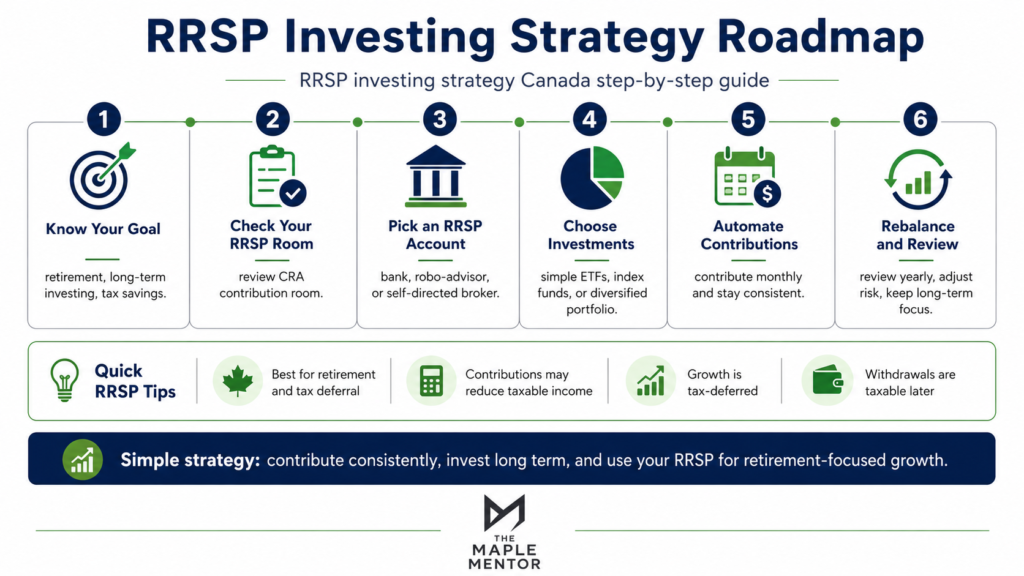
For most Canadians, a strong RRSP investing strategy includes:
- Contributing when an RRSP makes sense for your income
- Investing in diversified ETFs or index funds
- Reinvesting your tax refund strategically
- Avoiding unnecessary withdrawals
- Focusing on long-term growth
The goal is simple: build retirement wealth over decades while taking advantage of RRSP tax benefits.
What Is an RRSP?
An RRSP, or Registered Retirement Savings Plan, is one of Canada’s most popular retirement accounts.
Tax Deduction Today
Contributions may reduce your taxable income for the year.
Tax-Deferred Growth
Investments can grow without annual taxes while they remain inside the account.
Taxes Later
Withdrawals are taxed as income when money comes out.
One important point often gets overlooked: an RRSP is an account type, not an investment.
Think of the RRSP as the container. The investments you place inside the account are what actually grow your money.
According to the Canada Revenue Agency RRSP guide, RRSP contributions can provide tax deductions while allowing investments to grow tax-deferred.
How RRSP Investing Works in Canada
An RRSP can hold many different investments.
Common options include:
- ETFs
- Index funds
- Mutual funds
- Stocks
- Bonds
- GICs
- Cash
Because of this flexibility, two RRSPs can perform very differently depending on what they contain.
A beginner who holds diversified ETFs may have a completely different outcome than someone who leaves cash sitting in the account for years.
Therefore, choosing investments matters just as much as opening the RRSP itself.
Who Should Use an RRSP?
An RRSP can be an excellent tool, but it isn’t automatically the best choice for everyone.
Best For
- Canadians in higher tax brackets
- Long-term retirement savers
- Employees with workplace RRSP matching
- Self-employed Canadians with taxable income
- People expecting lower income in retirement
Less Urgent For
- Very low-income earners
- Investors with substantial unused TFSA room
- People who may need their money soon
If you’re deciding between accounts, read TFSA Investing Strategy for Beginners
RRSP vs TFSA: Which Should Beginners Prioritize?
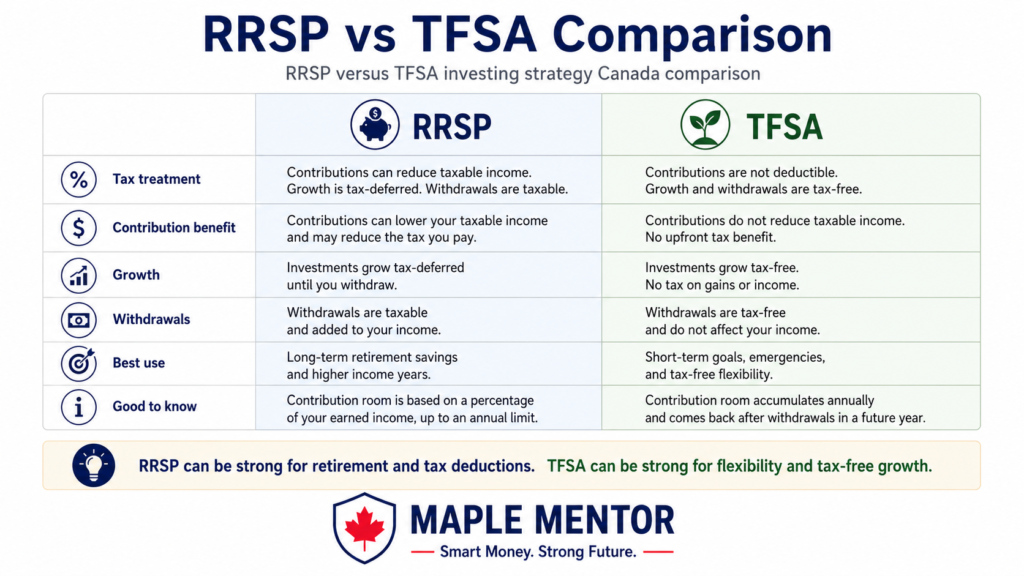
Many Canadians struggle with this decision.
| Account | Best For | Main Benefit | Main Drawback |
|---|---|---|---|
| RRSP | Higher-income retirement savers | Tax deduction today | Withdrawals taxed later |
| TFSA | Flexible long-term investing | Tax-free withdrawals | No tax deduction |
Simple Rule
- Lower income → often TFSA first
- Higher income → RRSP becomes more attractive
- Employer matching → usually take the match first
For many young investors, the TFSA provides greater flexibility. However, RRSP benefits become more valuable as income rises.
Learn more in TFSA Taxes Explained
You can also compare investment options in Best ETFs for TFSA in Canada
Best Investments to Hold in an RRSP
The best investments depend on your goals and risk tolerance.
All-In-One ETFs
A complete diversified portfolio in a single investment.
Index ETFs
Simple, low-cost exposure to broad markets.
Bond ETFs
Suitable for investors seeking lower volatility.
Dividend ETFs
Can provide income and diversification.
GICs
A conservative option for investors prioritizing capital preservation.
For most beginners, diversified ETFs are usually easier and more effective than selecting individual stocks.
Learn more about the differences in Index Funds vs ETFs
If you’re looking for a platform to invest through, compare options in Best Online Brokers Canada
According to Vanguard’s investing principles, diversification and low costs are among the most important drivers of long-term investing success.
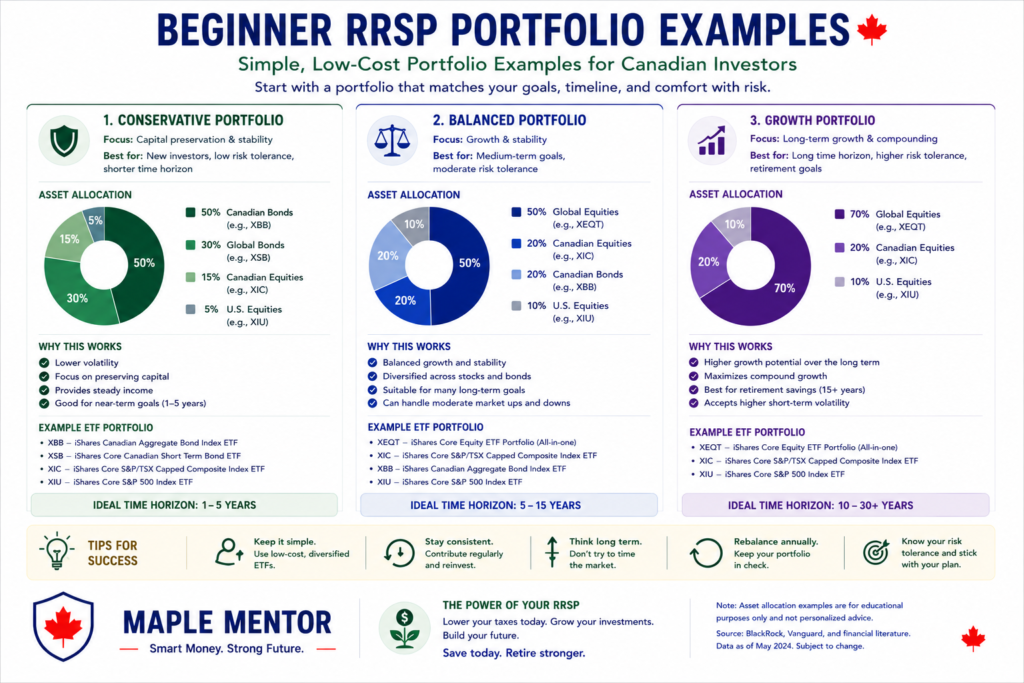
Simple RRSP Portfolio Examples
These examples are educational only and not personalized financial advice.
| Investor Type | Example Portfolio Style |
|---|---|
| Conservative | More bonds, fewer stocks |
| Balanced | Mix of stocks and bonds |
| Growth-Focused | Mostly stock ETFs |
| Aggressive | Nearly all equity ETFs |
As your time horizon increases, many investors become comfortable holding more equities.
However, risk tolerance remains an important consideration.
How Much Should You Contribute to Your RRSP?
Contribution room is generally based on earned income and unused room from previous years.
Keep It Simple
- Check your CRA My Account
- Avoid overcontributions
- Only contribute money you can leave invested
- Consider your tax bracket
Importantly, maxing your RRSP isn’t always necessary.
Sometimes a TFSA may provide greater flexibility depending on your circumstances.
You can verify contribution limits through CRA My Account
What Should You Do With Your RRSP Tax Refund?
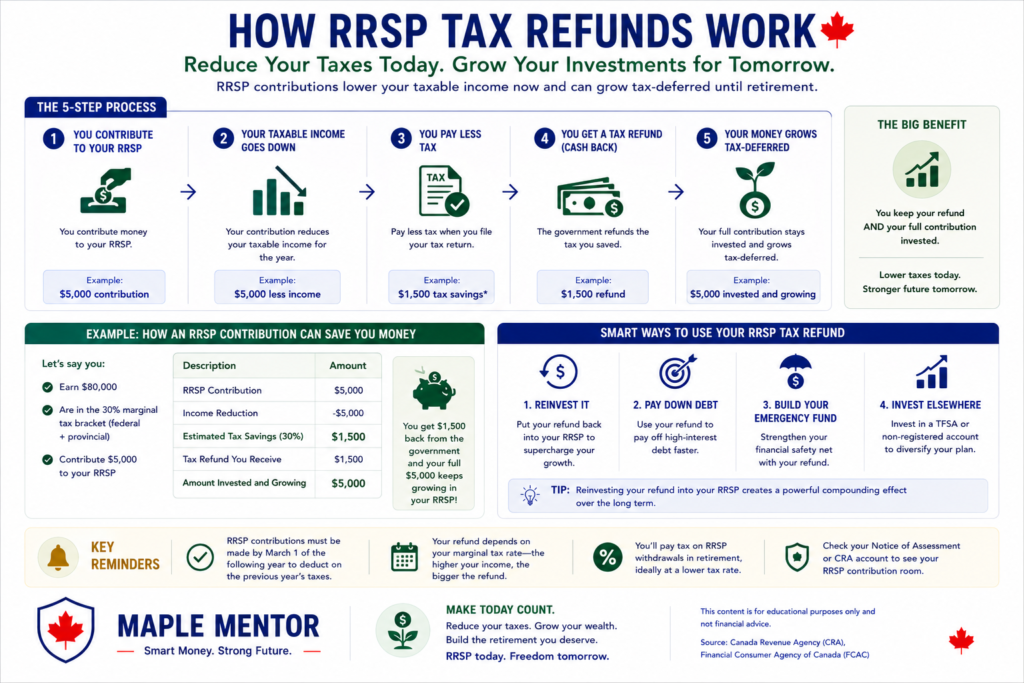
This is one of the most overlooked parts of a successful RRSP investing strategy Canada investors should understand.
The tax refund isn’t free money.
Instead, it’s a key component of the overall RRSP strategy.
Smart Uses for Your Tax Refund
Reinvest It
This can significantly increase long-term compounding.
Contribute to a TFSA
A great option if you have available room.
Pay Off High-Interest Debt
Often provides a guaranteed return.
Build Emergency Savings
Improves financial stability.
Before deciding, read Should You Pay Off Debt or Invest in Canada?
You should also understand Where to Keep Your Emergency Fund in Canada
RRSP Investing Mistakes to Avoid
Treating the RRSP Like a Savings Account
An RRSP is designed for long-term investing.
Holding Too Much Cash
Cash may reduce long-term growth potential.
Withdrawing Early
Early withdrawals can trigger taxes and permanently reduce contribution room.
Ignoring Fees
High fees can significantly impact long-term returns.
Investing Without a Plan
Consistency matters more than constantly changing strategies.
Skipping Employer Matching
Employer contributions are often one of the best returns available.
Spending the Tax Refund
Many investors miss an opportunity to strengthen their finances.
Overcontributing
Penalties may apply if you exceed your limits.
RRSP Withdrawals: What Beginners Should Know
RRSP withdrawals come with important rules.
Withdrawals Are Taxable
Money withdrawn is generally added to taxable income.
Contribution Room Is Usually Lost
Unlike a TFSA, RRSP room doesn’t come back after withdrawals.
Withholding Tax May Apply
Financial institutions often withhold a portion of withdrawals immediately.
RRSPs Are Designed for Retirement
Because of this, frequent withdrawals typically reduce the account’s effectiveness.
Exceptions
Certain programs provide special treatment:
- Home Buyers’ Plan (HBP)
- Lifelong Learning Plan (LLP)
Best RRSP Strategy for Most Beginners
A simple approach usually works best.
Step 1
Build emergency savings.
Step 2
Pay off high-interest debt.
Step 3
Take employer RRSP matching if available.
Step 4
Choose between TFSA and RRSP based on income and goals.
Step 5
Invest in diversified ETFs.
Step 6
Use your tax refund strategically.
Step 7
Stay invested for decades.
As a result, your RRSP becomes a powerful long-term wealth-building tool rather than just another savings account.
Final Answer
A strong RRSP investing strategy Canada beginners can follow is surprisingly simple.
Use your RRSP for long-term retirement savings, invest in diversified low-cost funds, avoid unnecessary withdrawals, and use your tax refund wisely.
Most importantly, remember that consistency often matters more than finding the perfect investment. The RRSP works best when you treat it as a long-term wealth-building tool rather than a short-term savings account.
FAQ
What is the best RRSP investing strategy in Canada?
For most beginners, the best RRSP strategy is to invest for retirement using diversified, low-cost ETFs or index funds while avoiding early withdrawals.
Should I invest in my RRSP or TFSA first?
It depends on your income, tax bracket, and goals. Lower-income Canadians often benefit from a TFSA first, while higher-income Canadians may benefit more from RRSP deductions.
Can I hold ETFs in an RRSP?
Yes. ETFs are commonly held inside RRSPs and can be an effective way to build a diversified retirement portfolio.
Should I keep cash in my RRSP?
Some cash is fine temporarily, but holding too much cash long term may reduce growth potential.
Is an RRSP good for beginners?
Yes, provided it fits your income level and financial goals. Understanding the tax implications before contributing heavily is important.