
Building an investment plan Canada beginners can actually follow does not require complicated spreadsheets, dozens of ETFs, or hours spent watching the stock market. In fact, a simple strategy is usually easier to maintain over the long term.
Your investment plan should answer a few basic questions: Why are you investing? When will you need the money? Which account should you use? What will you invest in? Finally, how much will you contribute each month?
Once those decisions are made, investing becomes much less confusing. In this guide, you’ll learn how to build an investment plan Canada beginners can use to start investing consistently without constantly changing strategies.
Quick Answer
A starter investment plan helps you know why you are investing, which account to use, how much to contribute, and what type of investments fit your goals.
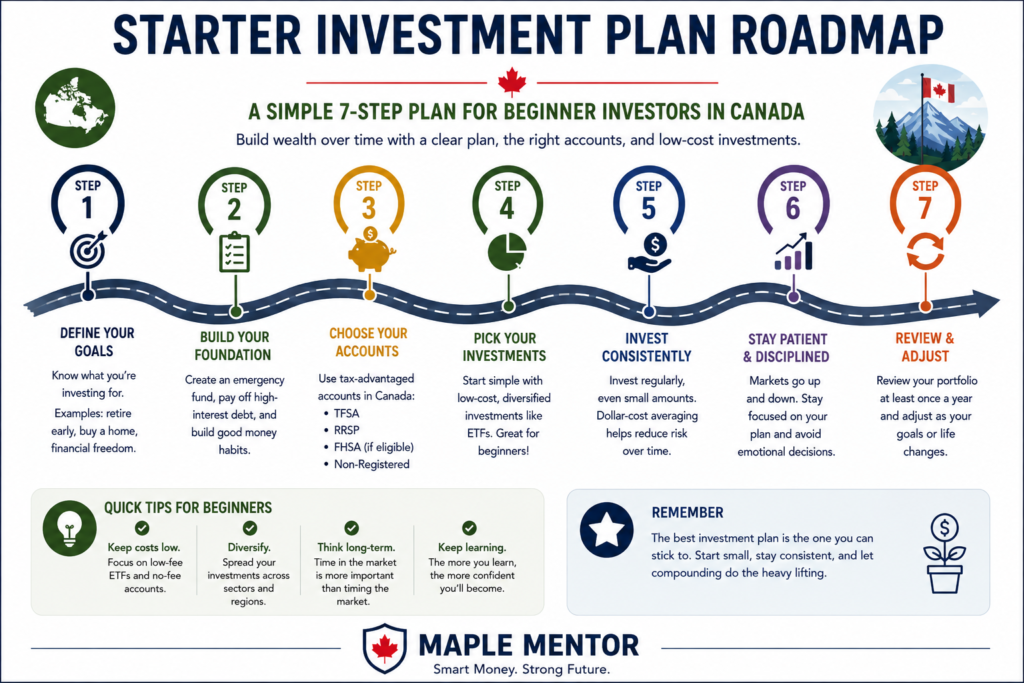
For most beginners in Canada, a simple plan includes:
- A clear financial goal
- A long-term timeline
- A TFSA, RRSP, or FHSA when appropriate
- Diversified ETFs or another simple investment strategy
- Consistent monthly contributions
- Regular—but not constant—reviews
The goal isn’t to find the perfect investment. Instead, build a simple investment plan Canada investors can realistically follow for years.
What Is an Investment Plan?
An investment plan is a simple strategy that explains where your investment money goes and why.
Without a plan, investing can quickly become random.
For example, you might:
- Buy an ETF because someone mentioned it online.
- Purchase a stock after seeing it rise.
- Sell investments because the market drops.
- Switch strategies every few months.
- Own several investments that do essentially the same thing.
A plan gives your decisions structure.
It might say:
“I’m investing for retirement 25 years from now. I’ll contribute $200 per month to my TFSA and invest it in a diversified all-in-one ETF that matches my risk tolerance.”
That single sentence answers most of the important questions.
Moreover, having a plan makes it easier to ignore short-term market noise because you already know what you’re supposed to do.
The Financial Consumer Agency of Canada explains that investments involve different levels of risk, costs, and potential returns, which makes understanding your objectives and risk tolerance important before investing.
Step 1 Choose Your Investing Goal
Before deciding what to buy, decide why you’re investing.
Your goal determines almost everything else.
Common investing goals include:
- Retirement
- Buying your first home
- Financial independence
- Building long-term wealth
- Creating future passive income
- Leaving money for family
For example, retirement money you won’t need for 30 years can usually tolerate more short-term volatility than money you’re saving for a home purchase three years from now.
Your goal should also be specific.
Instead of:
“I want to get rich.”
Try:
“I want to build a retirement portfolio over the next 30 years.”
Or:
“I want to invest enough to reach financial independence in my 50s.”
Clear goals make investment decisions much easier.
If you’re still defining your priorities, start with How to Set Financial Goals in Canada Without Getting Overwhelmed.
Step 2 Know Your Investment Timeline
Your timeline is the amount of time between today and when you’ll need the money.
This matters because investments can fall in value over short periods.
A simple framework is:
| Timeline | General Approach |
|---|---|
| Under 3 years | Usually prioritize savings and capital protection |
| 3–5 years | More conservative approach may be appropriate |
| 5+ years | Investing becomes more reasonable |
| 10–30+ years | Greater ability to tolerate short-term market volatility |
These aren’t rigid rules.
However, they illustrate an important principle: don’t invest aggressively with money you’ll definitely need soon.
Suppose you’re saving $30,000 for a house down payment you plan to use next year.
Putting everything into equities could create a serious problem if markets decline 25% shortly before you need the money.
Meanwhile, retirement savings for someone in their 20s or 30s have decades to recover from market downturns.
Time horizon and risk should always work together.
Step 3 Choose the Right Investment Account
Once you know your goal and timeline, decide where you’ll invest.
Canadian investors have several account types available.
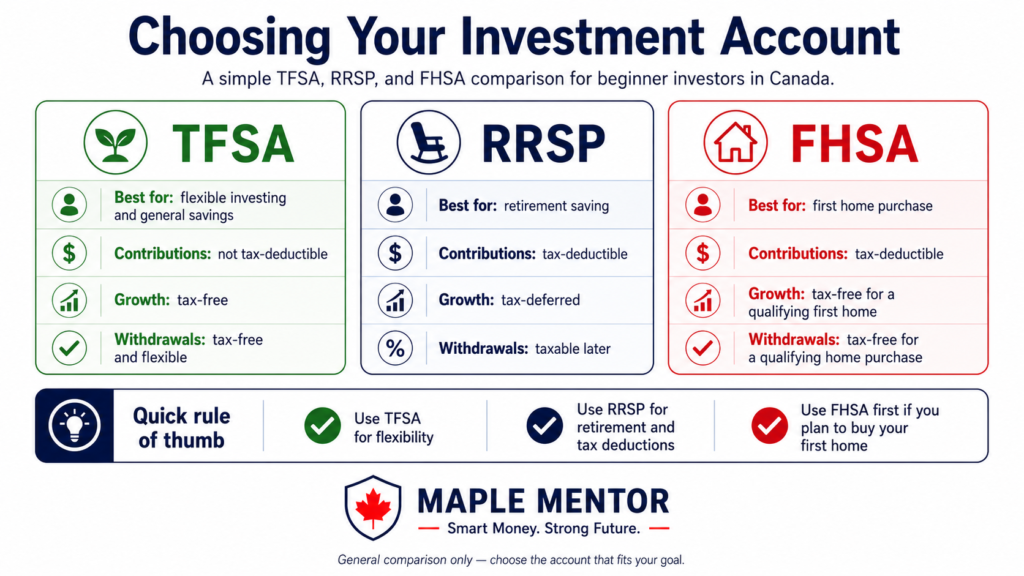
TFSA
A Tax-Free Savings Account can hold investments such as ETFs, stocks, bonds, and other eligible investments.
Investment income and gains earned inside a TFSA are generally tax-free, while withdrawals are generally tax-free as well.
For many beginners, its flexibility makes the TFSA an attractive place to start.
Learn how to use yours in TFSA Investing Strategy for Beginners.
You can also review the CRA’s official TFSA information here.
RRSP
An RRSP is primarily designed for retirement savings.
Contributions can potentially provide a tax deduction, while withdrawals are generally taxable later.
For higher-income Canadians or workers receiving employer matching contributions, an RRSP can become especially useful.
Read RRSP Investing Strategy Canada for a complete beginner strategy.
CRA provides its RRSP and registered retirement plan guidance here.
FHSA
The First Home Savings Account is specifically designed for eligible first-time home buyers.
It combines deductible contributions with the possibility of tax-free qualifying withdrawals toward a first home.
If home ownership is your goal, read FHSA Investing Strategy for First-Time Buyers.
CRA’s official FHSA guide is available here.
Non-Registered Account
A non-registered account does not provide the same tax shelter as registered accounts.
However, it has no registered-account contribution limit and can become useful once you’ve used available registered account room or when your strategy calls for additional taxable investing.
If you’re unsure which registered account to prioritize, compare them in TFSA vs RRSP vs FHSA in Canada.
Step 4 Understand Your Risk Tolerance
Risk tolerance isn’t just about how much volatility a spreadsheet says you can handle.
It’s also about how you react emotionally when your investments decline.
Imagine investing $20,000.
How would you react if the balance temporarily dropped to:
- $18,000?
- $16,000?
- $14,000?
Would you continue investing?
Or would you panic and sell everything?
That’s why your portfolio needs to match both your financial capacity for risk and your emotional comfort with volatility.
Conservative Investor
Prioritizes stability and generally accepts lower expected returns in exchange for reduced volatility.
Balanced Investor
Combines growth investments with more defensive assets such as bonds.
Growth Investor
Accepts significant volatility in exchange for greater long-term growth potential.
Aggressive Investor
May hold almost entirely equities and must be comfortable experiencing substantial temporary declines.
There is no prize for choosing the most aggressive portfolio.
A slightly more conservative portfolio you can hold through market downturns may be far better than an aggressive portfolio you abandon during the first crash.
Step 5 Pick Simple Investments
Once you’ve chosen your account and risk level, decide what you’ll actually invest in.
For beginners, simplicity can be a major advantage.
All-in-One ETFs
All-in-one asset allocation ETFs combine multiple markets and sometimes bonds into one fund.
Instead of managing several ETFs manually, you can own one diversified portfolio.
Index ETFs
Index ETFs attempt to track a market index rather than selecting individual companies.
They can provide broad diversification at relatively low costs.
Compare beginner-friendly choices in Best ETFs for Beginners in Canada.
If you’re confused about terminology, read Index Funds vs ETFs in Canada.
Robo-Advisors
A robo-advisor builds and manages a portfolio based on your goals and risk tolerance.
You’ll generally pay more than managing ETFs yourself, but the automation may be worthwhile if it keeps you investing consistently.
Compare your options in Best Robo-Advisors in Canada.
Diversified Portfolios
Regardless of which approach you choose, avoid concentrating your entire portfolio in one company, sector, or investment theme.
For most beginners, the goal should not be finding the next winning stock.
Instead, build an investment plan Canada beginners can maintain using broad diversification, reasonable fees, and long-term discipline.
Step 6 Decide How Much to Invest Monthly
You don’t need thousands of dollars to start.
What matters initially is creating the habit.
Possible starting amounts include:
- $25 per week
- $50 every two weeks
- $100 per month
- $250 per month
- $500 per month
Suppose you can comfortably invest $100 every month.
Start there.
As your income increases or expenses decrease, raise your contributions.
For example:
Year 1: $100/month
Year 2: $150/month
Year 3: $200/month
Gradually increasing contributions can be much easier than waiting until you can immediately invest $500 or $1,000 per month. Read How Much Should You Invest Each Month in Canada?
Most importantly, don’t invest money you cannot afford to leave invested.
Step 7 Automate Contributions
Automation turns your investment plan from an intention into a system.
Instead of asking yourself every payday whether you should invest, schedule your contribution automatically.
For example:
Friday: Paycheque arrives
Saturday: $100 transfers to TFSA
Monday: Investment is purchased
Depending on your brokerage or investing platform, you may be able to automate both deposits and purchases.
If not, automate the transfer and create a regular investing schedule.
Automation helps reduce:
- Forgetfulness
- Emotional decisions
- Attempts to time the market
- Spending money before investing it
Build a larger automated system using How to Automate Your Finances in Canada.
The best investment plan Canada investors can follow is often the one that requires the fewest unnecessary decisions.
Simple Starter Investment Plan Example
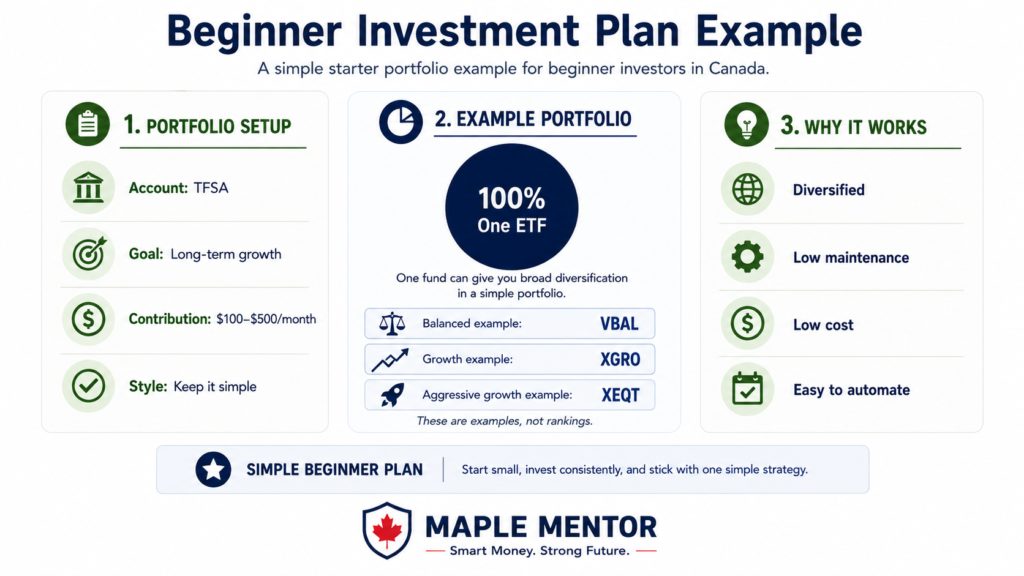
Here’s what a basic beginner plan could look like:
Notice how little is happening.
There are no individual stock picks.
There is no market prediction.
There is no complicated trading strategy.
The investor simply contributes regularly to a diversified portfolio and reviews the plan periodically.
For many beginners, that’s enough.
Common Mistakes to Avoid
Investing Without an Emergency Fund
Unexpected expenses can force you to sell investments at a bad time.
Before investing aggressively, build at least a small cash buffer.
Picking Random Stocks
Buying companies because they’re popular online isn’t an investment strategy.
If you’re a beginner, broad diversification is usually easier to manage.
Changing Strategy Too Often
A portfolio that changes every six months never gets a chance to work as intended.
Give your strategy time.
Ignoring Fees
Fees reduce your returns.
Pay attention to ETF management expenses, commissions, currency conversion costs, account fees, and advisory fees.
Investing Short-Term Money
Don’t expose money you’ll definitely need soon to unnecessary market volatility.
Copying Online Portfolios
Someone else’s age, income, risk tolerance, tax situation, and financial goals may be completely different from yours.
Use examples for education—not as automatic instructions.
Checking Investments Too Often
Watching your portfolio every day can encourage emotional decisions.
For long-term investors, your contribution habits usually deserve more attention than daily market movements.
Final Answer
A starter investment plan Canada beginners can follow does not need to be complicated.
Start by defining exactly why you’re investing and when you’ll need the money. Next, choose the appropriate TFSA, RRSP, FHSA, or other account and determine how much risk you’re genuinely comfortable taking.
From there, keep the investments simple. Diversified ETFs, index investing, or a robo-advisor can all provide beginner-friendly ways to build a portfolio without constantly selecting individual stocks.
Finally, automate your contributions and review your plan once or twice per year.
The strongest investment plan Canada investors can build isn’t necessarily the most sophisticated one. It’s the plan they can continue following when markets rise, when markets fall, and when investing becomes boring.
Consistency is the strategy.
FAQ
How do I start an investment plan in Canada?
Start by choosing your investing goal, timeline, account type, risk tolerance, investment strategy, and monthly contribution.
A basic investment plan Canada beginner strategy might involve contributing regularly to a diversified ETF inside a TFSA and reviewing the plan once or twice per year.
What is the best investment plan for beginners?
There isn’t one portfolio that’s best for everyone.
However, many beginners benefit from keeping things simple with diversified ETFs, index investing, or robo-advisors inside an appropriate registered account.
Should I invest before building an emergency fund?
Usually, establishing at least a small emergency fund first is sensible.
Emergency savings reduce the chance that you’ll need to sell investments or use expensive debt when an unexpected expense occurs.
How often should I review my investment plan?
Once or twice per year is enough for many long-term investors.
You should also review the plan after major life changes, such as buying a home, getting married, having children, significantly changing income, or approaching retirement.
Should beginners use a TFSA or RRSP?
It depends on income, goals, contribution room, and tax situation.
A TFSA can provide considerable flexibility, while an RRSP may become more attractive when tax deductions are particularly valuable or an employer provides matching contributions.