
How to Set Financial Goals in Canada
Looking to set financial goals Canada residents can actually achieve? Many Canadians want to save more money, invest, or become debt-free, but vague goals rarely lead to lasting results. Instead, successful financial planning starts with clear objectives, realistic timelines, and a simple action plan. In this guide, you’ll learn how to set financial goals in Canada, choose the right accounts, and build a monthly plan that keeps you moving forward.
Quick Picks
How to Set Financial Goals in Canada
For most Canadians, the simplest approach is to choose:
- One short-term goal
- One medium-term goal
- One long-term goal
Then give each goal:
- A dollar amount
- A deadline
- The right account
- A monthly contribution plan
The more specific your goal is, the easier it becomes to achieve.
Why Financial Goals Matter
Many people say things like:
- “I want to save more.”
- “I should invest.”
- “I want to be rich.”
Unfortunately, goals like these are too vague.
Instead, good financial goals tell you exactly what you’re working toward and how you’ll get there.
For example:
❌ Save more money.
✅ Save $10,000 for an emergency fund within two years.
Likewise, instead of saying you want to retire comfortably someday, decide how much you’ll need and when you hope to retire.
Clear goals make it easier to prioritize your money and stay motivated over time.
According to the Financial Consumer Agency of Canada’s goal-setting resources, setting specific financial goals makes it easier to create a realistic financial plan.
Start With Your Current Situation
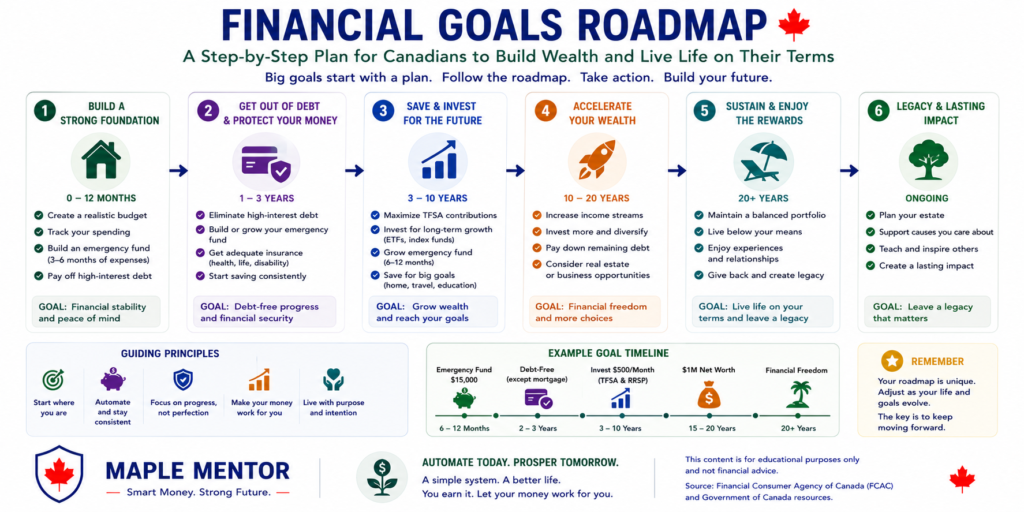
Before choosing goals, understand where you stand today.
Take a few minutes to review:
- Monthly income
- Monthly expenses
- Current debt
- Emergency savings
- Investment accounts
- Upcoming life changes
Knowing your starting point helps you choose realistic financial goals instead of chasing unrealistic expectations.
For example, someone carrying high-interest credit card debt should usually focus on debt repayment before investing aggressively.
A great place to start is How to Track Your Net Worth in Canada.
Choose Short-Term, Medium-Term, and Long-Term Goals
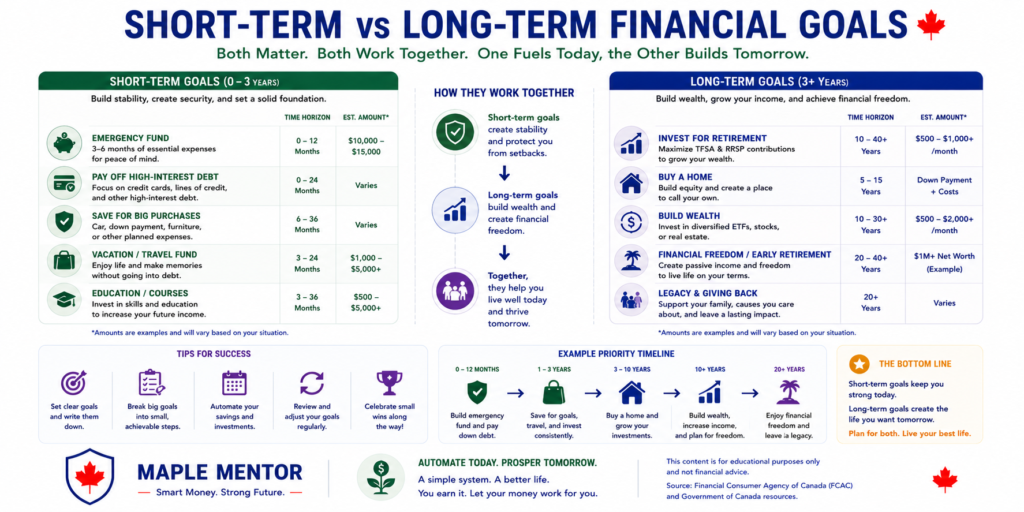
Most Canadians benefit from having goals across different time horizons.
| Goal Type | Timeline | Examples |
|---|---|---|
| Short-Term | Under 1 year | Emergency fund, vacation, paying off a credit card |
| Medium-Term | 1–5 years | New vehicle, home down payment, moving expenses |
| Long-Term | 5+ years | Retirement, financial independence, investing |
Having goals in each category keeps your money balanced.
Rather than focusing on only retirement or only today’s expenses, you’ll make progress across multiple priorities.
Give Every Goal a Dollar Amount
This is where many people struggle.
A goal without a number is simply a wish.
Instead of saying:
“I want to buy a house.”
Say:
“I want to save $25,000 for a down payment within three years.”
Likewise, don’t say:
“I should build an emergency fund.”
Instead, decide on a specific amount.
For example:
- Save $12,000 in two years.
- Save $500 per month.
Numbers create clarity.
They also make it much easier to measure your progress.
Choose the Right Account for Each Goal
Different financial goals belong in different accounts.
Choosing the right account can help you reduce taxes, earn more interest, or grow your investments more efficiently.
Emergency Fund
A high-interest savings account is usually the best option because your money stays safe and accessible.
Learn more in Where to Keep Your Emergency Fund in Canada.
Short-Term Savings
Goals within the next few years often belong in:
- High-interest savings accounts
- Cashable GICs
- Short-term savings accounts
First Home
Depending on your timeline, consider:
- FHSA
- TFSA
- High-interest savings account
Learn more in FHSA Investing Strategy for First-Time Buyers.
Retirement
For long-term retirement goals, common options include:
- RRSP
- TFSA
- Workplace pension
- Group RRSP
Investing
Long-term investing often takes place inside:
- TFSA
- RRSP
- FHSA
- Non-registered investment accounts
If you’re unsure which account fits your goals, read TFSA vs RRSP vs FHSA in Canada.
Break the Goal Into Monthly Contributions
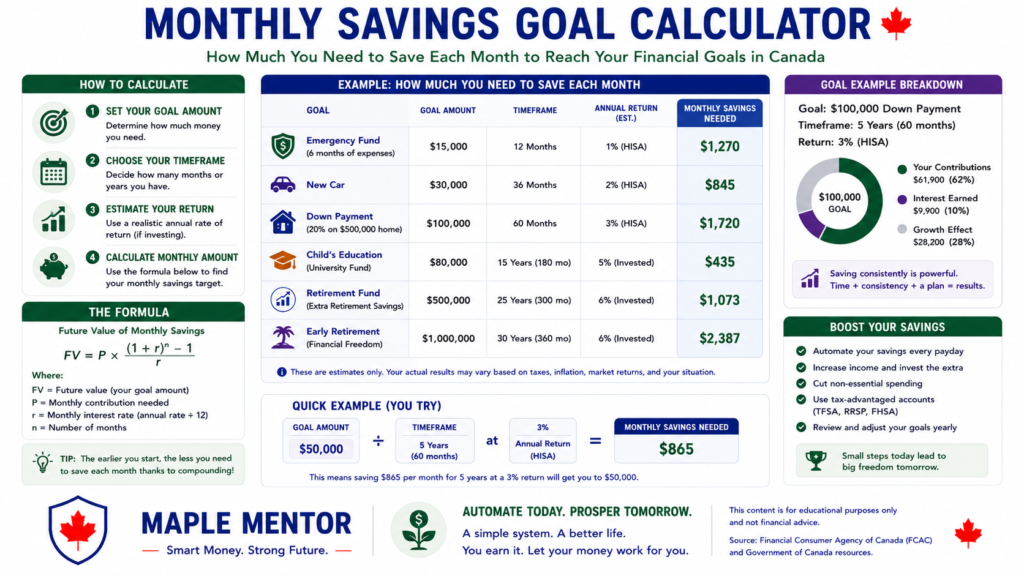
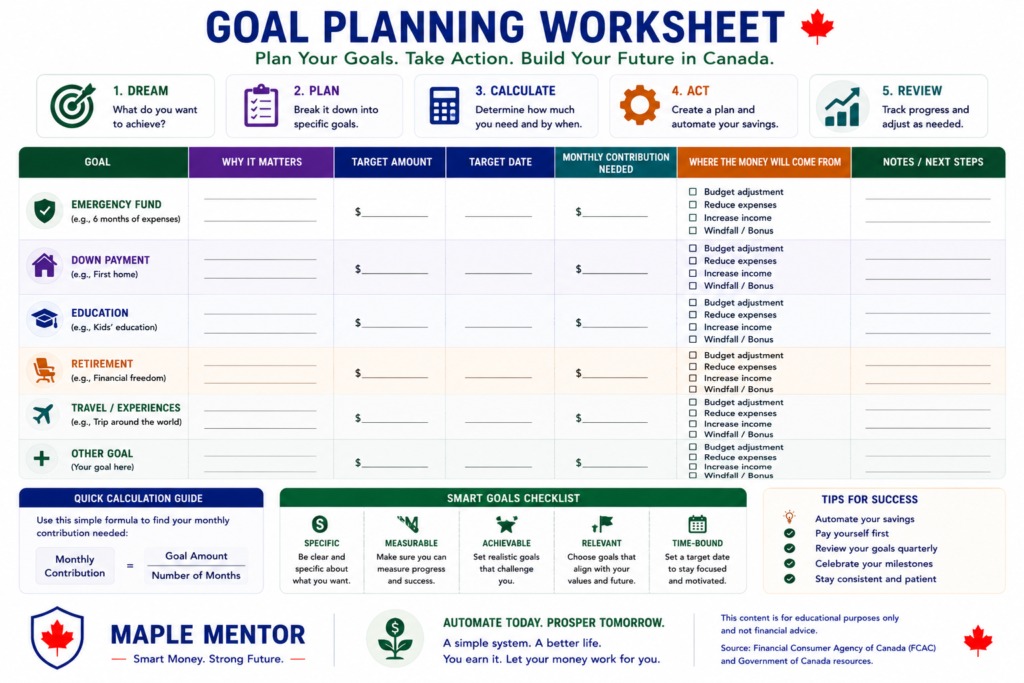
Once you’ve chosen your goal amount, break it into manageable monthly contributions.
The calculation is simple.
Goal Amount ÷ Number of Months = Monthly Savings Target
For example:
You want to save:
- Goal: $12,000
- Timeline: 24 months
Calculation:
$12,000 ÷ 24 = $500 per month
Suddenly, a large financial goal feels much more achievable.
Likewise, if $500 per month isn’t realistic, you can either extend the timeline or reduce the target amount.
The important thing is creating a plan you can actually follow.
Prioritize Your Goals
One of the biggest mistakes Canadians make is trying to accomplish every financial goal at once.
Unfortunately, money is limited, so your priorities should be clear.
For most people, this order makes the most sense:
- Cover your basic living expenses.
- Build a small emergency fund.
- Pay off high-interest debt.
- Build a full emergency fund.
- Invest for long-term goals.
- Save for larger lifestyle goals like a home, vehicle, or vacation.
This order creates financial stability before focusing on wealth building.
For example, investing while carrying 20% credit card debt usually isn’t the most effective strategy. Likewise, buying stocks before having any emergency savings can force you to sell investments during a market downturn if an unexpected expense arises.
If you’re unsure which goal deserves your next dollar, read How to Choose Between Saving, Investing, and Paying Off Debt in Canada.
Automate Your Progress
Once you’ve chosen your financial goals, automate as much of the process as possible.
Instead of relying on motivation every payday, let your bank move the money automatically.
For example, after each paycheque:
- Transfer money to your emergency fund.
- Make extra debt payments.
- Contribute to your TFSA or RRSP.
- Save toward short-term goals.
Automation removes the temptation to spend money before saving it.
Even small automatic contributions can grow into significant savings over time.
For instance, automatically investing $100 every month may not seem like much today, but consistency is what builds wealth over the long run.
Learn how to build an automatic system in How to Automate Your Finances in Canada.
Common Mistakes to Avoid
Setting Too Many Goals
Trying to save for a home, retirement, a vacation, a new car, and an emergency fund all at once often leads to slow progress everywhere.
Focus on your highest priorities first.
Choosing Goals Without Numbers
“I want to save more” isn’t a measurable goal.
Instead, attach a dollar amount and a deadline.
Investing Money You’ll Need Soon
Money needed within the next few years usually belongs in a high-interest savings account or another low-risk option—not the stock market.
Ignoring High-Interest Debt
A credit card charging 20% interest can erase years of investment gains.
Whenever possible, eliminate expensive debt before investing aggressively.
Never Reviewing Your Goals
Life changes.
Income changes.
Expenses change.
Your financial goals should evolve too.
Review them at least once a month to make sure you’re still on track.
Comparing Yourself to Others
Everyone’s financial journey is different.
Some people start investing at 20.
Others begin at 40.
The only progress that matters is your own.
According to Investopedia’s guide to SMART goals, specific and measurable goals are significantly easier to achieve than vague objectives.
Final Answer
Setting financial goals Canada residents can actually achieve doesn’t have to be complicated.
Start by choosing one short-term goal, one medium-term goal, and one long-term goal.
Then:
- Assign each goal a dollar amount.
- Give it a realistic deadline.
- Choose the right account.
- Calculate your monthly contribution.
- Automate your progress.
Remember, building wealth isn’t about making perfect decisions every month. It’s about consistently making good ones.
Small monthly contributions, combined with patience and a clear plan, can completely transform your financial future.
Frequently Asked Questions
What are good financial goals in Canada?
Good financial goals include building an emergency fund, paying off high-interest debt, saving for a home, investing for retirement, and increasing your net worth over time.
How many financial goals should I have?
Start with two or three major goals. Too many priorities can spread your money too thin and make it harder to see progress.
Should I save or invest for my goals?
Generally, save for short-term goals and invest for long-term goals. Money you’ll need within a few years is usually better kept in safe, accessible accounts.
What is the best account for financial goals?
It depends on the goal.
- Emergency savings: High-interest savings account
- First home: FHSA
- Retirement: RRSP
- Flexible long-term investing: TFSA
- Additional investing: Non-registered account