
Using multiple savings accounts Canada residents can organize around different financial goals is a simple way to make saving easier. Instead of seeing one large savings balance and trying to remember what every dollar is for, you can separate your money into clear buckets.
One account might hold your emergency fund. Another can cover annual bills. A third might be for a vacation, car repairs, furniture, or another planned purchase.
You don’t need a complicated banking system. A few well-organized savings accounts can make it much easier to understand how much you’ve actually saved for each goal.
Quick Answer
Using multiple savings accounts can help you separate money for different goals.
Instead of keeping all savings in one place, you can create separate buckets for:
- Emergency fund
- Annual expenses
- Big purchases
- Travel
- Taxes
- Home or car costs
- Short-term goals
For most people, however, you don’t need seven different accounts. A simpler multiple savings accounts Canada setup with two to four savings buckets may be enough.
The important part is giving each account a specific job.
Why Use Multiple Savings Accounts?
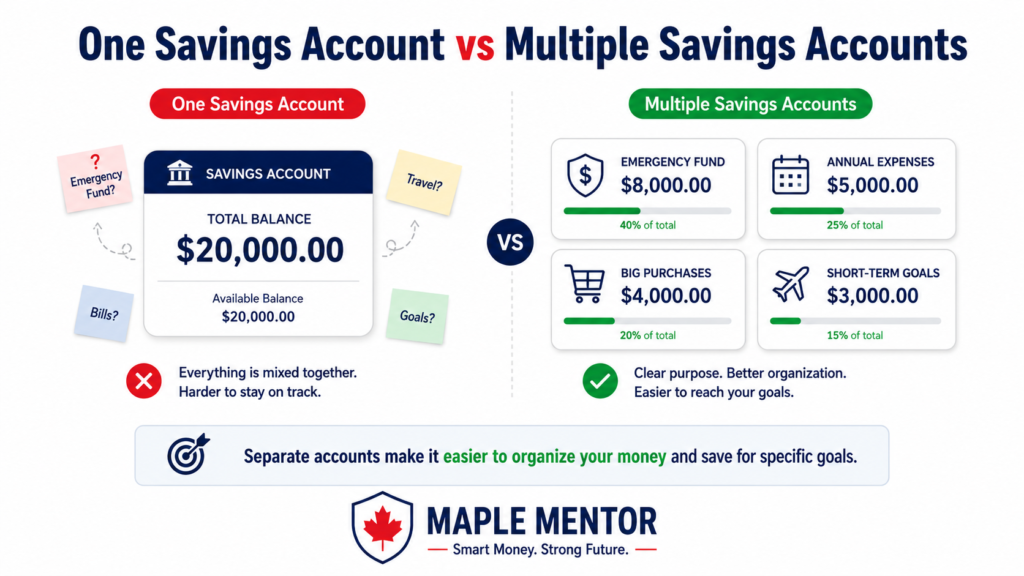
Imagine you have $8,000 sitting in one savings account.
At first, that sounds straightforward.
But perhaps:
- $4,000 is your emergency fund.
- $1,500 is for upcoming annual bills.
- $1,000 is for a vacation.
- $1,500 is for future car repairs.
Your bank account still shows $8,000.
Without keeping track elsewhere, it can be difficult to know how much of that balance is actually available for each purpose.
That’s where separate savings accounts can help.
Instead of treating savings as one large pile of money, each account represents a specific goal.
For example:
Emergency Fund: $4,000
Annual Expenses: $1,500
Vacation: $1,000
Car Fund: $1,500
Nothing about your total savings changed. However, the purpose of the money became much clearer.
That clarity is the main advantage of using multiple savings accounts Canada savers can organize around individual goals.
How Many Savings Accounts Do You Need?
You don’t need an account for every expense in your life.
Creating too many accounts can make your finances harder to manage rather than easier.
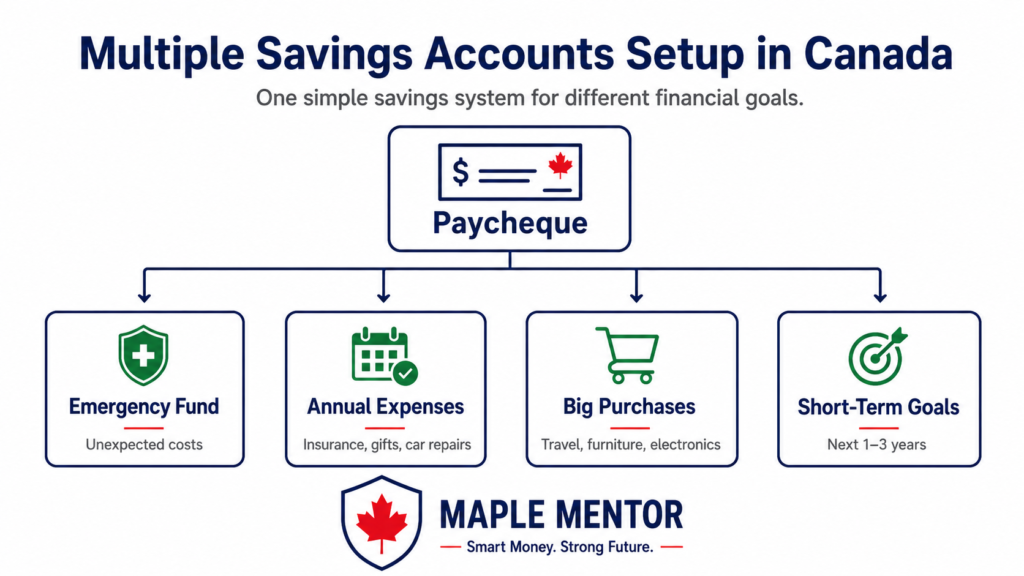
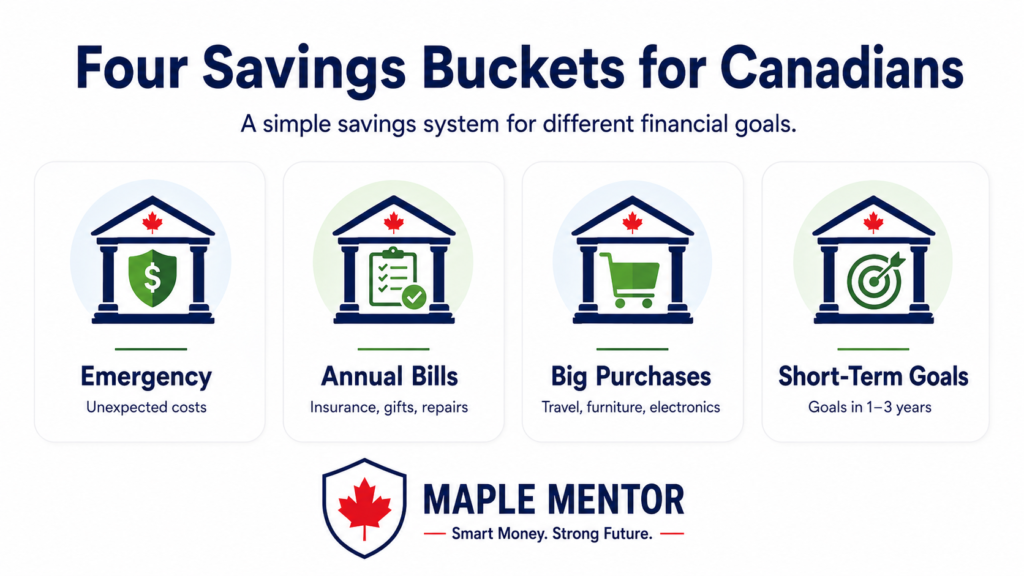
For many Canadians, a simple setup could include:
- Emergency fund
- Annual expenses
- Big purchases
- Short-term goals
You can always add another account later if there’s a good reason.
For example, someone who is self-employed might want a separate account for taxes. Someone planning a wedding might create a dedicated wedding fund.
The right number depends on your financial life.
A good rule is simple: every savings account should have a clear purpose.
If you have eight accounts and can’t remember why three of them exist, your system has probably become too complicated.
Account 1 Emergency Fund
Your emergency fund should be reserved for genuine unexpected expenses.
Examples might include:
- Job loss
- Unexpected car repairs
- Urgent travel
- Medical or dental expenses
- Emergency home repairs
- Temporary income loss
An emergency fund is different from normal savings because you don’t expect to spend it regularly.
If you know your car needs new tires in six months, that’s not really an emergency. You can create a separate savings bucket for the expense.
Keeping emergency savings separate creates a clear boundary between money available for planned spending and money reserved for genuine financial problems.
Learn where to hold this money in Where to Keep Your Emergency Fund in Canada.
If you’re unsure how large your fund should eventually become, read How Much Emergency Savings Do You Really Need in Canada.
The Financial Consumer Agency of Canada also recommends keeping emergency savings separate from your everyday spending account and making the money easy to access without paying unnecessary withdrawal penalties.
Account 2 Annual Expenses
Some expenses don’t happen monthly, but they’re still predictable.
These might include:
- Insurance renewals
- Holidays
- Gifts
- Car maintenance
- Taxes
- Annual subscriptions
- Licence renewals
- School expenses
- Property-related costs
Without planning, these bills can suddenly destroy an otherwise good monthly budget.
A dedicated annual-expenses account solves this problem.
Suppose you estimate that your non-monthly expenses will total $3,600 over the next year.
Divide that amount by 12:
$3,600 ÷ 12 = $300 per month
You could automatically transfer $300 each month into your annual-expenses account.
Then, when a $600 insurance bill arrives, the money is already waiting.
Build this system with How to Plan for Annual Expenses in Canada.
This type of account is sometimes called a sinking fund. The basic idea is simply to save gradually for expenses you already know are coming.
Account 3 Big Purchases
A separate savings account can also help you prepare for larger purchases without automatically turning to debt.
Examples include:
- Furniture
- Appliances
- Electronics
- Moving costs
- Vacations
- Home repairs
- Car expenses
Suppose you want to buy $2,400 worth of furniture one year from now.
Instead of financing the purchase, your target becomes:
$2,400 ÷ 12 months = $200 per month
Create a dedicated savings account and transfer $200 each month.
After 12 months, you’ve reached your target without needing to drain your emergency fund.
See the full strategy in How to Save for Big Purchases in Canada Without Going Into Debt.
Separating this money is particularly useful because it prevents planned purchases from competing with your emergency savings.
Account 4 Short-Term Goals
Your fourth account can cover shorter-term financial goals that don’t fit into the other categories.
Examples could include:
- Travel
- A future car
- Moving
- Education expenses
- Home projects
- A wedding
- Personal goals
You could keep several goals inside one account if you track them separately, or create individual savings accounts if your bank allows you to do so without additional fees.
The important consideration is the timeline.
Money you’ll need relatively soon should generally be treated differently from money you’re investing for decades.
If you’re planning to spend the money within the next few months or years, protecting the principal and maintaining access to the money may matter more than maximizing investment returns.
That usually makes a savings account more appropriate than an aggressive stock portfolio for short-term goals.
Should You Use a High-Interest Savings Account?
A high-interest savings account, commonly called a HISA, can be useful for several savings buckets.
Compared with leaving cash in a regular chequing account, a competitive HISA can allow your money to earn interest while remaining relatively accessible.
They’re particularly useful for:
- Emergency funds
- Annual expenses
- Big purchases
- Short-term savings
However, don’t choose an account based only on its advertised interest rate.
Also check:
- Monthly fees
- Transaction fees
- Withdrawal limits
- Transfer times
- Minimum balances
- Promotional rate expiration dates
- Deposit insurance eligibility
Compare options in Best High-Interest Savings Accounts in Canada.
You can also look at Best No-Fee Savings Accounts in Canada if avoiding recurring fees is your priority.
When comparing accounts, you can also check whether deposits at a particular institution are eligible for Canada Deposit Insurance Corporation protection. CDIC coverage is subject to eligibility rules, categories, and limits.
A good multiple savings accounts Canada strategy should balance interest rates with accessibility, fees, and simplicity rather than automatically choosing whichever account advertises the highest rate.
Simple Multiple Savings Account Setup
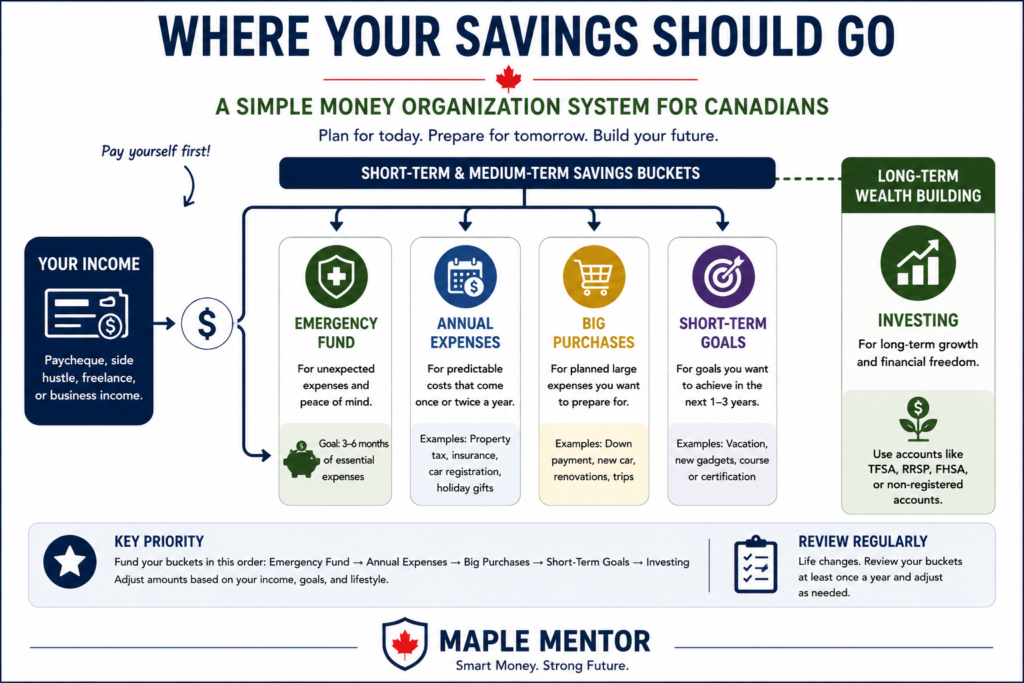
Here’s what a basic system could look like:
| Savings Account | Purpose |
|---|---|
| Emergency fund | Unexpected expenses |
| Annual expenses | Predictable yearly bills |
| Big purchases | Planned larger costs |
| Short-term goals | Travel, car, home, or personal goals |
You can also automate transfers into each account.
For example, after every paycheque:
$100 → Emergency Fund
$75 → Annual Expenses
$50 → Big Purchase Fund
$25 → Travel Fund
That’s $250 going toward different savings goals without requiring you to manually decide where the money should go every payday.
Once your emergency fund reaches its target, you could redirect that $100 toward another goal or long-term investing.
Should You Keep These Accounts at One Bank or Different Banks?
Both approaches can work.
Keeping Everything at One Bank
Using one financial institution can make your system simpler.
Potential advantages include:
- Easier tracking
- Faster transfers
- Fewer apps and passwords
- One place to view balances
- Simpler automation
If your bank allows several no-fee savings accounts or savings buckets, keeping everything together can be convenient.
Using Different Banks
There can also be advantages to separating your savings across institutions.
You might get:
- Better interest rates
- Lower fees
- Different account features
- Less temptation to spend savings
- A backup banking option
For example, you might keep your everyday chequing account at one bank but your emergency fund in a HISA at another institution offering a better ongoing rate.
The downside is additional complexity.
Transfers between financial institutions may also take longer, which is something to consider for emergency savings.
There’s no requirement for an effective multiple savings accounts Canada system to use several banks. Choose whichever structure makes your money easiest to manage.
When Multiple Savings Accounts Become Too Much
Separate accounts are supposed to simplify your finances.
If they start doing the opposite, consolidate them.
Suppose you have separate accounts for:
- Christmas
- Birthdays
- Car registration
- Insurance
- Annual subscriptions
You may not actually need five accounts.
One Annual Expenses account could handle all of them.
Likewise, you probably don’t need separate accounts for a couch, television, laptop, and refrigerator. A single Big Purchases account may be sufficient.
Use separate accounts when the distinction helps you make better decisions—not simply because you can open them.
What About Long-Term Savings?
Not every dollar should necessarily stay in a savings account forever.
Cash is useful for emergencies and short-term goals because stability and accessibility matter.
Long-term financial goals are different.
If you’re saving for retirement or another goal decades away, investing may offer greater long-term growth potential, although investment returns are not guaranteed and values can decline.
This creates a useful distinction:
Short-term money → savings
Long-term money → potentially investing
For example, your emergency fund might remain in a HISA while your retirement contributions go into diversified investments through a TFSA or RRSP.
A well-designed multiple savings accounts Canada system should therefore be part of your larger financial strategy rather than a replacement for long-term investing.
Common Mistakes to Avoid
Opening Too Many Accounts
More accounts aren’t automatically better.
Start with two to four clear savings buckets and expand only when necessary.
Paying Unnecessary Fees
If every account costs you money each month, dividing your savings could become expensive.
Look for accounts without unnecessary recurring fees.
Mixing Emergency Savings With Vacation Money
These two goals serve completely different purposes.
A vacation is planned spending. An emergency fund protects you from unexpected expenses.
Keep them separate.
Not Naming Accounts Clearly
If your bank lets you nickname accounts, use descriptive names such as:
Emergency Fund
Annual Bills
Vacation
Car Fund
Clear names make your system easier to understand at a glance.
Forgetting Transfer Times
Moving money between different financial institutions may not always happen instantly.
Know how quickly you can access important savings before choosing where to keep them.
Keeping Too Much Cash
Savings accounts are useful, but holding excessive cash for decades can limit long-term growth potential.
Once your emergency fund and short-term goals are covered, consider whether additional money should be invested toward longer-term goals instead.
Final Answer
Using multiple savings accounts Canada savers can dedicate to specific goals can make money significantly easier to organize.
You don’t need dozens of accounts.
Start with a few clear buckets:
- Emergency fund
- Annual expenses
- Big purchases
- Short-term goals
Use no-fee or competitive high-interest savings accounts when appropriate, automate your contributions, and give every account a clear purpose.
As your finances become more complicated, you can add additional buckets for taxes, travel, home expenses, or other goals.
The best multiple savings accounts Canada setup isn’t the one with the most accounts. It’s the simplest system that lets you immediately understand what your savings are for and how close you are to each goal.
FAQ
Is it good to have multiple savings accounts?
Yes. Having multiple savings accounts can make it easier to separate your emergency fund, annual bills, planned purchases, and other financial goals.
The system works best when every account has a clear purpose and you’re not paying unnecessary fees.
How many savings accounts should I have?
Most people can start with two to four savings accounts.
For example, you might have separate accounts for emergency savings, annual expenses, big purchases, and other short-term goals.
You can always add another account if your finances become more complex.
Should my emergency fund be separate?
Yes. Keeping your emergency fund separate from everyday spending and planned purchases can make it less tempting to use the money for non-emergencies.
It also makes it easier to see whether you’ve reached your emergency savings target.
Where should I keep short-term savings?
A high-interest savings account is often a practical option because your money can remain accessible while earning interest.
The right account depends on interest rates, fees, access requirements, deposit protection, and how soon you’ll need the money.
Can I have multiple savings accounts in Canada?
Yes. Canadians can generally have multiple savings accounts, including accounts at different financial institutions.
Before opening several accounts, check each institution’s fees, minimum balance requirements, transfer rules, and other account conditions.