
Learning how to save for big purchases Canada residents commonly face is one of the easiest ways to avoid unnecessary debt. Whether you’re planning to buy furniture, replace appliances, pay for a vacation, or cover moving costs, saving ahead of time lets you enjoy the purchase without worrying about high-interest credit card balances afterward.
The good news is that you don’t need a complicated financial plan. By choosing a savings goal, setting a timeline, and automating your contributions, you can save for big purchases Canada households regularly budget for while keeping your emergency fund and long-term investments intact.
Quick Answer
To save for big purchases Canada residents should choose the purchase, set a target amount, pick a deadline, and divide the cost into monthly savings.
Keep the money separate from your emergency fund and avoid using high-interest debt for planned expenses.
Quick Steps
- Choose the purchase.
- Calculate the total cost.
- Pick your deadline.
- Open a separate savings account.
- Automate your savings.
- Avoid financing planned purchases with debt.
What Counts as a Big Purchase?
A big purchase is any planned expense that would significantly affect your monthly budget if you had to pay for it all at once.
The exact amount depends on your financial situation. For some people, a $500 expense is manageable. For others, even a $2,000 purchase requires months of planning.
Common examples include:
- Car repairs
- Furniture
- Appliances
- Electronics
- Vacations
- Moving costs
- Wedding expenses
- Home repairs
- Annual insurance premiums
Unlike emergencies, these expenses are usually predictable. That means you have time to prepare and avoid borrowing money.
Why Big Purchases Become Debt Problems
Many people don’t intentionally go into debt.
Instead, planned expenses slowly become “emergencies” because they weren’t included in the budget.
For example, you might know you’ll need new tires before winter or that your home insurance renewal is due every year. However, if you don’t save for those expenses ahead of time, it’s easy to reach for a credit card when the bill arrives.
Unfortunately, relying on debt for planned purchases often leads to paying far more than the original cost.
Common sources of debt include:
- Credit cards
- Lines of credit
- Buy now, pay later financing
- Retail financing offers
While these options can seem convenient, they often encourage spending money before you’ve actually saved it.
Planning ahead is almost always the cheaper option.
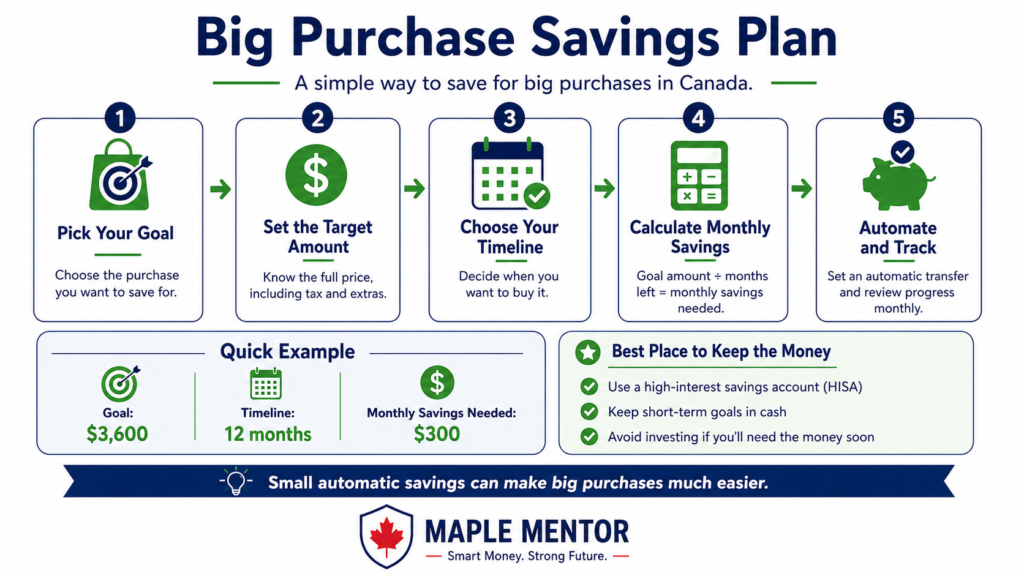
Step 1 Choose the Purchase Clearly
One of the biggest mistakes people make is setting vague goals.
Saying:
“I want to save more money.”
doesn’t provide any direction.
Instead, define exactly what you’re saving for.
For example:
“I want to save $2,000 for a new couch.“
A specific goal makes it much easier to stay motivated because you know exactly how much you need and why you’re saving.
It also helps you avoid spending the money on something else before reaching your goal.
Step 2 Set the Full Cost
Before you begin saving, calculate the complete cost of your purchase.
Many people only budget for the sticker price and forget about additional expenses.
Be sure to include:
- Sales taxes
- Delivery charges
- Installation fees
- Accessories
- Protection plans (if appropriate)
- Expected price increases
For example, a $2,000 couch could easily cost over $2,300 after taxes and delivery.
Saving for the full amount prevents unpleasant surprises later.
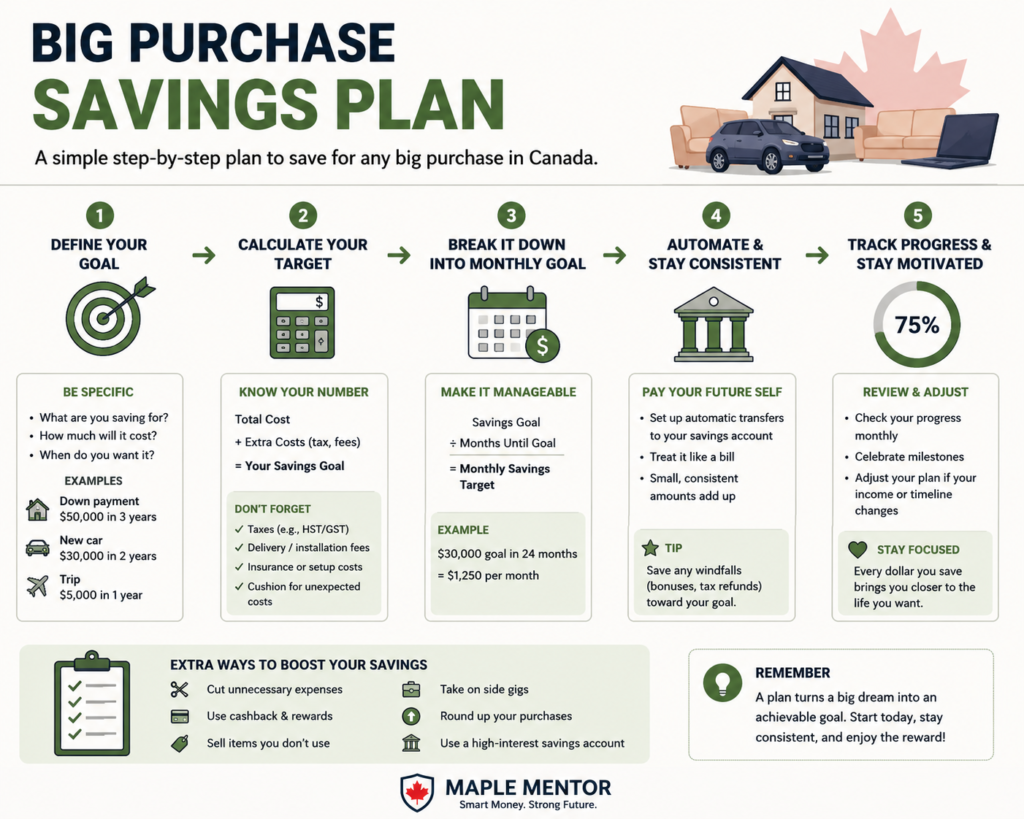
Step 3 Pick a Deadline
Your savings deadline determines how much you need to save each month.
The sooner you need the money, the larger your monthly contribution will be.
For example:
| Goal | Timeline | Monthly Savings |
|---|---|---|
| $3,000 | 12 months | $250 |
| $3,000 | 24 months | $125 |
| $3,000 | 36 months | About $84 |
If the monthly amount feels unrealistic, you have two options:
- Extend your timeline.
- Reduce the size of the purchase.
Choosing a realistic schedule makes it much easier to stay consistent.
Step 4 Keep the Money Separate
One of the best ways to save for big purchases Canada households can use is to keep the money in a separate account.
If your savings sit beside your everyday spending money, it’s much easier to dip into them for impulse purchases.
Instead, open a dedicated savings account or high-interest savings account (HISA) for your goal.
This separation creates a mental barrier that helps you stay disciplined.
It’s also easier to track your progress because you always know how much you’ve saved.
Read Best High-Interest Savings Accounts in Canada.
Compare Best No-Fee Savings Accounts in Canada.
Step 5 Automate the Savings
Saving becomes much easier when you remove willpower from the equation.
Set up an automatic transfer every payday so money moves into your savings account before you have a chance to spend it.
Even small automatic transfers add up over time.
For example:
- $50 every week equals $2,600 per year.
- $100 every two weeks equals $2,600 per year.
- $250 every month equals $3,000 per year.
Automation also helps ensure you continue making progress during busy months when saving might otherwise be forgotten.
Learn how in How to Automate Your Finances in Canada.
Step 6 Avoid Using Debt for Planned Purchases
Using a credit card isn’t necessarily a problem.
Carrying a balance is.
If you pay your credit card in full every month, you can benefit from rewards, purchase protection, and convenience without paying interest.
However, financing planned purchases with high-interest debt usually makes them far more expensive.
Whenever possible:
- Save first.
- Buy second.
- Borrow only when absolutely necessary.
Following this simple order helps prevent planned purchases from becoming long-term debt.
Continue with How to Pay Off Credit Card Debt Faster in Canada.
If you’re looking for more tips on building healthy saving habits, the Financial Consumer Agency of Canada has an excellent guide on saving money that complements the strategies discussed here.
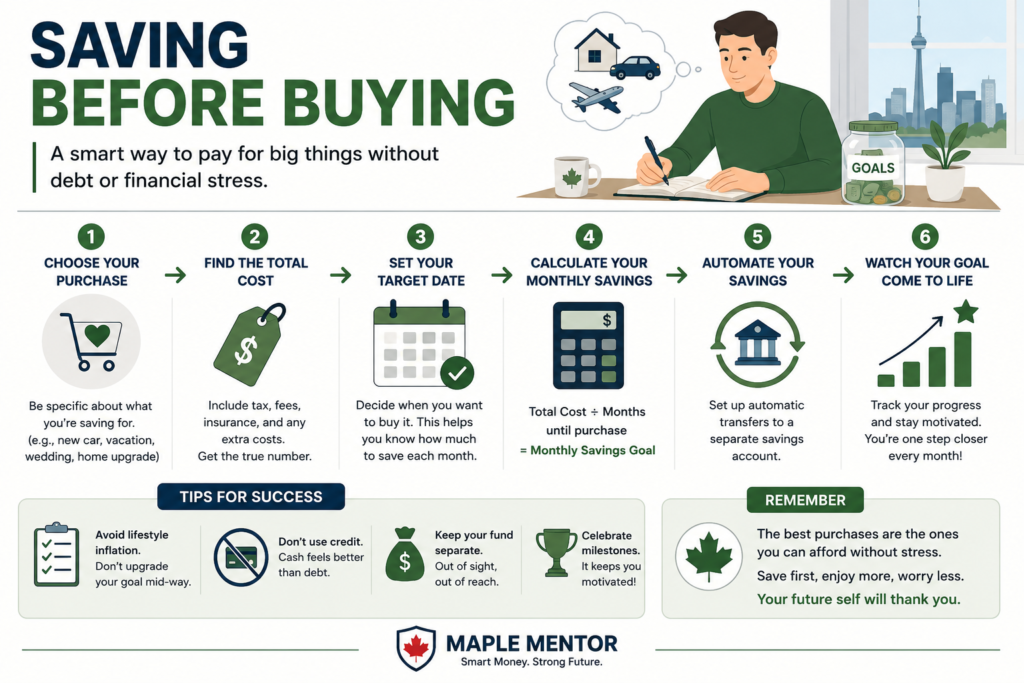
Should You Invest Money for a Big Purchase?
Whether you should invest money you’re saving depends largely on when you’ll need it.
A good rule of thumb is to match your savings strategy to your timeline.
If Your Purchase Is Less Than 3 Years Away
If you plan to buy something within the next three years, keeping your money in cash is usually the safest option.
A high-interest savings account (HISA) allows your money to earn interest while remaining accessible if your plans change.
Because the stock market can fluctuate significantly over short periods, investing money you’ll need soon could force you to sell at a loss.
If Your Purchase Is 3 to 5 Years Away
If your timeline is between three and five years, some Canadians may choose a conservative investment strategy.
However, it’s important to understand that investments can still lose value in the short term.
Only consider investing if:
- Your purchase date is somewhat flexible.
- You’re comfortable with some market risk.
- You understand that returns aren’t guaranteed.
If Your Purchase Is More Than 5 Years Away
When your purchase is many years away, investing may be worth considering.
A longer investment horizon gives your portfolio more time to recover from market downturns and potentially generate higher returns than a traditional savings account.
That said, money needed for a specific purchase should generally be invested more conservatively than money intended for retirement.
Learn more in How to Invest Your First $1,000 in Canada.
Continue with Best Investments for Beginners in Canada.
Simple Big Purchase Savings Example
Here’s how a savings plan might look for several common goals.
| Purchase | Cost | Timeline | Monthly Savings |
|---|---|---|---|
| Furniture | $2,400 | 12 months | $200 |
| Vacation | $3,000 | 10 months | $300 |
| Car Repairs | $1,200 | 6 months | $200 |
Breaking a large expense into smaller monthly contributions makes even expensive purchases feel much more manageable.
Instead of worrying about a large bill all at once, you simply focus on making one consistent savings contribution each month.
Big Purchase Fund vs Emergency Fund
Many people confuse planned expenses with emergencies.
They’re actually very different.
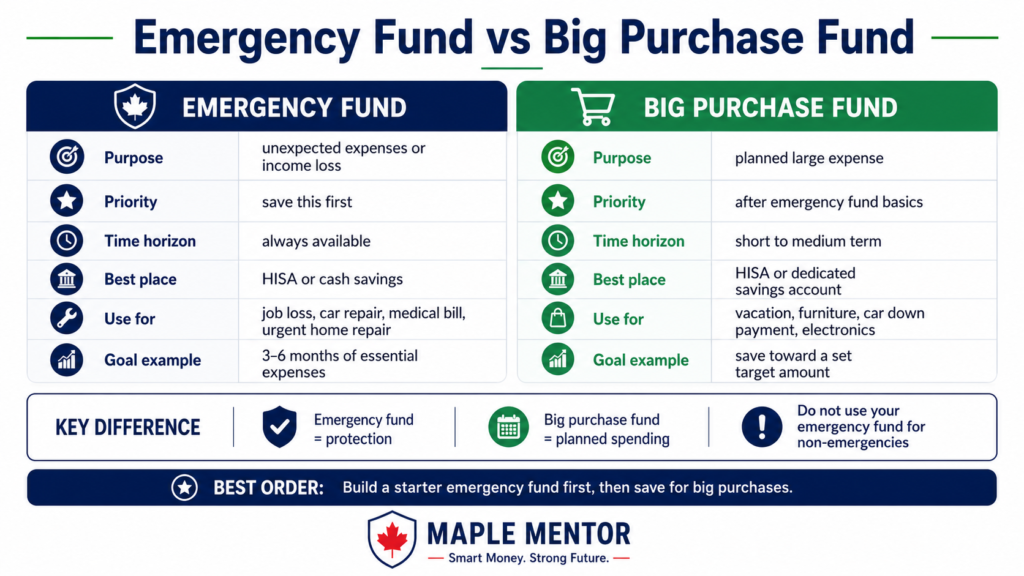
Emergency Fund
An emergency fund is designed for unexpected events.
Examples include:
- Losing your job
- Major medical expenses
- Emergency home repairs
- Unexpected vehicle breakdowns
Because these situations are unpredictable, emergency savings should remain untouched until they’re truly needed.
Big Purchase Fund
A big purchase fund is for expenses you already know are coming.
Examples include:
- Vacations
- Furniture
- New appliances
- Wedding costs
- Holiday shopping
- Annual insurance premiums
These expenses should be planned for in advance rather than paid from your emergency savings.
Keeping separate savings accounts for each goal makes it much easier to stay organized.
Learn more in Where to Keep Your Emergency Fund in Canada.
Common Mistakes to Avoid
Saving for a large purchase doesn’t have to be difficult, but avoiding a few common mistakes can make the process much smoother.
Forgetting Taxes and Extra Costs
Always include:
- Sales tax
- Shipping
- Installation
- Accessories
- Setup fees
Otherwise, you may reach your savings goal only to discover you still don’t have enough.
Saving in Your Everyday Spending Account
When savings sit beside spending money, they’re much easier to spend accidentally.
A separate account creates helpful separation and makes tracking your progress easier.
Using Credit Cards Without a Payoff Plan
Credit cards are excellent payment tools if you already have the cash available.
They’re expensive borrowing tools if you don’t.
Before using a credit card for a large purchase, make sure you’ll be able to pay the balance in full when the statement arrives.
Choosing Unrealistic Timelines
Saving $5,000 in three months may not be realistic for many households.
If the monthly savings amount feels impossible, extend the deadline rather than abandoning the goal altogether.
Draining Your Emergency Fund
Your emergency fund should remain available for genuine emergencies.
Using it for a planned purchase means it may not be there when you actually need it.
Buying Because of Sales Pressure
Limited-time sales and financing offers can create unnecessary urgency.
Unless the discount is exceptional, it’s usually better to continue saving until you can comfortably afford the purchase.
Remember, the goal isn’t simply to own something sooner.
The goal is to buy it without creating financial stress afterward.
Final Answer
Learning how to save for big purchases Canada households regularly face is one of the best ways to avoid unnecessary debt.
Instead of relying on credit cards or financing, choose the purchase, calculate the total cost, pick a realistic deadline, and divide that amount into manageable monthly savings.
Keep your savings separate from your emergency fund, automate your contributions after every paycheque, and avoid borrowing for purchases you’ve had time to plan for.
When you consistently save for big purchases Canada residents commonly budget for, you’ll enjoy greater financial flexibility, lower stress, and fewer interest payments over the long term.
Frequently Asked Questions
How do I save for a big purchase?
To save for big purchases Canada households should calculate the total cost, choose a deadline, divide the amount into monthly savings goals, and automate regular transfers into a separate savings account.
Where should I keep money for a big purchase?
A high-interest savings account is usually a good option because it keeps your money safe, accessible, and earning interest while you save.
Should I use my emergency fund for a big purchase?
Usually not. Emergency funds are intended for unexpected expenses, while planned purchases should have their own dedicated savings account.
Is it bad to use a credit card for a big purchase?
Not necessarily. If you can pay the balance in full when it’s due, a credit card can provide rewards and purchase protection. However, carrying a balance at high interest can make the purchase significantly more expensive.