
How to Organize Your Bank Accounts in Canada
Trying to organize your bank accounts in Canada can feel overwhelming, especially if all your money flows through a single account. A simple banking setup makes it easier to pay bills on time, save consistently, avoid overspending, and invest for the future. In this guide, you’ll learn how to organize your bank accounts in Canada using a straightforward system that separates your money by purpose without making your finances more complicated.
Quick Picks
Simple Bank Account Setup
For most Canadians, a simple banking system looks like this:
- Chequing account for bills
- Spending account for everyday purchases
- High-interest savings account for emergencies
- Savings account for short-term goals
- Investing account for long-term wealth
If you’re building a complete financial system, read How to Build a Simple Money System in Canada.
Simple Bank Account Setup Comparison
| Account | Purpose | Best For |
|---|---|---|
| Chequing | Bills and income | Monthly expenses |
| Spending | Daily purchases | Groceries, gas, shopping |
| High-Interest Savings Account | Emergency fund | Unexpected expenses |
| Savings Account | Short-term goals | Travel, taxes, repairs |
| Investing Account | Long-term wealth | Retirement and investing |
Why Organizing Your Bank Accounts Matters
Many Canadians keep every dollar in one chequing account.
While this may seem simple, it can quickly become confusing.
When bills, spending money, emergency savings, and vacation savings are all mixed together, it’s difficult to know how much money is actually available.
As a result, it’s easy to:
- Accidentally spend bill money.
- Dip into emergency savings.
- Forget about upcoming expenses.
- Overspend without realizing it.
Separating your money by purpose creates clarity.
Instead of wondering what your account balance is supposed to cover, every dollar already has a job.
That’s one of the easiest ways to reduce financial stress and improve your money habits.
Learn more about managing your finances with How to Automate Your Finances in Canada.
The Financial Consumer Agency of Canada offers additional information about choosing bank accounts and managing your money.
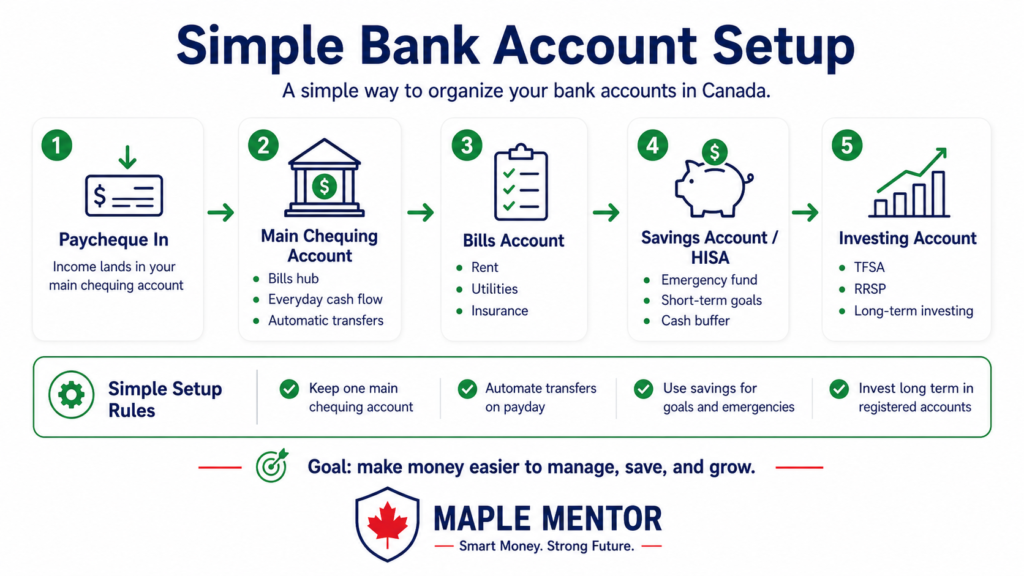
How Many Bank Accounts Do You Really Need?
You don’t need ten different bank accounts.
In fact, too many accounts often create unnecessary complexity.
For most Canadians, four or five accounts are enough.
A simple setup includes:
- One chequing account
- One high-interest savings account
- One savings account for planned expenses
- One investing account
Some people also like having a separate spending account or prepaid card for everyday purchases.
The exact number matters less than making sure each account has a clear purpose.
Account 1 Bills Chequing Account
Your primary chequing account should become your “bills account.”
This is where your paycheque is deposited and where fixed monthly expenses are paid automatically.
Typical bills include:
- Rent or mortgage
- Phone bill
- Internet
- Insurance
- Utilities
- Streaming subscriptions
- Loan payments
It’s also smart to leave a small cash buffer in this account.
Doing so reduces the risk of:
- Missed payments
- NSF (non-sufficient funds) fees
- Late payment charges
Rather than trying to keep the balance at exactly zero, maintaining a small cushion can provide extra peace of mind.
Compare options in Best No-Fee Chequing Accounts in Canada.
Account 2 Everyday Spending Account
Your spending account is for flexible expenses.
Think of it as your lifestyle account.
Use it for:
- Groceries
- Gas
- Restaurants
- Shopping
- Entertainment
- Coffee
- Personal spending
Many people transfer a fixed amount into this account every payday.
Once the money is gone, spending stops until the next transfer.
This approach makes budgeting much easier because your bill money stays protected in your chequing account.
It also helps reduce impulse spending since you always know how much is available.
Account 3 Emergency Fund Account
Your emergency fund deserves its own account.
Keeping it separate from your daily spending reduces the temptation to use it for non-emergencies.
For most Canadians, a high-interest savings account is the best choice because it offers:
- Easy access
- Better interest than most chequing accounts
- Low risk
- Separation from daily spending
Remember, your emergency fund is for unexpected events—not vacations, holiday shopping, or home upgrades.
Examples include:
- Job loss
- Medical expenses
- Major car repairs
- Emergency travel
- Unexpected home repairs
Learn more in Where to Keep Your Emergency Fund in Canada.
Compare options in Best High-Interest Savings Accounts in Canada.
Account 4 Short-Term Savings Account
Your emergency fund isn’t meant for planned expenses.
That’s why having a separate account for short-term goals can be extremely helpful.
This account can be used for:
- Vacations
- Car maintenance
- Gifts
- Moving expenses
- Furniture
- Annual insurance payments
- Property taxes
- Holiday spending
Unlike emergencies, these expenses are expected.
Saving for them separately prevents you from dipping into your emergency fund whenever a predictable expense comes along.
Many online banks let you create multiple savings accounts with custom names, making this system even easier to manage.
Account 5 Investing Account
Your investing account should be reserved for long-term financial goals.
Unlike your savings accounts, this money should remain invested for years rather than months.
Depending on your situation, your investing account could include:
- TFSA
- RRSP
- FHSA
- Non-registered investment account
These accounts are designed to help you build wealth over time—not pay next month’s bills.
Because of that, avoid investing money you’ll need in the near future.
Learn more in TFSA Investing Strategy for Beginners.
Learn how to maximize retirement savings in RRSP Investing Strategy Canada.
Saving for your first home? Read FHSA Investing Strategy for First-Time Buyers.
Simple Bank Account Setup Example
Here’s an example of how a simple banking system might look for the average Canadian.
| Account | Purpose |
|---|---|
| Chequing Account | Paycheque deposits, bills, automatic payments |
| Spending Account | Groceries, gas, restaurants, entertainment, shopping |
| High-Interest Savings Account (HISA) | Emergency fund |
| Savings Account | Travel, taxes, gifts, annual expenses, home repairs |
| Investing Account (TFSA, RRSP, FHSA, or Non-Registered) | Long-term investing and wealth building |
Each account has one clear purpose.
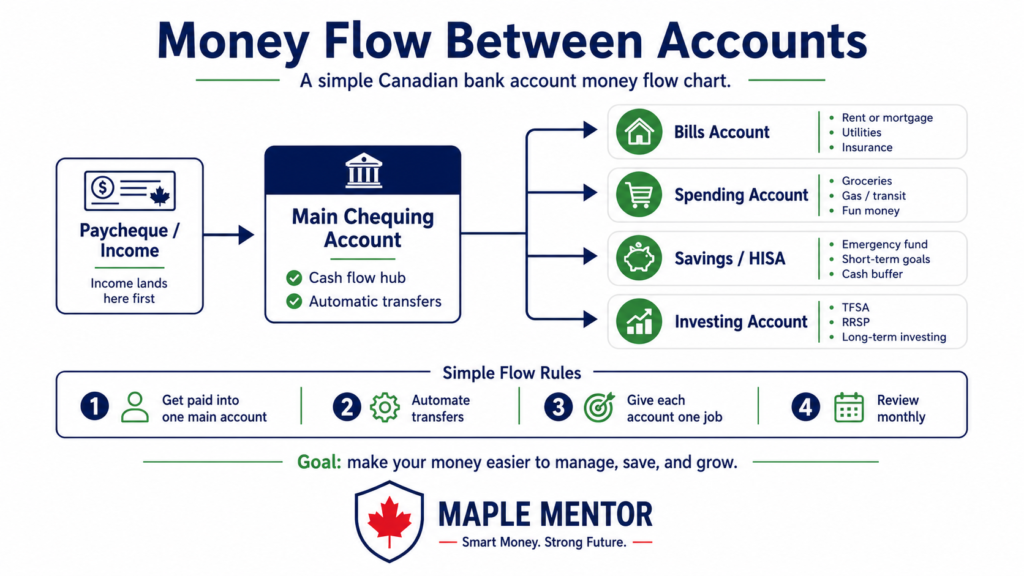
Instead of constantly wondering how much money is available, you’ll know exactly where every dollar belongs.
For example, if your spending account reaches zero before payday, you know it’s time to reduce discretionary spending—not dip into your emergency fund or investment account.
Likewise, if your emergency fund remains untouched month after month, you’ll have greater confidence knowing you’re prepared for unexpected expenses.
The goal isn’t to create a complicated banking system.
The goal is to create a system that makes good financial decisions easier.
Should You Use One Bank or Multiple Banks?
There isn’t a single right answer.
Some Canadians prefer keeping everything with one financial institution, while others use multiple banks to take advantage of better interest rates, lower fees, or promotional offers.
Using One Bank
Keeping all your accounts at one bank offers several advantages.
Pros
- Easier to manage everything in one app
- Instant transfers between accounts
- One login and one customer service team
- Simpler budgeting and account monitoring
Cons
- You may miss better savings rates elsewhere.
- Your bank might charge higher monthly fees.
- Limited product selection compared to shopping around.
Using Multiple Banks
Many Canadians choose one bank for everyday banking and another for savings or investing.
Pros
- Access to better savings rates
- Lower account fees
- Better promotional offers
- Less temptation to spend savings
- Backup banking option if one account has technical issues
Cons
- Multiple logins
- Transfers between institutions may take one to three business days
- Slightly more organization required
For many people, a hybrid approach works well.
For example:
- A no-fee chequing account at one bank
- A high-interest savings account at another institution
- Investment accounts with a brokerage
This allows you to combine convenience with competitive rates.
Compare your options in Best Bank Accounts for Investing in Canada.
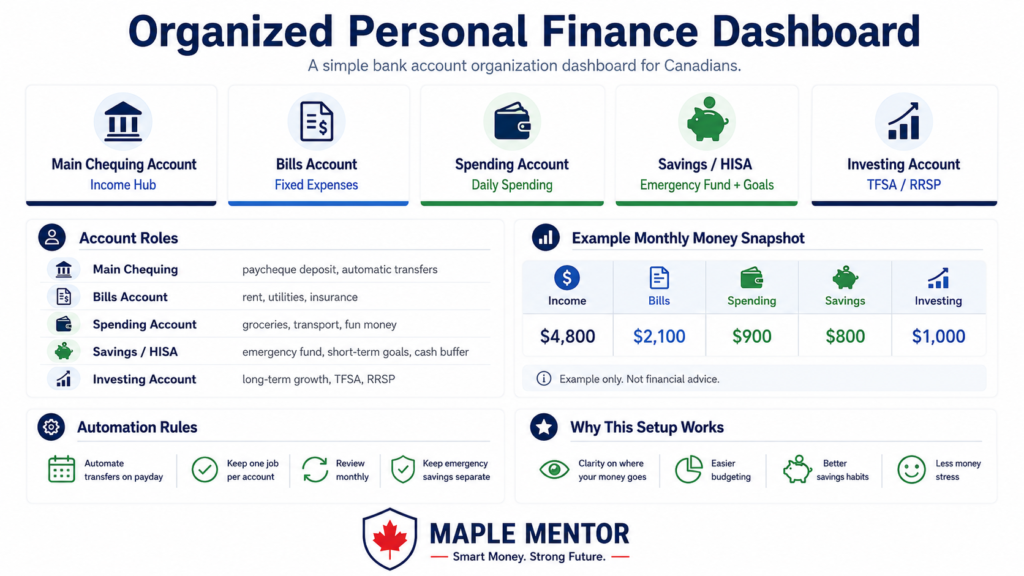
Common Mistakes to Avoid
Organizing your bank accounts doesn’t need to be complicated, but a few common mistakes can reduce the benefits of your system.
Keeping Everything in One Account
When every dollar sits in the same account, it’s much harder to know what money is available for spending and what should be reserved for bills or savings.
Opening Too Many Accounts
Having fifteen different accounts rarely makes life easier.
Stick to the few accounts you actually need.
Simple systems are usually the easiest to maintain.
Forgetting Minimum Balance Requirements
Some bank accounts require a minimum balance to avoid monthly fees.
Before opening an account, understand the requirements so you don’t pay unnecessary charges.
Paying Monthly Banking Fees Unnecessarily
Many Canadian banks now offer excellent no-fee chequing and savings accounts.
If you’re paying monthly fees without receiving meaningful benefits, it may be worth switching.
Mixing Emergency Savings With Goal Savings
Your emergency fund should remain separate from planned expenses.
Vacation money, holiday shopping, home renovations, and car maintenance are expected expenses—not emergencies.
Keeping these savings separate helps ensure your emergency fund is available when you truly need it.
Not Checking Transfer Times
If you use multiple banks, remember that transfers may not always happen instantly.
Plan ahead so your bill payments aren’t delayed.
Using Credit Cards Without a Payment System
Credit cards can be useful, but only if you have a system for paying them in full.
Many people use their spending account to ensure the money for credit card purchases is already set aside before the bill arrives.
Final Answer
The best way to organize your bank accounts in Canada is to keep your system simple.
For most people, that means using:
- One chequing account for bills
- One spending account for everyday purchases
- One high-interest savings account for emergencies
- One savings account for short-term goals
- One investing account for long-term wealth
Every account should have a clear purpose.
When each dollar has a job, budgeting becomes easier, savings become more consistent, and you’re less likely to accidentally spend money that should have been reserved for bills or emergencies.
A well-organized banking system doesn’t make you wealthy overnight.
However, it does make managing your money much simpler—and that’s often the foundation of long-term financial success.
Frequently Asked Questions
How many bank accounts should I have in Canada?
Most Canadians can manage their finances effectively with three to five accounts, including a chequing account, an emergency savings account, a short-term savings account, a spending account, and an investing account.
Should I keep my emergency fund in my chequing account?
Usually not. While keeping a small buffer in your chequing account is helpful, your emergency fund is generally better kept in a high-interest savings account where it remains separate, secure, and earns interest.
Is it bad to have multiple bank accounts?
No. Having multiple accounts can actually make managing your money easier, provided each account has a clear purpose and you avoid unnecessary fees.
Should I use different banks for different accounts?
It depends. Using multiple banks can help you earn higher interest rates or avoid fees, but keeping everything at one bank may be simpler. Choose the setup that you’ll find easiest to manage consistently.