
How to Deal With Financial Stress in Canada
Feeling overwhelmed by financial stress Canada has become increasingly common for many households. Rising living costs, debt, and uncertainty can make it feel like you’re constantly trying to catch up. The good news is that financial stress usually becomes easier to manage once you have a clear plan. In this guide, you’ll learn practical steps to deal with financial stress in Canada by organizing your finances, prioritizing what matters most, and building long-term financial stability.
Quick Picks
Quick Steps to Reduce Financial Stress
- List your income and bills.
- Cover essential expenses first.
- Create a simple survival budget.
- Focus on high-interest debt.
- Build a small emergency fund.
- Reduce one expense at a time.
- Review your finances every week.
Financial stress usually feels worse when everything is unclear.
Start by listing your bills, debts, income, and minimum payments. Then focus on one small step at a time: cover essentials, reduce high-interest debt, build a small cash buffer, and avoid panic decisions.
What Is Financial Stress?
Financial stress is the pressure, anxiety, or overwhelm caused by money problems or uncertainty about your financial future.
It affects people from all income levels. Even someone with a good salary can experience financial stress if expenses continue to rise or debt becomes difficult to manage.
Common causes include:
- High monthly bills
- Credit card debt
- Low savings
- Irregular income
- Job uncertainty
- Rising living costs
- Feeling behind financially
While financial stress is emotional, it usually has practical causes. That means practical solutions can often help reduce it.
Learn more about financial wellness from the Financial Consumer Agency of Canada.
Why Money Stress Feels So Overwhelming
Money affects almost every part of daily life.
It influences:
- Housing
- Food
- Transportation
- Family responsibilities
- Healthcare
- Retirement
- Future opportunities
Because money touches so many areas, even one financial problem can quickly feel much bigger than it actually is.
Many people avoid checking their bank account or opening bills because they’re afraid of what they’ll find.
Unfortunately, avoiding the numbers usually increases stress.
Clarity almost always reduces uncertainty.
Once you know exactly where you stand, you can begin making better decisions one step at a time.
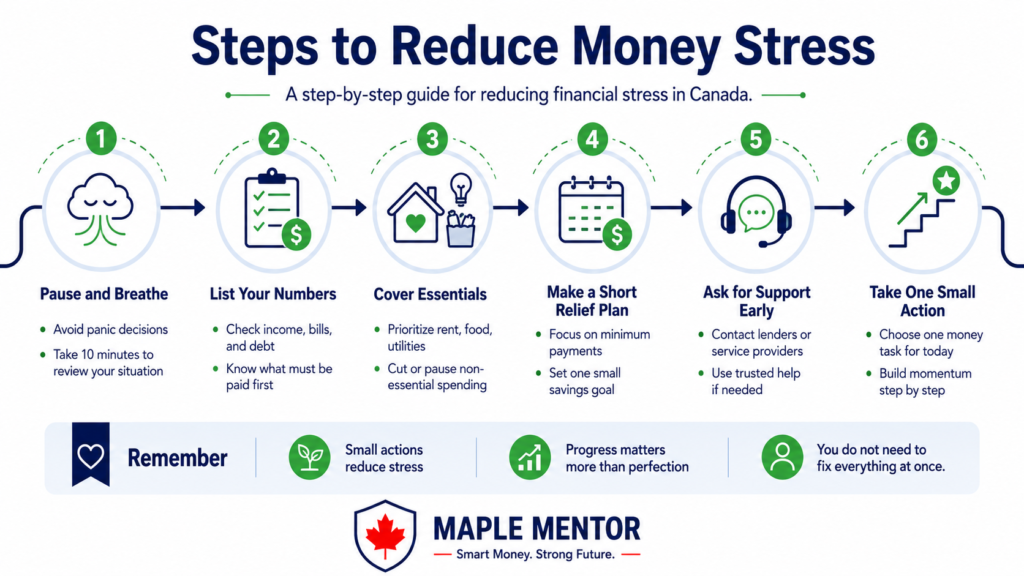
Step 1 Get a Clear Picture of Your Money
Before trying to fix anything, understand your current financial situation.
Write down:
- Monthly income
- Monthly bills
- Debt balances
- Minimum debt payments
- Savings
- Upcoming expenses
Don’t worry if the numbers aren’t perfect.
The objective isn’t perfection.
It’s clarity.
Once everything is on paper, you’ll likely discover that your finances are more manageable than they felt.
If you’d like a better system for organizing your finances, read How to Build a Simple Money System in Canada.
Step 2 Focus on Essentials First
When money feels tight, priorities become extremely important.
Cover essential expenses before anything else.
Focus on:
- Rent or mortgage
- Groceries
- Utilities
- Transportation
- Insurance
- Minimum debt payments
Avoid trying to solve every financial problem simultaneously.
Instead, keep asking yourself:
“What is the next most important financial decision?”
Small progress builds momentum.
Step 3 Make a Simple Survival Budget
A survival budget is designed for periods of financial stress.
Rather than budgeting for everything, it focuses only on your most important expenses.
Include:
- Essential bills
- Minimum debt payments
- Groceries
- Transportation
- Basic emergency savings if possible
Temporarily reduce or eliminate non-essential spending until your financial situation improves.
Remember, this isn’t forever.
It’s simply a temporary strategy to create stability.
Learn how to build one in How to Create a Monthly Budget in Canada.
Step 4 Deal With High-Interest Debt
Credit card debt and payday loans can create financial stress very quickly.
High interest makes balances grow faster, especially if you’re only making minimum payments.
Focus on:
- Paying at least the minimum on every debt
- Prioritizing the highest interest rate (Debt Avalanche)
- Or paying the smallest balance first if motivation helps (Debt Snowball)
- Avoiding new credit card balances whenever possible
Reducing expensive debt often creates immediate financial relief.
Learn more in How to Pay Off Credit Card Debt Faster in Canada.
Still deciding where your money should go? Read Should You Pay Off Debt or Invest in Canada?
Step 5 Build a Small Emergency Buffer
Many people believe they need thousands of dollars before an emergency fund is useful.
That’s simply not true.
Even saving:
- $500
- Then $1,000
can prevent unexpected expenses from becoming new credit card debt.
Once you’ve built that starter emergency fund, continue working toward three months of essential expenses.
If your income is irregular, six months may be a better long-term goal.
Learn how much you need in How Much Emergency Savings Do You Really Need in Canada.
Step 6 Reduce One Expense at a Time
Trying to eliminate every unnecessary expense overnight usually isn’t sustainable.
Instead, reduce one expense each week or month.
Examples include:
- Cancel one unused subscription.
- Compare phone plans.
- Switch bank accounts.
- Shop insurance rates.
- Cook one extra meal at home each week.
- Delay impulse purchases for 24 hours.
These changes may seem small individually.
However, together they can significantly improve your cash flow.
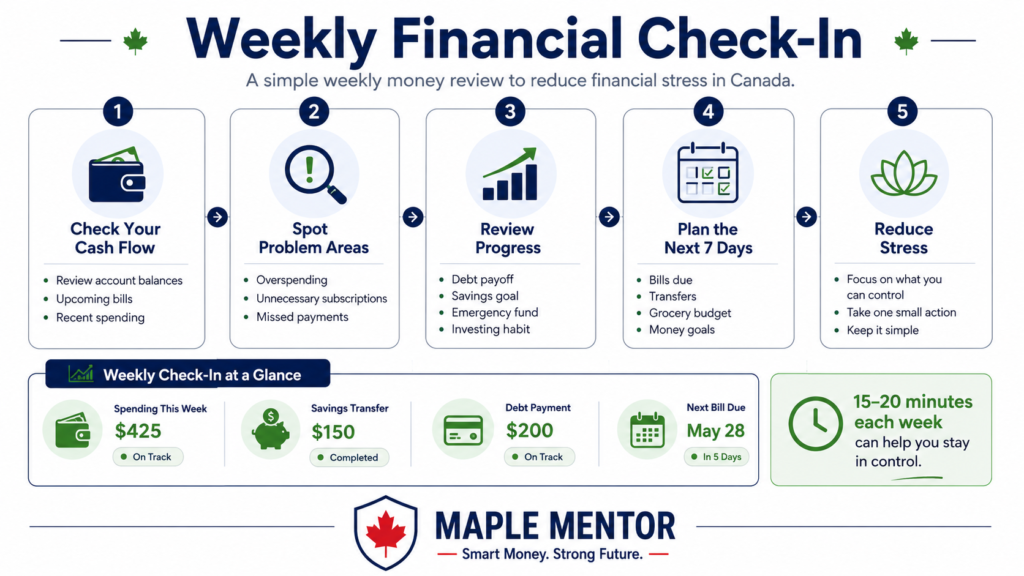
Step 7 Create a Weekly Money Check-In
You don’t need to think about money every day.
However, checking your finances once a week helps prevent surprises.
Spend 10 to 15 minutes reviewing:
- Account balances
- Upcoming bills
- Debt payments
- Spending
- Savings progress
A short weekly review makes your monthly financial review much easier.
Continue reading in How to Do a Monthly Money Review in Canada.
What Not to Do When You Feel Financial Stress
Financial stress can lead to emotional decisions that make your situation even harder. Instead of reacting impulsively, try to stay focused on practical, manageable steps.
Avoid these common mistakes:
Ignoring Bills
Ignoring bills doesn’t make them disappear. In fact, late fees, interest charges, and missed payments can make financial problems worse.
If you’re struggling, contact your lender or service provider early. Many companies offer payment arrangements before accounts become seriously overdue.
Opening More Credit Cards
Using new credit to solve an existing debt problem often creates a larger problem later.
Whenever possible, avoid relying on additional borrowing unless it’s part of a well-thought-out plan.
Panic Selling Investments
If you’re investing for long-term goals, temporary market declines are normal.
Selling investments during a downturn may lock in losses and make it harder to recover when markets improve.
Learn more in How to Protect Your Wealth in a Recession.
Taking Payday Loans
Payday loans usually carry extremely high borrowing costs and can quickly trap borrowers in a cycle of debt.
If you’re considering a payday loan, explore other options first, such as speaking with your financial institution or a nonprofit credit counsellor.
Comparing Yourself to Others
Social media often highlights people’s financial successes while hiding their struggles.
Instead of comparing your progress with someone else’s, focus on improving your own financial situation one step at a time.
Making Major Financial Decisions While Emotional
Stress can affect judgment.
If possible, avoid making major investment decisions, large purchases, or significant financial commitments while feeling overwhelmed.
Instead, take time to review the numbers before making important decisions.
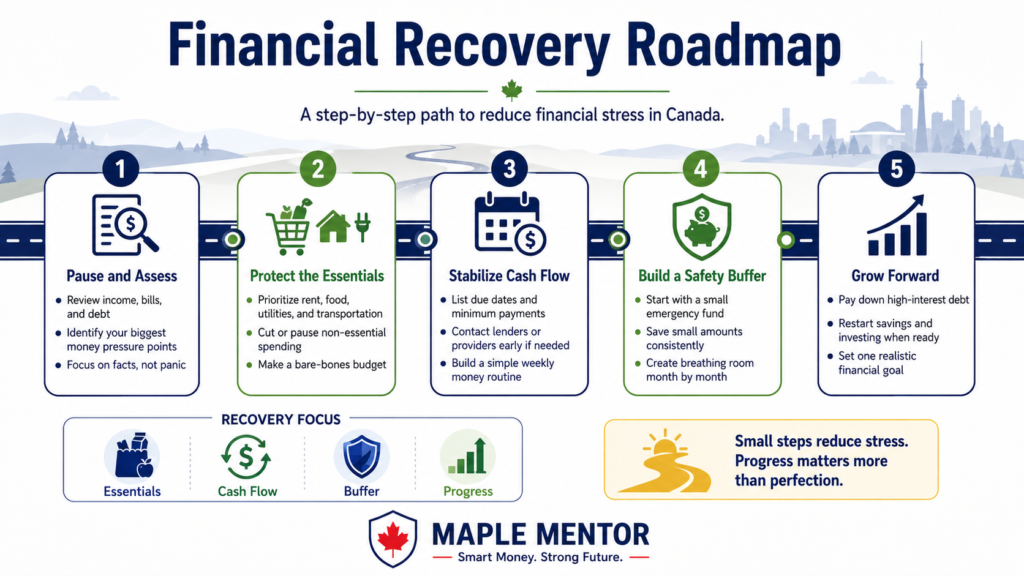
When to Ask for Help
Sometimes financial stress becomes too difficult to manage alone.
If you’re struggling to make minimum payments or feel like your debt is becoming unmanageable, it may be time to seek professional guidance.
Depending on your situation, you could consider speaking with:
- A licensed insolvency trustee
- A nonprofit credit counsellor
- A qualified financial professional
Asking for help isn’t a sign of failure.
Instead, it’s often the first step toward regaining control of your finances.
You can learn more through Credit Counselling Canada.
Final Answer
Experiencing financial stress Canada residents commonly face doesn’t mean you’ve failed financially.
In many cases, financial stress improves once you replace uncertainty with a simple plan.
Start by understanding your income, bills, debt, and savings.
Then focus on the essentials, reduce high-interest debt, build a small emergency fund, and review your finances regularly.
You don’t have to solve every financial problem today.
Instead, choose one practical step, complete it, and then move on to the next.
Small, consistent improvements are often the fastest way to reduce financial stress and build long-term confidence.
Frequently Asked Questions
How do I stop stressing about money?
Start by writing down your income, bills, debt, and savings. Having a clear picture of your finances usually reduces uncertainty and helps you decide what to do next.
What should I do first if I am overwhelmed financially?
Begin by covering essential expenses such as housing, food, utilities, transportation, insurance, and minimum debt payments. Once those are secure, work on reducing high-interest debt and building a small emergency fund.
Should I save money or pay off debt when stressed?
For most Canadians, it’s helpful to build a small emergency fund first, then focus on paying off high-interest debt while continuing to save gradually.
Can budgeting reduce financial stress?
Yes. A simple budget provides structure, reduces uncertainty, and helps you make more confident financial decisions.