
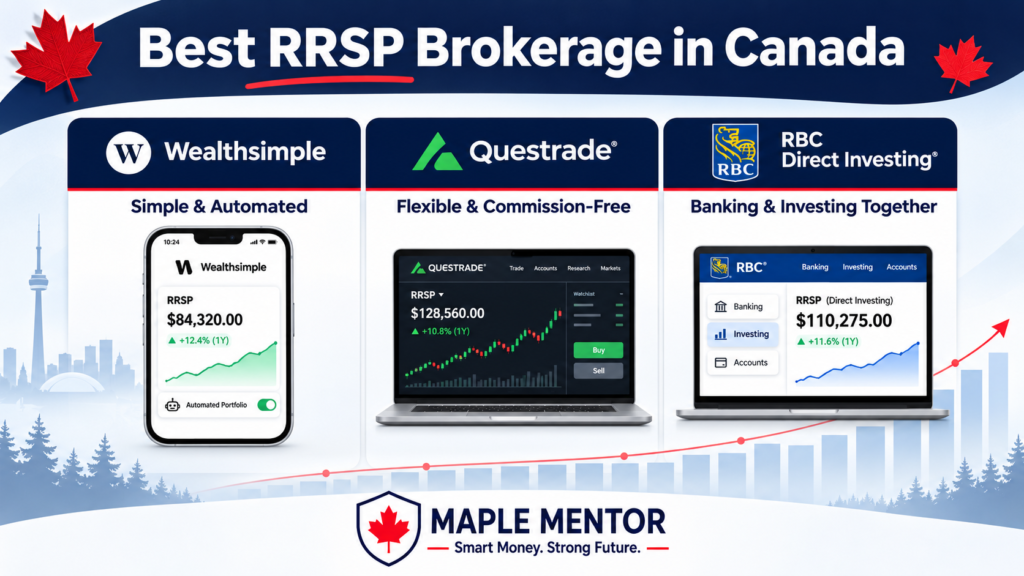
The best RRSP brokerage Canada offers depends on how you invest for retirement, how often you trade, and whether you prioritize simplicity, automatic investing, or access to more advanced brokerage features.
A Registered Retirement Savings Plan (RRSP) is one of Canada’s most valuable retirement savings accounts. However, choosing where to open your RRSP can make a meaningful difference in your investment costs and overall experience.
Should you choose Wealthsimple for its commission-free trading and recurring ETF purchases? Is Questrade a better option for investors who want greater flexibility and free CAD/USD account functionality? Or does RBC Direct Investing make more sense if you already bank with RBC?
The answer isn’t necessarily the same for every investor.
Someone contributing $100 every two weeks into a diversified ETF has very different needs from someone managing a $250,000 retirement portfolio with Canadian stocks, U.S. securities, bonds, and GICs.
In this guide, we’ll compare the best RRSP brokerage Canada options across trading fees, investment selection, automatic contributions, U.S. dollar functionality, managed investing, and long-term retirement planning.
We’ll also explain the important differences between RBC GoSmart and the full RBC Direct Investing platform.
Quick Answer: Best RRSP Brokerage Canada
For most Canadians who want a straightforward self-directed RRSP, Wealthsimple is my preferred choice for simplicity and automatic investing.
Its combination of commission-free eligible stock and ETF trading, fractional investing, and recurring purchases makes it especially convenient for long-term passive investors.
However, Questrade and RBC Direct Investing have their own advantages.
- Wealthsimple: Best for simplicity, recurring ETF investments, fractional shares, and investors who want an easy-to-manage RRSP.
- Questrade: Best for investors who want commission-free stock and ETF trading, free CAD/USD account functionality, and traditional brokerage tools.
- RBC GoSmart: Best for eligible RBC customers who want a beginner-friendly RRSP within the RBC Mobile app.
- RBC Direct Investing Full Suite: Best suited to RBC customers who want broader investment choices, research tools, and multi-currency functionality.
The most important distinction is that RBC GoSmart and RBC’s full brokerage platform have different pricing structures.
According to RBC Direct Investing’s pricing information, standard online stock and ETF trades on its full platform generally cost $9.95, while GoSmart offers a separate commission-free trading allowance.
Meanwhile, Questrade’s published pricing advertises $0 commissions on eligible online stock and ETF trades.
Ultimately, the best RRSP brokerage Canada offers is the platform that supports your retirement investment strategy without charging unnecessary fees.
Best RRSP Brokerage Canada: Comparison at a Glance
Before examining each platform individually, here’s how the main features compare.
| Feature | Wealthsimple | Questrade | RBC GoSmart | RBC Full Suite |
|---|---|---|---|---|
| Self-directed RRSP | Yes | Yes | Yes | Yes |
| Eligible stock/ETF commissions | $0 | $0 online | 50 free trades/year | Generally $9.95/trade |
| Recurring investments | Yes | Eligible securities | Selected all-in-one ETFs | Different automation features |
| Fractional investing | Eligible securities | Eligible securities | Limited | Product-dependent |
| Hold USD in RRSP | With USD functionality | Yes, included | No | Yes |
| Spousal RRSP | Yes | Yes | Not listed for GoSmart | Yes |
| Managed investing | Available | Questwealth | Not through GoSmart | Separate RBC solutions |
| Beginner experience | Excellent | Good | Excellent | Moderate |
| Advanced brokerage tools | Growing | Strong | Limited | Strong |
| Traditional fixed-income products | More limited | Available products vary | Limited | Broader selection |
| Banking integration | Wealthsimple ecosystem | Independent brokerage | RBC Mobile | RBC ecosystem |
Fees and account features reflect published offerings described for 2026 and may change. Other trading, foreign-exchange, transfer, or product fees can apply.
One important point is that all four options can provide access to an RRSP, but the investments available inside the account differ.
Choosing an RRSP and choosing a brokerage are two separate decisions.
For a broader comparison of investing platforms, our Best Investing Platform for Beginners in Canada guide explains how Wealthsimple, Questrade, and RBC GoSmart compare for newer investors.
How Does an RRSP Work Before Choosing a Brokerage?
Before selecting the best RRSP brokerage Canada offers, it’s worth reviewing a few basic RRSP rules.
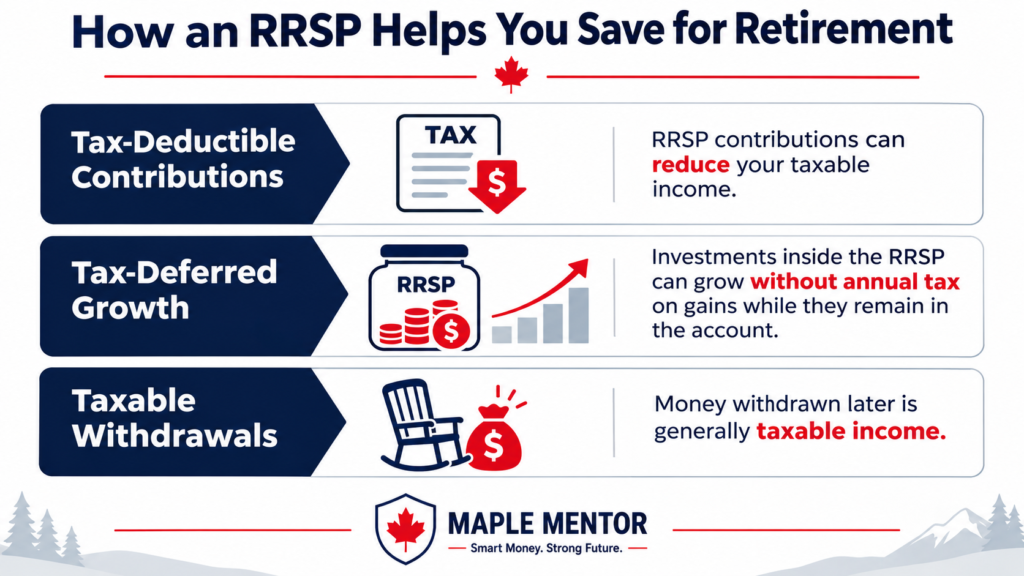
An RRSP is a registered account designed to help Canadians save for retirement.
Eligible contributions can generally be deducted from taxable income, while investment income and gains can grow tax-deferred inside the account.
Withdrawals are generally taxable, subject to specific exceptions and programs.
RRSP Contribution Limits for 2026
According to the Canada Revenue Agency’s RRSP contribution guidance, new RRSP deduction room is generally based on the lesser of:
- 18% of the previous year’s earned income
- The annual RRSP dollar limit
For 2026, the annual RRSP dollar limit is $33,810.
However, your actual deduction limit also depends on unused contribution room, pension adjustments, and other applicable factors.
For example, someone earning $80,000 in 2025 with no pension adjustment could generally generate $14,400 of new RRSP deduction room for 2026.
$80,000 x 18% = $14,400
This example excludes unused room and other adjustments.
RRSP Contribution Deadline
The deadline for RRSP contributions that can qualify for deduction against the 2026 tax year is March 1, 2027.
You can confirm important dates through the CRA’s registered-plan deadlines.
What Can You Hold Inside an RRSP?
Depending on the brokerage and account eligibility, an RRSP can hold investments such as stocks, ETFs, bonds, GICs, mutual funds, and other qualified investments.
However, not every brokerage offers the same investment products.
For example, someone investing exclusively in ETFs may prioritize low trading commissions and recurring purchases.
Someone approaching retirement may place greater value on fixed-income products and portfolio management tools.
Our RRSP Investing Strategy Canada: A Simple Beginner’s Guide explains how to build a long-term RRSP investment approach.
Is Wealthsimple the Best RRSP Brokerage Canada Offers?
Wealthsimple is one of the strongest choices for Canadians who want a straightforward retirement investing experience.
Its main advantage is the ability to combine low-cost self-directed investing with flexible recurring contributions and purchases.
Wealthsimple RRSP Trading Fees
Wealthsimple generally charges $0 standard commissions on eligible Canadian- and U.S.-listed stocks and ETFs.
For a long-term investor making regular purchases, this can help reduce trading costs.
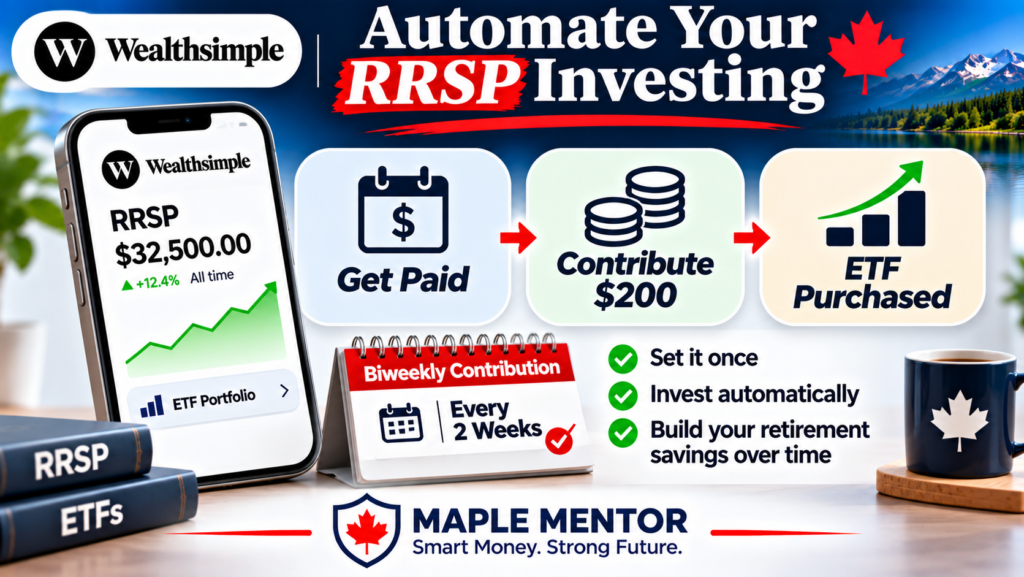
For example, someone investing $200 every two weeks into an eligible Canadian-listed ETF could avoid standard stock-trading commissions.
Over 26 contributions:
$200 x 26 = $5,200 annually
That’s $5,200 in annual investments, excluding market gains or losses and assuming sufficient RRSP contribution room.
Wealthsimple RRSP Account Types
Wealthsimple supports both regular RRSPs and spousal RRSPs through its self-directed investing platform.
Its official trading account documentation explains the available registered account types.
Spousal RRSPs can be useful for certain couples planning retirement income, although contribution deductions and attribution rules should be understood before opening one.
Wealthsimple Automatic RRSP Investing
One of Wealthsimple’s biggest advantages is recurring investing.
Investors can schedule eligible stock and ETF purchases:
- Daily
- Weekly
- Biweekly
- Monthly
For example, someone might configure a $150 purchase of XEQT every two weeks.
The brokerage then attempts to complete the eligible purchase according to the selected schedule and funding arrangements.
This can be useful for investors who want to maintain a consistent routine without placing manual orders every payday.
According to Wealthsimple’s recurring-investment instructions, recurring purchases are available for eligible securities in supported accounts.
For a more detailed explanation, our Automatic ETF Investing in Canada: Wealthsimple vs Questrade guide compares both platforms’ automation features.
Wealthsimple Fractional Investing
Wealthsimple supports fractional investing for eligible securities.
Instead of purchasing a fixed number of shares, investors can purchase a specified dollar amount.
For example, if an eligible ETF trades for $125 per share, a $100 purchase would represent approximately 0.8 shares.
$100 / $125 = 0.8 shares
This makes it easier to invest smaller contributions without waiting until you have enough money to purchase a full share.
Wealthsimple USD Accounts in an RRSP
Wealthsimple supports USD functionality for eligible self-directed RRSPs.
However, the account’s subscription requirements depend on the investor’s client tier.
According to Wealthsimple’s USD account documentation, Core clients can currently upgrade for $10 CAD per month plus applicable tax.
Premium and Generation clients can opt in without that subscription fee.
Having a USD account can help avoid repeated conversions when trading U.S.-listed securities using an existing USD balance.
However, currency-conversion costs may still apply when converting CAD into USD.
Wealthsimple’s Main Drawbacks
Wealthsimple isn’t necessarily the ideal brokerage for every retirement investor.
Its traditional fixed-income and specialized investment selection may be more limited than a full-service brokerage.
Certain advanced trading tools may also be less extensive.
Additionally, USD functionality may involve subscription or conversion costs.
Who Should Choose Wealthsimple?
Wealthsimple may be the best RRSP brokerage Canada offers for beginners, passive ETF investors, and Canadians who want a simple retirement investing routine.
Verdict: My preferred choice for straightforward, recurring ETF investing in an RRSP.
Is Questrade the Best RRSP Brokerage Canada Offers?
Questrade is another strong choice, especially for Canadians who want more traditional brokerage functionality.
Its current commission structure has made it considerably more competitive for investors making regular stock and ETF purchases.
Questrade RRSP Trading Fees
Questrade currently advertises:
- $0 commissions on eligible online stock trades
- $0 commissions on eligible online ETF trades
- No annual account fees
- No inactivity fees
- Free dual-currency functionality
These features are particularly attractive for long-term self-directed investors.
For example, someone purchasing $500 of an eligible ETF each month generally wouldn’t pay a standard online trading commission.
However, currency-conversion fees, certain transaction costs, and other service charges can still apply.
Questrade provides current details on its official pricing page.
Questrade Retirement Account Selection
This platform offers several retirement-related account types.
These include:
- RRSP
- Spousal RRSP
- Locked-in retirement accounts
- RRIF
- LIF
The broader selection can be useful for investors whose needs become more complex over time.
For example, someone transferring funds from an employer pension may eventually require a locked-in retirement account.
You can review the available options through Questrade’s account types.
Questrade CAD and USD Functionality
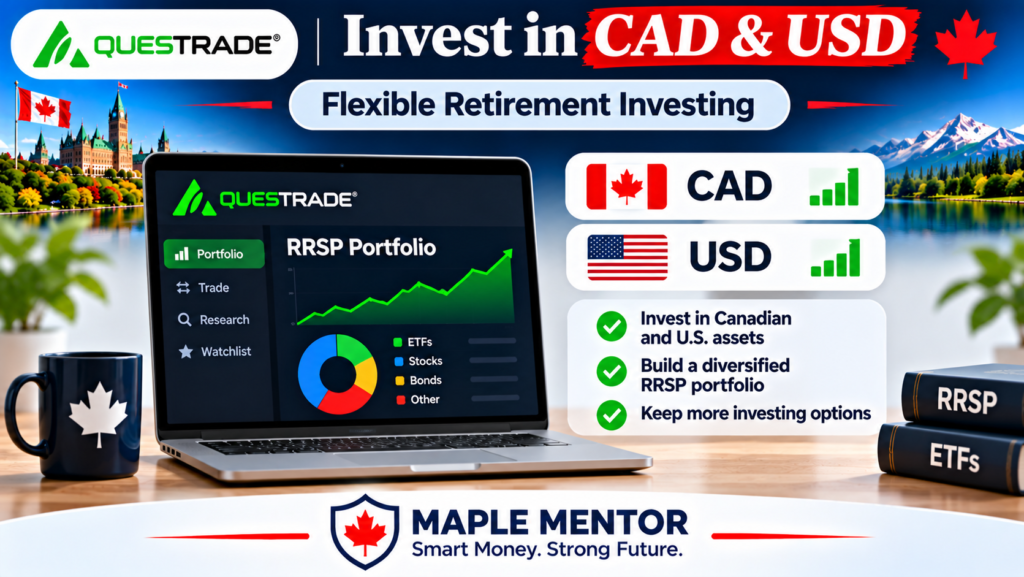
One of Questrade’s main advantages is that eligible accounts can hold both Canadian and U.S. dollars without a separate USD account subscription.
This can be particularly useful for investors purchasing U.S.-listed stocks or ETFs.
For example, someone who already holds USD can purchase eligible American securities without converting Canadian dollars for each trade.
However, converting CAD into USD through Questrade generally involves a 1.5% foreign-exchange fee.
The ability to hold USD doesn’t automatically make currency conversion free.
Questrade Automatic RRSP Investing
Questrade offers both pre-authorized deposits and recurring purchases.
However, these features serve different purposes.
A pre-authorized deposit moves money into the brokerage account.
A recurring purchase automatically buys an eligible security.
Questrade’s recurring-buy program currently focuses on eligible fractional U.S.-listed stocks and ETFs.
Consequently, someone wanting to automatically purchase Canadian-listed ETFs such as XEQT or VFV may find Wealthsimple more convenient.
Questrade explains its deposit functionality through its pre-authorized deposit guide.
Questrade’s Main Advantages
Questrade combines commission-free eligible trading with a broader traditional brokerage experience.
This may appeal to investors who want access to additional research tools, investment products, and retirement account types.
It also provides free dual-currency functionality, which can be valuable for investors holding U.S. securities.
Questrade’s Main Drawbacks
Questrade may feel less streamlined than Wealthsimple for someone who simply wants to automate ETF purchases.
Its recurring-buy program also has eligibility limitations.
Additionally, standard currency-conversion fees can become significant for frequent U.S. investors.
Who Should Choose Questrade?
Questrade could be the best RRSP brokerage Canada offers for investors who want commission-free eligible stock and ETF trading, free CAD/USD functionality, and more traditional brokerage tools.
Verdict: A strong alternative for investors who want greater control and flexibility.
For a broader comparison, our Wealthsimple vs Questrade Canada article explains how the two brokerages differ beyond retirement accounts.
Is RBC Direct Investing the Best RRSP Brokerage Canada Offers?
RBC Direct Investing is worth considering for Canadians who prefer managing their retirement investments through an established Canadian bank.
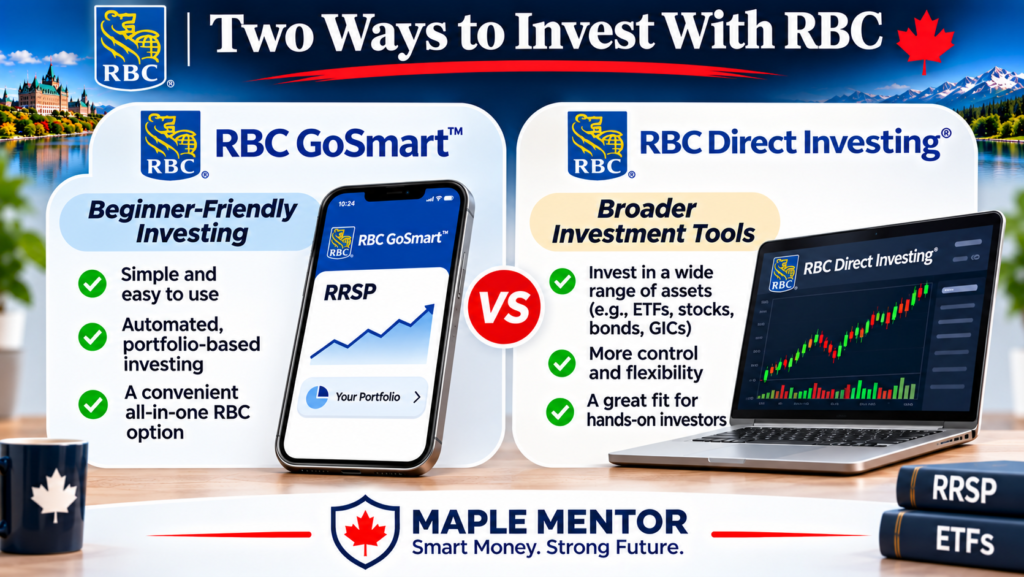
However, RBC offers two distinct self-directed investing experiences: RBC GoSmart and the full RBC Direct Investing platform.
They have different fee structures, investment choices, and levels of functionality.
Understanding those differences is essential before opening an RRSP.
RBC GoSmart RRSP: Best for Beginners
RBC GoSmart is a beginner-focused investing experience available to eligible RBC customers through the RBC Mobile app.
It aims to simplify investing by offering a more limited selection of features than the full brokerage platform.
According to RBC’s official GoSmart information, its features include:
- No minimum investment requirement
- No account maintenance fee
- 50 commission-free Canadian and U.S. stock and ETF trades per year
- Unlimited commission-free trading on more than 50 selected ETFs
- Recurring investments into selected all-in-one ETFs
- RRSP, TFSA, and FHSA availability
- Integration with RBC Mobile
For an existing RBC customer who wants to begin investing for retirement, GoSmart can be a convenient option.
RBC GoSmart Trading Fees
GoSmart’s pricing is different from Wealthsimple and Questrade.
While those brokerages generally offer unlimited $0 standard commissions on eligible online stock and ETF trades, GoSmart provides an annual allowance of 50 commission-free trades.
It also offers unlimited commission-free purchases and sales of selected ETFs.
For example, someone purchasing one ETF every month would make 12 trades annually.
If those trades qualify under GoSmart’s free-trading allowance, the investor could avoid standard trading commissions.
However, someone placing several trades every week could exceed the allowance.
Investors should review the current pricing for transactions outside the free-trade limits.
RBC GoSmart Automatic RRSP Investing
GoSmart supports recurring investments into a selection of four eligible all-in-one ETFs.
This can make it convenient for beginners who want a diversified investment approach without selecting individual stocks.
However, the recurring-investment selection is more restrictive than Wealthsimple’s.
Someone wanting to automatically purchase a specific ETF should verify that it is supported.
RBC GoSmart USD Limitations
One important drawback is that GoSmart operates in Canadian dollars.
Although investors can purchase eligible U.S.-listed securities, the account cannot hold USD cash directly.
This means currency conversion can occur when purchasing or selling U.S. securities.
For someone investing primarily in Canadian-listed ETFs, this may not be a major concern.
However, it becomes more important for investors who regularly trade American stocks.
Full-Suite RBC Direct Investing RRSP
RBC’s full brokerage platform offers a more traditional investing experience.
Its investment selection and research tools are broader than those available through GoSmart.
However, trading costs can be higher.
Under RBC Direct Investing’s published pricing, standard online or mobile stock and ETF trades generally cost $9.95 for investors who don’t qualify for reduced active-trader pricing.
The full platform also offers features such as:
- Canadian and U.S. dollar account functionality
- Stocks and ETFs
- Mutual funds
- Eligible bonds and GICs
- Additional investment products
- Research and portfolio analysis tools
- Dividend reinvestment for eligible securities
- More advanced trading functionality
For investors who want to build a retirement portfolio containing several investment types, these features may be useful.
How Much Could RBC Trading Commissions Cost?
Suppose you purchase one ETF every month through RBC’s full brokerage platform and pay the standard $9.95 commission.
Over one year:
$9.95 x 12 = $119.40
Over ten years, assuming the same commission and purchase frequency:
$119.40 x 10 = $1,194
This excludes any investment returns that could have been earned on those fees.
By comparison, eligible online ETF trades at Wealthsimple or Questrade generally carry no standard trading commission.
That difference can matter for investors making frequent small contributions.
However, RBC’s broader investment selection and banking integration may justify its costs for certain investors.
Does RBC Charge an RRSP Maintenance Fee?
RBC Direct Investing currently advertises no quarterly or annual account maintenance fee and no minimum account balance requirement.
However, trading commissions and other service fees can still apply.
This distinction matters because an account can have no maintenance fee while still being relatively expensive for frequent trading.
Who Should Choose RBC Direct Investing?
RBC GoSmart may be the best RRSP brokerage Canada offers for eligible RBC customers who want a simplified investing experience.
The full RBC Direct Investing platform may be more suitable for investors who value broader investment choices, research tools, and integration with their existing banking relationship.
Verdict: RBC is worth considering for banking convenience and traditional investment products, but its full brokerage’s standard trading commissions make it less attractive for frequent small ETF purchases.
For a broader comparison, see our RBC Direct Investing vs Wealthsimple guide.
Best RRSP Brokerage Canada for ETF Investing
For many Canadians, ETFs are among the most practical investments to hold inside an RRSP.
A diversified ETF can provide exposure to hundreds or thousands of underlying securities through a single purchase.
However, the brokerage you choose can affect how easily and affordably you build that portfolio.
Wealthsimple for RRSP ETFs
Wealthsimple is particularly attractive for investors who want to purchase Canadian-listed ETFs regularly.
Its combination of $0 standard commissions, fractional investing, and recurring purchases makes it convenient for long-term passive investors.
For example, someone could schedule recurring purchases of an eligible Canadian-listed asset allocation ETF.
This reduces the need to manually place an order every payday.
Questrade for RRSP ETFs
Questrade also offers commission-free eligible online ETF trading.
It may appeal to investors who prefer more traditional brokerage tools or want to maintain both CAD and USD balances.
However, its recurring-buy program is more limited for Canadian-listed ETFs.
For investors who don’t mind placing manual orders, this may not be a significant drawback.
RBC GoSmart for RRSP ETFs
GoSmart can be attractive for investors purchasing ETFs included in its commission-free selection.
Its annual free-trade allowance may also be sufficient for someone investing monthly.
However, investors should verify which ETFs qualify and whether their preferred recurring-investment schedule is supported.
RBC Full Suite for RRSP ETFs
RBC’s full platform offers broad ETF access but generally charges standard trading commissions.
For someone purchasing ETFs infrequently, those commissions may be manageable.
For someone investing small amounts every week, they can become more significant.
Which ETFs Are Worth Considering for an RRSP?
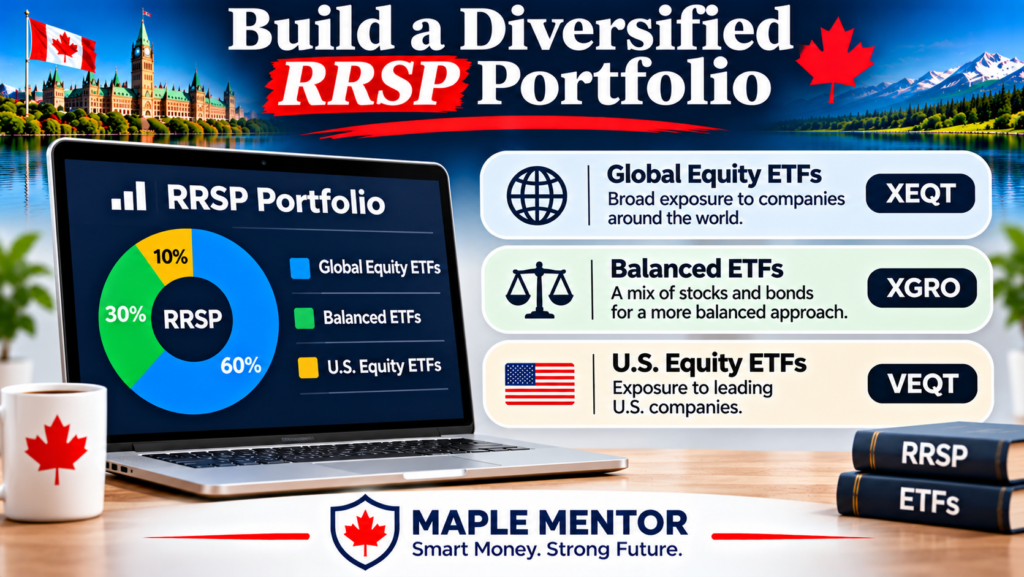
Several Canadian-listed ETFs offer different investment exposures.
| ETF | Investment Exposure | Main Consideration |
|---|---|---|
| XEQT | Globally diversified equities | 100% equity allocation |
| VEQT | Globally diversified equities | 100% equity allocation |
| XGRO | Diversified stocks and bonds | Approximately 80% equities |
| VFV | S&P 500 companies | U.S. large-cap equity exposure |
These ETFs aren’t interchangeable.
XEQT and VEQT provide broad global equity exposure, while XGRO includes a fixed-income allocation.
VFV focuses on large U.S. companies rather than a globally diversified portfolio.
For a more detailed explanation, our Best ETFs for RRSP in Canada guide explores investment choices for retirement accounts.
Investors comparing asset allocation ETFs can also review our XEQT vs VEQT and XEQT vs XGRO articles.
The appropriate investment depends on your retirement timeline, risk tolerance, and overall portfolio.
Best RRSP Brokerage Canada for Automatic Investing
Automatic investing can be particularly useful for Canadians who contribute to their RRSP regularly.
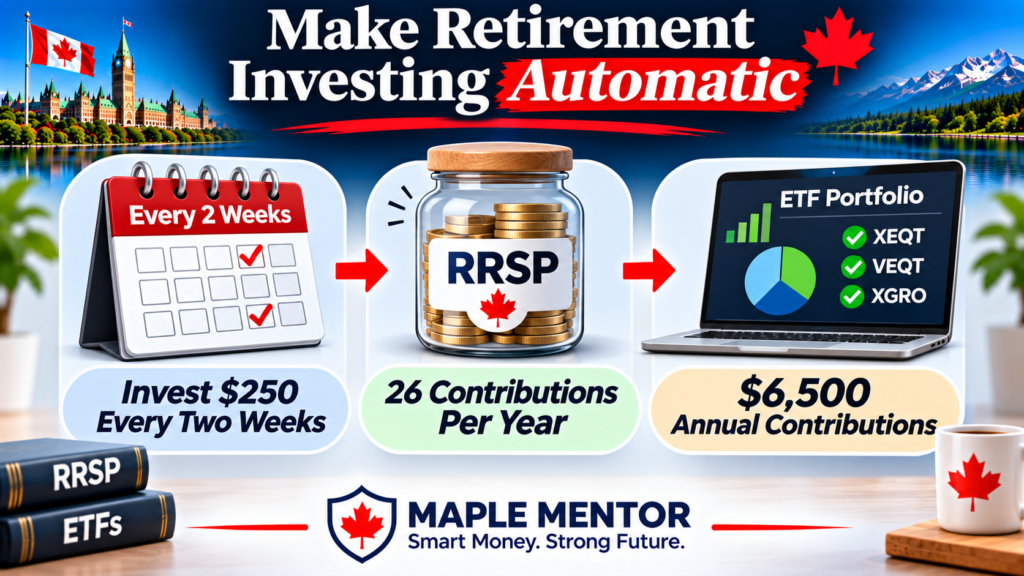
For example, suppose you want to invest $250 every two weeks.
Over 26 contributions:
$250 x 26 = $6,500 annually
If your brokerage supports recurring purchases of your chosen ETF, you may be able to automate much of the process.
Wealthsimple Automatic RRSP Investing
Wealthsimple offers recurring purchases for eligible stocks and ETFs.
Investors can choose daily, weekly, biweekly, or monthly schedules.
This is especially useful for Canadians purchasing eligible Canadian-listed ETFs.
Questrade Automatic RRSP Investing
Questrade supports pre-authorized deposits and recurring purchases of eligible securities.
However, its recurring-buy program currently focuses on eligible U.S.-listed fractional stocks and ETFs.
Investors purchasing Canadian-listed ETFs may still need to place orders manually.
RBC GoSmart Automatic RRSP Investing
GoSmart supports recurring purchases of four selected all-in-one ETFs.
This may be sufficient for someone who wants a simple diversified portfolio.
However, the choice of investments is narrower.
Which Platform Wins for Automation?
For investors who want to automatically purchase eligible Canadian-listed ETFs, Wealthsimple currently offers the most flexible option among these platforms.
Questrade and RBC GoSmart can still work well when their supported investments match your strategy.
For a complete breakdown, see our Automatic ETF Investing in Canada: Wealthsimple vs Questrade comparison.
Best RRSP Brokerage Canada for U.S. Stocks and ETFs
U.S. dollar functionality is another important difference between these brokerages.
Canadian investors who purchase American stocks or U.S.-listed ETFs should consider both trading commissions and foreign-exchange costs.
Wealthsimple RRSP USD Accounts
Wealthsimple allows eligible self-directed RRSP investors to hold USD through its USD account functionality.
Depending on the client’s tier, a subscription fee may apply.
Once USD is available in the account, eligible purchases and sales can occur without converting the entire balance between currencies after every transaction.
However, conversion fees may still apply when exchanging CAD for USD.
Questrade RRSP USD Accounts
Questrade includes dual-currency functionality for eligible accounts without a separate USD subscription.
This can be particularly useful for investors who already hold U.S. dollars.
However, converting CAD into USD through the brokerage generally involves a foreign-exchange fee.
RBC GoSmart RRSP USD Accounts
GoSmart doesn’t support holding USD cash.
Eligible U.S. securities can be purchased, but transactions settle in Canadian dollars.
This may create repeated conversion costs for investors who frequently trade U.S. securities.
RBC Full-Suite RRSP USD Accounts
RBC’s full brokerage supports multi-currency accounts.
This provides greater flexibility for investors maintaining U.S. dollar holdings.
However, trading commissions and currency-conversion costs should still be considered.
What About U.S. Dividend Withholding Tax?
U.S. investments can have different tax treatment depending on the account in which they’re held.
For example, certain U.S.-source dividends paid on eligible U.S.-listed investments held directly in an RRSP can benefit from treaty-based withholding-tax treatment.
However, the rules depend on the investment structure and other factors.
A Canadian-listed ETF holding U.S. stocks may not receive the same treatment as directly held U.S.-listed securities.
This is a separate consideration from brokerage trading fees.
For investors who purchase American securities regularly, our Best Broker for U.S. Stocks in Canada article compares currency-conversion costs and brokerage functionality in greater detail.
Best RRSP Brokerage Canada for Beginners
Someone opening their first RRSP may prioritize different features from an experienced investor.
For beginners, ease of use, clear fees, and straightforward investment choices are often more important than sophisticated trading tools.
Wealthsimple for Beginners
Wealthsimple is my preferred choice for beginners who want to automate regular ETF purchases.
Its interface is straightforward, and its recurring-investment functionality can help investors build consistent habits.
Questrade for Beginners
Questrade is also accessible to newer investors.
Its $0 eligible stock and ETF commissions make it affordable for small portfolios.
However, its broader functionality may take more time to learn.
RBC GoSmart for Beginners
GoSmart is specifically designed for newer investors.
For an existing RBC customer, investing through the RBC Mobile app may feel more familiar than opening an account with a separate brokerage.
Its selected commission-free ETFs and recurring-investment features can support a straightforward retirement strategy.
Which Should a Beginner Choose?
Wealthsimple is a strong starting point for someone who wants simplicity and automation.
Questrade is attractive for investors who expect to use more traditional brokerage tools.
RBC GoSmart can be convenient for eligible RBC customers who prefer keeping their banking and investing together.
The best RRSP brokerage Canada offers for beginners is ultimately the one they can use confidently and consistently.
Best RRSP Brokerage Canada for Larger Retirement Portfolios
As retirement portfolios grow, investors may begin prioritizing different features.
Someone managing a $250,000 RRSP may care more about currency handling, research tools, fixed-income products, and account transfers than someone investing their first $500.
Wealthsimple for Larger RRSPs
Wealthsimple has expanded beyond basic beginner investing.
Its growing account functionality, managed investment services, and recurring purchases can serve investors with substantial portfolios.
However, investors requiring specific traditional fixed-income products should verify availability.
Questrade for Larger RRSPs
Questrade’s broader brokerage functionality may become more useful as portfolios grow.
Investors may appreciate dual-currency holdings, additional retirement account types, and more detailed trading tools.
RBC Direct Investing for Larger RRSPs
RBC’s full brokerage offers a broad range of investment products and research tools.
For investors approaching retirement, access to eligible bonds, GICs, and other fixed-income investments may be valuable.
However, higher trading commissions should be considered when evaluating overall costs.
Does Portfolio Size Change the Best Brokerage?
Sometimes.
For a small portfolio, minimizing commissions and automating contributions may be the biggest priorities.
For a larger portfolio, investment selection, portfolio management, currency handling, and account-transfer functionality may become more important.
However, a larger portfolio doesn’t automatically require a more complicated brokerage.
Many investors can manage substantial retirement savings using diversified ETFs and a straightforward platform.
Self-Directed vs Managed RRSP: Which Is Better?
Not everyone wants to select and manage their own investments.
A self-directed RRSP allows investors to choose eligible securities directly.
A managed RRSP delegates some or all investment selection and portfolio management to a service provider.
Wealthsimple Managed and Automated Investing
Wealthsimple offers managed investing services alongside its self-directed platform.
It also offers an Automated Investing feature for eligible accounts.
According to Wealthsimple’s Automated Investing documentation, this service currently charges an annual service fee of 0.25%, capped at $250 per account per calendar year.
The feature helps automate investment allocations and related account activity according to selected targets.
Investors should distinguish this service from Wealthsimple’s separate managed portfolios, which have their own fee structures.
Questrade Questwealth Portfolios
Questrade offers Questwealth Portfolios as a managed investing alternative.
Management fees currently start at 0.25% annually, with underlying ETF expenses also applying.
This can appeal to investors who want professional portfolio management rather than selecting individual investments.
RBC Managed Investing Options
RBC offers managed investment solutions through services separate from GoSmart’s basic self-directed investing experience.
Available products, advisory services, and fees depend on the specific RBC offering.
Which Approach Is Better?
Self-directed investing may be more cost-effective for someone comfortable choosing and maintaining a diversified ETF portfolio.
Managed investing may be appropriate for someone who values portfolio management, rebalancing, and additional guidance.
However, managed services introduce ongoing costs.
For a broader discussion, see our ETF vs Robo-Advisor in Canada guide.
Wealthsimple vs Questrade vs RBC: Which RRSP Brokerage Should You Choose?
After comparing the available features, the best RRSP brokerage Canada offers depends on your investing habits and long-term retirement strategy.
| Investor Priority | Brokerage to Consider |
|---|---|
| Complete beginner | Wealthsimple or RBC GoSmart |
| Simplest recurring ETF investing | Wealthsimple |
| Passive Canadian ETF investor | Wealthsimple or Questrade |
| Free CAD/USD account functionality | Questrade |
| Already holds U.S. dollars | Questrade or RBC Full Suite |
| Existing RBC customer | RBC GoSmart or RBC Full Suite |
| Traditional brokerage tools | Questrade or RBC Full Suite |
| Selected commission-free ETFs at RBC | RBC GoSmart |
| Broader traditional fixed-income selection | RBC Full Suite |
| Managed investing | Wealthsimple or Questwealth |
| Larger self-directed retirement portfolio | Depends on investment needs |
| Wants to minimize trading commissions | Wealthsimple or Questrade |
When I Would Choose Wealthsimple
I would choose Wealthsimple for someone who wants to build a long-term ETF portfolio without spending much time managing individual purchases.
Its combination of eligible commission-free ETF trading, fractional investing, and recurring purchases makes it particularly convenient.
For example, an investor could arrange to purchase $200 of an eligible diversified ETF every payday.
The ability to maintain this routine automatically is a meaningful advantage.
When I Would Choose Questrade
I would consider Questrade for someone who wants more traditional brokerage functionality.
Its combination of eligible commission-free stock and ETF trading, free dual-currency accounts, and broader investment tools makes it a strong choice for self-directed investors.
It may also be attractive to Canadians who hold U.S. securities regularly.
When I Would Choose RBC GoSmart
I would consider GoSmart for an existing RBC customer who wants to keep retirement investing simple.
Its commission-free trading allowance and selected recurring ETF purchases may be sufficient for someone following a straightforward investment strategy.
However, investors should understand its CAD-only functionality and investment limitations.
When I Would Choose RBC Full Suite
RBC’s full brokerage may be appropriate for investors who value traditional investment products, detailed research tools, and integration with their existing RBC banking relationship.
However, I would carefully evaluate its standard trading commissions, particularly when making frequent small purchases.
Common Mistakes When Choosing an RRSP Brokerage
Even after finding the best RRSP brokerage Canada offers for your needs, several mistakes can reduce the effectiveness of your retirement strategy.
1. Choosing a Brokerage Based Only on Trading Commissions
Commission-free trading is attractive, but it doesn’t guarantee that a brokerage is the cheapest option for every investor.
Currency conversion, managed investing fees, account transfers, and other service charges can affect overall costs.
2. Leaving RRSP Contributions Uninvested
Depositing money into an RRSP doesn’t automatically mean it has been invested.
If you open a self-directed RRSP and deposit $5,000, the money may remain as cash until you purchase an investment.
That may be intentional, but investors should understand the difference between funding an account and investing the money.
3. Ignoring RRSP Contribution Room
RRSP contribution room is shared across your registered retirement savings plans.
Opening RRSPs at multiple brokerages doesn’t increase your available contribution room.
Excess contributions can trigger tax penalties.
4. Investing Too Aggressively Near Retirement
An investor who expects to begin withdrawing substantial amounts in the next few years may need a different asset allocation from someone retiring in 30 years.
Stocks can experience significant short-term declines.
Your portfolio should reflect your retirement timeline, withdrawal needs, and ability to tolerate losses.
5. Paying for Features You Don’t Need
Advanced charting tools, complex order types, and specialized investment products can be useful.
However, they aren’t necessary for every retirement investor.
Someone following a simple diversified ETF strategy may benefit more from low costs and consistent contributions.
6. Forgetting About Currency-Conversion Costs
Canadian investors buying U.S.-listed securities should understand how their brokerage handles CAD and USD.
A platform offering $0 trading commissions can still charge substantial foreign-exchange fees.
7. Switching Brokerages Without Considering Transfer Costs
Moving an RRSP between institutions can involve transfer fees and processing delays.
When possible, investors should use a direct RRSP-to-RRSP transfer rather than withdrawing the money personally.
An ordinary RRSP withdrawal can create taxable income and generally doesn’t restore contribution room.
Final Verdict: Best RRSP Brokerage Canada
Choosing the best RRSP brokerage Canada offers is ultimately about finding a platform that matches your retirement investment strategy.
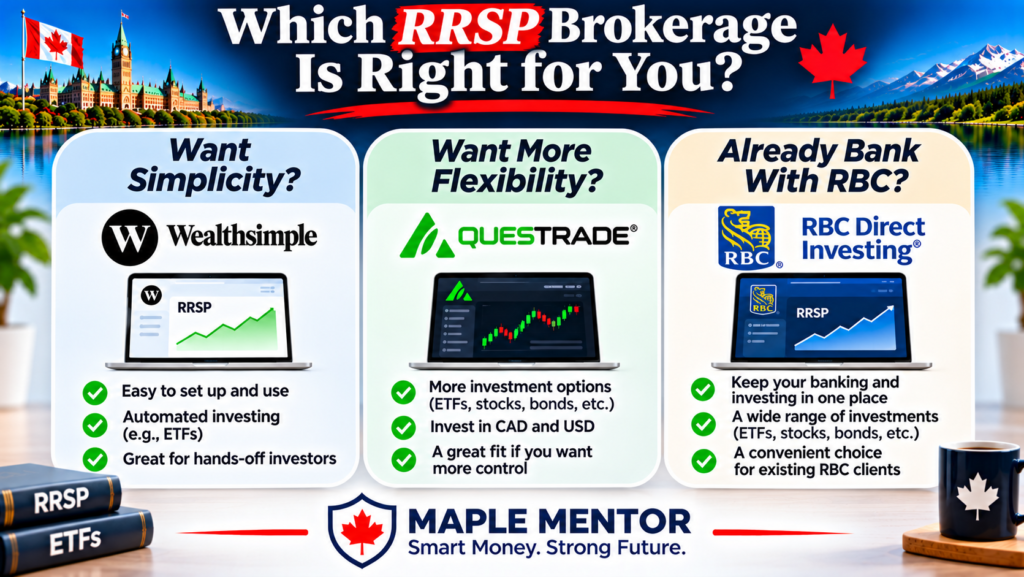
Wealthsimple, Questrade, and RBC Direct Investing all provide useful RRSP options, but their strengths differ.
Wealthsimple is my preferred choice for straightforward passive investing.
Its commission-free eligible stock and ETF trading, fractional investing, and recurring purchases make it particularly convenient for Canadians building retirement portfolios through regular contributions.
Questrade is my preferred alternative for investors who want greater brokerage flexibility.
Its commission-free eligible online stock and ETF trading, free CAD/USD functionality, and traditional brokerage tools make it attractive for self-directed investors.
RBC GoSmart is worth considering for eligible RBC customers who prioritize convenience.
Its beginner-focused interface and commission-free trading allowance can support a simple retirement investing strategy.
RBC Direct Investing Full Suite is more suitable for investors who value broader investment choices and traditional brokerage functionality.
However, its standard trading commissions may make it less attractive for frequent small ETF purchases.
The most important lesson is that the best RRSP brokerage Canada offers isn’t necessarily the one with the most features or the lowest advertised commission.
It’s the brokerage that allows you to build and maintain an appropriate retirement portfolio efficiently.
Before opening an account, consider your preferred investments, contribution schedule, currency needs, and long-term financial goals.
A straightforward investment strategy followed consistently can be more valuable than access to sophisticated trading features you rarely use.
Frequently Asked Questions
What Is the Best RRSP Brokerage Canada Offers?
Wealthsimple is a strong choice for simplicity, recurring investments, and commission-free eligible ETF trading.
Questrade is attractive for investors who want traditional brokerage tools and free dual-currency functionality.
RBC GoSmart and RBC Direct Investing may be suitable for existing RBC customers who value banking integration.
The best choice depends on your investment strategy.
Does Wealthsimple Offer an RRSP?
Yes. Wealthsimple offers self-directed RRSPs, spousal RRSPs, and managed or automated investing options.
Its self-directed accounts support eligible stocks, ETFs, fractional investing, and recurring purchases.
Does Questrade Charge Fees for an RRSP?
Questrade currently advertises no annual account fee or inactivity fee, along with $0 commissions on eligible online stock and ETF trades.
However, currency-conversion fees, transfer charges, and other transaction costs may apply.
Does RBC Direct Investing Charge an RRSP Maintenance Fee?
RBC Direct Investing currently advertises no quarterly or annual maintenance fee and no minimum account balance requirement.
However, standard trading commissions and other service charges may apply.
GoSmart has a separate trading fee structure from the full brokerage platform.
Can I Hold U.S. Dollars in an RRSP?
Yes, depending on the brokerage.
Questrade supports CAD and USD balances in eligible accounts without a separate USD account subscription.
Wealthsimple offers USD functionality for eligible self-directed RRSPs, subject to account-tier requirements.
RBC’s full brokerage supports multi-currency accounts, while GoSmart doesn’t hold USD cash.
What Is the RRSP Contribution Limit for 2026?
The annual RRSP dollar limit for 2026 is $33,810.
However, your personal deduction limit depends on earned income, unused room, pension adjustments, and other factors.
Check your CRA records or most recent notice of assessment to determine your available room.
Is Wealthsimple or Questrade Better for RRSP ETFs?
Wealthsimple may be more convenient for automatic purchases of eligible Canadian-listed ETFs.
Questrade offers commission-free eligible online ETF trading and free dual-currency functionality.
Both can be suitable for long-term self-directed ETF investing.
Is RBC GoSmart Better Than RBC Direct Investing?
GoSmart may be better for beginners who want a simplified interface and a commission-free trading allowance.
The full RBC Direct Investing platform offers broader investment choices, multi-currency functionality, and additional research tools.
However, its standard trading commissions are generally higher.
Can I Transfer My RRSP to Another Brokerage?
Yes. RRSPs can generally be transferred directly between financial institutions without triggering a taxable withdrawal.
However, transfer fees, processing times, and investment restrictions may apply.
Request a direct transfer through the receiving institution rather than withdrawing the funds personally.
Should I Use a Self-Directed or Managed RRSP?
A self-directed RRSP may be appropriate if you’re comfortable selecting and maintaining your own investments.
A managed RRSP may appeal to investors who prefer portfolio management and additional assistance.
Compare investment selection, management fees, and the services provided before deciding.