

The best FHSA brokerage in Canada depends on how you plan to save or invest for your first home. Wealthsimple, Questrade, and RBC all offer First Home Savings Accounts, but they differ in investment choices, automation, fees, and ease of use.
Opening an FHSA is one of the most valuable financial decisions an eligible first-time homebuyer can make. The account combines tax-deductible contributions with tax-free qualifying withdrawals, making it particularly attractive for Canadians saving for a down payment.
However, choosing where to open your FHSA isn’t always straightforward.
Should you use Wealthsimple for its simple interface and automatic investing features? Is Questrade better for someone who wants greater control over their investments? Or does RBC make more sense if you already bank there?
More importantly, should you even invest your FHSA in stocks if you’re planning to purchase a home within the next few years?
In this guide, we’ll compare the best FHSA brokerage in Canada options across trading fees, account features, investment flexibility, automatic contributions, and different home-buying timelines.
Quick Answer: Best FHSA Brokerage in Canada
For most Canadians who want a straightforward self-directed investing experience, Wealthsimple is my preferred choice.
Its combination of commission-free eligible stock and ETF trading, recurring investments, and different FHSA account options makes it particularly convenient.
However, Questrade and RBC also have meaningful advantages.
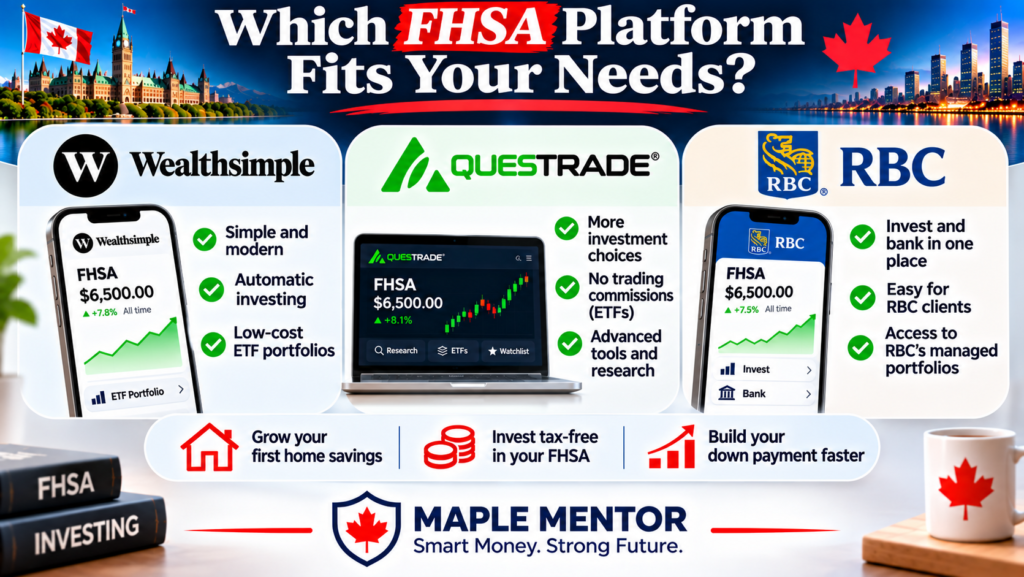
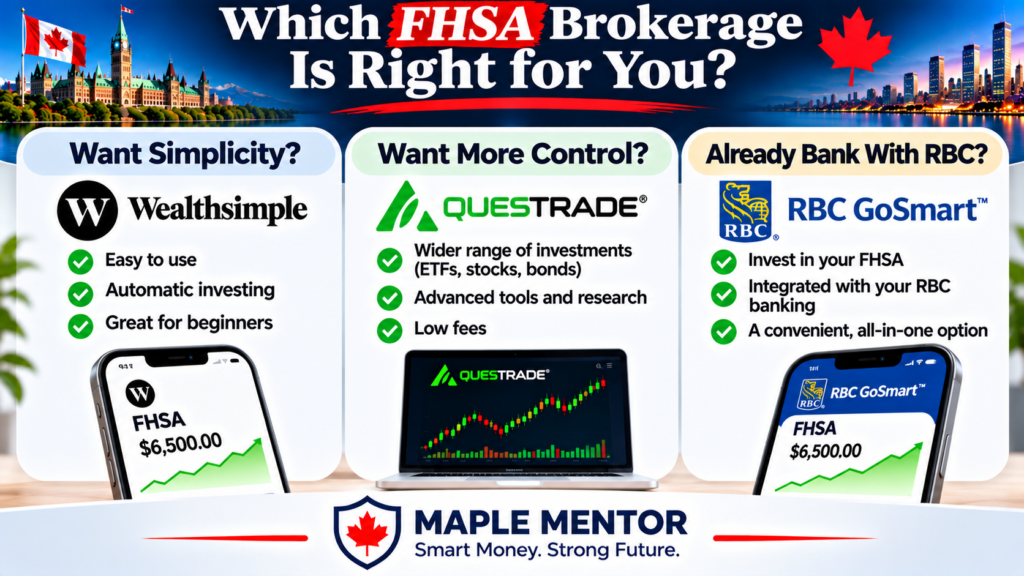
- Wealthsimple: Best for simplicity, automatic ETF investing, and investors who want access to self-directed, managed, and savings-style FHSA options.
- Questrade: Best for investors who prefer a traditional brokerage, broader trading functionality, and the ability to hold Canadian and U.S. dollars.
- RBC GoSmart: Best for eligible RBC customers who want a beginner-friendly FHSA within the RBC Mobile app.
- RBC Direct Investing: Worth considering for investors who want broader investment choices, including eligible fixed-income products.
The most important consideration isn’t necessarily which brokerage has the most features.
The best FHSA brokerage in Canada is the one that supports an investment strategy appropriate for your home-purchase timeline.
Someone buying a home in two years has very different needs from someone planning to purchase in eight years.
Best FHSA Brokerage in Canada: Comparison at a Glance
Here’s how Wealthsimple, Questrade, and RBC GoSmart compare.
| Feature | Wealthsimple | Questrade | RBC GoSmart |
|---|---|---|---|
| Self-directed FHSA | Yes | Yes | Yes |
| Managed investing | Yes | Questwealth available separately | Not through GoSmart |
| Stocks and ETFs | Yes | Yes | Yes |
| Eligible stock/ETF commissions | $0 | $0 online | 50 free trades/year plus selected free ETFs |
| Recurring investments | Yes | Eligible securities | Selected all-in-one ETFs |
| USD holdings | Eligible self-directed accounts | Yes | No |
| Minimum to start | No large minimum | No minimum balance | No minimum |
| Beginner-friendly | Excellent | Good | Excellent |
| Fractional investing | Eligible securities | Eligible securities | More limited |
| Banking integration | Wealthsimple ecosystem | Independent brokerage | RBC Mobile |
| Broader traditional brokerage tools | More limited | Yes | No |
Account features, trading fees, and eligibility may change. Always review the latest brokerage terms before opening an account.
According to Wealthsimple’s FHSA documentation, its platform offers trading, managed, and registered savings FHSA options.
Meanwhile, Questrade’s FHSA offering focuses on self-directed investing, with recurring deposit and eligible recurring-purchase functionality.
RBC GoSmart takes a different approach. Its beginner-focused investing platform integrates eligible investment accounts with RBC Mobile.
Each approach can work well, depending on your needs.
How Does an FHSA Work Before Choosing a Brokerage?
Before comparing the best FHSA brokerage in Canada, it’s important to understand what the account actually does.
A First Home Savings Account is a registered account designed to help eligible Canadians save for their first qualifying home.
It offers several important tax advantages.
FHSA Contribution Limits
According to the Canada Revenue Agency’s FHSA contribution rules, eligible individuals generally receive $8,000 in FHSA participation room in the first year they open an FHSA.
The lifetime contribution limit is $40,000.
Unused participation room can be carried forward under specific rules, generally up to $8,000.
For example, someone who opens an FHSA in 2026 and makes no contributions that year could potentially have $16,000 of participation room in 2027, assuming they meet the applicable conditions.
However, the annual carryforward rules don’t mean you can accumulate unlimited unused room.
FHSA Tax Advantages
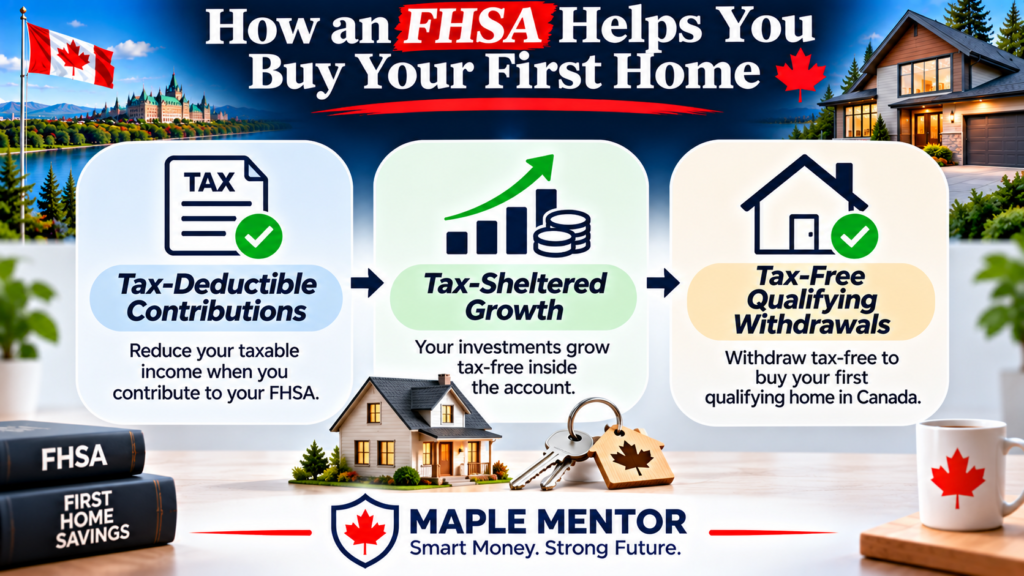
An FHSA offers three major benefits.
1. Tax-deductible contributions
Eligible contributions can generally be deducted from taxable income.
For example, if you contribute $8,000 and your marginal tax rate is 30%, the deduction could reduce your income tax by approximately $2,400.
$8,000 x 30% = $2,400
This is an illustrative example. Actual tax savings depend on your income, province, and tax situation.
2. Tax-sheltered investment growth
Eligible investments can grow inside the account without annual Canadian tax on investment income and gains.
3. Tax-free qualifying withdrawals
When you meet the requirements for a qualifying first-home withdrawal, the withdrawn amount is generally tax-free.
Why Opening an FHSA Early Can Matter
An important detail is that FHSA participation room generally begins accumulating when you open your first FHSA.
It doesn’t automatically accumulate from the year you turn 18.
Consequently, opening an FHSA before you’re ready to contribute the maximum may provide additional flexibility.
However, opening your first FHSA also starts the account’s maximum participation-period clock, so opening early isn’t automatically the right decision for everyone.
If you’re still deciding whether an FHSA is appropriate, our FHSA vs RRSP comparison explains how the two accounts differ.
For a more detailed discussion of investment choices, see our FHSA Investing Strategy for First-Time Buyers guide.
Is Wealthsimple the Best FHSA Brokerage in Canada?
Wealthsimple is one of the strongest choices for Canadians who want a simple FHSA experience.
Its biggest advantage is that it offers multiple approaches to managing your first-home savings.
Rather than limiting investors to one account style, Wealthsimple provides self-directed, managed, and savings-style options.
Wealthsimple Self-Directed FHSA
A self-directed FHSA allows you to select your own eligible investments.
Depending on the account and security, these may include:
- Canadian stocks
- U.S. stocks
- Exchange-traded funds
- Eligible options and other supported securities
Wealthsimple generally charges $0 standard commissions on eligible Canadian- and U.S.-listed stock and ETF trades.
This is particularly attractive for investors purchasing ETFs regularly.
For example, you could invest $200 every two weeks into an eligible Canadian-listed ETF without paying a standard stock-trading commission.
Over one year:
$200 x 26 = $5,200
That’s $5,200 in annual contributions, assuming all 26 deposits are completed and sufficient FHSA contribution room is available.
Wealthsimple Managed FHSA
Not everyone wants to select individual investments.
Wealthsimple also offers managed investing, where a portfolio is selected and managed according to the investor’s profile.
This may be appealing to someone who wants professional portfolio management without manually choosing ETFs.
However, managed investing involves management fees in addition to applicable underlying fund expenses.
Investors should compare those costs with self-directed investing before choosing.
Wealthsimple Savings-Style FHSA
One particularly important feature is Wealthsimple’s registered savings FHSA option.
Unlike an FHSA focused on stock-market investing, a savings-style account may be more appropriate for someone prioritizing capital preservation.
For example, a Canadian planning to purchase a home within 18 months may prefer a savings-oriented approach rather than exposing their down payment to stock-market fluctuations.
Savings rates and account terms can change, so investors should confirm the current offering before depositing money.
Wealthsimple Automatic FHSA Investing
Wealthsimple supports recurring investments for eligible securities.
This can make it convenient to build a consistent savings routine.
For example, you might schedule a $300 purchase of an eligible ETF every two weeks.
Rather than manually placing every order, the brokerage attempts to complete purchases according to your schedule.
For a detailed explanation of how recurring investments work, our Automatic ETF Investing in Canada: Wealthsimple vs Questrade guide compares both platforms.
Wealthsimple USD Accounts
Wealthsimple also supports USD account functionality for eligible self-directed FHSAs.
This can help investors who already hold U.S. dollars or want to maintain USD balances.
However, currency-conversion fees and subscription requirements may apply depending on the client’s account tier.
The official Wealthsimple USD account guide explains the applicable eligibility and fee structure.
Wealthsimple FHSA Drawbacks
Wealthsimple isn’t necessarily the best choice for everyone.
Its self-directed platform may offer fewer traditional brokerage tools than Questrade.
Its managed investing option also involves ongoing fees.
Additionally, investors who want specific GICs or fixed-income products should verify whether their preferred products are available.
Who Should Choose Wealthsimple?
Wealthsimple may be the best FHSA brokerage in Canada for someone who wants a straightforward platform, automatic investing, and several different ways to manage their first-home savings.
Verdict: My preferred choice for simplicity and flexibility between self-directed, managed, and savings-style FHSA approaches.
Is Questrade the Best FHSA Brokerage in Canada?
Questrade is another strong option, particularly for Canadians who want more direct control over their investments.
Its FHSA combines commission-free eligible stock and ETF trading with more traditional brokerage functionality.
Questrade FHSA Trading Fees
Questrade currently advertises $0 commissions on eligible online Canadian- and U.S.-listed stock and ETF trades.
This is a significant advantage for investors making regular purchases.
For example, someone purchasing $250 of an eligible ETF each month generally wouldn’t pay a standard online trading commission.
However, certain other costs may apply, including currency-conversion charges and applicable transaction fees.
You can review these details through Questrade’s official commission and fee schedule.
Questrade FHSA Investment Choices
Questrade offers access to a broad selection of eligible investments through its self-directed brokerage.
Depending on account eligibility and product availability, these can include stocks, ETFs, and other supported securities.
This flexibility may appeal to investors who prefer researching and managing their own portfolios.
Questrade Recurring Deposits and Investments
Questrade offers both pre-authorized deposits and recurring investments.
However, these are different features.
A pre-authorized deposit transfers money into your account.
A recurring investment automatically purchases an eligible security.
Questrade’s current recurring-buy program focuses on eligible fractional U.S.-listed stocks and ETFs.
This means investors wanting to automatically purchase Canadian-listed ETFs such as XEQT or VFV should verify whether those securities are supported.
Someone who wants to automate Canadian ETF purchases may find Wealthsimple more convenient.
Questrade CAD and USD Holdings
One of Questrade’s main advantages is its dual-currency functionality.
Eligible accounts can hold both Canadian and U.S. dollars.
This may be useful for investors purchasing U.S.-listed stocks or ETFs.
However, Questrade’s standard CAD/USD currency-conversion fee is generally 1.5%.
For example, converting $5,000 CAD at a 1.5% fee would represent approximately $75 in conversion costs.
$5,000 x 1.5% = $75
Investors who already hold USD may be able to avoid repeated conversions.
Our Best Broker for U.S. Stocks in Canada guide explores how currency costs differ across Canadian brokerages.
Questrade FHSA Drawbacks
Questrade’s interface may feel more complex than Wealthsimple’s for a first-time investor.
Its recurring-investment eligibility is also more limited for Canadian-listed ETFs.
Additionally, a broad selection of trading tools isn’t necessarily useful for someone whose main objective is preserving a down payment.
Who Should Choose Questrade?
Questrade could be the best FHSA brokerage in Canada for investors who want a traditional self-directed brokerage, commission-free eligible ETF trades, and CAD/USD account flexibility.
Verdict: A strong alternative for investors who want greater portfolio control and more traditional brokerage functionality.
For a broader comparison of the platforms, see our Wealthsimple vs Questrade Canada guide.
Is RBC the Best FHSA Brokerage in Canada?
RBC is worth considering for Canadians who already use the bank for their everyday finances.
However, there’s an important distinction between RBC GoSmart and the full RBC Direct Investing platform.
Both can provide access to an FHSA, but they’re designed for different investing needs.
RBC GoSmart FHSA
RBC GoSmart is a beginner-focused investing experience available to eligible clients through the RBC Mobile app.
Its purpose is to simplify self-directed investing for people who may not need the full functionality of a traditional brokerage.
According to RBC’s official GoSmart information, the platform offers several beginner-friendly features:
- No minimum investment requirement
- No account maintenance fee
- 50 commission-free Canadian and U.S. stock and ETF trades annually
- Unlimited commission-free trading on selected ETFs
- Recurring investing into eligible all-in-one ETFs
- TFSA, RRSP, and FHSA accounts
- Integration with RBC Mobile
For someone who already banks with RBC, keeping their investments and everyday banking within the same ecosystem can be convenient.
RBC GoSmart Trading Fees
GoSmart’s commission-free trading structure differs from Wealthsimple and Questrade.
Instead of offering unlimited $0 standard commissions on all eligible online stock and ETF trades, GoSmart provides an annual allowance of 50 commission-free trades.
It also offers unlimited commission-free trading on a selection of ETFs.
For example, someone purchasing one ETF every month would make 12 trades annually.
If those transactions qualify for GoSmart’s free-trade allowance, the investor could avoid standard trading commissions.
However, someone who purchases several different securities every week could exceed the allowance.
Before choosing GoSmart, review the current fees for trades that don’t qualify for free commissions.
RBC GoSmart Automatic Investing
GoSmart supports recurring investments into selected all-in-one ETFs.
This can be particularly useful for beginners who want a diversified portfolio without manually purchasing individual securities.
However, its recurring-investment selection is more restrictive than Wealthsimple’s.
Someone who wants to automate purchases of a specific Canadian-listed ETF should confirm that the investment is eligible.
RBC GoSmart USD Limitations
One important drawback is that GoSmart doesn’t support holding USD cash directly.
Although eligible investors can purchase U.S.-listed stocks and ETFs, transactions are settled in Canadian dollars.
Currency-conversion costs can therefore become relevant.
For someone primarily investing in Canadian-listed ETFs, this limitation may not matter much.
However, it becomes more important for investors who frequently buy and sell U.S.-listed securities.
Who Should Choose RBC GoSmart?
RBC GoSmart may be the best FHSA brokerage in Canada for an existing RBC customer who wants a beginner-friendly investing experience without managing a separate brokerage app.
Verdict: A convenient option for eligible RBC clients, particularly those making relatively few trades or purchasing supported commission-free ETFs.
RBC GoSmart vs RBC Direct Investing: Which FHSA Is Better?
When someone searches for an RBC FHSA, they may encounter two different self-directed investing experiences.
Understanding the difference is important.
RBC GoSmart: Designed for Simplicity
GoSmart focuses on straightforward stock and ETF investing.
It offers a simplified interface, beginner-friendly features, and integration with RBC Mobile.
However, its investment selection is limited compared with RBC’s full brokerage platform.
GoSmart doesn’t offer the same range of fixed-income investments, mutual funds, or advanced trading products.
RBC Direct Investing: Broader Investment Choices
RBC’s full Direct Investing platform offers a more traditional brokerage experience.
Its broader investment selection can include:
- Stocks
- ETFs
- GICs
- Bonds
- Mutual funds
- Other eligible investment products
However, not every product available through RBC Direct Investing is necessarily eligible for an FHSA.
For example, RBC notes that certain GICs cannot currently be purchased, sold, or transferred within an FHSA.
You can review RBC’s broader account and investment offerings through its official Direct Investing website.
Why This Matters for First-Time Homebuyers
Imagine two investors.
The first investor plans to purchase a home in eight years and wants to invest in diversified equity ETFs.
The second investor expects to purchase a home in 18 months and wants to preserve their down payment.
The first investor may be satisfied with a simple ETF investing platform.
The second may place greater value on savings products, eligible GICs, or other lower-risk investments.
Consequently, the best RBC FHSA option depends on what you intend to hold inside the account.
Important: RBC Direct Investing and RBC GoSmart have different pricing and product availability. Don’t assume GoSmart’s commission-free trading allowances automatically apply to the full brokerage platform.

Best FHSA Brokerage in Canada for ETF Investing
For Canadians investing in ETFs, Wealthsimple and Questrade are particularly competitive.
Both offer $0 standard commissions on eligible online stock and ETF trades.
RBC GoSmart can also be attractive, depending on which ETFs you purchase and how frequently you trade.
Wealthsimple for FHSA ETFs
Wealthsimple is particularly convenient for investors who want to purchase Canadian-listed ETFs regularly.
Its recurring-investment features can make it easier to maintain a consistent schedule.
For example, someone with a long investment horizon could schedule regular purchases of a diversified ETF.
However, the ETF should match the investor’s risk tolerance and expected home-purchase date.
Questrade for FHSA ETFs
Questrade also provides commission-free eligible ETF trading.
Its broader brokerage tools may appeal to investors who want greater control over their portfolios.
However, investors who want automatic purchases of Canadian-listed ETFs should pay attention to its recurring-buy eligibility.
RBC GoSmart for FHSA ETFs
GoSmart offers commission-free trading on selected ETFs and an annual free-trade allowance for other eligible transactions.
This may be sufficient for someone who purchases one ETF monthly.
However, its investment and automation choices are more limited.
Which ETFs Should You Consider?
Several popular Canadian-listed ETFs provide different types of market exposure.
| ETF | General Investment Exposure | Main Consideration |
|---|---|---|
| XEQT | Globally diversified equities | 100% equity exposure |
| VEQT | Globally diversified equities | 100% equity exposure |
| XGRO | Diversified stocks and bonds | Approximately 80% equities |
| VFV | S&P 500 companies | Concentrated in U.S. large-cap stocks |
For someone investing over a long period, these ETFs may be worth researching.
However, none is automatically suitable for a short-term down payment.
Our XEQT vs VEQT comparison explains the differences between two popular all-equity ETFs, while XEQT vs XGRO examines how adding bonds changes a portfolio’s risk profile.
Investors specifically considering U.S. equity exposure can also review our VFV vs XEQT comparison.
The key is to choose an ETF based on your investment needs rather than simply selecting the most popular fund.
Best FHSA Brokerage in Canada for Automatic Investing
Automatic investing can make FHSA contributions easier to maintain.
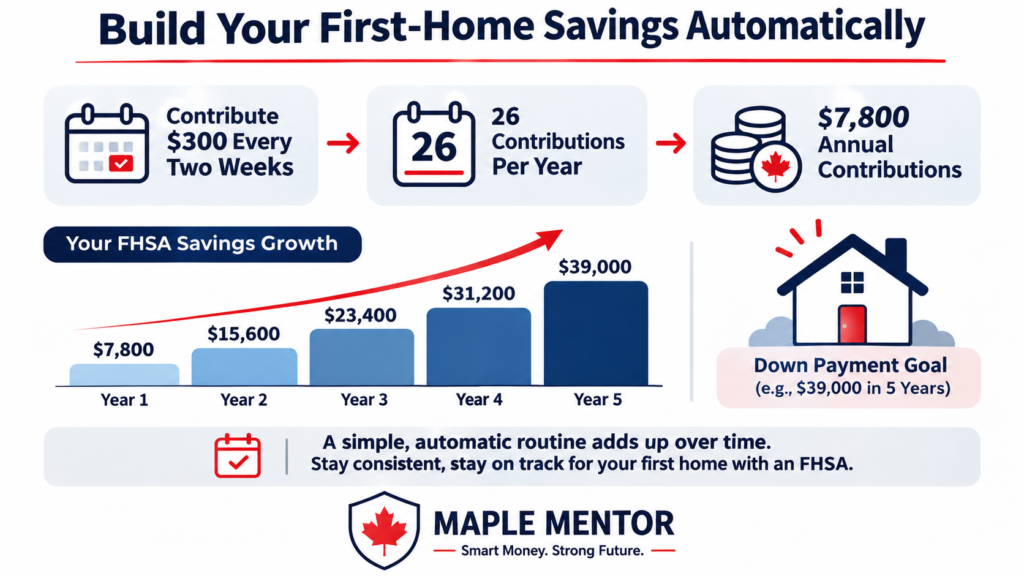
For example, suppose you want to contribute $300 every two weeks.
Over 26 contributions:
$300 x 26 = $7,800 annually
That would represent $7,800 in annual FHSA contributions, assuming you have sufficient contribution room.
However, automatic deposits and automatic investments aren’t necessarily the same thing.
Wealthsimple Automatic FHSA Investing
Wealthsimple supports recurring purchases of eligible stocks and ETFs.
Investors can configure purchases on supported daily, weekly, biweekly, or monthly schedules.
For someone wanting to automatically invest in eligible Canadian-listed ETFs, this is a meaningful advantage.
Questrade Automatic FHSA Investing
Questrade offers pre-authorized deposits and recurring buys.
However, its recurring-investment program currently focuses on eligible fractional U.S.-listed stocks and ETFs.
Investors who want to purchase Canadian-listed ETFs may need to place orders manually.
RBC GoSmart Automatic FHSA Investing
GoSmart offers recurring investing into selected all-in-one ETFs.
This can be useful for investors who prefer a limited selection of diversified funds.
However, it doesn’t offer the same broad recurring-purchase flexibility as Wealthsimple.
Which Platform Is Best for Automation?
For most Canadians wanting recurring purchases of Canadian-listed ETFs, Wealthsimple currently has the advantage.
Questrade and RBC GoSmart remain reasonable alternatives when their supported investment selections match the investor’s needs.
Our Automatic ETF Investing in Canada: Wealthsimple vs Questrade guide explains the differences in greater detail.
Best FHSA Brokerage in Canada for Buying a Home in 1–3 Years
This is arguably the most important section of the comparison.
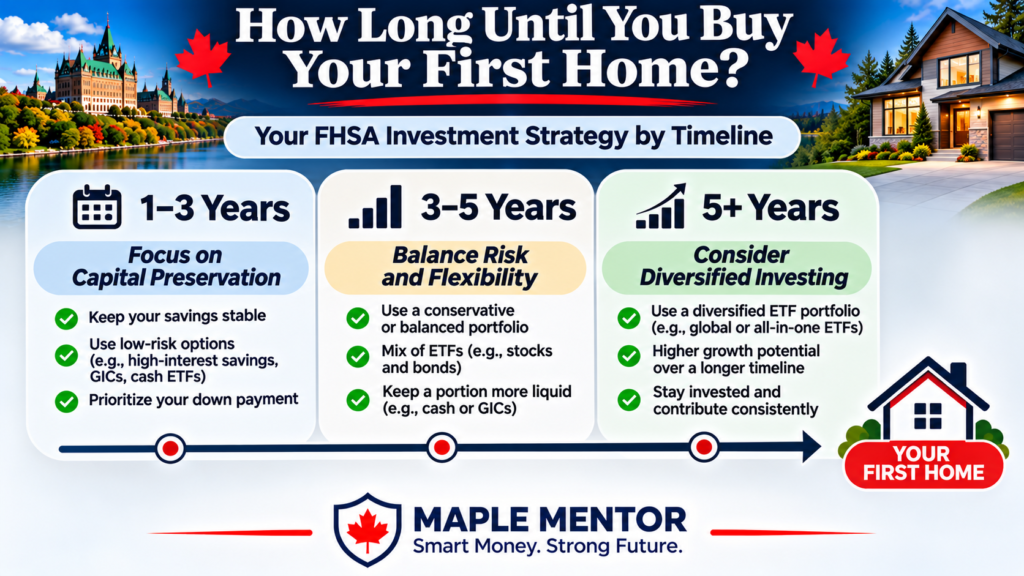
If you expect to purchase a home within the next one to three years, your investment strategy should reflect that short timeline.
A brokerage with excellent stock-trading features may not be the best place for your down payment if it doesn’t offer the conservative investments you need.
Why Short-Term Investing Is Different
Suppose you have $20,000 saved in an FHSA.
You plan to use that money toward a home purchase in two years.
If you invest the entire amount in stocks and your portfolio declines by 25%, your balance would fall to approximately $15,000.
$20,000 x 25% = $5,000 loss
That could significantly affect your ability to purchase the property you want.
Although stock markets have historically provided attractive long-term returns, they can experience substantial declines over shorter periods.
And there’s no guarantee that markets will recover before you need your down payment.
Conservative FHSA Investments to Consider
Depending on your needs and account eligibility, lower-risk choices may include:
- Cash savings
- Interest-bearing savings products
- Eligible GICs
- High-interest savings investment products
- Short-term fixed-income investments
- Certain money-market products
These products aren’t identical.
For example, a GIC may provide a guaranteed rate but restrict access to your money until maturity.
A money-market ETF may offer convenient trading and relatively low volatility, but it isn’t equivalent to an insured savings deposit.
Investors should compare liquidity, principal protection, deposit insurance eligibility, and expected returns.
Wealthsimple for a Short-Term FHSA
Wealthsimple’s registered savings FHSA option is worth investigating.
It may be more appropriate for a short-term down payment than a self-directed account invested entirely in stocks.
However, confirm the current interest rate, withdrawal conditions, and account features.
Questrade for a Short-Term FHSA
Questrade provides self-directed investing flexibility.
Investors can research eligible cash-oriented or lower-volatility investment products.
However, product availability and risk characteristics should be checked carefully.
A brokerage account holding a money-market ETF isn’t the same as a guaranteed savings account.
RBC for a Short-Term FHSA
RBC’s broader banking and investing ecosystem may appeal to someone seeking conservative savings products.
Its full Direct Investing platform offers access to a wider range of investments than GoSmart, subject to FHSA eligibility.
Investors should also compare RBC’s banking FHSA options separately from its self-directed brokerage products.
My Preferred Approach for a Short-Term FHSA
For someone purchasing a home within one to three years, I would prioritize:
- Preserving the down payment.
- Maintaining access to funds when needed.
- Earning a reasonable return without unnecessary risk.
- Minimizing account fees and withdrawal complications.
In this situation, the best FHSA brokerage in Canada may not be the one offering the most advanced investment tools.
It may be the institution offering the most appropriate savings or low-risk investment options.
Our FHSA Investing Strategy for First-Time Buyers guide explores how investment choices should change as your home-purchase date approaches.
Best FHSA Brokerage in Canada for a 5+ Year Timeline
Someone planning to purchase a home in five, eight, or ten years has a different set of considerations.
With a longer investment horizon, taking some investment risk may be more reasonable.
However, a longer timeline doesn’t eliminate the possibility of losses.
Diversified ETFs for Longer-Term FHSA Investing
A diversified ETF portfolio can provide exposure to different markets and asset classes.
For example, an investor with a long timeline and high risk tolerance might consider an equity-focused portfolio.
Someone with a lower tolerance for volatility may prefer a combination of stocks and bonds.
The appropriate allocation depends on the investor’s circumstances.
Wealthsimple for Long-Term FHSA Investing
Wealthsimple’s recurring ETF purchases make it particularly convenient for long-term investors.
Someone who wants to contribute every payday and automatically purchase an eligible diversified ETF may appreciate its simplicity.
Questrade for Long-Term FHSA Investing
Questrade also makes sense for long-term self-directed investors.
Its commission-free eligible ETF trading and broader brokerage functionality provide flexibility.
However, investors wanting fully automatic purchases of Canadian-listed ETFs should consider its current limitations.
Reducing Risk as Your Home Purchase Approaches
An important part of long-term FHSA investing is adjusting your risk as your timeline changes.
For example, an investor might begin with a diversified stock-and-bond portfolio when their home purchase is many years away.
As the purchase approaches, they may gradually shift toward cash or lower-volatility investments.
This can reduce the risk of experiencing a major market decline immediately before withdrawing the down payment.
There is no universal schedule for reducing risk.
Your decision should reflect how flexible your purchase date is and how much loss you could tolerate.
Best FHSA Brokerage in Canada for U.S. Stocks and ETFs
Although an FHSA is primarily intended for first-home savings, eligible investors can hold U.S.-listed securities inside the account.
However, buying American investments introduces additional considerations.
Wealthsimple USD Functionality
Wealthsimple supports USD account functionality for eligible self-directed FHSAs.
This can help investors maintain U.S. dollar balances rather than repeatedly converting currencies for every eligible trade.
However, account subscription costs and foreign-exchange fees may apply.
Questrade USD Functionality
Questrade allows eligible FHSAs to hold Canadian and U.S. dollars.
This is a useful feature for investors purchasing U.S.-listed securities.
However, currency-conversion fees may still apply when moving between CAD and USD.
RBC GoSmart USD Functionality
GoSmart doesn’t support holding USD cash balances.
Although eligible U.S. securities can be purchased, transactions are settled in Canadian dollars.
This can create additional currency-conversion costs.
Do You Actually Need U.S. Stocks in an FHSA?
Not necessarily.
A Canadian-listed ETF can provide exposure to U.S. companies without requiring the investor to directly purchase securities in USD.
For example, VFV provides exposure to the S&P 500 while trading in Canadian dollars.
However, holding a Canadian-listed ETF doesn’t eliminate the underlying currency exposure.
For many first-time homebuyers, the more important question is whether stock-market exposure is appropriate for their expected purchase timeline.
What Happens to Your FHSA If You Never Buy a Home?
One concern some Canadians have is what happens if they open an FHSA but never purchase a qualifying home.
Fortunately, the account doesn’t necessarily become useless.
Under the applicable FHSA rules, eligible remaining funds can generally be transferred directly into an RRSP or RRIF on a tax-deferred basis.
A qualifying direct transfer generally doesn’t use existing RRSP contribution room.
However, the transfer must meet the applicable requirements.
If you withdraw funds directly without meeting the qualifying withdrawal rules, the withdrawal is generally taxable.
How Long Can You Keep an FHSA?
An FHSA’s maximum participation period generally ends on December 31 of the year in which the earliest of the following occurs:
- The 15th anniversary of opening your first FHSA
- The year you turn 71
- The year following your first qualifying withdrawal
This means an FHSA isn’t an account you can keep open indefinitely.
However, the transfer rules provide flexibility if your plans change.
For more information, the CRA’s FHSA guidance explains the account’s contribution, withdrawal, and transfer requirements.
Our TFSA vs RRSP vs FHSA comparison also explains how the three registered accounts can serve different financial goals.
Wealthsimple vs Questrade vs RBC: Which FHSA Should You Choose?
After comparing the available features, the best FHSA brokerage in Canada depends primarily on your investment strategy, experience, and expected home-purchase date.
Here’s how I would approach the decision.
| Your Priority | Brokerage to Consider |
|---|---|
| Simplest self-directed FHSA | Wealthsimple |
| Automatic Canadian ETF investing | Wealthsimple |
| Managed FHSA investing | Wealthsimple |
| Savings-style FHSA option | Wealthsimple |
| More traditional brokerage tools | Questrade |
| CAD and USD holdings without a USD account subscription | Questrade |
| Existing RBC customer | RBC GoSmart |
| Banking and investing within RBC Mobile | RBC GoSmart |
| Selected commission-free ETF purchases | RBC GoSmart |
| Broader traditional investment selection | RBC Direct Investing |
| Buying a home within 1–3 years | Compare conservative savings options |
| Long-term passive ETF investing | Wealthsimple or Questrade |
| Wants to choose individual U.S. securities | Wealthsimple or Questrade |
When I Would Choose Wealthsimple
I would lean toward Wealthsimple for someone who wants to keep investing simple.
Its combination of eligible commission-free ETF trading, recurring purchases, and different FHSA account options makes it attractive.
It is especially convenient for someone who wants to automate their investing without constantly monitoring their portfolio.
When I Would Choose Questrade
I would consider Questrade for someone who wants more control over their investments.
Its broader brokerage functionality and dual-currency support may be valuable to investors who prefer managing their own portfolios.
However, its recurring-investment restrictions should be considered.
When I Would Choose RBC
I would consider RBC GoSmart for someone who already banks with RBC and wants a straightforward investing experience.
For more complex investment needs, I would compare GoSmart with the full RBC Direct Investing platform.
However, I’d pay particular attention to trading commissions, account fees, and the availability of appropriate investments.
What About Someone Buying a Home Soon?
For someone buying within one to three years, I wouldn’t automatically recommend any brokerage based solely on its ETF trading features.
Instead, I would compare the actual savings and investment products available.
Capital preservation and liquidity may be more important than commission-free stock trading.
Common FHSA Mistakes to Avoid
Even after choosing the best FHSA brokerage in Canada, there are several mistakes that first-time homebuyers should avoid.
1. Investing Too Aggressively Before Buying
A short investment timeline leaves less room to recover from market declines.
If you expect to need your down payment soon, consider whether stocks are appropriate.
2. Confusing an FHSA With a Savings Account
An FHSA is a registered account type, not a specific investment.
Depending on the institution, an FHSA can hold eligible stocks, ETFs, savings products, GICs, and other investments.
Opening an FHSA doesn’t automatically mean your money is invested or earning interest.
3. Ignoring Contribution Limits
FHSA contribution room is shared across all your FHSAs.
Opening accounts at multiple institutions doesn’t increase your contribution limit.
Excess contributions can create tax consequences.
4. Forgetting About Liquidity
Some investments are easier to access than others.
For example, a non-redeemable GIC may restrict access to your money until maturity.
Make sure your investments align with when you’ll need the down payment.
5. Choosing a Brokerage Only Because of Free Trades
Commission-free trading can be useful, but it isn’t the only consideration.
Investment availability, currency-conversion fees, account functionality, and ease of withdrawals can matter just as much.
6. Failing to Review the Strategy
Your home-purchase timeline can change.
An investment strategy that made sense when you expected to buy in eight years may no longer be appropriate when you’re preparing to buy next year.
Review your FHSA periodically and adjust your investments when necessary.
Final Verdict: Best FHSA Brokerage in Canada
Choosing the best FHSA brokerage in Canada requires more than comparing trading commissions.
Wealthsimple, Questrade, and RBC each offer useful features, but they serve somewhat different investors.
Wealthsimple is my preferred choice for simplicity and automatic investing.
Its combination of self-directed, managed, and savings-style FHSA options makes it particularly flexible.
For someone who wants to contribute regularly and automatically purchase eligible Canadian-listed ETFs, Wealthsimple is especially convenient.
Questrade is my preferred alternative for traditional self-directed investing.
Its commission-free eligible stock and ETF trading, dual-currency functionality, and broader brokerage tools make it attractive for investors who want more control.
RBC GoSmart is worth considering for existing RBC customers.
Its beginner-focused experience and integration with RBC Mobile may appeal to investors who value convenience.
However, RBC’s full Direct Investing platform may be more appropriate for investors seeking a broader selection of eligible investment products.
Most importantly, the best FHSA brokerage in Canada depends on how you plan to use the account.
If you’re purchasing a home in two years, protecting your down payment may be your biggest priority.
If you’re purchasing in eight years, diversified investing may play a larger role in your strategy.
Before opening an FHSA, determine your expected purchase timeline, contribution plan, and investment risk tolerance.
Then choose the brokerage that supports those needs.
Frequently Asked Questions
What Is the Best FHSA Brokerage in Canada?
Wealthsimple is a strong choice for simplicity, recurring investments, and multiple FHSA account options.
Questrade is attractive for investors seeking traditional brokerage functionality and dual-currency holdings.
RBC GoSmart may be convenient for eligible RBC customers.
The best choice depends on your investment strategy and expected home-purchase date.
Does Wealthsimple Offer an FHSA?
Yes. Wealthsimple offers self-directed trading, managed investing, and registered savings FHSA options.
Its self-directed platform supports eligible stocks and ETFs, while other account options serve different savings and investing needs.
Does Questrade Offer an FHSA?
Yes. Questrade offers self-directed FHSAs with commission-free eligible online stock and ETF trading.
It also provides pre-authorized deposits, eligible recurring investments, and dual-currency functionality.
Does RBC Offer an FHSA?
Yes. RBC offers FHSAs through its investing ecosystem, including GoSmart and full-suite Direct Investing.
The available investments, features, and trading costs differ between the platforms.
Can I Invest My FHSA in ETFs?
Yes. Eligible ETFs can generally be held in a self-directed FHSA.
However, the ETF should match your risk tolerance and expected home-purchase timeline.
An equity ETF may not be appropriate for someone needing their down payment within the next year or two.
How Much Can I Contribute to an FHSA?
Eligible individuals generally receive $8,000 in FHSA participation room in the first year they open an FHSA.
The lifetime contribution limit is $40,000.
Unused room can be carried forward subject to the CRA’s rules, including the annual carryforward limit.
Can I Have More Than One FHSA?
Yes. You can generally hold multiple FHSAs at different financial institutions.
However, your total FHSA participation room applies across all accounts.
Opening additional FHSAs doesn’t increase your contribution limit.
Should I Invest My FHSA If I’m Buying a Home Soon?
Not necessarily.
If your home purchase is only one to three years away, protecting your down payment may be more important than pursuing higher stock-market returns.
Depending on your circumstances, savings products, eligible GICs, or other conservative investments may be more appropriate.
Can I Transfer My FHSA to Another Brokerage?
Generally, yes. Eligible direct FHSA-to-FHSA transfers can be made between institutions without using new contribution room.
However, transfer fees, processing times, and investment-transfer restrictions may apply.
Avoid withdrawing the money yourself if your intention is to complete a tax-deferred direct transfer.
What Happens If I Never Buy a Home?
Under the applicable rules, eligible FHSA funds can generally be transferred directly to an RRSP or RRIF on a tax-deferred basis.
This provides flexibility if you decide not to purchase a qualifying home.