
The best investing platform for beginners Canada offers depends on whether you value simplicity, automation, banking integration, or having more room to grow as an investor.
Starting to invest can feel complicated. Between choosing a brokerage, opening a TFSA, understanding ETFs, and comparing fees, beginners often face more decisions than they expected.
Fortunately, Canadians no longer need thousands of dollars or an expensive financial advisor to begin investing.
Platforms such as Wealthsimple, Questrade, and RBC GoSmart make it possible to start with relatively small amounts while accessing stocks, ETFs, and registered investment accounts.
However, these three platforms aren’t identical.
Wealthsimple focuses on simplicity, fractional shares, and automatic investing. Questrade offers commission-free stock and ETF trading alongside more traditional brokerage tools. RBC GoSmart is specifically designed for newer investors, particularly those who already bank with RBC.
So, which one should you choose?
In this guide, we’ll compare the best investing platform for beginners Canada options across fees, minimum deposits, automatic investing, TFSA and FHSA availability, U.S. stock investing, and long-term flexibility.
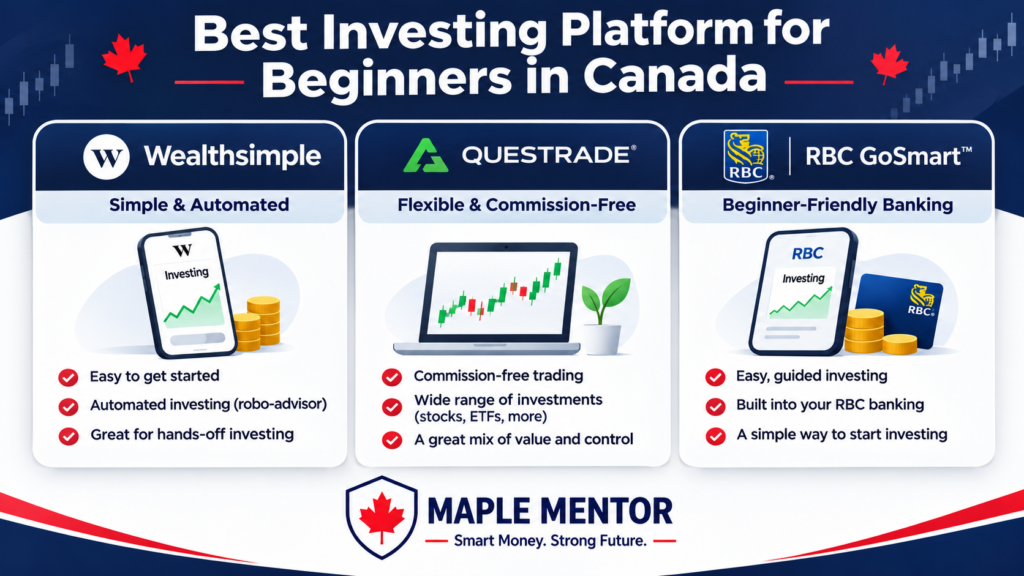
Quick Answer: Best Investing Platform for Beginners Canada
For most beginners who want a simple investing experience, Wealthsimple is my preferred choice.
Its combination of $0 stock and ETF trading commissions, fractional shares, and recurring investments makes it particularly convenient for someone investing a small amount every payday.
However, Questrade and RBC GoSmart are also worth considering.
- Wealthsimple: Best for simplicity, small investments, and automatic ETF purchases.
- Questrade: Best for beginners who want commission-free trading with more traditional brokerage functionality.
- RBC GoSmart: Best for existing RBC clients who want a beginner-focused investing experience within their banking app.
The right platform ultimately depends on your investing habits.
For example, someone who wants to invest $100 into an ETF every two weeks may prefer Wealthsimple.
Someone who wants to learn more advanced investing techniques over time may prefer Questrade.
Meanwhile, an RBC customer who wants to manage banking and investments through one familiar app may find RBC GoSmart particularly convenient.
The best investing platform for beginners Canada has to offer isn’t necessarily the platform with the most features. It’s the one that makes investing affordable, understandable, and consistent.
Wealthsimple vs Questrade vs RBC GoSmart: Comparison at a Glance
Before examining each brokerage individually, here’s how their main beginner-focused features compare.
| Feature | Wealthsimple | Questrade | RBC GoSmart |
|---|---|---|---|
| Stock trading commissions | $0 | $0 online | 50 free trades/year |
| ETF trading commissions | $0 | $0 online | 50 free trades/year plus selected free ETFs |
| Minimum investment | No large minimum | $0 | $0 |
| Fractional investing | Yes, eligible securities | Yes, eligible securities | More limited |
| Recurring investing | Extensive | Eligible securities | Selected all-in-one ETFs |
| TFSA | Yes | Yes | Yes |
| RRSP | Yes | Yes | Yes |
| FHSA | Yes | Yes | Yes |
| RESP | Yes | Yes | No |
| Hold USD | Yes, with eligible account functionality | Yes | No |
| Beginner experience | Very simple | Beginner-accessible | Designed for beginners |
| Advanced trading tools | Growing selection | Broader functionality | Limited |
| Banking integration | Wealthsimple ecosystem | External banking connections | RBC Mobile |
Features and pricing reflect the brokerages’ published offerings described for 2026. Eligibility, fees, and account functionality can change.
An important distinction is that RBC GoSmart offers commission-free trading within defined limits, whereas Wealthsimple and Questrade generally offer unlimited $0 standard commissions on eligible online stock and ETF trades.
GoSmart also settles transactions in Canadian dollars, including purchases of U.S.-listed securities.
For investors who plan to buy American stocks regularly, this difference deserves attention.
What Should Beginners Look for in an Investing Platform?
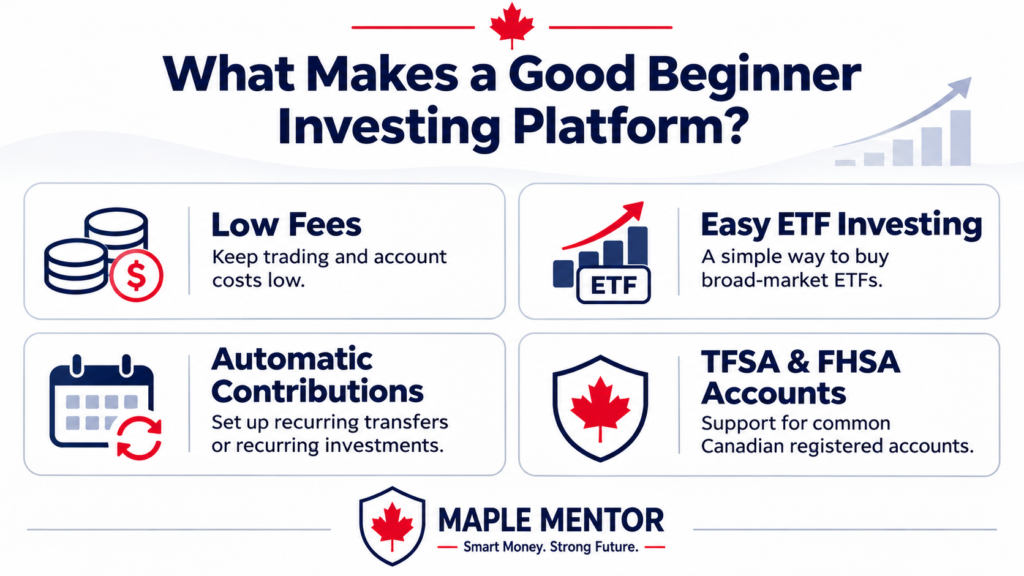
Choosing the best investing platform for beginners Canada offers involves more than comparing brokerage advertisements.
A beginner investing their first $250 probably doesn’t need professional trading software, complicated order types, or access to dozens of international exchanges.
Instead, a few practical features matter most.
1. Low Trading Fees
Trading commissions can reduce the amount of money available for investing.
For example, imagine investing $100 each month while paying a $9.95 commission per purchase.
Over 12 months:
$9.95 x 12 = $119.40
That’s almost 10% of your $1,200 in annual contributions.
This is why commission-free trading is especially valuable for smaller investors.
2. No Large Minimum Deposit
Some traditional investing services require substantial initial deposits.
Fortunately, many Canadian self-directed platforms allow investors to start with much smaller amounts.
Being able to begin with $100 or $250 can make investing more accessible.
3. TFSA, RRSP, and FHSA Availability
The account you choose can be just as important as the brokerage.
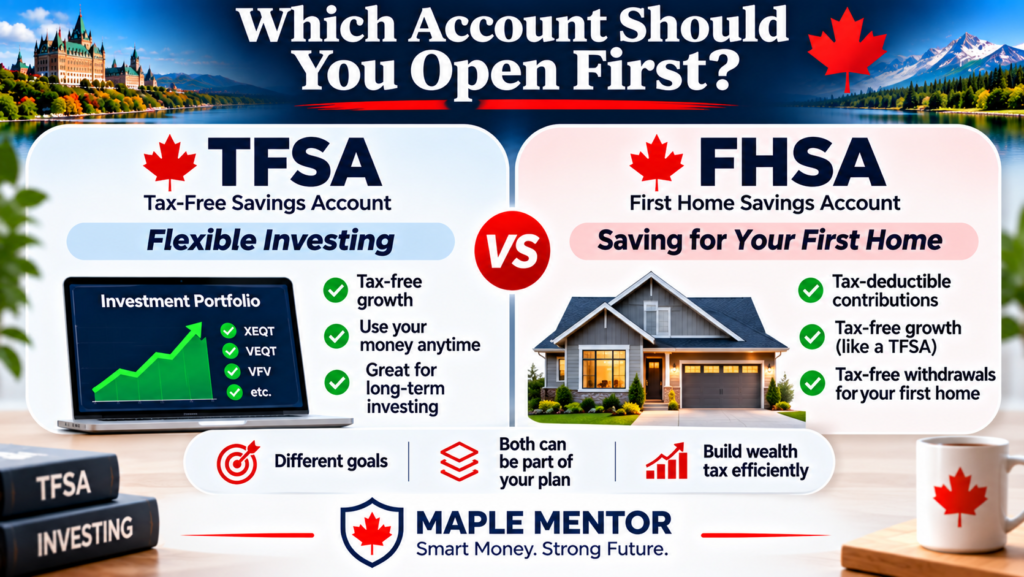
A TFSA offers flexible tax-free investing under Canadian rules.
An RRSP can provide tax deductions and tax-deferred investment growth.
An FHSA offers tax advantages for eligible first-time homebuyers.
All three platforms offer these major registered account types.
4. Easy ETF Investing
Exchange-traded funds can help beginners build diversified portfolios without selecting individual companies.
For example, an asset allocation ETF may provide exposure to hundreds or thousands of stocks through a single investment.
However, ETFs still carry investment risk, and their suitability depends on your goals and timeline.
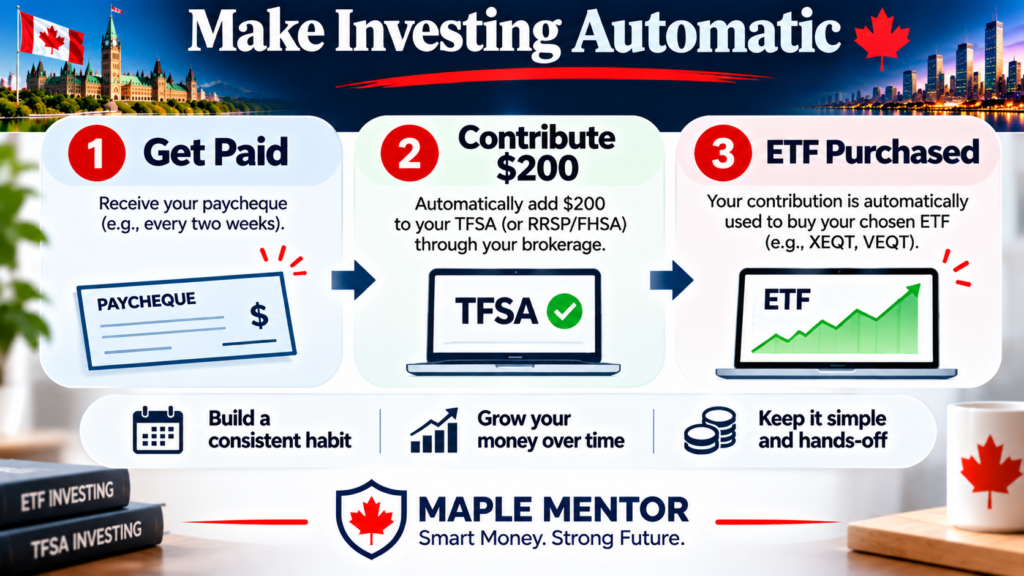
5. Automatic Investing
Automatic investing can make it easier to contribute consistently.
For example:
Payday ($200) → TFSA contribution → Automatic ETF purchase
A platform that supports recurring purchases can reduce the need to place manual orders every payday.
6. Fractional Shares
Fractional investing allows eligible investors to purchase part of a share.
This can be particularly useful when investing small amounts.
For example, if a stock costs $300 per share, an investor with $100 could potentially purchase approximately one-third of a share.
7. Room to Grow
Beginners don’t necessarily remain beginners forever.
You may eventually want access to additional account types, U.S. dollar balances, advanced research tools, or more sophisticated investments.
Choosing a brokerage with room to grow can reduce the need to switch platforms later.
Is Wealthsimple the Best Investing Platform for Beginners Canada Offers?
Wealthsimple is one of the strongest options for Canadians who want to begin investing without navigating a complicated brokerage interface.
Its biggest advantage is how easily investors can combine account funding, ETF purchases, and recurring investments.
Wealthsimple Trading Fees
Wealthsimple currently offers $0 standard commissions on eligible Canadian- and U.S.-listed stocks and ETFs.
For a beginner purchasing Canadian-listed ETFs, this is a meaningful advantage.
For example, you could purchase $100 of an eligible ETF without paying a standard stock-trading commission.
However, currency-conversion fees can apply when purchasing U.S.-listed investments using Canadian dollars.
Fractional Shares for Small Investors
Wealthsimple supports fractional investing in eligible stocks and ETFs.
Suppose you want to invest $75 into a security trading for $150 per share.
With fractional investing, you could purchase approximately half a share.
This makes it easier to invest fixed dollar amounts without waiting until you have enough money for a full share.
Automatic Investing With Wealthsimple
One of Wealthsimple’s most useful beginner features is recurring investing.
Investors can schedule eligible stock and ETF purchases:
- Daily
- Weekly
- Biweekly
- Monthly
Recurring purchases can use supported funding sources, including available trading cash, Wealthsimple chequing, or eligible linked bank accounts.
For example, you could schedule a $150 purchase of XEQT every two weeks.
Over 26 contributions:
$150 x 26 = $3,900 annually
The purchases can happen automatically, provided the account and funding source meet the applicable requirements.
This makes Wealthsimple particularly attractive for long-term passive investing.
For a detailed comparison of automation features, see our:
Automatic ETF Investing in Canada: Wealthsimple vs Questrade
Wealthsimple Account Types
Wealthsimple offers several account types, including:
- TFSA
- RRSP
- FHSA
- RESP
- Non-registered investing accounts
Additional account types and features are available depending on eligibility.
This means beginners can use the same platform for several financial goals.
Wealthsimple’s Main Drawbacks
Despite its simplicity, Wealthsimple isn’t perfect.
Currency-conversion fees can become expensive for Canadians who frequently purchase U.S. stocks with CAD.
Certain advanced investing tools and products may also be more limited than those available through traditional brokerages.
Additionally, a simple interface doesn’t eliminate investment risk.
Who Should Choose Wealthsimple?
Wealthsimple may be the best investing platform for beginners Canada offers for someone who wants to start with a small amount, automatically invest in ETFs, and avoid complicated trading software.
Verdict: My preferred platform for beginners who prioritize convenience, recurring investments, and straightforward ETF investing.
For a broader comparison, see our Wealthsimple vs Questrade Canada post.
Official information: https://www.wealthsimple.com/en-ca
Is Questrade the Best Investing Platform for Beginners Canada Offers?
Questrade is another strong option for Canadians beginning their investing journey.
Historically, Questrade was often associated with more traditional self-directed investing.
However, its updated pricing has made it considerably more competitive for beginners.
Questrade Trading Fees
Questrade now advertises $0 commissions for eligible online Canadian- and U.S.-listed stock and ETF trades.
It also offers:
- No minimum balance for self-directed investing
- No annual account fee
- No inactivity fee
- CAD and USD holdings in supported accounts
These features make Questrade accessible to investors starting with relatively small amounts.
For example, someone investing $250 per month into an eligible Canadian-listed ETF generally wouldn’t pay a standard online trading commission.
Questrade Account Types
One of Questrade’s strengths is its broad account selection.
Available account types include:
- TFSA
- RRSP
- FHSA
- RESP
- LIRA
- RRIF
- Cash accounts
- Margin accounts
Not every account is appropriate for beginners.
However, having access to additional account types can be useful as your financial circumstances change.
Questrade and U.S. Dollar Investing
Questrade allows eligible accounts to hold Canadian and U.S. dollars.
This can be valuable for investors who eventually want to purchase U.S.-listed stocks or ETFs.
For example, an investor who already holds USD can purchase eligible American stocks without converting CAD for every transaction.
However, Questrade’s standard currency-conversion fee is generally 1.5%.
Investors should distinguish between the ability to hold USD and the cost of converting money into USD.
Does Questrade Offer Automatic Investing?
Yes.
Questrade offers recurring investments for eligible fractional U.S.-listed stocks and ETFs.
However, its published recurring-buy program is more restrictive than Wealthsimple’s for Canadian-listed ETFs.
For example, someone wanting to automatically purchase XEQT every payday may find Wealthsimple more convenient.
Questrade still supports recurring deposits and manual purchases of Canadian-listed ETFs.
Questrade’s Main Advantages
Questrade is attractive because it combines beginner-accessible pricing with more traditional brokerage functionality.
Investors can start with straightforward ETF purchases and later explore additional research tools, account types, and investment products.
This flexibility can be useful for someone who wants to become more involved in managing their portfolio.
Questrade’s Main Drawbacks
Questrade may feel less streamlined than Wealthsimple for someone who wants the simplest possible investing experience.
Its recurring-investment eligibility also differs from Wealthsimple’s.
Furthermore, standard currency-conversion charges can be significant when purchasing U.S. securities.
Who Should Choose Questrade?
Questrade could be the best investing platform for beginners Canada offers for investors who want to start simply but expect to use more traditional brokerage features later.
Verdict: An excellent alternative for beginners who value flexibility, dual-currency holdings, and room to grow.
For a comparison of its more advanced functionality, see our Questrade vs Interactive Brokers Canada
Official information: https://www.questrade.com
Is RBC GoSmart the Best Investing Platform for Beginners Canada Offers?
RBC GoSmart is an interesting alternative because it was specifically designed for newer investors.
Unlike Wealthsimple and Questrade, GoSmart is closely integrated with RBC’s banking ecosystem.
This can make it particularly convenient for Canadians who already use RBC for everyday banking.
What Is RBC GoSmart?
RBC GoSmart is a mobile-first self-directed investing experience available to eligible RBC clients through the RBC Mobile app.
Its purpose is to make investing more approachable.
Rather than offering every feature available through a full-service brokerage platform, GoSmart focuses on simpler investing needs.
RBC GoSmart Trading Fees
GoSmart currently advertises:
- 50 commission-free Canadian and U.S. stock and ETF trades per year
- Unlimited commission-free trades on more than 50 selected ETFs
- No minimum investment requirement
- No account maintenance fee
For someone investing once or twice per month, 50 annual commission-free trades may be sufficient.
However, the distinction matters if you eventually trade more frequently.
Wealthsimple and Questrade offer $0 standard commissions on eligible online stock and ETF trades without the same 50-trade annual limit.
GoSmart users should review the current commission schedule for transactions outside the free-trade allowance.
RBC GoSmart Account Types
GoSmart currently supports:
- TFSA
- RRSP
- FHSA
These cover several common beginner investing goals.
However, GoSmart doesn’t offer the same range of accounts as RBC’s full Direct Investing platform.
For example, RESPs aren’t available through GoSmart.
RBC GoSmart Automatic Investing
GoSmart offers recurring investing into selected all-in-one ETFs.
This can be useful for beginners who want a diversified investment approach without repeatedly placing manual orders.
However, its recurring-investment selection is more limited than Wealthsimple’s.
Can You Buy U.S. Stocks With RBC GoSmart?
Yes.
GoSmart allows eligible investors to purchase U.S.-listed stocks and ETFs.
However, GoSmart accounts operate in Canadian dollars and don’t hold USD balances.
This means U.S. transactions involve currency conversion.
For someone regularly buying and selling American stocks, this limitation may become important.
RBC GoSmart Limitations
GoSmart doesn’t currently provide the same investment selection as a full traditional brokerage.
Its limitations include:
- No RESP accounts
- No cash or margin accounts
- No options trading
- No fixed-income products
- No mutual funds
- No securities outside Canadian and U.S. markets
- No USD cash balances
These restrictions aren’t necessarily disadvantages for someone making their first ETF investment.
However, they become more relevant as investing needs become more sophisticated.
Who Should Choose RBC GoSmart?
RBC GoSmart may be the best investing platform for beginners Canada offers for an existing RBC customer who values convenience and wants to manage basic investments through the RBC Mobile app.
Verdict: A compelling beginner-focused option for eligible RBC clients, although its account and investment limitations make it less flexible than the other two platforms.
For a broader comparison, see our RBC Direct Investing vs Wealthsimple
Official information: https://www.rbcdirectinvesting.com/gosmart-for-new-investors/index.html
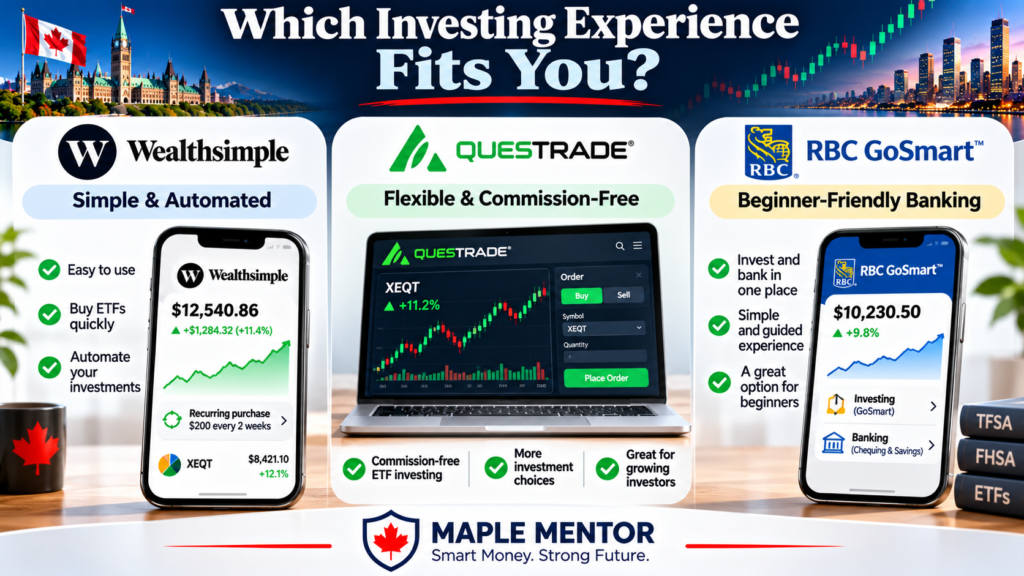
Best Investing Platform for Beginners Canada: Starting With $100–$500
One of the biggest misconceptions about investing is that you need thousands of dollars to begin.
In reality, many Canadians can start with much smaller amounts.
The important part is choosing investments that match your financial situation and building a sustainable habit.
Starting With $100
Suppose you have $100 available to invest.
At Wealthsimple, you could purchase an eligible Canadian-listed ETF without paying a standard trading commission.
Fractional investing may also allow you to invest the full amount in an eligible security.
Questrade similarly offers commission-free eligible online ETF trading and supports fractional investing in eligible securities.
RBC GoSmart may also work, particularly if the desired ETF is among its commission-free selections.
For a beginner investing $100, simplicity and diversification are generally more important than advanced trading tools.
Starting With $250
Suppose you invest $250 every month.
Your annual contributions would equal:
$250 x 12 = $3,000
If you automate those contributions, you can build a consistent investing routine without making a new decision every month.
Wealthsimple is particularly convenient for this approach because of its recurring-investment functionality.
Questrade and RBC GoSmart may also be appropriate depending on the investments you select.
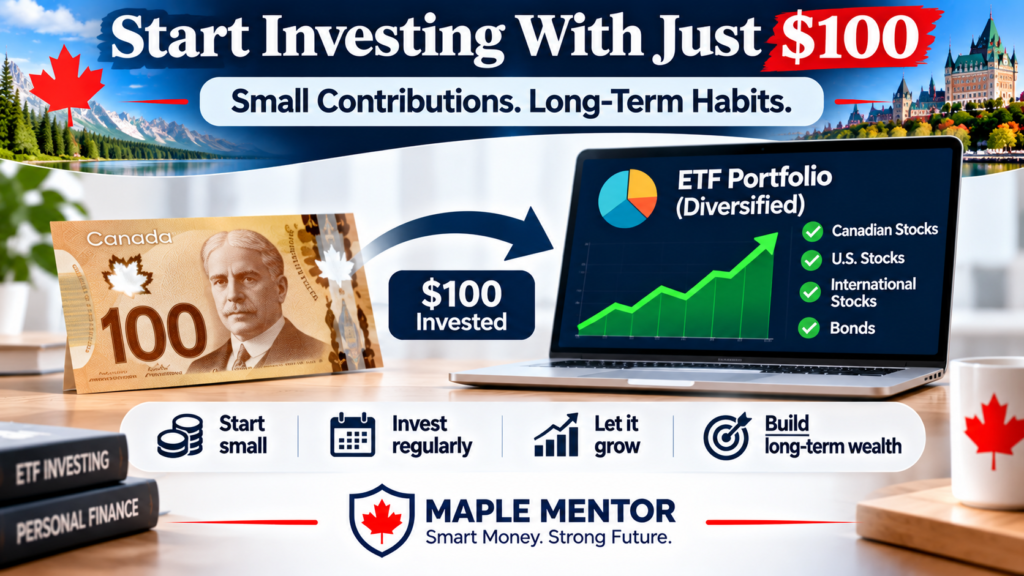
Starting With $500
A $500 initial investment provides slightly more flexibility.
However, having $500 doesn’t mean you need to purchase five different stocks.
A diversified ETF may provide exposure to many companies through a single investment.
For example, all-in-one ETFs such as XEQT, VEQT, or XGRO offer diversified portfolios with different asset allocations.
The appropriate choice depends on your risk tolerance and investment horizon.
What Matters More Than Your Starting Amount?
Consistency.
Consider an investor contributing $100 every month.
Over five years:
$100 x 12 x 5 = $6,000
That’s $6,000 in contributions before accounting for investment gains or losses.
Starting small can still be meaningful when contributions continue over time.
For additional guidance, see our
How to Invest Your First $1,000 in Canada
How to Invest $100 Per Month in Canada
Best ETFs for Beginners in Canada
Best Investing Platform for Beginners Canada: Automatic Investing
Automatic investing can be particularly useful for people who want to build wealth without constantly monitoring their portfolios.
However, the three platforms offer different levels of automation.
Wealthsimple
Wealthsimple supports recurring purchases of eligible Canadian- and U.S.-listed stocks and ETFs.
Its flexible schedules and funding methods make it particularly convenient for investors who want to automate Canadian ETF purchases.
Questrade
Questrade supports recurring purchases of eligible U.S.-listed fractional securities.
However, investors wanting to automate Canadian-listed ETFs should verify eligibility because its recurring-buy program has important restrictions.
RBC GoSmart
RBC GoSmart supports recurring investing into selected all-in-one ETFs.
This can be convenient for beginners who prefer a simplified selection of investments.
Which Is Best for Automatic Investing?
Wealthsimple is my preferred choice for beginners who want flexible recurring purchases of Canadian-listed ETFs.
Questrade and RBC GoSmart offer useful automation features, but their supported investments are more limited.
For a complete explanation, see our:
Automatic ETF Investing in Canada: Wealthsimple vs Questrade
Best Investing Platform for Beginners Canada: TFSA Comparison
A TFSA is often one of the first investment accounts Canadians consider.
Eligible investments can grow tax-free under Canadian rules, and withdrawals are generally tax-free.
However, choosing a TFSA and choosing a brokerage are two separate decisions.
All three platforms offer TFSAs.
Wealthsimple TFSA
Wealthsimple is attractive for beginners who want commission-free ETF trading, fractional shares, and recurring investments.
It may be especially convenient for someone contributing a fixed amount every payday.
Questrade TFSA
Questrade offers commission-free eligible online stock and ETF trading and supports holding CAD and USD.
It may be appealing to investors who want more traditional brokerage functionality.
RBC GoSmart TFSA
GoSmart offers a beginner-focused TFSA experience through the RBC Mobile app.
For an existing RBC customer, having banking and investments in the same ecosystem may be convenient.
However, GoSmart’s trading allowance and investment restrictions should be considered.
Which TFSA Platform Is Best for Beginners?
Wealthsimple is my preferred choice for simple recurring ETF investing.
Questrade is attractive for investors who want greater flexibility.
RBC GoSmart can be convenient for eligible RBC customers who prefer a familiar banking interface.
Remember that your TFSA contribution room applies across all your TFSAs, not separately to each brokerage.
For more information, see our:
TFSA Investing Strategy for Beginners
Best Investing Platform for Beginners Canada: FHSA Comparison
An FHSA can be particularly valuable for eligible Canadians saving for their first home.
It combines tax-deductible contributions with tax-free qualifying withdrawals, subject to the program’s rules.
Wealthsimple, Questrade, and RBC GoSmart all offer FHSAs.
Wealthsimple FHSA
It may be attractive for beginners who want a simple interface and recurring purchases of eligible investments.
However, the investments selected should reflect the expected home-purchase timeline.
Questrade FHSA
Questrade offers self-directed FHSAs with access to eligible investments and traditional brokerage functionality.
It may appeal to investors who want more control over their holdings.
RBC GoSmart FHSA
RBC GoSmart offers FHSAs through its beginner-focused investing experience.
This may be convenient for existing RBC customers who want to manage their first-home savings alongside their other banking accounts.
Should You Invest Your FHSA in Stocks?
Not necessarily.
If you plan to purchase a home within the next two or three years, preserving your down payment may be more important than maximizing potential returns.
Stocks and equity ETFs can experience substantial short-term declines.
Depending on your timeline, cash savings, eligible GICs, or other lower-risk investments may be more appropriate.
The best FHSA platform isn’t automatically the one with the most stock-trading features.
Best Investing Platform for Beginners Canada: U.S. Stocks
Some beginners eventually want to purchase individual American companies such as Apple, Microsoft, or Amazon.
All three platforms provide access to eligible U.S.-listed stocks.
However, their currency functionality differs.
Wealthsimple for U.S. Stocks
Wealthsimple offers $0 standard commissions on eligible U.S.-listed securities.
However, converting CAD into USD can trigger currency-conversion fees.
Eligible USD account functionality can help reduce repeated conversions.
Questrade for U.S. Stocks
Questrade offers commission-free eligible online U.S. stock trading and supports holding both CAD and USD.
However, its standard currency-conversion fee is generally 1.5%.
RBC GoSmart for U.S. Stocks
GoSmart allows eligible U.S. stock purchases, but its accounts settle in Canadian dollars.
It doesn’t offer USD cash balances.
Consequently, investors should understand how currency conversion affects purchases and sales.
Which Platform Is Better for U.S. Investing?
For occasional U.S. stock purchases, Wealthsimple or Questrade may be attractive.
For investors who already hold USD, Questrade’s dual-currency functionality can be useful.
RBC GoSmart is more limited because it doesn’t hold USD.
However, frequent U.S. investors should also consider Interactive Brokers, which offers a different currency-conversion pricing structure.
For a complete comparison, see our:
Best Broker for U.S. Stocks in Canada
What Happens When You Outgrow a Beginner Investing Platform?
An important consideration when choosing the best investing platform for beginners Canada offers is whether the platform can continue meeting your needs as you gain experience.
Fortunately, starting with a beginner-friendly brokerage doesn’t necessarily mean you’ll have to switch later.
Growing With Wealthsimple
Wealthsimple has expanded its investing functionality significantly over time.
Beyond basic stock and ETF investing, it now offers additional account features and trading capabilities.
For many long-term ETF investors, Wealthsimple may provide everything they need.
However, investors seeking specialized investment products or extensive international market access may eventually consider alternatives.
Growing With Questrade
Questrade already offers a broad selection of account types and traditional brokerage tools.
A beginner can start with basic ETF investing and later explore additional features as their experience develops.
This makes Questrade attractive for investors who expect their needs to become more complex.
Growing With RBC
RBC GoSmart focuses on simpler investing needs.
Investors who eventually require additional account types, advanced trading products, or USD holdings can consider RBC’s full Direct Investing platform.
However, they should review the full platform’s fees and functionality before making the transition.
Do You Actually Need Advanced Trading Features?
Not necessarily.
Someone following a long-term diversified ETF strategy may never need options trading, margin borrowing, or sophisticated charting tools.
More features don’t automatically produce better investment results.
In many cases, a simple and consistent strategy is preferable to unnecessary complexity.
Wealthsimple vs Questrade vs RBC GoSmart: Which Should Beginners Choose?
The best investing platform for beginners Canada offers depends on your priorities.
Here’s how I would approach the decision.
| Your Priority | Platform to Consider |
|---|---|
| Simplest overall experience | Wealthsimple |
| Automatic Canadian ETF investing | Wealthsimple |
| Starting with $100 | Wealthsimple or Questrade |
| Fractional investing | Wealthsimple or Questrade |
| Existing RBC customer | RBC GoSmart |
| Banking and investing in one familiar app | RBC GoSmart |
| Traditional brokerage tools | Questrade |
| Free CAD/USD holdings | Questrade |
| Broad account selection | Wealthsimple or Questrade |
| Simple selected all-in-one ETF automation | Wealthsimple or RBC GoSmart |
| Wants more advanced features later | Questrade |
| Wants to minimize manual investing tasks | Wealthsimple |
These recommendations aren’t absolute.
For example, an RBC customer who wants to purchase one eligible ETF every month may find GoSmart perfectly suitable.
Similarly, a beginner who prefers Questrade’s interface may have no reason to choose Wealthsimple.
The most important factors are the investments you plan to purchase, the fees you’ll actually pay, and how easily you can maintain your investing routine.
Common Mistakes Beginners Should Avoid
Even after choosing a good brokerage, beginners can make mistakes that affect their results.
1. Investing Money Needed Soon
Money needed for rent, emergencies, or a near-term home purchase generally shouldn’t be exposed to unnecessary stock-market risk.
Before investing, consider your emergency savings and expected expenses.
2. Choosing Individual Stocks Without Diversification
Buying shares of a familiar company may seem appealing.
However, owning only one or two companies can expose your portfolio to significant company-specific risk.
Diversified ETFs may be worth considering, particularly for beginners.
3. Ignoring Currency-Conversion Fees
Commission-free trading doesn’t necessarily mean every transaction is free.
Canadians buying U.S. securities should understand foreign-exchange costs.
4. Overcomplicating the Portfolio
A beginner doesn’t necessarily need ten ETFs, several brokerage accounts, or a complicated trading strategy.
A straightforward portfolio aligned with your objectives may be easier to manage.
5. Investing Without Understanding the Account
A TFSA, RRSP, and FHSA serve different purposes.
Before contributing, understand the account’s eligibility rules, contribution limits, and withdrawal treatment.
6. Expecting Immediate Results
Investing is generally more effective when approached with realistic expectations.
Market returns are unpredictable, and even diversified portfolios can experience losses.
Consistent contributions and an appropriate investment strategy matter more than trying to predict every market movement.
Final Verdict: Best Investing Platform for Beginners Canada
Choosing the best investing platform for beginners Canada offers doesn’t need to be complicated.
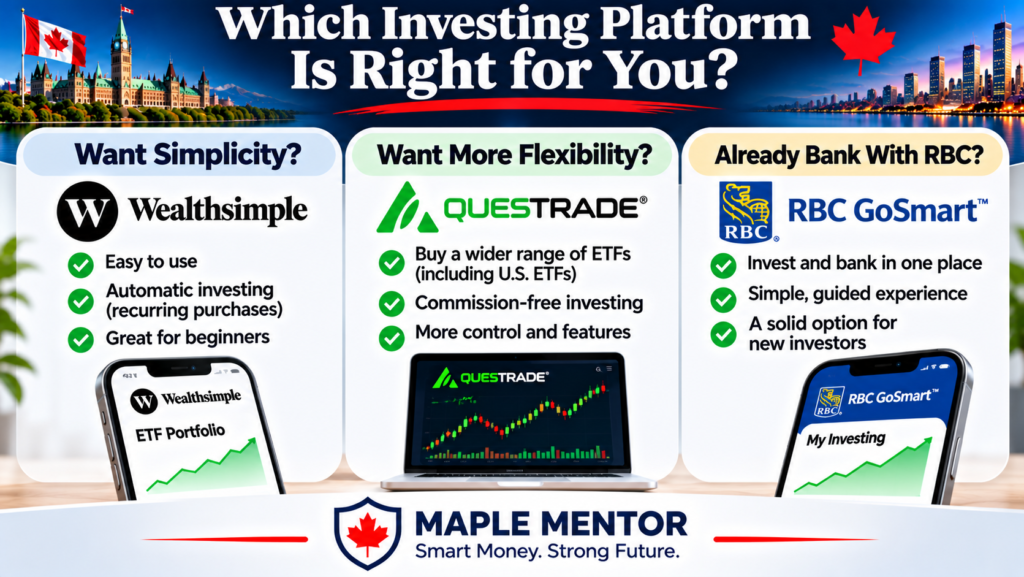
Wealthsimple, Questrade, and RBC GoSmart each provide accessible ways for Canadians to begin investing.
However, their strengths differ.
Wealthsimple is my preferred choice for most beginners.
Its straightforward interface, commission-free eligible stock and ETF trading, fractional shares, and recurring investments make it particularly attractive for people starting with small amounts.
Someone who wants to automatically invest $100 or $200 every payday may find Wealthsimple especially convenient.
Questrade is my preferred alternative for beginners who want greater brokerage flexibility.
Its commission-free eligible online trading, broad account selection, and CAD/USD functionality make it attractive for investors who expect to explore additional features later.
RBC GoSmart is worth considering for existing RBC customers.
Its beginner-focused design, lack of a minimum investment requirement, and commission-free trading allowance make it a convenient option for eligible investors who prefer RBC’s banking ecosystem.
However, its account and investment limitations should be considered.
Ultimately, the best investing platform for beginners Canada offers is the one that allows you to invest consistently in a sensible portfolio without paying unnecessary fees.
You don’t need to start with $10,000.
You don’t need to become a professional trader.
And you don’t need to understand every investing strategy before making your first contribution.
Start by understanding your goals, choosing the right account, and selecting investments appropriate for your risk tolerance.
Then focus on building a consistent long-term habit.
Frequently Asked Questions
What Is the Best Investing Platform for Beginners Canada Offers?
Wealthsimple is my preferred choice for most beginners because of its simple interface, commission-free eligible stock and ETF trading, fractional shares, and recurring investments.
Questrade is attractive for investors who want more traditional brokerage functionality.
RBC GoSmart may be convenient for existing RBC clients who prefer investing through their banking app.
How Much Money Do I Need to Start Investing in Canada?
You don’t necessarily need thousands of dollars.
Platforms such as Wealthsimple, Questrade, and RBC GoSmart allow eligible investors to begin with relatively small amounts.
Starting with $100 or $250 can be practical, particularly when investing in eligible fractional shares or affordable ETFs.
Is Wealthsimple Good for Beginners?
Yes.
Wealthsimple offers a straightforward interface, $0 standard commissions on eligible stocks and ETFs, fractional investing, and recurring purchases.
These features make it particularly accessible to newer investors.
Is Questrade Good for Beginners?
Yes.
Questrade offers $0 commissions on eligible online stock and ETF trades, no minimum balance for self-directed investing, and a broad selection of investment accounts.
It may be especially attractive for beginners who want more flexibility as their experience develops.
Is RBC GoSmart Good for Beginners?
RBC GoSmart is specifically designed for newer investors.
It currently offers no minimum investment requirement, no account maintenance fee, 50 commission-free stock and ETF trades annually, and unlimited commission-free trading on selected ETFs.
However, its investment and account selection is more limited than a full traditional brokerage.
Is RBC GoSmart Better Than Wealthsimple?
It depends on your priorities.
Wealthsimple offers broader recurring-investment flexibility and unlimited $0 standard commissions on eligible stock and ETF trades.
RBC GoSmart may be more convenient for eligible RBC customers who want to invest through the RBC Mobile app.
Should Beginners Invest in ETFs or Individual Stocks?
Diversified ETFs are often worth considering because they can provide exposure to many companies through a single investment.
Individual stocks may offer growth opportunities but introduce additional company-specific risk.
The appropriate choice depends on your goals, risk tolerance, and understanding of the investments.
Should a Beginner Open a TFSA or FHSA?
That depends on your eligibility and financial goals.
An FHSA can be particularly attractive for eligible first-time homebuyers because of its tax advantages.
A TFSA offers broader flexibility for different savings and investment goals.
Investors should understand the rules of both accounts before contributing.
For more information, see our FHSA vs TFSA