
Choosing a Canadian brokerage isn’t only about finding the platform with the lowest advertised commission.
Trading fees matter, but so do account types, foreign-exchange costs, research tools, automation, investment selection, and how you actually plan to invest.
In the RBC Direct Investing vs Wealthsimple comparison, Wealthsimple will likely be the better fit for many beginner and cost-conscious investors because it charges $0 commissions for Canadian- and U.S.-listed stocks and ETFs. RBC Direct Investing, however, offers a broader full-service investing platform with multi-currency accounts, international trading, more investment products, and deeper research and trading tools.
RBC has also become considerably more competitive for beginners through GoSmart, which offers 50 commission-free stock and ETF trades per year plus unlimited commission-free trades on a selection of more than 50 ETFs.
So which one should you choose?
Let’s compare them.
Quick Answer
For many beginner and cost-conscious investors comparing RBC Direct Investing vs Wealthsimple, Wealthsimple is likely the better choice because Canadian- and U.S.-listed stocks and ETFs can be traded without commissions. Wealthsimple also supports recurring investments and fractional shares, making it particularly convenient for investors who regularly contribute smaller amounts.
Wealthsimple’s current pricing
RBC Direct Investing becomes more attractive if you want deeper research, multi-currency accounts, international trading, additional investment products, or closer integration with RBC banking.
Standard full-suite RBC Direct Investing currently charges $9.95 per online/mobile stock or ETF trade. Active traders completing at least 150 trades per quarter can qualify for $6.95 pricing. RBC has eliminated its account maintenance fee and also offers unlimited commission-free trading on a selection of more than 50 ETFs.
RBC Direct Investing’s current pricing
For beginners, RBC’s GoSmart option changes the comparison significantly: eligible GoSmart accounts receive 50 commission-free Canadian/U.S. stock and ETF trades per year across their GoSmart accounts, plus the selected commission-free ETFs.
My overall breakdown:
Best for most beginners: Wealthsimple
Best for frequent small ETF purchases: Wealthsimple
Best for existing RBC clients wanting a simple registered account: RBC GoSmart deserves consideration
Best for deeper research and broader investment choices: RBC Direct Investing full-suite
Best for international markets and multiple currencies: RBC Direct Investing full-suite
RBC Direct Investing vs Wealthsimple at a Glance
| Feature | Wealthsimple | RBC Direct Investing |
|---|---|---|
| Canadian/U.S. stock & ETF commissions | $0 | $9.95 standard full-suite |
| Beginner RBC GoSmart pricing | N/A | 50 free stock/ETF trades/year + 50+ selected commission-free ETFs |
| Account maintenance fee | $0 for self-directed trading | $0 |
| TFSA | Yes | Yes |
| RRSP | Yes | Yes |
| FHSA | Yes | Yes |
| Non-registered | Yes | Yes with full-suite |
| USD accounts | Available; Core $10/month, included at higher tiers | Multi-currency available with full-suite |
| CAD/USD conversion | 1.5% Wealthsimple conversion fee | FX spread applies |
| Recurring investments | Yes | GoSmart offers recurring investments on select all-in-one ETFs |
| Fractional investing | Yes, eligible securities | More limited |
| Research/tools | Growing feature set | Stronger full-suite research/tool offering |
| International markets outside Canada/U.S. | More limited | Full-suite international trading |
| Beginner friendliness | Excellent | GoSmart is beginner-focused |
| Advanced investing | Increasingly capable | Strong full-suite platform |
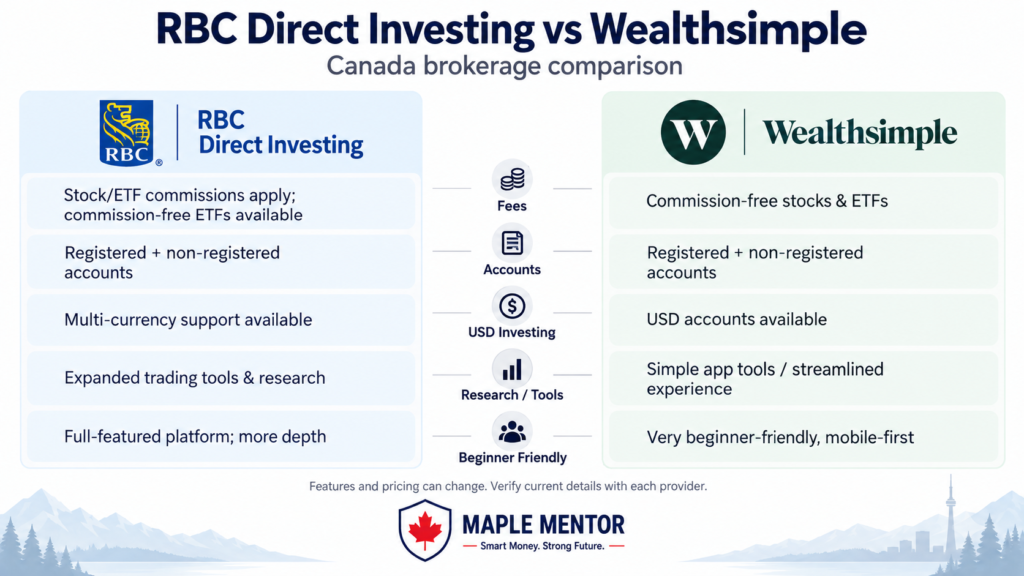
Pricing and features can change, so verify the current terms directly with each brokerage before opening or transferring an account.
Trading Fees
This is traditionally where the RBC Direct Investing vs Wealthsimple comparison has heavily favoured Wealthsimple.
Wealthsimple Trading Fees
Wealthsimple currently charges $0 commission when buying or selling Canadian- or U.S.-listed stocks and ETFs through its self-directed platform.
That can be especially useful for investors making frequent small purchases.
Suppose you invest $250 every two weeks.
If every purchase carried a $9.95 commission, making 26 purchases would cost:
$9.95 × 26 = $258.70 per year
That’s more than one entire $250 contribution.
With $0 commissions, you don’t have to worry as much about grouping small ETF purchases together simply to reduce trading costs.
However, commission-free doesn’t mean every transaction is completely free. Currency conversion and certain other services can still carry fees.
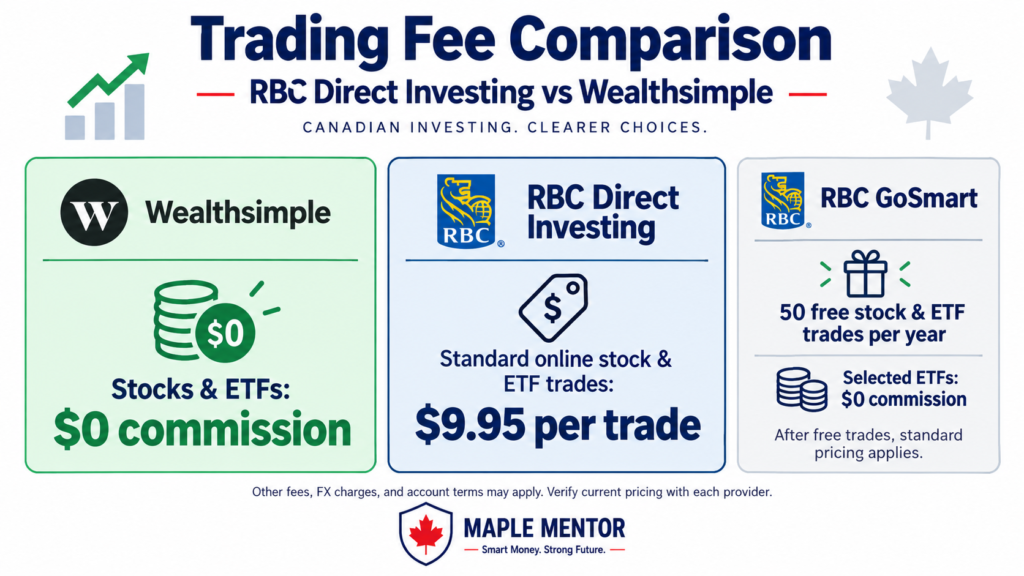
RBC Direct Investing Trading Fees
RBC’s current full-suite standard pricing is:
$9.95 per online/mobile stock or ETF trade
Active Trader pricing drops to:
$6.95 per trade
when you make at least 150 trades per quarter.
RBC also currently charges no account maintenance fee, regardless of the amount invested.
Importantly, RBC now provides unlimited commission-free trading on a selection of more than 50 ETFs across its account offerings.
That means the difference isn’t as simple as “$0 versus $9.95” anymore.
What you invest in, and which RBC account you use matters.
RBC Direct Investing GoSmart vs Wealthsimple
GoSmart is perhaps the biggest change to this comparison.
RBC describes GoSmart as its streamlined, mobile-first investing solution for newer investors.
It currently includes:
- 50 commission-free Canadian/U.S. stock and ETF trades per year
- Unlimited commission-free trading on 50+ selected ETFs
- No account maintenance fee
- No minimum investment
- TFSA
- FHSA
- RRSP
- Canadian and U.S.-listed stocks and ETFs
- Recurring investing into select all-in-one ETFs
That’s much more competitive with Wealthsimple than RBC’s traditional $9.95-per-trade structure.
If you make fewer than 50 stock/ETF trades per year or primarily buy one of RBC’s eligible commission-free ETFs, the commission difference could effectively disappear.
There are important limitations, though.
GoSmart is currently limited to registered TFSA, FHSA and RRSP accounts, operates in Canadian dollars, and doesn’t support mutual funds, fixed income, options, margin, or foreign securities listed outside Canada and the United States. RBC also says GoSmart is currently available to RBC clients through the RBC Mobile app.
If you need those additional features, RBC’s full-suite account is the relevant comparison.
Account Types
Most beginner investors will find the major accounts they need at either brokerage.
Wealthsimple
Wealthsimple provides self-directed investing through major account types including:
- TFSA
- RRSP
- FHSA
- Non-registered accounts
It also supports additional account types and investment products beyond these core beginner accounts.
RBC Direct Investing
GoSmart currently focuses specifically on:
- TFSA
- RRSP
- FHSA
RBC’s full-suite Direct Investing platform expands the selection considerably and includes accounts such as:
- TFSA
- FHSA
- RRSP
- RESP
- RRIF
- Cash accounts
- Margin accounts
- Business, trust and other accounts
So if you’re a beginner simply opening a TFSA or RRSP, account availability probably won’t determine the winner.
If your financial situation becomes more complicated, RBC’s full-suite platform has an advantage in breadth.
U.S. Stocks and Currency Conversion
This is where looking only at trading commissions can become misleading.
A “$0 trade” doesn’t necessarily mean buying U.S. stocks costs nothing.
Wealthsimple
Wealthsimple charges a 1.5% currency conversion fee when converting between Canadian and U.S. dollars.
Core clients can currently add USD accounts for $10 per month, while Wealthsimple’s higher client tiers include USD accounts. Wealthsimple says USD already held elsewhere can be transferred into the USD account without paying its currency conversion fee; converting CAD into USD still carries the 1.5% conversion fee.
For someone occasionally buying a U.S. stock, this may not matter much.
For someone frequently moving large amounts between CAD and USD, it can matter considerably.
For example, a hypothetical:
$10,000 CAD conversion × 1.5% = $150
That’s why you shouldn’t choose a brokerage for U.S. investing based only on the words “commission-free.”
RBC Direct Investing
RBC’s full-suite accounts support multiple currencies, including USD, and RBC advertises multi-currency accounts as part of the full-suite platform.
Foreign exchange isn’t free, however.
RBC states that its foreign currency conversion rate includes a spread earned by RBC Direct Investing or its affiliates, with the spread varying based on factors such as market conditions, transaction amount, date, and transaction type.
GoSmart is different.
It is CAD-only. You can purchase U.S.-listed securities, but you cannot hold U.S. dollars in the account, so applicable U.S.-dollar transactions require currency conversion.
For someone frequently trading U.S. securities, RBC’s full-suite account is therefore much more relevant than GoSmart.
Research and Trading Tools
This category traditionally favours RBC Direct Investing, although Wealthsimple has been expanding its trading capabilities.
RBC Direct Investing
RBC’s full-suite platform includes:
- Live streaming market data
- Level 2 TSX and TSX-V quotes
- Pre- and post-market trading
- Multi-currency accounts
- International trading
- Portfolio analysis
- Research tools
- Trading Dashboard
- Dividend reinvestment on eligible securities
Active Trader clients receive additional Level 2 data and premium research features.
RBC also supports direct international trading beyond Canada and the United States, including markets such as the UK, Hong Kong, Australia, Europe, Japan, and Singapore, although international commissions and local market charges apply.
RBC international trading information
Wealthsimple
Wealthsimple historically focused much more heavily on simplicity.
That remains one of its strengths, but it shouldn’t now be described as a platform with virtually no advanced functionality.
Wealthsimple offers features including recurring investments, dividend reinvestment, fractional shares, real-time streaming quotes, price alerts, and extended trading functionality. It has also been expanding its advanced trading offering.
For someone simply buying an ETF every payday, those features may already be more than enough.
For investors who want deeper research, multiple currencies, international exchanges, and a more traditional full-service brokerage environment, RBC still has a stronger case.
Which Is Better for Beginners?
For the typical beginner, I’d still give the advantage to Wealthsimple.
There are several reasons.
$0 Commissions
You can make small Canadian and U.S. stock or ETF purchases without worrying about a commission consuming part of every contribution.
Fractional Shares
Eligible stocks and ETFs can be purchased fractionally, with Wealthsimple saying investors can start with as little as $1.
Recurring Investments
You can automatically purchase stocks or ETFs weekly, biweekly, or monthly.
This is particularly useful for a simple long-term strategy.
For example:
Every payday → $250 → diversified ETF
You don’t need to manually place the same order every two weeks.
Simple Interface
Wealthsimple’s platform is built around making investing relatively straightforward.
For someone who doesn’t need advanced market data or international trading, that’s often an advantage rather than a limitation.
If you’re considering opening an account, read Is Wealthsimple Safe?
For alternatives beyond these two platforms, see Best Online Brokers in Canada.
If you’re not sure what to buy once the account is open, start with Best ETFs for Beginners in Canada.
That said, RBC GoSmart deserves more consideration than RBC traditionally would have received in a beginner brokerage comparison.
Fifty commission-free trades per year could be plenty for a passive investor making approximately one purchase per week, and recurring purchases of eligible all-in-one ETFs don’t count toward those 50 trades.
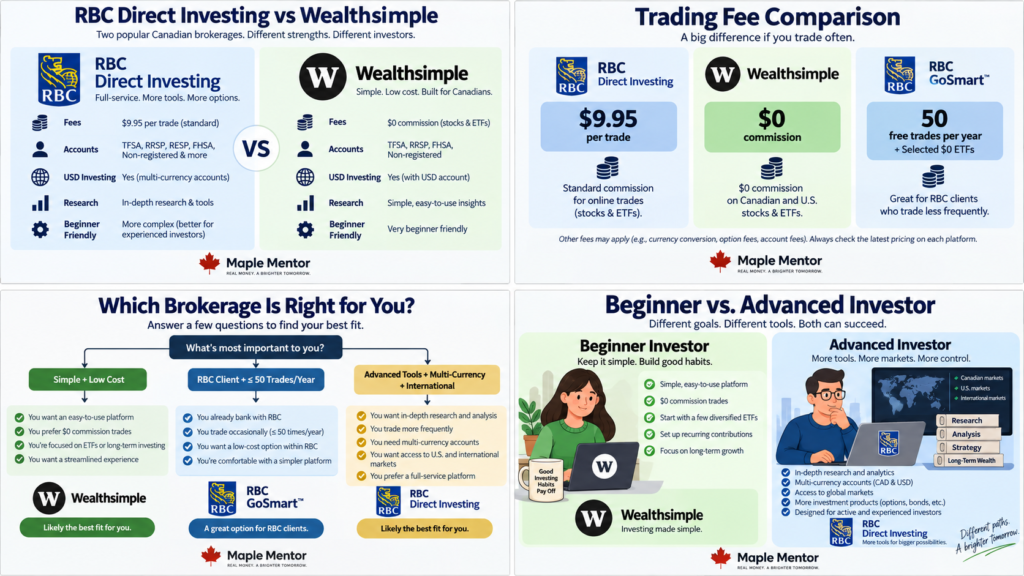
Which Is Better for Experienced Investors?
This category is more complicated.
RBC Direct Investing may make more sense for investors who:
- Already bank with RBC
- Want multiple currencies
- Want deeper research
- Need fixed income or mutual funds
- Trade options
- Want margin
- Want international markets
- Use more sophisticated trading tools
Its full-suite platform supports stocks, ETFs, mutual funds, options, fixed income and additional investments, while GoSmart deliberately strips many of these features away for simplicity.
However, don’t automatically assume every experienced investor needs RBC.
An experienced Canadian investor whose entire strategy is buying one or two broad-market ETFs may prefer Wealthsimple precisely because they don’t need the additional complexity.
Likewise, Wealthsimple has continued adding advanced trading functionality, meaning this category could become increasingly competitive.
Experience level alone shouldn’t determine the brokerage.
Your strategy should.
RBC Direct Investing vs Wealthsimple: Pros and Cons
Wealthsimple Pros
$0 stock and ETF commissions
This is the biggest advantage for frequent contributions.
Beginner-friendly
The platform makes straightforward investing relatively simple.
Recurring investments
Useful for automating long-term contributions.
Fractional investing
You don’t necessarily need enough money to purchase an entire share.
Strong fit for ETF investors
Someone building a simple Canadian ETF portfolio may not need much more.
Wealthsimple Cons
Currency conversion costs
The 1.5% CAD/USD conversion fee deserves attention if you frequently convert currencies.
USD accounts aren’t automatically free for every client
Core currently pays $10/month after the trial, while higher tiers include the feature.
International investing is more limited
Investors wanting direct access to a broader range of foreign exchanges may find RBC’s full-suite offering more suitable.
RBC Direct Investing Pros
Broader full-suite platform
You get more investment products, account types, currencies, research, and trading tools.
Multi-currency capabilities
Full-suite accounts support currencies beyond CAD.
International investing
Direct access to several international markets is available.
RBC integration
Existing RBC clients may value having banking and investing within the same ecosystem.
GoSmart has dramatically improved beginner pricing
Fifty free stock/ETF trades annually plus unlimited trading on selected ETFs makes RBC considerably more competitive.
RBC Direct Investing Cons
$9.95 standard commissions
Outside GoSmart’s free trades and eligible commission-free ETFs, full-suite stock and ETF trading can be substantially more expensive than Wealthsimple for frequent small transactions.
GoSmart has limitations
It’s registered-account only, CAD-only, and doesn’t support several investments and trading features available through RBC’s full-suite platform.
The broader platform may be unnecessary for simple investors
More tools aren’t automatically better if you’ll never use them.
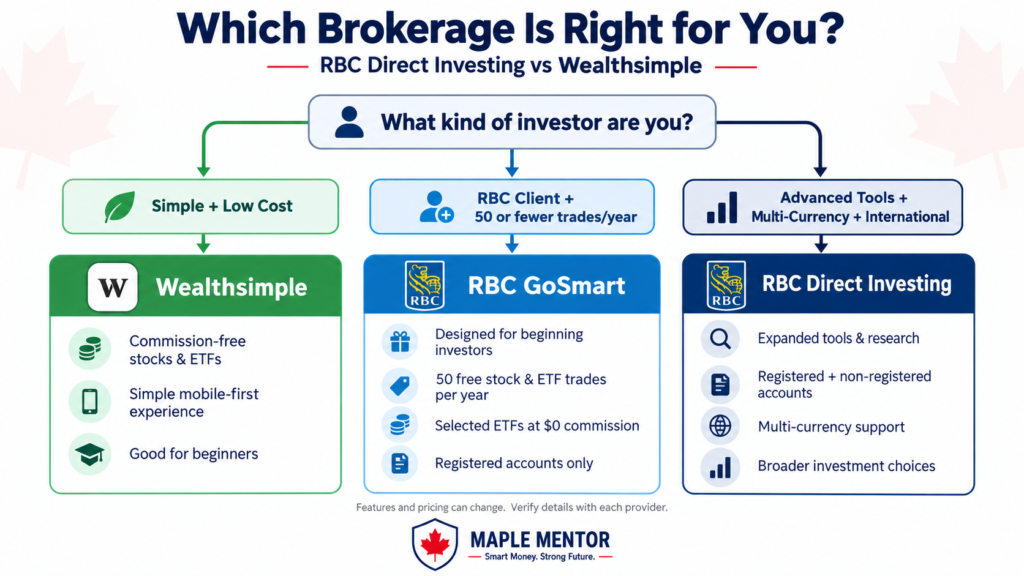
Which One Should You Choose?
The answer to RBC Direct Investing vs Wealthsimple depends primarily on how you invest.
Choose Wealthsimple If:
You primarily want:
- $0 stock and ETF commissions
- A simple investing experience
- Automatic recurring investments
- Fractional shares
- Small regular contributions
- A straightforward ETF portfolio
For a beginner investing $100, $250, or $500 at a time, avoiding trading commissions can be particularly valuable.
If that describes your strategy, How Much Should You Invest Each Month in Canada? can help you build a realistic recurring contribution plan.
Consider RBC GoSmart If:
You:
- Already bank with RBC
- Want a TFSA, FHSA, or RRSP
- Make 50 or fewer stock/ETF trades annually
- Invest in eligible commission-free ETFs
- Want your banking and investing closely connected
- Don’t need to hold USD
GoSmart has closed much of the commission gap for this specific type of investor.
Choose Full-Suite RBC Direct Investing If:
You value:
- Deeper research
- Multi-currency accounts
- International markets
- Fixed income
- Options
- Margin
- More account types
- More sophisticated trading tools
- Integration with the broader RBC ecosystem
In this situation, paying commissions may be acceptable because you’re receiving capabilities that matter to your strategy.
Don’t Choose a Brokerage Based Only on Commission
Trading commissions are easy to compare because they’re obvious.
But your total investing cost can include much more.
Consider:
- Trading commissions
- Foreign-exchange costs
- Account fees
- Subscription fees
- ETF management expense ratios
- Options fees
- International trading costs
- Transfer fees
Then consider functionality.
If Brokerage A saves you $50 per year but doesn’t support something essential to your strategy, the cheaper platform isn’t necessarily better.
Likewise, paying $9.95 per trade for sophisticated features you never use doesn’t make much sense either.
Choose the platform that matches what you’ll actually do.
Final Verdict
In the RBC Direct Investing vs Wealthsimple comparison, there isn’t one universal winner.
For the typical Canadian beginner building a straightforward portfolio of stocks or ETFs, Wealthsimple likely wins because of its $0 commissions, fractional investing, recurring purchases, and relatively simple experience.
RBC Direct Investing, however, is much more competitive than its traditional $9.95 headline commission suggests.
GoSmart gives newer RBC investors 50 commission-free Canadian/U.S. stock and ETF trades annually plus unlimited commission-free trading on selected ETFs. For an RBC client making relatively few trades in a TFSA, FHSA, or RRSP, that could be enough to eliminate most or all trading commissions.
Meanwhile, full-suite RBC Direct Investing remains more compelling for investors who need multi-currency accounts, international markets, additional investment products, deeper research, or advanced trading tools.
So the simplest conclusion is:
Choose Wealthsimple for low-cost simplicity.
Consider RBC GoSmart for simple registered investing inside the RBC ecosystem.
Choose full-suite RBC Direct Investing when its additional capabilities are worth the trading costs.
That’s a more useful way to approach RBC Direct Investing vs Wealthsimple than declaring either brokerage universally better.
FAQ
Is Wealthsimple cheaper than RBC Direct Investing?
For standard self-directed stock and ETF trading, Wealthsimple generally has lower commissions because it charges $0 for Canadian- and U.S.-listed stock and ETF trades.
Standard full-suite RBC Direct Investing currently charges $9.95 per online/mobile stock or ETF trade. However, RBC GoSmart provides 50 commission-free trades per year, and RBC offers unlimited commission-free trading on a selection of more than 50 ETFs.
Other costs, particularly foreign-exchange fees, should also be considered.
Is RBC Direct Investing good for beginners?
Yes, particularly with GoSmart.
GoSmart is specifically designed for newer investors and currently offers TFSA, FHSA, and RRSP accounts, 50 commission-free stock/ETF trades annually, selected commission-free ETFs, no minimum investment, and no account maintenance fee.
Wealthsimple may still be simpler for investors whose main priorities are unlimited $0 stock/ETF commissions and automated investing.
Can I have both RBC Direct Investing and Wealthsimple?
Yes.
You’re not restricted to one brokerage. You could hold investments at both institutions.
However, opening multiple registered accounts does not create additional contribution room. Your TFSA, RRSP, and FHSA limits apply across your eligible accounts, not separately to each brokerage.
The Canada Revenue Agency provides current registered-plan information.
Which is better for U.S. stocks?
It depends on how frequently you trade and convert currencies.
Wealthsimple offers $0 commissions on U.S.-listed stocks but currently charges 1.5% when converting CAD and USD. USD accounts are $10/month for Core clients and included at higher Wealthsimple tiers.
RBC’s full-suite platform supports multi-currency accounts, including USD, but standard stock trades carry commissions and foreign currency conversions can include an FX spread.
For frequent U.S. investing, compare the entire currency and trading cost, not simply the commission.
Is RBC GoSmart better than Wealthsimple?
It can be for certain RBC clients.
If you already bank with RBC, need only a TFSA, RRSP, or FHSA, and make fewer than 50 stock/ETF trades annually, GoSmart could cover your needs without regular trading commissions.
Wealthsimple remains more flexible for unlimited commission-free stock/ETF purchases and offers features such as fractional investing and broad recurring purchases.