
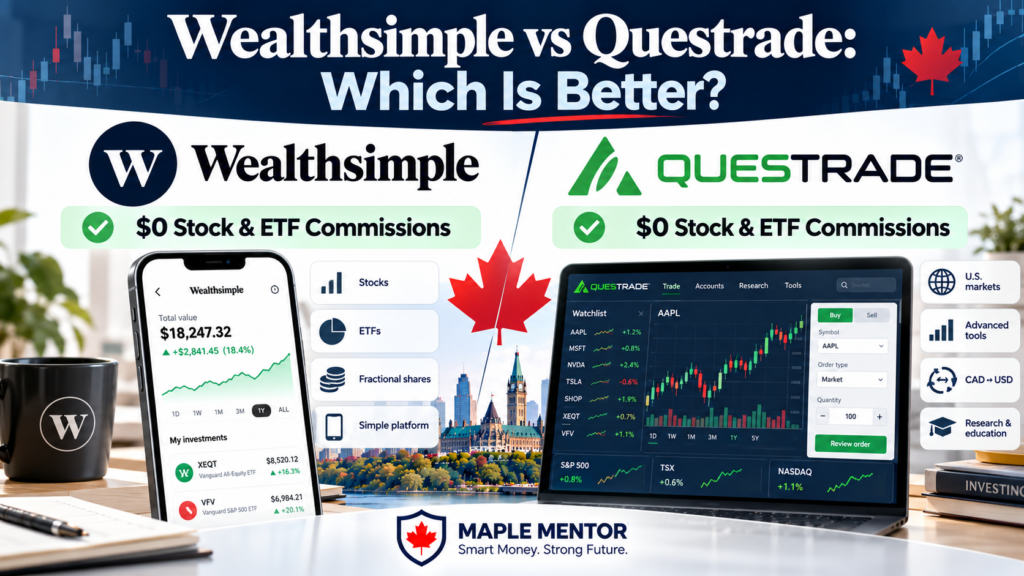
Wealthsimple vs Questrade is a much closer comparison in 2026 than it was just a few years ago. Both Canadian online brokerages now offer $0 commissions on eligible online stock and ETF trades, making them attractive options for beginners, long-term investors, and Canadians managing their own portfolios.
For years, the comparison was relatively straightforward. Wealthsimple appealed to investors looking for commission-free trading, while Questrade attracted those who wanted more traditional brokerage features and flexibility.
That distinction has changed.
Questrade now offers commission-free online stock and ETF purchases and sales. Wealthsimple has also expanded its services, introducing more advanced trading features, additional account types, and improved USD investing options.
Today, choosing between these platforms involves much more than comparing stock-trading commissions.
The most important differences include:
- Currency conversion: How much does each brokerage charge when investing in U.S. securities?
- USD accounts: Can you hold U.S. dollars without repeatedly converting currencies?
- Automation: Which platform makes recurring investments easier?
- Account types: Which registered and non-registered accounts are available?
- Trading tools: Which brokerage offers greater control for experienced investors?
- User experience: Which platform makes managing investments simpler?
In this guide, we’ll compare Wealthsimple vs Questrade across these categories, explain where each brokerage stands out, and help you determine which one makes the most sense for your investing strategy.
Quick Answer: Wealthsimple vs Questrade
Wealthsimple is generally the better fit for investors who prioritize simplicity, automated investing, and an integrated financial platform.
Its intuitive interface, recurring investment features, fractional shares, and commission-free trading make it particularly attractive for Canadians building long-term portfolios.
Questrade is a strong alternative for investors who want more traditional brokerage functionality, convenient CAD and USD holdings, and greater control over their investments.
Both brokerages now offer $0 commissions on eligible online stock and ETF trades.
That means there’s no longer a clear winner based on standard stock and ETF commissions alone.
For someone investing $200 every payday into a Canadian-listed ETF, either platform could work well.
For someone regularly purchasing U.S. stocks, using margin, or managing a more complex portfolio, differences in account features and trading tools become more important.
The bottom line: Wealthsimple has an advantage in simplicity and automation, while Questrade appeals to investors seeking a more traditional, flexible brokerage experience.
Wealthsimple vs Questrade at a Glance
| Feature | Wealthsimple | Questrade |
|---|---|---|
| Canadian stock commissions | $0 | $0 |
| Canadian ETF commissions | $0 | $0 |
| U.S. stock commissions | $0 | $0 |
| U.S. ETF commissions | $0 | $0 |
| CAD/USD conversion | Tiered pricing depending on account and transaction | Generally 1.5% |
| Hold USD | Yes, through USD account functionality | Yes |
| TFSA | Yes | Yes |
| RRSP | Yes | Yes |
| FHSA | Yes | Yes |
| RESP | Yes | Yes |
| LIRA/LIF | Yes | Yes |
| Fractional shares | Available for eligible securities | Available for eligible securities |
| Recurring investments | Extensive automation | Available for eligible securities |
| Options trading | Yes | Yes |
| Margin accounts | Yes | Yes |
| Advanced trading platforms | Growing selection | More traditional brokerage tools |
| Beginner experience | Very straightforward | Beginner-accessible, with more controls |
| Best suited for | Simple and automated investing | Flexible self-directed investing |
The comparison covers standard self-directed investing. Eligibility restrictions, foreign-exchange fees, market-data charges, and other transaction fees may apply.
For a broader comparison that also includes Interactive Brokers, see our Questrade vs Wealthsimple vs Interactive Brokers guide.
Wealthsimple vs Questrade Trading Fees
Trading commissions used to be one of the biggest differences between these two Canadian brokerages.
That is no longer the case.
Both now advertise commission-free online trading for eligible Canadian and U.S. stocks and ETFs.
However, commission-free trading doesn’t mean every investment transaction is completely free.
Currency conversion, options-related charges, certain account services, and other fees can still affect your total investing costs.
Wealthsimple Trading Fees
Wealthsimple offers $0 commissions on eligible Canadian- and U.S.-listed stocks and ETFs.
For example, you can generally buy or sell supported securities without paying a standard stock-trading commission.
| Transaction | Wealthsimple Commission |
|---|---|
| Buy Canadian stock | $0 |
| Sell Canadian stock | $0 |
| Buy Canadian ETF | $0 |
| Sell Canadian ETF | $0 |
| Buy U.S. stock | $0 |
| Sell U.S. stock | $0 |
| Buy U.S. ETF | $0 |
| Sell U.S. ETF | $0 |
Wealthsimple also generally has no minimum deposit requirement for standard self-directed trading accounts and doesn’t charge a standard inactivity fee.
However, additional fees may apply to currency conversions, certain options transactions, and specific account services.
You can review the current details through Wealthsimple’s official trading fee schedule.
Questrade Trading Fees
One of the most important developments in this comparison is Questrade’s updated commission structure.
Older articles frequently state that Questrade offers free ETF purchases but charges commissions when selling ETFs or trading stocks.
That information is outdated under its newer online pricing schedule.
Questrade now lists $0 commissions for eligible online stock and ETF purchases and sales.
| Transaction | Questrade Commission |
|---|---|
| Buy Canadian stock | $0 |
| Sell Canadian stock | $0 |
| Buy Canadian ETF | $0 |
| Sell Canadian ETF | $0 |
| Buy U.S. stock | $0 |
| Sell U.S. stock | $0 |
| Buy U.S. ETF | $0 |
| Sell U.S. ETF | $0 |
Other charges may still apply, including foreign-exchange fees, certain options-related charges, and applicable third-party fees.
Questrade’s current schedule is available through its official self-directed trading pricing page.
Example: Investing $500 Every Month
Suppose you invest $500 into a Canadian-listed ETF every month.
Over one year, you contribute:
$500 × 12 = $6,000
With Wealthsimple, your standard trading commissions would generally be $0.
With Questrade, your standard online trading commissions would also generally be $0.
That means both platforms allow you to invest the full $6,000 without deducting standard stock or ETF trading commissions.
The ETF’s management expense ratio still applies regardless of which brokerage you choose.
Which Brokerage Wins on Trading Fees?
It’s effectively a tie for eligible online stock and ETF commissions.
Wealthsimple and Questrade both provide commission-free trading for the securities most Canadian beginners and passive investors purchase.
Consequently, the more meaningful differences involve currency conversion, USD account functionality, automation, and trading tools.
Wealthsimple vs Questrade for U.S. Stocks and USD Accounts
For Canadians investing in American companies, USD account functionality can be more important than stock-trading commissions.
Both platforms offer access to eligible U.S.-listed stocks and ETFs.
However, their approaches to holding and converting currencies differ.
Wealthsimple USD Accounts
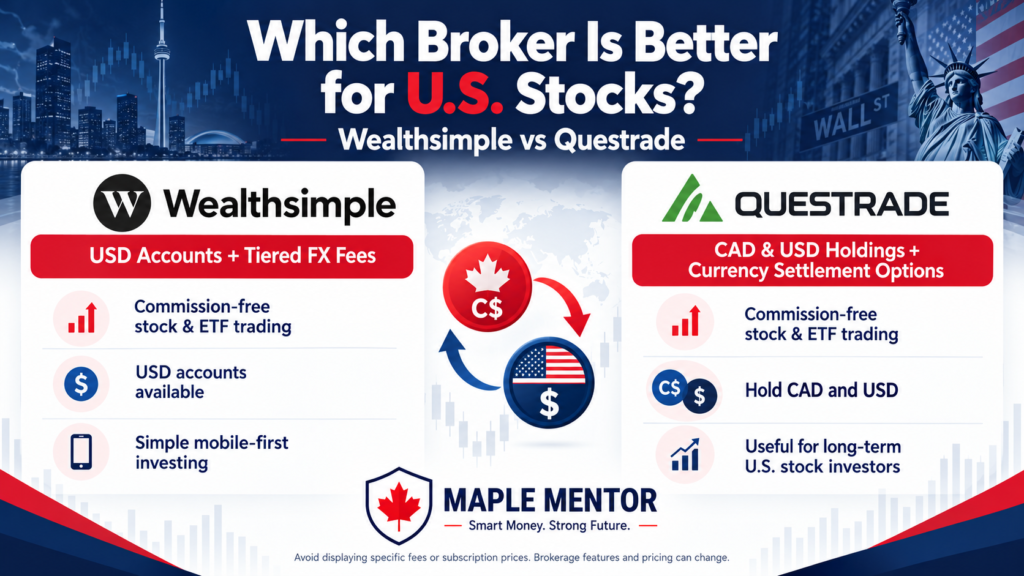
Wealthsimple offers USD account functionality that allows eligible investors to hold U.S. dollars.
This is important because repeatedly converting between Canadian and U.S. dollars can become expensive.
For Core clients, USD account functionality has been offered through a subscription costing approximately $10 CAD per month.
Premium and Generation clients can receive USD account access without that additional subscription fee.
Client-tier eligibility and subscription terms should be confirmed before opening an account.
Once USD is held in an eligible USD account, investors can generally purchase and sell U.S.-listed securities without triggering a new CAD/USD conversion on every transaction.
However, converting Canadian dollars into U.S. dollars can still generate fees.
Wealthsimple’s published conversion structure includes different rates depending on the transaction size and account arrangement.
| Eligible Conversion Amount | Published Conversion Rate |
|---|---|
| Under $10,000 | 1.5% |
| $10,000–$24,999.99 | 1.0% |
| $25,000–$99,999.99 | 0.5% |
| $100,000 or more | 0% |
These tiers apply to eligible conversions through the relevant USD-account structure. Transactions in CAD accounts may follow different pricing rules.
For example, converting $5,000 CAD at 1.5% would cost approximately $75 CAD.
That can be considerably more expensive than a standard stock-trading commission.
Questrade USD Accounts
Questrade allows investors to hold Canadian and U.S. dollars in supported accounts, including registered accounts such as TFSAs and RRSPs.
This provides flexibility when investing in American securities.
For example, suppose you already have $5,000 USD in your Questrade TFSA.
You could use those funds to purchase eligible U.S.-listed stocks without converting Canadian dollars first.
If you later sell those investments and settle the proceeds in USD, you can generally maintain the U.S. dollar balance for future investments.
Questrade also offers currency-settlement settings that affect how transactions are handled in registered accounts.
However, Questrade’s standard CAD/USD conversion fee is generally 1.5%.
You can review its official currency conversion and settlement guidance.
Example: Converting $10,000 CAD Into USD
Suppose you want to purchase $10,000 worth of U.S.-listed securities and need to convert Canadian dollars first.
Under Questrade’s standard 1.5% conversion fee:
$10,000 × 1.5% = $150 CAD
Under Wealthsimple’s eligible 1.0% USD-account conversion tier:
$10,000 × 1.0% = $100 CAD
In this example, Wealthsimple would have a $50 advantage on the conversion itself.
However, if Wealthsimple’s standard 1.5% CAD-account conversion fee applies, the costs would be similar.
The account setup and conversion method matter.
What About Norbert’s Gambit?
Some Canadian investors use a strategy called Norbert’s Gambit to reduce currency-conversion costs.
The strategy generally involves purchasing a security in one currency, transferring or journaling it to its corresponding listing in another currency, and selling it.
Questrade has traditionally been popular among investors using this approach because of its support for dual-currency holdings and security journaling.
However, the strategy involves additional steps, potential market-price movements, settlement considerations, and possible fees.
It also isn’t automatically worthwhile for small conversions.
Investors should confirm current journaling procedures and security eligibility before relying on this strategy.
Which Is Better for U.S. Investing?
For occasional U.S. stock purchases, either brokerage can be suitable.
For investors who want straightforward USD holdings without paying an additional account subscription, Questrade may be attractive.
Eligible Wealthsimple clients who already receive USD account functionality, Wealthsimple becomes more competitive.
For frequent large currency conversions, it may also be worth comparing both platforms against Interactive Brokers.
Our Questrade vs Interactive Brokers Canada comparison examines how IBKR’s foreign-exchange pricing differs from Questrade’s.
Wealthsimple vs Questrade Account Types
Both brokerages support a wide range of Canadian investment accounts.
For most Canadians opening a TFSA, RRSP, or FHSA, account availability is unlikely to be the deciding factor.
Wealthsimple Account Types
Wealthsimple offers self-directed trading accounts including:
- Tax-Free Savings Account (TFSA)
- Registered Retirement Savings Plan (RRSP)
- Spousal RRSP
- First Home Savings Account (FHSA)
- Registered Education Savings Plan (RESP)
- Locked-In Retirement Account (LIRA)
- Life Income Fund (LIF)
- Registered Retirement Income Fund (RRIF)
- Non-registered accounts
- Business accounts
This broad selection allows Canadians to manage different financial goals through one platform.
For example, an investor might use a TFSA for long-term investing, an RRSP for retirement savings, and an FHSA for a future home purchase.
Wealthsimple also integrates investing with other financial products, which can make managing money more convenient.
Its supported account types are outlined in the Wealthsimple Help Centre.
Questrade Account Types
Questrade offers a similarly broad selection of accounts.
These include:
- TFSA
- RRSP
- Spousal RRSP
- FHSA
- RESP and Family RESP
- LIRA
- LIF
- RRIF
- Cash accounts
- Margin accounts
- Corporate accounts
- Other specialized account structures
Questrade’s account selection has traditionally been one of its strengths.
It supports a variety of registered, non-registered, and specialized investment structures.
You can review its available options through Questrade’s official account types page.
Which Brokerage Has Better Account Options?
For the average Canadian investor, this category is effectively a tie.
Both platforms offer the most common registered accounts.
Questrade may appeal to investors looking for certain specialized account structures or traditional brokerage arrangements.
Wealthsimple may appeal to investors who want their investments integrated with other everyday financial products.
The better choice depends on the specific account you need and the investments you intend to hold.
Wealthsimple vs Questrade for Beginners
For someone opening their first investment account, Wealthsimple generally offers the simpler experience.
Its interface is designed to make investing approachable without requiring extensive knowledge of brokerage platforms.
Why Wealthsimple Appeals to Beginners
Wealthsimple combines several beginner-friendly features.
These include:
- A straightforward mobile and web interface.
- Commission-free stock and ETF trading.
- Recurring investment functionality.
- Fractional shares for eligible securities.
- Easy access to popular registered accounts.
- Integration with other Wealthsimple financial services.
For example, someone could open a TFSA, deposit $100, and purchase a diversified ETF.
They could then schedule recurring contributions rather than manually placing every order.
This helps make investing a consistent habit.
Wealthsimple also provides a relatively simple pricing structure for basic Canadian stock and ETF investing.
Is Questrade Beginner-Friendly?
Yes.
Questrade is accessible to beginners, particularly those who want to learn more about self-directed investing.
Its platform offers access to standard investment accounts, commission-free stock and ETF trading, and a range of research and order-entry tools.
However, its more traditional brokerage structure can involve additional settings and decisions.
For example, investors may encounter different trading interfaces, order types, and currency-settlement options.
These features can be valuable, but they may also feel unnecessary to someone simply purchasing their first ETF.
Which Is Better for First-Time Investors?
I’d generally give Wealthsimple the advantage for complete beginners.
However, Questrade is still a reasonable choice for someone who wants to become comfortable with a more traditional brokerage platform.
For readers comparing additional Canadian options, our Best Online Brokers in Canada guide explores other platforms worth considering.

Wealthsimple vs Questrade for Recurring Investing
Automating investments can make it easier to maintain a consistent long-term strategy.
Rather than trying to predict the best time to buy, investors can schedule purchases at regular intervals.
Both Wealthsimple and Questrade now offer recurring investment functionality.
However, their supported securities and automation features differ.
Wealthsimple Recurring Investments
Wealthsimple allows investors to schedule recurring purchases of eligible stocks and ETFs.
Available frequencies include daily, weekly, biweekly, and monthly purchases.
For example, someone paid every Friday could schedule a $100 ETF purchase each payday.
This can help reduce the temptation to delay investing while waiting for a better market price.
Wealthsimple also supports fractional investing in eligible securities, allowing investors to purchase a dollar amount rather than a whole number of shares.
Its recurring investment guide explains how the feature works.
Questrade Recurring Investments
Questrade has also introduced recurring investments for eligible securities.
Its published recurring investment disclosures describe scheduled purchases of eligible fractional U.S.-listed stocks and ETFs.
Supported frequencies include daily, weekly, biweekly, and monthly purchases.
This is a meaningful improvement for investors who prefer Questrade but want some automation.
However, recurring purchase eligibility isn’t necessarily identical across Canadian-listed ETFs, U.S.-listed securities, and different account types.
Investors should confirm whether their preferred investment is supported before choosing Questrade specifically for automated purchases.
Which Brokerage Wins for Automation?
Wealthsimple generally has the advantage for investors who want a simple, recurring investment experience.
Its recurring investment functionality is a central part of the platform.
Questrade has become more competitive, but the availability of automated purchases for specific securities remains an important consideration.
For investors planning to purchase the same ETF every payday, checking recurring investment eligibility is more useful than comparing commissions alone.
Wealthsimple vs Questrade for ETF Investors
ETFs are among the most popular investment products for Canadians building diversified portfolios.
They allow investors to hold baskets of securities without purchasing every underlying stock individually.
Both Wealthsimple and Questrade now offer commission-free online trading for eligible ETFs.
That makes the comparison particularly close for passive investors.
Investing in XEQT, VEQT, VFV, or XGRO
Consider four popular Canadian-listed ETFs:
| ETF | General Investment Exposure |
|---|---|
| XEQT | Globally diversified all-equity portfolio |
| VEQT | Globally diversified all-equity portfolio |
| VFV | S&P 500 exposure |
| XGRO | Diversified portfolio with approximately 80% equities and 20% fixed income |
An investor purchasing any of these ETFs through an eligible online trade would generally pay $0 in standard trading commissions at either brokerage.
That means the choice increasingly depends on convenience and account features.
For example, someone investing $150 every week might prioritize fractional shares and recurring purchases.
Someone making larger purchases manually might prioritize research tools and order functionality.
Wealthsimple for Passive ETF Investing
Wealthsimple is particularly attractive for investors who want to automate a simple portfolio.
Its recurring investment features can make it easy to purchase eligible ETFs consistently.
For example, an investor might automatically contribute to XEQT every two weeks.
Alternatively, someone who prefers Vanguard’s asset allocation approach might choose VEQT.
Our XEQT vs VEQT comparison explains how these two all-equity ETFs differ.
Questrade for Passive ETF Investing
Questrade also provides commission-free online ETF purchases and sales.
This makes it competitive for investors who prefer placing their own orders.
Its additional trading tools may appeal to investors who want more control over their transactions.
However, someone who wants fully automated purchases of a particular Canadian-listed ETF should confirm whether that security is supported by Questrade’s recurring investment functionality.
What About Investment Fees?
Even when trading commissions are $0, ETFs still have ongoing management expenses.
These expenses are generally reflected in the fund’s performance rather than charged as a separate brokerage trading commission.
For example, two investors holding the same ETF through Wealthsimple and Questrade generally face the same ETF management expense ratio.
The brokerage doesn’t change the ETF’s underlying management cost.
Which Brokerage Is Better for ETFs?
For simple long-term ETF investing, both are strong choices.
Wealthsimple may be more convenient for investors who prioritize automation and fractional investing.
Questrade may be more attractive for investors who want a traditional brokerage interface and additional order controls.
Investors comparing Canadian and U.S. market exposure can also read our VFV vs XEQT guide.
Wealthsimple vs Questrade for Options Trading
Both brokerages offer options trading, but their pricing structures and available tools differ.
Options are more complex than ordinary stock and ETF investing.
They can involve leverage, time decay, and potentially substantial losses.
Investors should understand these risks before trading them.
Wealthsimple Options Trading
Wealthsimple has expanded its options offering considerably.
Its current fee schedule lists $0 commissions and contract fees for eligible equity and ETF options.
However, other charges can apply depending on the contract and transaction.
Certain index options, exercise events, and other activities may have separate fees.
Wealthsimple also offers additional options strategies for eligible clients, although availability depends on trading permissions and account requirements.
Its official trading fee schedule provides current pricing details.
Questrade Options Trading
Questrade also offers options trading through its self-directed platform.
Its published pricing includes different schedules depending on the option type.
| Options Transaction | Published Questrade Pricing |
|---|---|
| Eligible U.S. equity options | $0 base/contract charge under current schedule |
| Canadian options | $0 base + CAD $0.99/contract |
| U.S. index options | $0 base + USD $0.99/contract |
Other fees and conditions may apply.
Questrade also provides a more traditional brokerage environment with order controls and options-related tools.
Which Is Better for Options?
Wealthsimple may appeal to investors who prioritize low contract fees for eligible equity and ETF options.
Questrade may appeal to investors who want a traditional brokerage trading environment and additional order functionality.
However, the better choice depends on more than commissions.
Consider supported strategies, account permissions, execution features, and potential exercise or assignment charges.
Neither platform should be selected for options trading based on headline fees alone.
Wealthsimple vs Questrade for Active Investors
For active investors, trading tools and execution features can matter as much as commissions.
Someone purchasing one ETF every month doesn’t need the same capabilities as someone actively trading multiple securities.
Questrade’s Trading Tools
Questrade offers a more traditional self-directed brokerage experience.
Its platforms provide access to market data, research tools, order functionality, and additional trading controls.
Depending on the platform and account, investors may have access to advanced order types, options trading, and margin functionality.
These capabilities can be useful for investors who want greater control over their trades.
For example, someone placing limit orders or monitoring multiple securities may prefer a more traditional brokerage interface.
Wealthsimple’s Expanding Trading Features
Wealthsimple has expanded beyond its original beginner-focused stock-trading experience.
It now offers additional features such as options, margin, and more advanced trading functionality for eligible investors.
That makes it more competitive with traditional brokerages than it was several years ago.
However, its main appeal remains simplicity and integration with its broader financial platform.
Which Brokerage Is Better for Active Trading?
Questrade may be more appealing to investors who prefer traditional brokerage tools and order controls.
Wealthsimple may be sufficient for investors trading eligible Canadian and U.S. securities who value its simpler interface.
For highly sophisticated strategies, it’s also worth comparing other brokerages.
Our Interactive Brokers vs Wealthsimple Canada article examines how Wealthsimple compares with a platform known for professional-grade trading tools.
Wealthsimple vs Questrade for Passive Investors
Passive investors generally follow a different strategy from active traders.
Instead of frequently buying and selling securities, they typically invest regularly and hold diversified investments for the long term.
For example, a passive investor might contribute $250 every two weeks to a TFSA and purchase a globally diversified ETF.
Both Wealthsimple and Questrade can support this approach.
Why Passive Investors May Prefer Wealthsimple
Wealthsimple’s biggest advantages are convenience and automation.
Its recurring investment functionality allows investors to establish a consistent contribution schedule.
Fractional investing can also make it easier to invest a fixed dollar amount without leaving as much cash uninvested.
For someone who wants to spend minimal time managing investments, these features can be valuable.
Why Passive Investors May Prefer Questrade
Questrade may appeal to investors who want a more traditional brokerage platform.
Its support for CAD and USD holdings can also be useful for investors who occasionally purchase U.S.-listed ETFs.
Additionally, investors who expect to explore more advanced strategies later may appreciate having access to additional trading tools.
Does the Brokerage Really Matter for Long-Term Returns?
If two investors purchase the same ETF at the same price and hold it for the same period, their underlying investment returns should be essentially identical before brokerage-specific costs.
The brokerage doesn’t change the securities held inside the ETF.
What can differ are transaction costs, currency-conversion charges, execution prices, and the ease of maintaining a consistent investment strategy.
For long-term investors, choosing a platform that encourages regular investing may be more important than having access to advanced features they never use.
Wealthsimple vs Questrade: Which Should You Choose?
The best brokerage depends on your investing habits and the features you value most.
| Investor Type | Platform to Consider | Main Reason |
|---|---|---|
| Complete beginner | Wealthsimple | Simpler interface |
| Wants automated ETF investing | Wealthsimple | Strong recurring investment functionality |
| Passive Canadian ETF investor | Either | Both offer $0 eligible online ETF trades |
| Wants fractional shares | Either | Both support eligible fractional securities |
| Frequent U.S. stock investor | Compare both | USD setup and FX costs matter |
| Wants traditional brokerage tools | Questrade | More established brokerage functionality |
| Wants advanced order controls | Questrade | Traditional trading platform features |
| Wants TFSA, RRSP, or FHSA | Either | Both support these accounts |
| Wants RESP or locked-in accounts | Either | Both offer relevant Canadian account types |
| Wants an integrated financial app | Wealthsimple | Investing alongside other financial services |
These recommendations aren’t absolute.
For example, a beginner interested in U.S. stocks might prefer Questrade’s USD account arrangement.
An experienced investor who only purchases Canadian-listed ETFs may find Wealthsimple perfectly adequate.
Can You Use Both Wealthsimple and Questrade?
Yes.
Some Canadians maintain accounts with more than one brokerage.
For example, someone might use Wealthsimple for recurring Canadian ETF investments and Questrade for a separate portfolio involving U.S. securities.
However, maintaining multiple platforms creates additional administration.
You’ll need to track investments, transfers, and registered-account contributions across institutions.
For TFSAs and FHSAs, contribution limits apply across eligible accounts rather than separately at each brokerage.
For taxable accounts, tracking adjusted cost bases across institutions can also become more complicated.
Using two brokerages makes sense when each provides a distinct advantage.
Otherwise, keeping investments in one place may be simpler.
Final Verdict: Wealthsimple vs Questrade Canada
The Wealthsimple vs Questrade comparison has changed significantly.
Both platforms now offer commission-free online stock and ETF trading, eliminating one of the biggest historical differences between them.
For many Canadians, the decision increasingly comes down to automation, USD account functionality, trading tools, and overall user experience.
Wealthsimple is my preferred option for investors who want simple, automated, long-term investing.
Its recurring investment functionality, fractional shares, and integrated financial services make it particularly convenient for Canadians building portfolios over time.
Questrade remains a strong option for investors who prefer traditional brokerage features and greater control over their investments.
Its commission-free online stock and ETF trading, support for CAD and USD holdings, and broader trading functionality make it competitive.
For someone purchasing a Canadian-listed ETF every payday, either brokerage can be an excellent choice.
For someone frequently investing in U.S. securities, I’d pay closer attention to currency conversion and USD account arrangements before deciding.
Ultimately, Wealthsimple vs Questrade isn’t about finding a universally better brokerage.
It’s about choosing the platform that makes your particular investing strategy easier and more cost-effective.

Frequently Asked Questions
Is Wealthsimple better than Questrade?
Wealthsimple is generally more convenient for investors who prioritize simplicity, recurring investments, and an integrated financial platform.
Questrade may be more attractive to investors who prefer traditional brokerage tools, additional trading controls, and flexible CAD and USD holdings.
Neither is universally better.
Is Questrade still free for ETF purchases only?
No.
Under its current online pricing structure, Questrade lists $0 commissions for eligible stock and ETF purchases and sales.
Older comparisons claiming Questrade only offers free ETF purchases may be outdated.
Other fees can still apply.
Does Wealthsimple charge trading commissions?
Wealthsimple generally charges $0 standard commissions for eligible Canadian- and U.S.-listed stock and ETF trades.
However, currency-conversion charges and other transaction-related fees may still apply.
Which Is Better for a TFSA: Wealthsimple or Questrade?
Both brokerages offer self-directed TFSAs and commission-free eligible online stock and ETF trading.
Wealthsimple may be more convenient for automated Canadian ETF investing.
Questrade may appeal to investors who prioritize USD holdings and traditional brokerage functionality.
Can You Hold U.S. Dollars With Wealthsimple?
Yes.
Wealthsimple offers USD account functionality.
Core clients may need to pay a monthly subscription, while eligible Premium and Generation clients can receive USD account access without the additional subscription fee.
Check the current terms before opening an account.
Can Questrade Hold USD in a TFSA or RRSP?
Yes.
Questrade supports CAD and USD holdings in eligible registered accounts, including TFSAs and RRSPs.
This allows investors to maintain U.S. dollar balances rather than automatically converting every transaction back into Canadian dollars.
Which Is Better for ETF Investing: Wealthsimple or Questrade?
Both are competitive because they offer commission-free online ETF purchases and sales.
Wealthsimple generally has the advantage for simple recurring investments.
Questrade may be preferable for investors who want more traditional brokerage tools and order controls.
The better choice depends on your preferred ETFs, automation requirements, and investing habits.