
Interactive Brokers vs Wealthsimple is one of the most important brokerage comparisons for Canadians choosing between commission-free investing and advanced trading capabilities. Both platforms offer competitive ways to invest in stocks, ETFs, and registered accounts, but their pricing structures, currency-conversion costs, and trading tools differ significantly.
Wealthsimple has become a popular choice among Canadian investors because of its simple interface, $0 stock and ETF trading commissions, recurring investments, and broad selection of Canadian account types.
Interactive Brokers Canada (IBKR), meanwhile, is known for its low foreign-exchange costs, extensive international market access, and sophisticated trading tools.
For someone buying XEQT every month in a TFSA, Wealthsimple may be the more convenient option.
For someone regularly converting Canadian dollars into U.S. dollars, trading options, or purchasing securities on international exchanges, Interactive Brokers could offer significantly more value.
In this guide, we’ll compare Interactive Brokers vs Wealthsimple across trading fees, currency conversion, Canadian and U.S. stocks, ETFs, account types, options, and platform usability to help you determine which brokerage fits your investing strategy.
Disclosure: This article may contain affiliate links. The Maple Mentor may earn a commission if you open an account through one of our links, at no additional cost to you.
Quick Answer: Interactive Brokers vs Wealthsimple
Wealthsimple is likely the better fit for many beginner and long-term Canadian investors.
Its combination of commission-free stock and ETF trading, recurring investments, fractional shares, and Canadian registered accounts makes it particularly attractive for investors building simple portfolios.
Interactive Brokers is generally better suited to investors who prioritize low currency-conversion costs, global market access, and advanced trading tools.
Its platform is more complex, but that complexity comes with capabilities that experienced investors may value.
The main distinction is straightforward:
- Choose Wealthsimple if you want a simple investing experience, $0 commissions on eligible Canadian and U.S. stocks and ETFs, and convenient long-term portfolio management.
- Choose Interactive Brokers if you frequently convert currencies, trade internationally, use sophisticated trading strategies, or need professional-grade tools.
Neither brokerage is automatically cheaper for every investor.
Someone purchasing a Canadian-listed ETF every payday may spend less on trading commissions with Wealthsimple.
Someone converting $20,000 from CAD to USD could potentially save hundreds of dollars with Interactive Brokers compared with Wealthsimple’s standard conversion rate.
The right choice depends on how you actually invest.
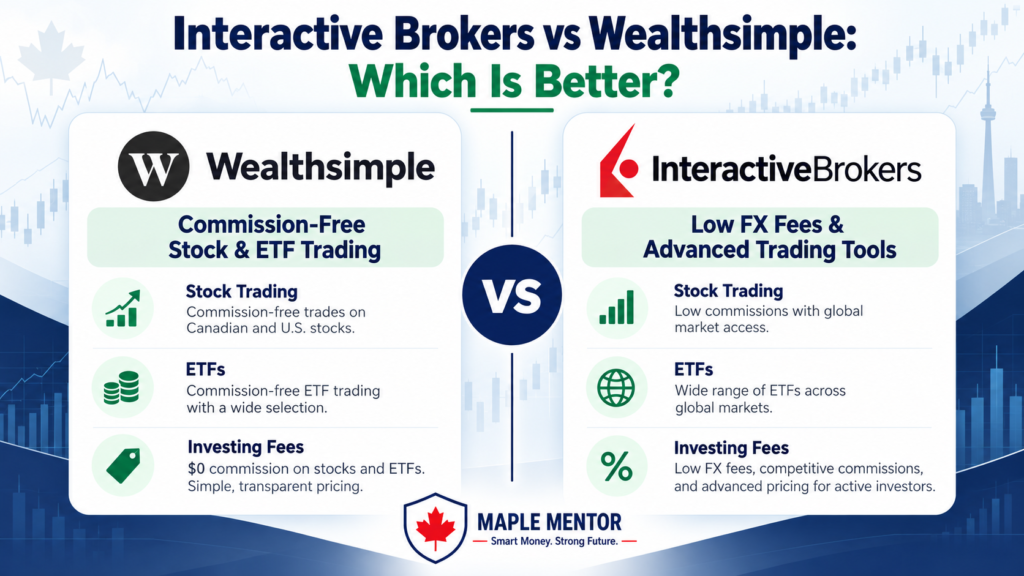
Interactive Brokers vs Wealthsimple at a Glance
| Feature | Wealthsimple | Interactive Brokers Canada |
|---|---|---|
| Canadian stock commissions | $0 | Per-share commissions |
| Canadian ETF commissions | $0 | Per-share commissions |
| U.S. stock commissions | $0 | Low per-share commissions |
| U.S. ETF commissions | $0 | Low per-share commissions |
| CAD/USD conversion | Tiered rates, generally 0%–1.5% depending on conversion amount and account setup | Low-cost spot FX |
| TFSA | Yes | Yes |
| RRSP | Yes | Yes |
| FHSA | Yes | Yes |
| RESP | Yes | Not listed among standard Canadian registered accounts |
| LIRA/LIF | Yes | Not listed among standard Canadian registered accounts |
| Fractional shares | Yes, eligible securities | Available for eligible securities |
| Recurring investments | Yes | Features vary by security and account |
| International markets | Primarily Canada and U.S. | Extensive global access |
| Options | Yes | Yes |
| Futures | Available to eligible clients | Extensive access |
| Advanced trading tools | Growing selection | Extensive |
| Account minimum | Generally $0 for standard self-directed accounts | Generally $0 for standard individual accounts |
| Beginner friendliness | Easier | More complex |
| Best suited for | Beginner and long-term investors | Active and international investors |
Fees, account eligibility, and trading features can change. Additional exchange, regulatory, market-data, or transaction-related fees may apply.
For investors considering a third brokerage, our Questrade vs Wealthsimple vs Interactive Brokers comparison explores how these platforms stack up against one another.
Interactive Brokers vs Wealthsimple Trading Fees
Trading fees are often the first thing investors compare when choosing a brokerage.
However, focusing exclusively on commissions can be misleading.
Wealthsimple offers commission-free trading on eligible Canadian and U.S. stocks and ETFs.
Interactive Brokers charges low commissions but offers other cost advantages, particularly for currency conversion and international investing.
Wealthsimple Trading Fees
Wealthsimple currently advertises $0 commissions on eligible Canadian- and U.S.-listed stocks and ETFs.
That means you can generally purchase or sell supported securities without paying a standard trading commission.
For example:
| Investment | Wealthsimple Commission |
|---|---|
| Canadian stocks | $0 |
| Canadian ETFs | $0 |
| U.S. stocks | $0 |
| U.S. ETFs | $0 |
| Eligible fractional shares | $0 |
| Standard self-directed account minimum | $0 |
Wealthsimple also doesn’t charge a standard inactivity fee for its regular self-directed trading accounts.
However, commission-free investing doesn’t mean every service is free.
Other costs can include currency-conversion fees, certain options-related charges, account-service fees, and applicable regulatory charges.
You can review the latest details on Wealthsimple’s official trading fee schedule.
Interactive Brokers Canada Trading Fees
Interactive Brokers uses a more traditional commission structure.
Its stock-trading fees generally depend on the market, trading volume, and whether you choose fixed or tiered pricing.
Under its published schedules, U.S. stock commissions can be as low as USD $0.0005–$0.0035 per share with tiered pricing.
Fixed U.S. stock pricing is generally USD $0.005 per share, subject to minimum commissions.
For Canadian stocks, tiered commissions can start around CAD $0.008 per share at the first volume tier, with a CAD $1 minimum.
| Investment | IBKR Commission Structure |
|---|---|
| Canadian stocks/ETFs | Per-share pricing, with applicable minimums |
| U.S. stocks/ETFs | Tiered pricing around USD $0.0005–$0.0035/share |
| U.S. fixed stock pricing | USD $0.005/share |
| U.S. options | Tiered commissions, generally USD $0.15–$0.65/contract |
| Standard inactivity fee | None |
| Standard individual account minimum | Generally none |
Interactive Brokers’ pricing is more complicated because tiered commissions can include separate exchange, clearing, or other third-party charges.
You can review the applicable schedules through Interactive Brokers Canada’s official pricing page.
Example: Investing $500 Every Month
Suppose you invest $500 into a Canadian-listed ETF every month.
At Wealthsimple, eligible purchases have $0 commissions.
At Interactive Brokers, those purchases generally incur commissions under the applicable pricing schedule.
If a CAD $1 minimum commission applies to each monthly purchase, the annual trading commissions would be approximately:
$12 per year.
That’s not an enormous expense, but it is an unnecessary cost if another brokerage provides the same investment at $0 commission.
For investors making small, regular contributions, Wealthsimple has a straightforward advantage.
What About Larger Trades?
Suppose you invest $20,000 into U.S.-listed stocks.
Wealthsimple’s standard stock-trading commission remains $0.
Interactive Brokers charges a commission.
However, if you need to convert CAD into USD first, IBKR’s currency-conversion pricing could more than offset that commission.
That’s why the next section is particularly important.
Interactive Brokers vs Wealthsimple Currency Conversion Fees
For Canadians purchasing U.S.-listed investments, foreign-exchange fees can be significantly more expensive than trading commissions.
This is one of the biggest differences in the Interactive Brokers vs Wealthsimple comparison.
Wealthsimple Currency Conversion Fees
Wealthsimple’s currency-conversion pricing depends on the transaction amount and account arrangement.
For eligible conversions within its USD-account structure, Wealthsimple’s published fee tiers include:
| Conversion Amount | Currency Conversion Fee |
|---|---|
| Under $10,000 | 1.5% |
| $10,000–$24,999.99 | 1.0% |
| $25,000–$99,999.99 | 0.5% |
| $100,000 or more | 0% |
These tiers apply to the relevant USD-account conversion arrangements. Other conversion methods, including transactions in CAD accounts, can follow different rules.
For a standard CAD account, Wealthsimple has generally charged 1.5% when converting between Canadian and U.S. dollars for U.S.-listed securities.
This matters because buying and later selling a U.S. stock can trigger currency conversion in both directions if the proceeds aren’t maintained in USD.
Wealthsimple USD Accounts
Wealthsimple offers USD account functionality that allows eligible investors to hold U.S. dollars rather than converting proceeds back into Canadian dollars after every trade.
Once you already have USD in the appropriate account, trading another U.S.-listed security doesn’t automatically require another CAD/USD conversion.
That’s useful for investors who frequently purchase and sell American stocks.
However, the initial conversion cost can still be meaningful.
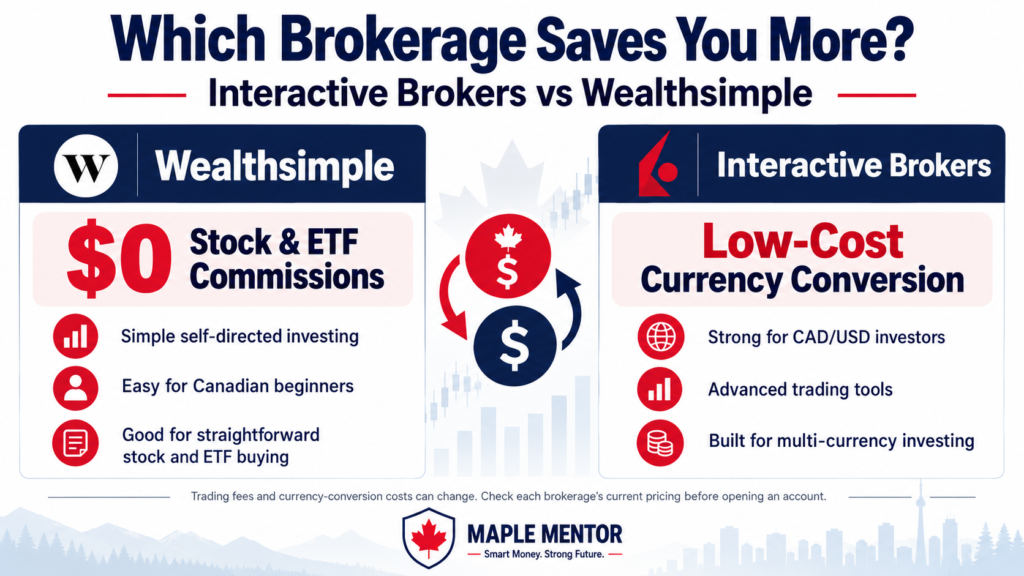
Interactive Brokers Currency Conversion Fees
Interactive Brokers offers direct foreign-exchange trading at very low published commission rates.
Its spot-currency pricing generally ranges from approximately 0.08 to 0.20 basis points of trade value, depending on trading volume.
A basis point is 0.01%.
Therefore, 0.20 basis points equals just 0.002%.
However, minimum commissions matter.
A manually executed spot-FX transaction may be subject to a minimum commission of approximately USD $2.
Automatic currency conversion can follow different pricing arrangements.
The distinction matters because IBKR’s extremely low percentage-based rate doesn’t mean every small currency conversion costs only a few cents.
Example: Converting $25,000 CAD Into USD
For an eligible $25,000 conversion under Wealthsimple’s 0.5% tier:
$25,000 × 0.005 = $125 CAD
Interactive Brokers’ manual spot-FX commission could remain near its applicable minimum, depending on the transaction.
The difference can be significant.
However, if you’re purchasing Canadian-listed ETFs using Canadian dollars, you may not need currency conversion at all.
In that case, IBKR’s FX advantage becomes largely irrelevant.
Who Benefits Most From IBKR’s FX Pricing?
Interactive Brokers becomes particularly attractive if you:
- Regularly convert thousands of dollars between CAD and USD.
- Purchase U.S.-listed stocks and ETFs.
- Invest in securities listed on foreign exchanges.
- Maintain investments in multiple currencies.
- Make larger international transactions.
For someone investing $200 occasionally into a U.S. stock, Wealthsimple’s simplicity may matter more.
For someone converting $10,000 or $20,000 several times a year, currency-conversion costs can become a major factor.
Interactive Brokers has a clear advantage for frequent currency conversion, while Wealthsimple remains attractive for commission-free investing without FX transactions.
Wealthsimple vs Interactive Brokers for Canadian Investors
For many Canadians, Wealthsimple’s biggest advantage isn’t a sophisticated trading feature.
It’s simplicity.
Wealthsimple makes it relatively easy to open an investment account, deposit money, and start purchasing stocks or ETFs.
Its platform is designed around a straightforward investing experience rather than requiring users to understand advanced trading software.
Why Wealthsimple Appeals to Canadian Investors
Wealthsimple offers several features that are particularly useful for long-term investing.
These include commission-free stock and ETF trading, recurring investments, fractional shares, and access to popular Canadian registered accounts.
For example, a Canadian investor might open a TFSA and automatically invest $100 every week into a diversified ETF.
Instead of manually placing every order, recurring investment features can help maintain a consistent contribution schedule.
Fractional shares can also make investing more accessible when a full share costs more than the amount someone wants to invest.
Wealthsimple’s Canadian-focused account selection is another advantage.
It supports accounts such as TFSAs, RRSPs, FHSAs, RESPs, and certain locked-in retirement accounts.
Where Interactive Brokers Can Still Make Sense
Interactive Brokers also offers Canadian registered accounts and access to Canadian-listed securities.
Its fractional-share capabilities and multiple trading interfaces mean it isn’t exclusively for professional traders.
However, IBKR’s main strengths become more relevant when an investor’s needs go beyond simple Canadian stock and ETF purchases.
If you frequently trade U.S. securities, convert currencies, or purchase investments listed internationally, Interactive Brokers deserves serious consideration.
For a broader look at Canadian platforms, see our Best Online Brokers in Canada guide.
Interactive Brokers vs Wealthsimple for U.S. Stocks
American companies such as Apple, Microsoft, and Nvidia are popular among Canadian investors.
Both Wealthsimple and Interactive Brokers provide access to eligible U.S.-listed stocks.
However, their total costs can differ significantly.
Wealthsimple for U.S. Stocks
Wealthsimple offers $0 commissions on eligible U.S. stock purchases and sales.
That’s attractive for investors who want to buy individual American companies without paying standard trading commissions.
However, Canadians investing with CAD must consider currency-conversion costs.
If you’re purchasing a U.S. stock through a CAD account, Wealthsimple generally applies its standard 1.5% conversion fee.
If you’re using an eligible USD account, you may benefit from its transaction-size-based conversion pricing.
Once the money is held in USD, subsequent trades using that balance don’t require another CAD/USD conversion.
Interactive Brokers for U.S. Stocks
Interactive Brokers charges commissions on U.S. stock trades.
However, its low currency-conversion costs can make it significantly more competitive for Canadians converting large amounts of money.
For example, suppose you convert CAD $15,000 into USD to purchase several American stocks.
Under Wealthsimple’s applicable 1.0% USD-account conversion tier, the conversion fee would be approximately $150 CAD.
At IBKR, a manually executed spot-FX conversion may cost approximately USD $2 in commission, subject to the applicable pricing rules.
Even after paying stock-trading commissions, Interactive Brokers could be considerably cheaper.
What If You Already Have USD?
The comparison changes if you already hold U.S. dollars.
If no conversion is required, Wealthsimple’s commission-free stock trading becomes particularly attractive.
IBKR’s foreign-exchange advantage is less relevant in that situation.
For Canadians investing in U.S. stocks, the best choice depends on how much they invest, how often they convert currencies, and whether they already maintain a USD balance.
Interactive Brokers vs Wealthsimple for Global Investing
International investing is one of Interactive Brokers’ strongest advantages.
Wealthsimple primarily supports eligible securities listed on major Canadian and U.S. exchanges.
That works well for many Canadians because Canadian-listed ETFs can provide exposure to international markets without requiring direct purchases on foreign exchanges.
However, some investors want to buy individual companies listed in Europe, Asia, or other markets.
Interactive Brokers is built for that type of investing.
Interactive Brokers Global Market Access
It provides access to a broad range of international exchanges and investment products.
Its global offering includes stocks, ETFs, bonds, options, futures, and currencies.
IBKR advertises access to approximately 175 markets worldwide, although specific products and exchanges depend on the investor’s jurisdiction and trading permissions.
For example, an investor interested in purchasing shares directly on the London Stock Exchange may find IBKR more suitable than a platform primarily focused on North American listings.
Interactive Brokers also offers multicurrency capabilities that support investing across different markets.
You can explore its global offering through Interactive Brokers Canada’s official website.
Wealthsimple Global Exposure Through ETFs
Wealthsimple investors can still build globally diversified portfolios.
For example, XEQT and VEQT are Canadian-listed ETFs that hold stocks from multiple countries.
Rather than purchasing dozens of individual international securities, investors can obtain broad market exposure through a single ETF.
XEQT vs VEQT explains the differences between these two globally diversified Canadian ETFs.
This distinction matters because international diversification doesn’t necessarily require direct international stock trading.
For someone purchasing a globally diversified ETF every month, Wealthsimple may be entirely sufficient.
For someone directly trading international stocks, Interactive Brokers has a clear advantage.
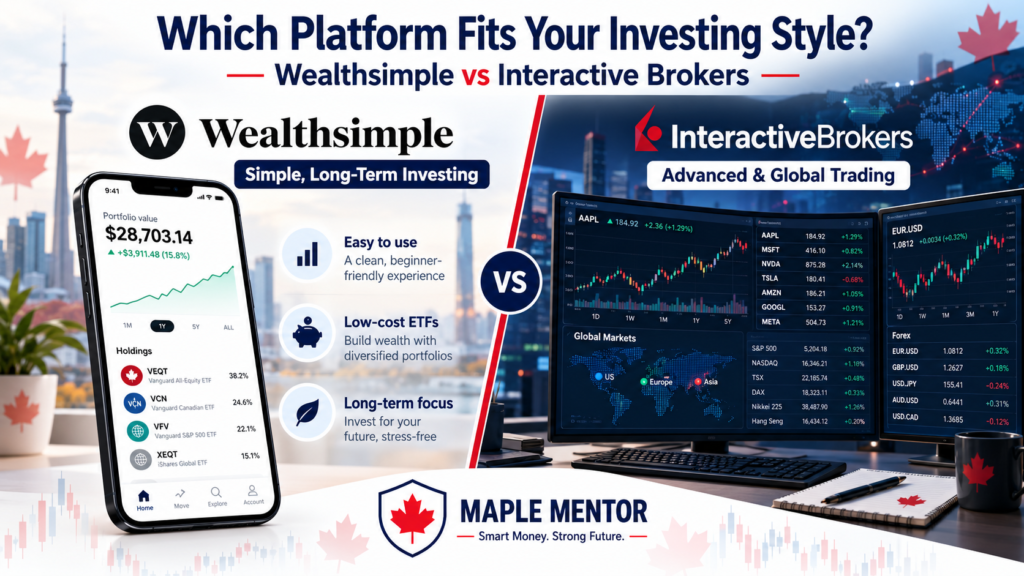
Interactive Brokers vs Wealthsimple Account Types
Account selection is an important consideration for Canadian investors.
Both platforms offer popular registered accounts, but Wealthsimple currently supports a broader range of Canadian account types for self-directed investing.
Wealthsimple Account Types
Wealthsimple supports self-directed trading accounts including:
- TFSA
- RRSP and spousal RRSP
- FHSA
- RESP
- RRIF
- LIRA
- LIF
- Non-registered accounts
- Business accounts
This is useful for Canadians managing several financial goals.
For example, someone could maintain a TFSA for long-term investing, an RRSP for retirement, an FHSA for a future home purchase, and an RESP for a child’s education.
Not every account type supports identical investments or features, so investors should review account-specific restrictions.
Wealthsimple’s official account-opening guide lists the currently supported account types.
Interactive Brokers Canada Account Types
Interactive Brokers Canada offers accounts including TFSAs, RRSPs, spousal RRSPs, FHSAs, RRIFs, and taxable individual or joint accounts.
However, its standard Canadian registered-account offering doesn’t list RESPs, LIRAs, or LIFs.
This may matter for investors who want to consolidate all their accounts at one institution.
Which Brokerage Has Better Account Options?
For a basic TFSA, RRSP, or FHSA, both platforms are worth considering.
For an RESP or locked-in retirement account, Wealthsimple has an advantage between these two brokerages.
However, investors should also compare the investments available within each account.
For example, an investor who wants to hold U.S.-listed securities inside an RRSP may prioritize currency-conversion costs.
An investor saving for a child’s education may prioritize RESP availability.
The best brokerage depends on both account type and investing strategy.
Interactive Brokers vs Wealthsimple for Beginners
For most complete beginners, Wealthsimple is likely the easier choice.
Its interface, commission structure, and recurring investment features are designed to simplify the investing process.
Why Wealthsimple Is Beginner-Friendly
A new investor can open a TFSA, transfer money, and purchase an eligible ETF without paying a standard trading commission.
They can also set up recurring investments to help automate their contributions.
This is particularly useful for investors following a long-term strategy rather than actively trading.
For example, someone investing $200 every two weeks into a diversified ETF may not need access to advanced order types or international exchanges.
They primarily need a reliable platform that makes regular investing straightforward.
Best ETFs for Beginners in Canada provides a starting point for choosing diversified investments.
Is Interactive Brokers Too Complicated for Beginners?
Not necessarily.
Interactive Brokers has expanded beyond its traditional professional trading platform.
It now offers multiple interfaces, including mobile applications and more accessible desktop and web-based tools.
However, its commission schedules, currency features, and extensive trading capabilities create a steeper learning curve.
A beginner who plans to invest internationally or regularly convert currencies may still prefer IBKR.
But for someone opening their first TFSA and buying a Canadian-listed ETF, Wealthsimple is generally simpler.
Interactive Brokers vs Wealthsimple for Active Traders
The comparison changes considerably for active traders.
An investor who purchases XEQT once a month has very different requirements from someone trading stocks, options, futures, and currencies throughout the week.
Interactive Brokers Trading Tools
Interactive Brokers offers Trader Workstation (TWS), a sophisticated platform designed for advanced market analysis and trading.
Its broader capabilities include advanced order types, options analytics, international market access, market-data subscriptions, margin trading, and professional execution tools.
These features can be valuable for experienced traders who need more control over their orders.
However, they also introduce complexity.
Investors should consider market-data fees, margin interest, and the risks associated with leveraged trading.
Wealthsimple’s Expanding Trading Features
Wealthsimple is no longer limited to basic stock and ETF trading.
Its platform has expanded to include options, margin accounts, and futures trading for eligible customers.
It also offers additional order types and trading functionality compared with its earlier versions.
This makes Wealthsimple more capable than some older brokerage comparisons suggest.
However, Interactive Brokers still provides substantially broader international market access and more extensive professional trading infrastructure.
For active traders who require sophisticated execution, IBKR may be the better fit.
For investors who primarily trade eligible Canadian and U.S. securities and value a simpler interface, Wealthsimple remains competitive.
Interactive Brokers vs Wealthsimple for Options Trading
Options trading is another area where the platforms differ.
Both offer options trading, but their pricing structures and advanced features aren’t identical.
Wealthsimple Options Fees
Wealthsimple’s current fee schedule lists $0 commissions and contract fees for eligible equity and ETF options.
That applies across its Core, Premium, and Generation client tiers.
However, other charges can apply.
For example, its published schedule lists a USD $45 early-exercise fee, while certain index options have separate contract fees.
Wealthsimple also supports more advanced options strategies than it did previously, including eligible multi-leg strategies.
Interactive Brokers Options Fees
Interactive Brokers charges options commissions.
For U.S. options, its published tiered pricing generally ranges from approximately USD $0.15 to $0.65 per contract, depending on factors such as contract premium and monthly trading volume.
Canadian options pricing starts at approximately CAD $1.25 per contract at the first volume tier, with a minimum commission per order.
IBKR offers sophisticated options analytics, order types, and execution functionality.
These features can be important for experienced traders managing complex strategies.
Which Is Better for Options?
Wealthsimple can be attractive for investors who prioritize low commissions on eligible equity and ETF options.
Interactive Brokers may appeal more to sophisticated traders who need advanced analytics, execution features, and broader market access.
Options can involve substantial risk, including losses beyond the initial investment for certain strategies.
Investors should understand the risks and account requirements before trading them.
Interactive Brokers vs Wealthsimple for ETFs
For passive investors, ETF trading is one of the strongest arguments in Wealthsimple’s favour.
Many Canadians build portfolios using a small number of diversified ETFs.
For example, XEQT, VEQT, XGRO, and VFV are popular Canadian-listed ETFs offering different investment exposures.
Wealthsimple for ETF Investors
Wealthsimple offers $0 commissions on eligible Canadian-listed ETF purchases and sales.
It also supports recurring investments and fractional purchases of eligible securities.
For someone contributing $100 or $200 every week, these features can make investing easier.
For example, an investor might purchase XEQT for global stock exposure or XGRO for a portfolio that includes bonds.
XEQT vs XGRO explains how adding fixed income can affect portfolio risk and volatility.
Investors interested in U.S. large-cap stocks may instead consider VFV.
VFV vs XEQT compares an S&P 500 ETF with a globally diversified all-equity portfolio.
Interactive Brokers for ETF Investors
Interactive Brokers also supports ETF investing, including eligible fractional shares.
However, stock and ETF commissions generally apply.
Its advantages become more relevant when investors purchase foreign-listed ETFs or regularly convert currencies.
For example, a Canadian investor purchasing U.S.-listed ETFs with CAD may find IBKR’s FX pricing particularly attractive.
Which Is Better for Long-Term ETF Investing?
For Canadians primarily buying Canadian-listed ETFs with Canadian dollars, Wealthsimple is likely the more convenient option.
Its combination of $0 commissions and recurring investments is difficult to ignore.
For investors regularly purchasing U.S.-listed or internationally listed ETFs, Interactive Brokers may offer meaningful cost or market-access advantages.
The correct choice depends on the ETFs you purchase and the currencies involved.
Interactive Brokers vs Wealthsimple: Which Should You Choose?
The best brokerage depends on your investment strategy, account requirements, and trading habits.
| Investor Type | Likely Better Fit | Main Reason |
|---|---|---|
| Complete beginner | Wealthsimple | Simpler investing experience |
| Passive ETF investor | Wealthsimple | $0 commissions and recurring investments |
| Wants fractional shares | Both | Available for eligible securities |
| Wants RESP, LIRA, or LIF | Wealthsimple | Broader Canadian registered-account selection |
| Frequent CAD/USD converter | Interactive Brokers | Low FX commissions |
| International stock investor | Interactive Brokers | Extensive international exchange access |
| Advanced options trader | Interactive Brokers | Sophisticated tools and execution |
| Active multi-asset trader | Interactive Brokers | Broader trading infrastructure |
| Wants $0 stock commissions | Wealthsimple | Commission-free eligible stock trades |
| Wants the simplest platform | Wealthsimple | Beginner-oriented interface |
These are general recommendations, not absolute rules.
For example, a beginner who regularly converts large amounts of CAD into USD might benefit from Interactive Brokers despite its steeper learning curve.
Similarly, an experienced investor who only purchases Canadian-listed ETFs may find Wealthsimple entirely sufficient.
Can You Use Both Wealthsimple and Interactive Brokers?
Yes, and there can be practical reasons to do so.
For example, an investor might use Wealthsimple for recurring Canadian ETF investments while using Interactive Brokers for international securities and currency conversions.
However, maintaining multiple brokerages introduces additional administration.
You’ll need to track contributions, account balances, and investment activity across both platforms.
For registered accounts, remember that contribution limits generally apply across all accounts of the same registered type, not separately at each brokerage.
For taxable accounts, maintaining accurate adjusted cost base records across institutions is also important.
Using both brokerages makes sense when each serves a distinct purpose—not simply because both offer attractive features.
Final Verdict: Interactive Brokers vs Wealthsimple Canada
The Interactive Brokers vs Wealthsimple comparison comes down to what you expect from your brokerage.
Wealthsimple is likely the better choice for many everyday Canadian investors.
Its commission-free stock and ETF trading, recurring investments, fractional shares, and broad Canadian registered-account support make it particularly attractive for long-term investing.
The platform has also expanded considerably, adding options, margin, and other trading capabilities.
For someone investing in a TFSA or RRSP and regularly purchasing diversified Canadian-listed ETFs, Wealthsimple provides a straightforward solution.
Interactive Brokers is particularly compelling for investors who need inexpensive currency conversion, international market access, and advanced trading tools.
Its stock-trading commissions aren’t necessarily a disadvantage when the complete cost of investing is considered.
For someone regularly converting thousands of dollars into USD, IBKR’s foreign-exchange pricing could save considerably more than the stock-trading commissions it charges.
Before choosing, consider three questions:
- What will I invest in? Canadian-listed ETFs, U.S. stocks, international securities, or advanced trading products?
- How frequently will I convert currencies? Rarely, occasionally, or several times each month?
- Which features do I actually need? Recurring investments and simple account management, or advanced orders and international market access?
For many Canadian beginners and passive investors, I’d lean toward Wealthsimple.
For active traders and internationally focused investors, I’d lean toward Interactive Brokers.
Ultimately, the winner in Interactive Brokers vs Wealthsimple depends more on your investing behaviour than on which platform advertises the lowest stock-trading commission.
Frequently Asked Questions
Is Interactive Brokers better than Wealthsimple?
Interactive Brokers may be better for investors who prioritize international market access, low currency-conversion costs, and advanced trading tools.
Wealthsimple is generally more approachable for beginners and long-term investors, with $0 commissions on eligible Canadian and U.S. stocks and ETFs.
Neither platform is universally better.
Is Interactive Brokers cheaper than Wealthsimple?
It depends on your transactions.
Wealthsimple charges $0 standard commissions for eligible Canadian and U.S. stock and ETF trades, while Interactive Brokers charges low per-share commissions.
However, IBKR’s foreign-exchange pricing can be considerably more attractive for investors frequently converting currencies.
Compare total trading and FX costs rather than commissions alone.
Is Wealthsimple good for U.S. stocks?
Yes. Wealthsimple offers commission-free trading on eligible U.S.-listed stocks and ETFs.
However, Canadian investors should understand the currency-conversion charges that may apply when funding purchases with CAD.
Wealthsimple’s USD-account functionality can help investors avoid repeated conversions when trading with existing U.S. dollars.
Does Interactive Brokers have a TFSA?
Yes. Interactive Brokers Canada offers TFSAs, along with RRSPs, spousal RRSPs, FHSAs, and other eligible account types.
Investors should review the investment restrictions and trading permissions applicable to registered accounts.
Does Wealthsimple have an FHSA?
Yes. Wealthsimple offers First Home Savings Accounts, including self-directed investing options.
An FHSA can provide eligible first-time homebuyers with tax-deductible contributions and tax-free qualifying withdrawals, subject to Canadian tax rules.
Which is better for beginners: Wealthsimple or Interactive Brokers?
Wealthsimple is likely easier for most beginners because of its straightforward interface, commission-free stock and ETF trading, and recurring investment features.
Interactive Brokers can still be appropriate for motivated beginners who need international market access or low-cost currency conversion.