
VFV and XEQT are two popular Canadian-listed ETFs, but they solve very different portfolio problems.
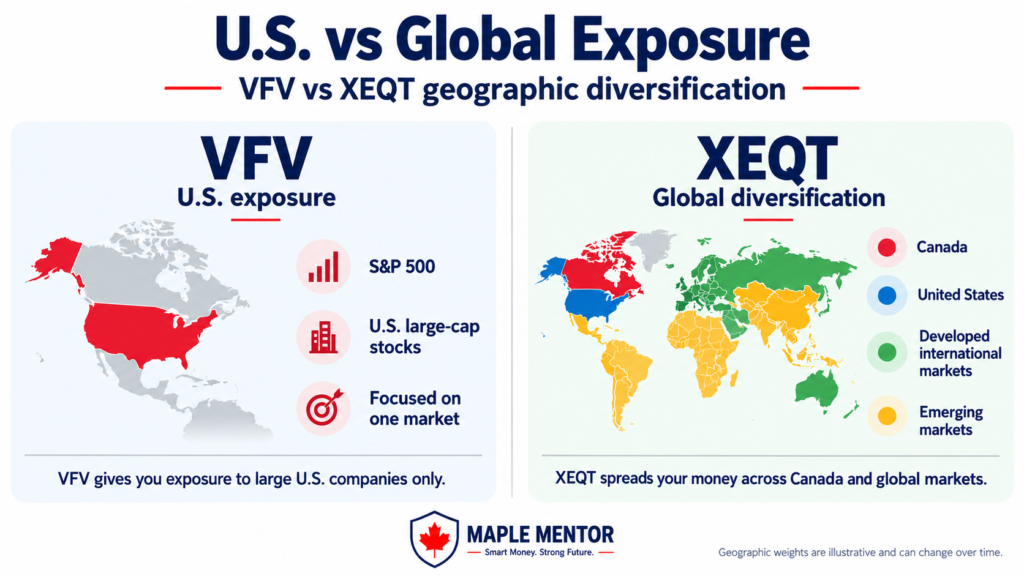
VFV gives you concentrated exposure to approximately 500 of the largest publicly traded U.S. companies through the S&P 500. XEQT is an all-in-one equity portfolio that spreads your money across Canada, the United States, developed international markets, and emerging markets.
That distinction matters much more than the difference in their fees.
In the VFV vs XEQT comparison, you’re essentially deciding between U.S. large-cap exposure and a globally diversified all-equity portfolio.
Neither is automatically better for every Canadian investor.
VFV vs XEQT: Quick Answer
VFV and XEQT are both low-cost equity ETFs, but they aren’t direct substitutes.
Vanguard S&P 500 Index ETF
VFV tracks the S&P 500 and invests primarily in the U.S.-domiciled Vanguard S&P 500 ETF. Vanguard reports that its market allocation is currently 100% United States. Its current MER is 0.08%. Vanguard Canada
XEQT — iShares Core Equity ETF Portfolio
XEQT is designed as a complete equity portfolio. BlackRock targets a strategic allocation of 100% equities, diversifies the portfolio across regions, and automatically rebalances it as needed. Its current MER is 0.19%. BlackRock
BlackRock’s official XEQT page
The simplest way to think about VFV vs XEQT is:
VFV: “I specifically want the S&P 500 to represent a large part of my portfolio.”
XEQT: “I want one ETF to manage my entire globally diversified equity portfolio.”
VFV currently has the lower fee, but XEQT gives you much broader geographic diversification.
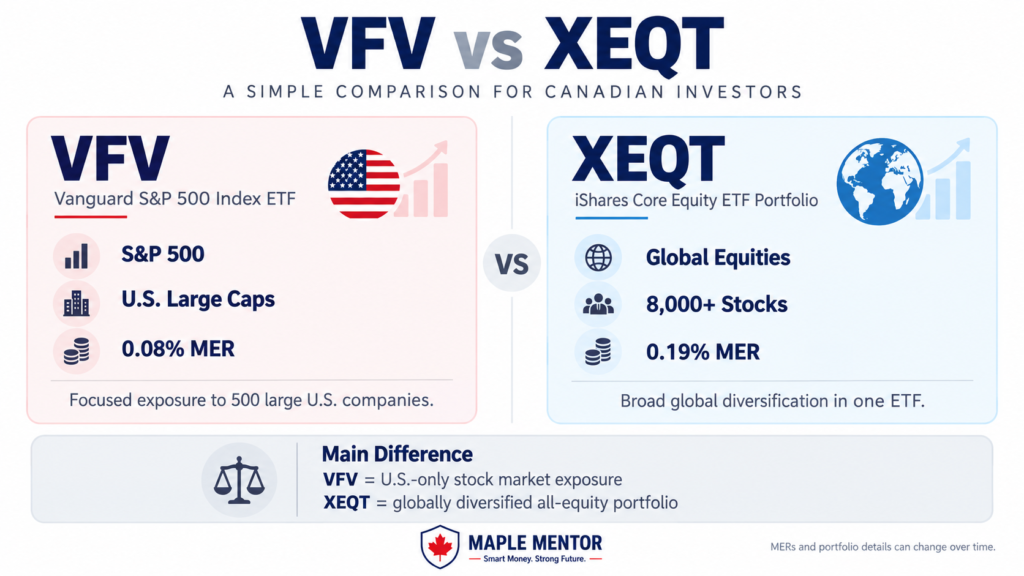
VFV vs XEQT at a Glance
| Feature | VFV | XEQT |
|---|---|---|
| Provider | Vanguard | BlackRock/iShares |
| Investment approach | S&P 500 index ETF | All-in-one equity portfolio |
| Equity allocation | ~100% | ~100% |
| Geographic exposure | United States | Canada, U.S., developed international, emerging markets |
| Current MER | 0.08% | 0.19% |
| Underlying exposure | ~500 large U.S. companies | ~8,300 underlying holdings |
| Automatic geographic rebalancing | No | Yes |
| Distribution frequency | Quarterly | Quarterly |
| Canadian stocks | No meaningful exposure | Yes |
| International ex-U.S. stocks | No | Yes |
| Primary portfolio role | U.S. large-cap allocation | Complete global equity portfolio |
| Stock-market risk | High | High |
| Best suited to | Investors deliberately seeking S&P 500 exposure | Investors wanting a one-fund global equity portfolio |
Vanguard reports VFV’s current MER at 0.08%, quarterly distributions, and 100% U.S. market allocation. BlackRock reports XEQT’s MER at 0.19%, quarterly distributions, and about 8,300 underlying holdings. Vanguard Canada
What Does Each ETF Actually Hold?
Understanding what’s underneath these ETFs makes the comparison much easier.
What VFV Holds
VFV is the Vanguard S&P 500 Index ETF.
Its objective is to track the performance of the S&P 500 Index before fees and expenses.
Rather than directly building its own portfolio of every S&P 500 company from scratch, VFV invests primarily in the U.S.-domiciled Vanguard S&P 500 ETF.
That ultimately gives Canadian VFV investors exposure to large U.S. companies. Vanguard Canada
As of August 31, 2026, some of VFV’s largest underlying positions included:
- NVIDIA
- Apple
- Microsoft
- Amazon
- Alphabet
- Broadcom
- Meta
- Tesla
Vanguard reported NVIDIA alone at about 8.1% of VFV’s market value, with Apple around 7.0% and Microsoft around 5.7%. Vanguard Canada
So VFV isn’t simply a generic “diversified ETF.”
It’s specifically a bet on large U.S. companies as represented by the S&P 500.
What XEQT Holds
XEQT takes a fundamentally different approach.
The iShares Core Equity ETF Portfolio holds a collection of underlying ETFs that provide exposure to thousands of stocks across several regions.
BlackRock describes XEQT as a convenient portfolio diversified across regions with a strategic allocation of 100% equities. It continuously monitors and automatically rebalances the portfolio to maintain its target asset-class weights. BlackRock
XEQT’s strategic structure is roughly:
- 45% U.S. equities
- 25% Canadian equities
- 25% developed international equities
- 5% emerging-market equities
Actual allocations fluctuate with markets and rebalancing.
BlackRock reported approximately 8,300 underlying holdings in late September 2026. BlackRock
This means XEQT already owns many of the same major U.S. companies found in VFV.
The difference is that those companies sit inside a much broader global portfolio.
If you’re comparing all-in-one portfolios specifically, see XEQT vs VEQT: Which Is Better for Canadian Investors?
Diversification and Risk: U.S. Concentration vs Global Exposure
This is probably the most important part of the VFV vs XEQT comparison.
Both ETFs own stocks.
Both can decline substantially.
But their diversification is very different.
VFV Is Geographically Concentrated
Vanguard reported VFV’s market allocation as 100% United States as of August 31, 2026. Vanguard Canada
That doesn’t mean the underlying companies only earn money in America. Many S&P 500 businesses are enormous multinational corporations.
Apple sells products worldwide.
Microsoft operates globally.
Amazon serves multiple countries.
But those are still U.S.-listed companies operating within the U.S. equity market.
With VFV alone, you don’t directly own broad allocations to Canadian, European, Japanese, emerging-market, or other non-U.S. stock markets.
XEQT Spreads the Portfolio Globally
XEQT intentionally diversifies across multiple regions.
You get U.S. equities, but also substantial exposure to:
Canada
Developed international markets
Emerging markets
The result is that your portfolio isn’t dependent entirely on one country’s stock market.
VFV Also Has Large-Cap Concentration
There’s another distinction.
The S&P 500 consists primarily of large U.S. companies.
That means VFV isn’t only geographically concentrated, it also has more exposure to America’s largest corporations.
Its largest positions are currently heavily influenced by major technology and technology-adjacent businesses. Vanguard Canada
XEQT’s global structure spreads your investment across a much larger collection of companies and markets.
Does That Make XEQT Safe?
No.
This is important.
Diversification reduces concentration risk. It doesn’t eliminate equity risk.
XEQT still targets 100% equities. BlackRock
During a major global stock-market decline, both VFV and XEQT can fall significantly.
If global equities fell 30%, diversification wouldn’t magically prevent losses.
The purpose of diversification is to avoid making your entire investment outcome dependent on one market, sector, or small group of companies, not to eliminate volatility.
VFV vs XEQT Fees and Historical Performance
VFV has the clear fee advantage based on current reported MERs.
VFV MER: 0.08%
XEQT MER: 0.19% Vanguard Canada
That’s a difference of:
0.11 percentage points per year
Here’s what that looks like approximately:
| Portfolio Value | VFV at 0.08% | XEQT at 0.19% | Difference |
|---|---|---|---|
| $10,000 | $8 | $19 | $11 |
| $50,000 | $40 | $95 | $55 |
| $100,000 | $80 | $190 | $110 |
| $500,000 | $400 | $950 | $550 |
These are simplified illustrations based on the current MERs.
On a $10,000 investment, the difference is approximately $11 per year.
That shouldn’t be ignored, but you also shouldn’t choose your entire geographic asset allocation to save $11.
You’re paying more for XEQT partly because it’s doing more.
Instead of providing one U.S. index exposure, XEQT packages multiple regional exposures into one automatically managed portfolio.
What About Historical Returns?
As of August 31, 2026, Vanguard reported VFV annualized NAV total returns of approximately:
- 1 year: 21.08%
- 3 years: 21.72%
- 5 years: 14.59%
These figures are in Canadian dollars, net of fund fees, and assume distributions are reinvested. Vanguard Canada
For the same August 31, 2026 endpoint, BlackRock reported XEQT annualized NAV returns of approximately:
- 1 year: 24.49%
- 3 years: 21.82%
- 5 years: 13.14% BlackRock
| Period | VFV | XEQT |
|---|---|---|
| 1 Year | 21.08% | 24.49% |
| 3 Years annualized | 21.72% | 21.82% |
| 5 Years annualized | 14.59% | 13.14% |
Those numbers are useful for understanding how the portfolios behaved historically.
They’re not a reason to declare one the future winner.
Over different periods, U.S., Canadian, international, and emerging markets will outperform or underperform one another.
A period of strong S&P 500 performance can favour VFV.
A period when non-U.S. stocks outperform can favour XEQT.
You don’t know which market will lead over the next 10 or 20 years.
That’s why portfolio construction matters more than chasing whichever ETF recently had the better return.
Should You Hold Both VFV and XEQT?
You can.
But you should understand what you’re actually doing.
XEQT already has substantial U.S. equity exposure, its strategic U.S. allocation is approximately 45%.
Adding VFV doesn’t meaningfully introduce a new asset class.
It primarily increases your U.S. large-cap weighting.
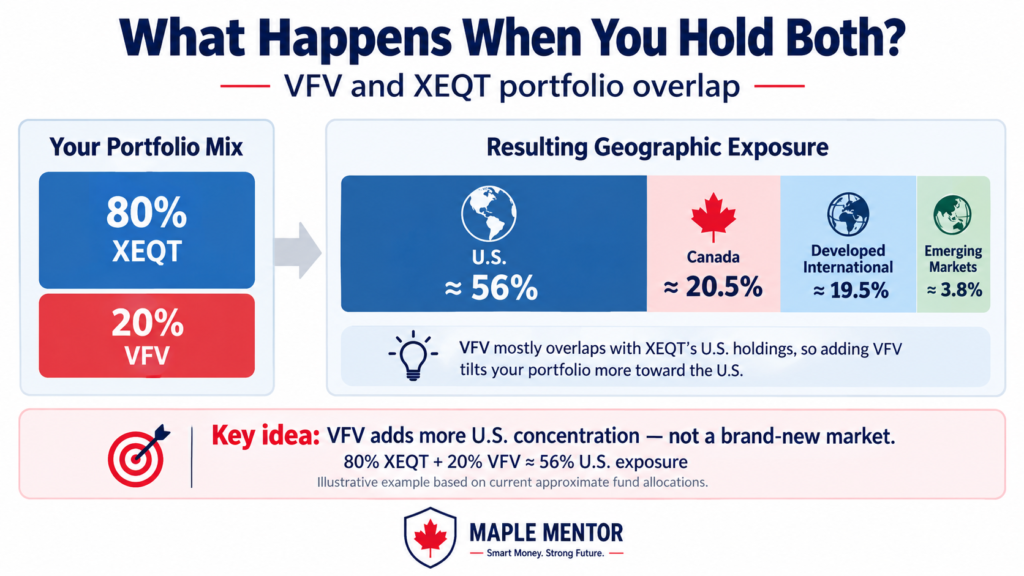
Simple Example
Suppose you build:
80% XEQT
20% VFV
Using XEQT’s strategic U.S. target of approximately 45%, the XEQT portion contributes roughly:
80% × 45% = 36% U.S. exposure
VFV contributes another:
20% × 100% = 20% U.S. exposure
Your combined portfolio would therefore have roughly:
56% U.S. exposure
The remaining 44% would come primarily from XEQT’s Canadian, developed international, and emerging-market allocations.
That’s significantly different from holding XEQT alone at approximately 45% U.S. equities.
And because VFV focuses on the S&P 500, you’re specifically tilting toward large U.S. companies.
Is Holding Both Wrong?
No.
It can be completely intentional.
Maybe you want global diversification but believe a 45% U.S. allocation is lower than you’d prefer.
You could use XEQT as your portfolio foundation and VFV as a deliberate U.S. overweight.
The problem is buying both without realizing what it does.
If you think:
“XEQT is diversified, and VFV is diversified, so buying both must make me even more diversified.”
that’s not quite right.
There’s substantial overlap.
Many of VFV’s biggest companies, NVIDIA, Apple, Microsoft, Amazon, Alphabet, Meta, and others—are already represented within XEQT’s U.S. holdings.
Adding VFV primarily changes their weight, not whether you own them at all.
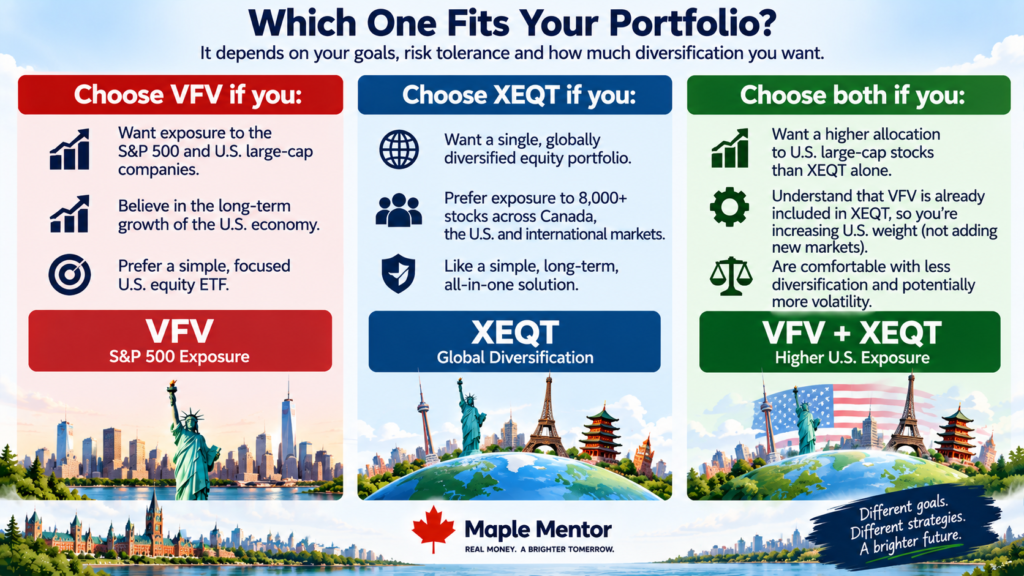
VFV vs XEQT: Which Fits Your Investing Plan?
Instead of asking which ETF is objectively better, start with the role the ETF needs to play.
VFV Makes More Sense as a Specific U.S. Allocation
VFV can make sense if you deliberately want:
- S&P 500 exposure
- Large U.S. companies
- A low 0.08% MER
- More control over your geographic allocation
- To combine multiple ETFs yourself
For example, you might build a portfolio using separate ETFs for:
United States + Canada + international + emerging markets
VFV could fill the U.S. portion.
But then you are responsible for determining the allocations and rebalancing them.
XEQT Makes More Sense as a Complete Portfolio
XEQT is designed to do much of that work for you.
You get:
- Canada
- United States
- Developed international markets
- Emerging markets
- Thousands of underlying stocks
- Automatic rebalancing
- One ETF to buy
BlackRock specifically describes XEQT as a convenient package providing broad regional diversification while maintaining its target asset allocation automatically. BlackRock
For someone who wants:
Deposit money → buy one ETF → continue investing
XEQT has a compelling structure.
For other options that can play a long-term portfolio role, see Best ETFs for Long-Term Growth in Canada.
What About a TFSA?
Both VFV and XEQT can be held in a TFSA.
The more important question is what your entire portfolio looks like.
If VFV is your only investment, you’re choosing a U.S.-focused portfolio.
If XEQT is your only investment, you’re choosing a globally diversified equity portfolio.
If you already own substantial Canadian and international equities elsewhere, VFV might fill a specific gap.
What About an RRSP?
The same portfolio logic applies.
Both ETFs can be held inside an RRSP.
One nuance is that VFV is a Canadian-listed ETF that invests primarily in a U.S.-domiciled Vanguard ETF. Simply holding VFV in an RRSP shouldn’t be confused with directly holding a U.S.-listed S&P 500 ETF when considering foreign withholding-tax treatment.
Tax efficiency can matter as portfolios become larger, but it shouldn’t automatically override diversification, simplicity, trading costs, and your overall investment plan.
For a broader approach, read RRSP Investing Strategy Canada: A Simple Beginner’s Guide.
Remember That Both Are 100% Equity Investments
There’s a risk of spending so much time debating VFV versus XEQT that you overlook the much bigger decision:
Should you have 100% of this money invested in stocks at all?
Both ETFs can experience substantial losses.
Imagine investing $100,000.
A hypothetical 35% decline would leave you with:
$65,000
Would you continue investing?
Would you hold?
Or would you panic and sell?
If losing tens of thousands of dollars temporarily would cause you to abandon the strategy, choosing between VFV and XEQT isn’t the main problem.
Your equity allocation may be too aggressive.
These ETFs generally make more sense for long-term money than for:
- An emergency fund
- Next year’s home down payment
- Tuition needed soon
- A car purchase in two years
- Other short-term financial goals
Vanguard itself warns that investment funds aren’t guaranteed, their values change frequently, and past performance may not be repeated. Vanguard Canada
Where Can You Buy VFV and XEQT?
Both trade on the Toronto Stock Exchange in Canadian dollars and can be purchased through Canadian self-directed brokerages.
For long-term investors making regular contributions, pay attention to:
- ETF trading commissions
- Recurring investment support
- Fractional-share availability
- Account fees
- Registered accounts
- Currency conversion if you later add U.S.-listed securities
See Questrade vs Wealthsimple vs Interactive Brokers: Which Is Best in Canada? for a detailed brokerage comparison.
A $0-commission brokerage can be particularly useful if you’re making frequent small ETF purchases, but brokerage features and costs can change, so compare the current terms before opening an account.
Final Verdict: Choose Your Exposure First
The most important difference in VFV vs XEQT isn’t 0.08% versus 0.19%.
It’s what you’re choosing to own.
VFV gives you concentrated exposure to large U.S. companies through the S&P 500.
XEQT gives you a complete all-equity portfolio diversified across Canada, the United States, developed international markets, and emerging markets.
VFV currently has the lower MER.
XEQT has much broader geographic diversification and handles portfolio rebalancing automatically.
Before choosing, ask yourself:
- Do I want the S&P 500 specifically, or a global portfolio?
- What Canadian and international investments do I already own?
- Am I intentionally overweighting the United States?
- Do I want to manage multiple ETFs myself?
- Am I comfortable with an approximately 100% equity portfolio?
- Can I remain invested through a severe market decline?
- Is this money invested for the long term?
If you want one ETF to serve as a globally diversified equity portfolio, XEQT is structured for that job.
If you specifically want S&P 500 exposure—either alone or as one component of a broader portfolio—VFV is structured for that job.
And if you hold both, understand that you’re not simply “adding diversification.” You’re deliberately increasing the weight of U.S. large-cap stocks already represented inside XEQT.
That’s the key distinction when deciding between VFV vs XEQT.
FAQ
Is VFV better than XEQT for long-term investing?
Neither is universally better for long-term investing.
VFV provides low-cost exposure to the S&P 500, while XEQT provides a complete globally diversified equity portfolio.
The appropriate choice depends on whether you want concentrated U.S. large-cap exposure or broader global diversification.
Does XEQT already hold the same stocks as VFV?
Yes, many of them.
XEQT has substantial U.S. exposure, so companies such as NVIDIA, Apple, Microsoft, Amazon, Alphabet, and other major S&P 500 businesses are already represented within its underlying U.S. holdings.
However, XEQT also holds thousands of Canadian, international, emerging-market, and additional U.S. stocks that VFV doesn’t provide exposure to.
Should I buy both VFV and XEQT?
You can, but understand the overlap.
Adding VFV to XEQT primarily increases your allocation to large U.S. companies.
For example, an 80% XEQT and 20% VFV portfolio would have roughly 56% U.S. exposure using XEQT’s approximate 45% strategic U.S. target.
Holding both can make sense if that overweight is intentional.
Is XEQT safer than VFV?
XEQT is more geographically diversified, which reduces concentration in a single country’s stock market.
However, both are essentially 100% equity investments and can experience substantial losses during stock-market declines.
Broader diversification doesn’t make XEQT a low-risk investment.
Is VFV or XEQT better for a TFSA?
Either can be held in a TFSA.
VFV may fit investors specifically seeking S&P 500 exposure, while XEQT may fit investors who want their TFSA invested in a globally diversified all-equity portfolio through one ETF.
Your investment horizon, risk tolerance, existing holdings, and overall portfolio are more important than the account label alone.