
If you want a simple portfolio that gives you exposure to thousands of companies around the world, two ETFs will probably appear near the top of your research: XEQT and VEQT.
Both are Canadian-listed, globally diversified, all-equity asset-allocation ETFs designed to function as complete portfolios. Instead of choosing separate Canadian, U.S., international, and emerging-market ETFs yourself, you can buy a single fund and let the provider manage the allocation and rebalancing.
The differences in XEQT vs VEQT are relatively small, but they aren’t identical.
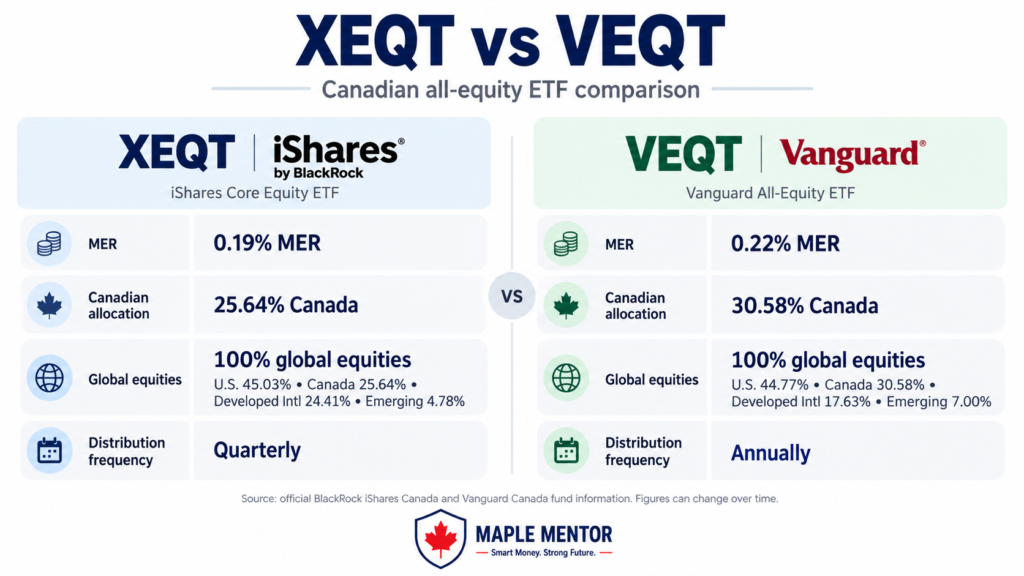
XEQT currently has a 0.19% management expense ratio (MER) and targets approximately 25% Canadian equities, while VEQT’s latest reported MER is 0.22% and its Canadian allocation is currently around 30%. XEQT distributes income quarterly, while VEQT currently distributes annually.
For most investors, the decision should come down to your preferred geographic allocation and portfolio structure, not trying to predict which ETF will produce the highest return next year.
Quick Answer
Both XEQT and VEQT are strong candidates for Canadian investors who want a globally diversified portfolio consisting almost entirely of stocks.
XEQT — iShares Core Equity ETF Portfolio
- Approximately 100% equities
- 0.19% current MER
- 25% strategic Canadian equity target
- 45% U.S. equity target
- 25% developed international equity target
- 5% emerging-market equity target
- Quarterly distributions
- Automatic rebalancing
BlackRock’s official XEQT page
VEQT — Vanguard All-Equity ETF Portfolio
- Approximately 100% equities
- 0.22% latest reported MER
- About 30% Canadian equities
- About 45% U.S. equities
- Remaining allocation primarily developed and emerging markets
- Annual distributions
- Automatic portfolio management and rebalancing
The XEQT vs VEQT decision therefore isn’t about one ETF being fundamentally good and the other bad.
XEQT currently costs slightly less and has somewhat less Canadian exposure.
VEQT allocates more heavily to Canada and follows Vanguard’s asset-allocation methodology.
Either can potentially serve as an entire equity portfolio for a long-term investor who has the risk tolerance to hold 100% stocks.
XEQT vs VEQT at a Glance
| Feature | XEQT | VEQT |
|---|---|---|
| Provider | BlackRock/iShares | Vanguard |
| Fund name | iShares Core Equity ETF Portfolio | Vanguard All-Equity ETF Portfolio |
| Current/latest reported MER | 0.19% | 0.22% |
| Equity allocation | ~100% | ~100% |
| Canadian equities | 25% strategic target | ~30% currently |
| U.S. equities | 45% strategic target | ~45% currently |
| Developed international | 25% strategic target | ~18% underlying allocation |
| Emerging markets | 5% strategic target | ~7% underlying allocation |
| Underlying stocks | ~8,300 | ~13,700 |
| Automatic rebalancing | Yes | Yes |
| Distribution frequency | Quarterly | Annually |
| Bonds | Essentially none | Essentially none |
| Registered-plan eligible | Yes | Yes |
| Risk | All-equity market risk | All-equity market risk |
BlackRock reported roughly 8,300 underlying XEQT holdings in September 2026, while Vanguard reported 13,721 stocks in VEQT as of August 31, 2026. These counts aren’t perfectly comparable because the providers can calculate and report underlying holdings differently, so a larger number shouldn’t automatically be interpreted as meaningfully better diversification.
Allocations also change with markets and portfolio rebalancing. Always check the providers’ current holdings before relying on exact percentages.
What Is XEQT?
XEQT is the iShares Core Equity ETF Portfolio, managed by BlackRock.
BlackRock describes it as a convenient portfolio of ETFs that provides broad exposure across geographic regions while targeting a strategic asset allocation of 100% equities.
The portfolio is continuously monitored and automatically rebalanced as necessary to maintain its target asset-class weights.
That makes XEQT what’s commonly called an asset-allocation ETF or all-in-one ETF.
Instead of building something like:
Canadian ETF + U.S. ETF + international ETF + emerging-markets ETF
and manually deciding how much to allocate to each one, you can simply own XEQT.
BlackRock handles the underlying portfolio.
Its current strategic targets are approximately:
- 25% Canadian equities
- 45% U.S. equities
- 25% international developed equities
- 5% emerging-market equities
Those target allocations can change at BlackRock’s discretion.
XEQT currently has a 0.17% management fee and a reported 0.19% MER. BlackRock reduced its management fee from 0.18% to 0.17% in December 2025.
For other growth-oriented Canadian ETFs, see Best Canadian ETFs for Long-Term Growth.
What Is VEQT?
VEQT is the Vanguard All-Equity ETF Portfolio.
Like XEQT, it was designed to provide an entire globally diversified equity portfolio through a single ETF.
Vanguard states that under normal market conditions, VEQT’s sub-advisor strives to maintain a long-term strategic allocation of 100% equity securities. The portfolio can be reconstituted and rebalanced as necessary.
VEQT currently holds four primary underlying Vanguard funds.
As of August 31, 2026, Vanguard reported approximately:
- 44.77% Vanguard U.S. equity exposure
- 30.58% Vanguard Canadian equity exposure
- 17.63% developed markets outside North America
- 7.00% emerging markets
Its actual stock allocation was 99.98%, with a very small amount in short-term reserves.
Vanguard currently reports a 0.17% management fee and 0.22% MER for VEQT. Its management fee was reduced from 0.22% to 0.17% in November 2025.
Like XEQT, the idea is straightforward:
Buy one ETF and receive a complete global equity portfolio.
XEQT vs VEQT Fees
The current fee advantage goes to XEQT, although the difference is small.
XEQT MER: 0.19%
VEQT latest reported MER: 0.22%
That’s a difference of:
0.03 percentage points per year
Here’s approximately what that means based solely on those MERs:
| Portfolio | XEQT at 0.19% | VEQT at 0.22% | Difference |
|---|---|---|---|
| $10,000 | $19/year | $22/year | $3 |
| $50,000 | $95/year | $110/year | $15 |
| $100,000 | $190/year | $220/year | $30 |
| $500,000 | $950/year | $1,100/year | $150 |
These figures are simplified illustrations. Actual fund expenses and MERs can change.
At $10,000 or even $50,000, the dollar difference is tiny.
At $500,000, it becomes more noticeable, but $150 per year still shouldn’t necessarily determine your entire portfolio strategy.
There’s also an important wrinkle.
Vanguard reduced VEQT’s management fee to 0.17% in November 2025, but its latest published MER remains 0.22%. Because MERs are backward-looking calculations based on the fund’s most recent financial period, the eventual effect of the lower management fee may not yet be fully reflected in the reported MER. Vanguard’s official page should be checked for updated figures over time.
So don’t assume today’s 0.03-percentage-point difference will remain unchanged indefinitely.
Canadian vs U.S. and International Exposure
This is a more meaningful distinction than the current MER difference.
XEQT and VEQT are both globally diversified, but they don’t allocate their money identically.
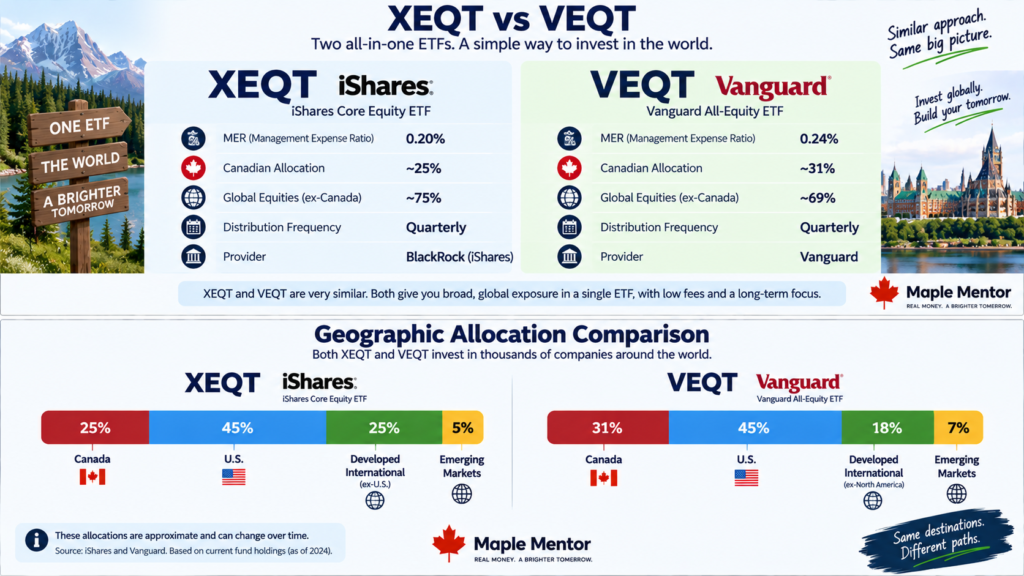
XEQT
BlackRock’s strategic targets are:
Canada: 25%
United States: 45%
Developed international: 25%
Emerging markets: 5%
VEQT
Vanguard’s underlying allocations as of August 31, 2026 were approximately:
Canada: 30.58%
United States: 44.77%
Developed ex-North America: 17.63%
Emerging markets: 7.00%
So VEQT currently gives you more Canadian exposure.
XEQT’s strategic allocation puts somewhat less into Canada and somewhat more into developed international markets.
Why Do They Own So Much Canada?
Canada represents only a relatively small portion of the global stock market.
Yet both portfolios allocate far more than that to Canadian equities.
This is known as home-country bias.
For a Canadian investor, some home bias can have practical portfolio benefits. It increases exposure to Canadian-dollar assets and Canadian companies and can have tax and behavioural considerations depending on the account.
But more home bias also means your portfolio becomes more dependent on the Canadian market.
Canada’s stock market is relatively concentrated in sectors such as financials, energy and materials compared with the global market.
That’s why the allocation difference matters.
Choosing VEQT effectively means saying:
I’m comfortable with somewhat more Canadian exposure.
Choosing XEQT means:
I prefer somewhat less Canada and somewhat more exposure elsewhere.
Neither allocation guarantees better future performance.
XEQT vs VEQT Holdings
Both ETFs accomplish their diversification by holding other ETFs.
Think of them as containers holding several broad-market funds.
XEQT’s Structure
XEQT uses iShares ETFs to provide exposure to:
- Canadian equities
- U.S. equities
- Developed international equities
- Emerging markets
BlackRock reported approximately 8,285 underlying holdings in XEQT as of September 11, 2026.
VEQT’s Structure
VEQT currently uses four major Vanguard underlying funds covering:
- U.S. total market equities
- Canadian all-cap equities
- Developed markets outside North America
- Emerging markets
Vanguard reported 13,721 stocks in the portfolio as of August 31, 2026.
Don’t read too much into the difference between 8,000 and 13,000 stocks.
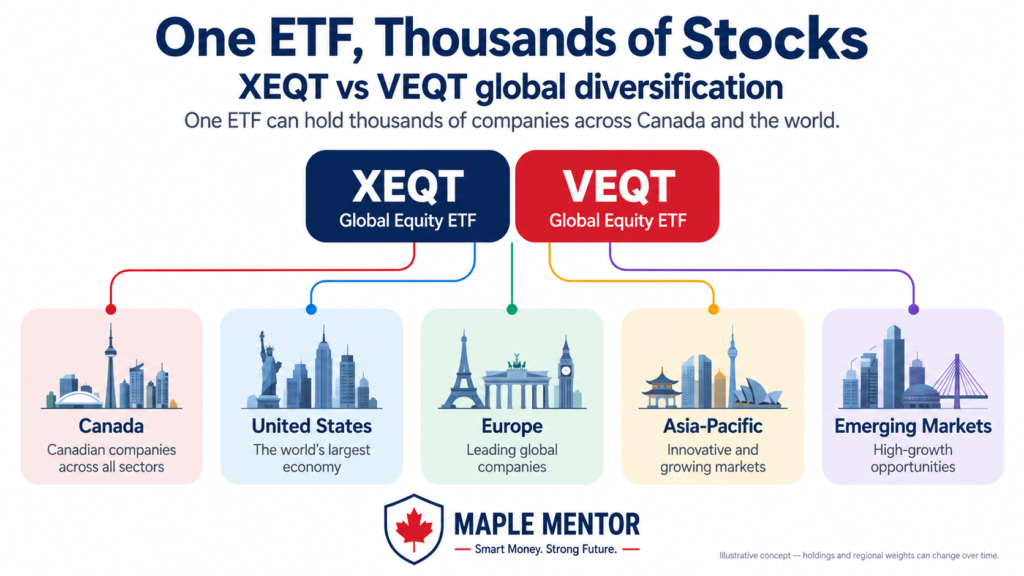
Once a portfolio already contains thousands of securities spread across Canada, the United States, Europe, Asia and emerging markets, both are extremely broadly diversified compared with owning a handful of individual stocks.
They also overlap substantially.
Both portfolios ultimately own companies such as:
- NVIDIA
- Apple
- Microsoft
- Royal Bank of Canada
- Toronto-Dominion Bank
- Amazon
- Shopify
The weights differ, but you’re accessing many of the same global businesses.
Performance: Does XEQT or VEQT Have Better Returns?
Their returns won’t be identical.
Even though both are 100% equity portfolios, different geographic allocations create different results.
Suppose Canadian stocks have an unusually strong year.
VEQT’s larger Canadian allocation could help it relative to XEQT.
If developed international markets outperform Canada, XEQT’s higher strategic allocation there could work in its favour.
Currency movements can also influence returns.
But this can reverse from one period to another.
That’s why looking at the previous year’s performance and buying whichever ETF performed better is a weak strategy.
Past performance doesn’t tell you which geographic allocation will outperform over the next decade.
Instead, compare their portfolio construction.
Ask:
- How much Canada do I want?
- Am I comfortable with 100% equities?
- Do I prefer Vanguard or iShares?
- Do I care about distribution frequency?
- Do I care about the small fee difference?
Those are decisions you can actually control.
Future market returns aren’t.
XEQT vs VEQT for a TFSA
Both ETFs can work inside a TFSA for a long-term investor comfortable with an all-equity portfolio.
BlackRock specifically lists XEQT as eligible for registered plans, and VEQT is a Canadian-listed Vanguard ETF that can be held through Canadian investment accounts.
A TFSA can be particularly powerful for long-term investing because investment income and capital gains can grow tax-free, and qualifying TFSA withdrawals aren’t included in taxable income.
The CRA provides current TFSA rules at:
CRA — Tax-Free Savings Account information
However, don’t confuse “good long-term TFSA investment” with “appropriate for every TFSA.”
If your TFSA contains money you’re planning to use for a house next year, an all-equity ETF could be far too volatile.
If you’re investing for retirement decades away and can tolerate major market declines, the situation is very different.
See Best ETFs for TFSA in Canada for other options.
For building the account itself, read TFSA Investing Strategy for Beginners.
XEQT vs VEQT for an RRSP
The same basic principle applies to an RRSP.
Either XEQT or VEQT can potentially serve as a simple long-term equity portfolio.
For an investor with decades until retirement, a high equity allocation may be appropriate if it matches their ability and willingness to tolerate volatility.
But age alone doesn’t determine risk tolerance.
You also need to consider:
- Expected retirement date
- Other investments
- Pension income
- Financial obligations
- Ability to tolerate losses
- Whether you’d actually remain invested during a major crash
Compare other options in Best ETFs for RRSP in Canada.
For a broader account strategy, read RRSP Investing Strategy Canada: A Simple Beginner’s Guide.
Which Is Better for Beginners?
Both XEQT and VEQT have a major advantage for beginners:
There isn’t much to manage.
You don’t need to select dozens of stocks.
You don’t need to decide how much money goes into Canada versus the U.S. every month.
You don’t need to manually rebalance four different ETFs.
You don’t need to constantly research which country will perform best next year.
BlackRock describes XEQT as a broadly diversified portfolio that is automatically monitored and rebalanced. Vanguard similarly manages VEQT around its long-term strategic all-equity allocation.
That makes the process potentially as simple as:
1. Deposit money
2. Buy XEQT or VEQT
3. Continue contributing
4. Stay invested
The difficult part isn’t portfolio construction.
It’s accepting what 100% equities actually means when markets fall.
Distribution Frequency: One Small Difference
XEQT and VEQT also distribute income differently.
XEQT currently pays distributions quarterly.
VEQT currently pays distributions annually.
For a long-term accumulation investor, this probably shouldn’t be a deciding factor.
A distribution isn’t free additional return. When a fund makes a distribution, that value comes from the underlying portfolio.
If you’re reinvesting everything anyway, whether distributions arrive quarterly or annually is mostly an administrative difference.
However, investors who prefer more frequent cash distributions may appreciate XEQT’s schedule.
XEQT vs VEQT Example
Here’s a simple framework:
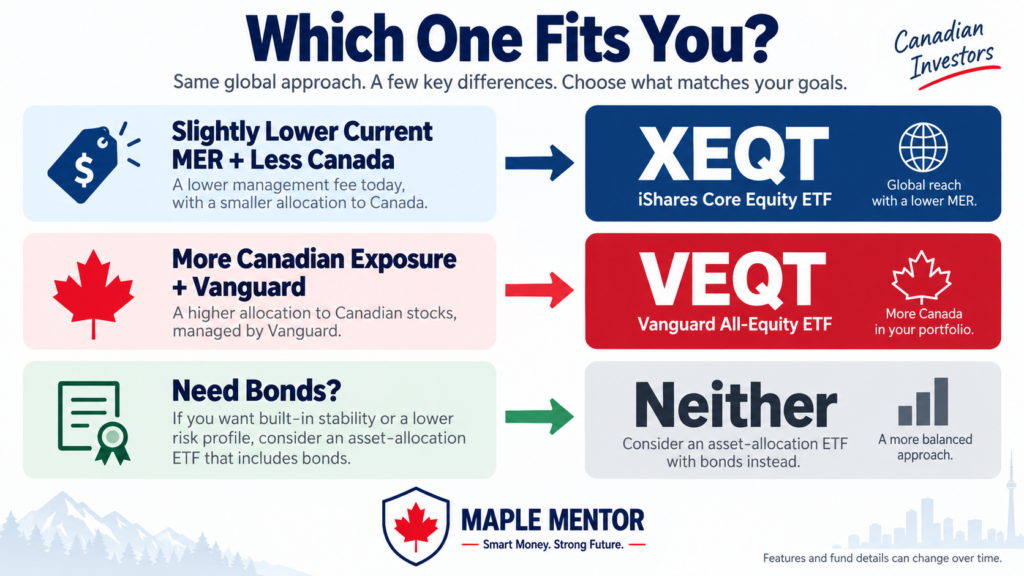
| Investor Preference | ETF to Consider |
|---|---|
| Slightly lower current reported MER | XEQT |
| More Canadian exposure | VEQT |
| Less Canadian exposure | XEQT |
| Prefer iShares/BlackRock | XEQT |
| Prefer Vanguard | VEQT |
| Prefer quarterly distributions | XEQT |
| Want a one-fund 100% equity portfolio | Either |
| Want bonds in the portfolio | Neither |
The last row is important.
If you’re uncomfortable with a portfolio consisting almost entirely of stocks, choosing between XEQT and VEQT doesn’t solve the underlying problem.
You may need a different asset allocation entirely.
Risks of XEQT and VEQT
XEQT and VEQT are diversified.
They are not low-risk savings accounts.
Diversification can reduce the risk associated with individual companies, sectors and countries.
It doesn’t eliminate stock-market risk.
They’re Essentially 100% Stocks
BlackRock targets 100% equities for XEQT, while Vanguard reported VEQT at 99.98% stocks as of August 31, 2026.
There are essentially no bonds cushioning the portfolio.
Significant Market Declines Are Possible
A globally diversified equity portfolio can still fall substantially during a major bear market.
You need to be financially and psychologically prepared for that.
Imagine investing $100,000.
A hypothetical 30% market decline would temporarily reduce that to:
$70,000
If seeing that number would cause you to panic-sell, a 100% equity allocation may be too aggressive.
They’re Poor Choices for Short-Term Savings
Money needed for:
- Next year’s home purchase
- Tuition in two years
- An emergency fund
- A car you’re buying soon
generally shouldn’t depend on the stock market cooperating with your timeline.
Your investment horizon matters.
Currency Risk Still Exists
Buying XEQT or VEQT in Canadian dollars doesn’t mean all of the underlying investments are Canadian.
Both portfolios hold substantial foreign exposure.
Changes in exchange rates can therefore influence returns measured in Canadian dollars.
Diversification Doesn’t Guarantee Profits
Owning thousands of stocks reduces concentration risk.
It doesn’t guarantee positive returns over every period.
That’s why these funds are designed around long-term capital growth, not short-term capital preservation.
Should You Own Both XEQT and VEQT?
You can.
But there usually isn’t an obvious diversification reason to do so.
Both are already designed as complete all-equity portfolios.
If you invest:
50% XEQT + 50% VEQT
you aren’t suddenly creating a fundamentally new portfolio.
You’re mostly combining two portfolios that already hold many of the same markets and companies.
What you effectively create is an allocation somewhere between their respective geographic weights.
That’s not necessarily harmful.
It’s just usually unnecessary.
If you prefer XEQT’s allocation, buy XEQT.
If you prefer VEQT’s allocation, buy VEQT.
The entire appeal of asset-allocation ETFs is simplifying portfolio management. Owning multiple nearly identical all-in-one portfolios can work against that simplicity.
Don’t Overthink a Tiny Fee Difference
The difference between a 0.19% and 0.22% MER deserves consideration.
But it shouldn’t overshadow much larger investing decisions.
For example, these behaviours will probably matter much more over decades:
- How much you save
- How consistently you invest
- Whether you stay invested
- Your asset allocation
- Whether you panic during downturns
- How much unnecessary trading you do
- Whether your portfolio matches your goals
Saving an additional $100 every month can matter far more than obsessing over three basis points while leaving thousands of dollars sitting uninvested.
Likewise, switching repeatedly between XEQT and VEQT based on whichever recently performed better defeats much of the purpose of a passive long-term portfolio.
Choose a reasonable strategy you can actually stick with.
XEQT vs VEQT: Final Comparison
The XEQT vs VEQT debate ultimately comes down to relatively small differences between two broadly similar products.
Both provide:
- Approximately 100% equity exposure
- Thousands of global stocks
- Canadian equities
- U.S. equities
- Developed international markets
- Emerging markets
- Automatic portfolio management
- Automatic rebalancing
- Low ongoing costs
- A one-ticket portfolio structure
XEQT currently has the lower reported MER at 0.19% versus VEQT’s 0.22%, although Vanguard reduced VEQT’s management fee in late 2025, so future reported MERs should be monitored.
XEQT also targets somewhat less Canadian equity approximately 25% while VEQT currently has roughly 30% allocated to Canada.
If you prefer slightly less Canadian exposure and the currently lower reported MER, XEQT may fit your preferences better.
If you prefer somewhat greater Canadian exposure and Vanguard’s portfolio methodology, VEQT may fit your preferences better.
Neither choice requires predicting which country or ETF will outperform next.
And for many long-term investors, consistently investing in either diversified portfolio may matter much more than endlessly debating XEQT vs VEQT.
FAQ
Is XEQT better than VEQT?
Neither is universally better.
XEQT currently has a lower reported MER of 0.19% and targets approximately 25% Canadian equities. VEQT’s latest reported MER is 0.22%, and its Canadian allocation was approximately 30.6% as of August 31, 2026.
Your preferred geographic allocation is more important than declaring one universally superior.
Is XEQT or VEQT more diversified?
Both provide extensive global diversification.
BlackRock reported approximately 8,300 underlying XEQT holdings in September 2026, while Vanguard reported 13,721 stocks in VEQT as of August 31, 2026.
However, differences in how providers construct and report portfolios mean the raw holdings count shouldn’t be used by itself to determine which ETF is “more diversified.”
Can I hold XEQT or VEQT in a TFSA?
Yes.
Both can be held through Canadian registered investment accounts such as a TFSA or RRSP.
Whether either is appropriate depends on your investment horizon and risk tolerance.
Should I own both XEQT and VEQT?
You can, but there is substantial overlap.
Both are intended to provide complete globally diversified all-equity portfolios. Holding both generally gives you a blended version of their allocations rather than dramatically increasing diversification.
Are XEQT and VEQT risky?
Yes.
Both target approximately 100% equity exposure, which means substantial declines are possible during stock-market downturns.
They may be appropriate for long-term investors who can tolerate significant volatility, but they’re generally unsuitable for money that must remain stable over a short time horizon.
Does XEQT pay dividends?
XEQT currently makes distributions quarterly. Its underlying portfolio contains dividend-paying companies, but distributions can vary over time.
VEQT currently makes distributions annually.