
Impulse purchases can seem harmless in the moment. A takeout order, discounted gadget, new shirt, or small online purchase may not feel significant on its own.
However, when these purchases happen repeatedly, they can quietly consume hundreds of dollars every month. That makes it harder to pay bills, eliminate debt, build an emergency fund, or invest for the future.
Learning how to stop impulse spending in Canada does not mean removing every enjoyable purchase from your life. Instead, it means creating a system that gives you enough time to decide whether something is genuinely worth buying.
The most effective approach is to create friction between the urge to spend and the purchase itself.
Quick Answer
To stop impulse spending in Canada, create friction before you buy.
Use a waiting rule, separate spending money from bills, unsubscribe from sales emails, avoid buy-now-pay-later plans, and review your purchases weekly.
The goal is not to rely entirely on discipline. It is to make impulsive purchases less convenient while making thoughtful spending easier.
Quick Steps
- Identify your spending triggers.
- Wait 24 hours before non-essential purchases.
- Wait seven days before larger purchases.
- Separate needs from wants.
- Use a dedicated spending account.
- Remove sales emails and shopping notifications.
- Delete saved payment information.
- Be cautious with buy-now-pay-later plans.
- Review impulse purchases every week.
What Is Impulse Spending?
Impulse spending means buying something you did not plan to purchase before seeing it.
The decision usually happens quickly and is driven by emotion, convenience, advertising, or the fear of missing an opportunity.
Common examples include:
- Random online orders
- Unplanned takeout
- Clothes you did not need
- New gadgets
- Discounted sale items
- Convenience-store purchases
- In-app purchases
- Unplanned subscription trials
- Small purchases that gradually add up
Not every spontaneous purchase is financially harmful.
Buying an occasional coffee or ordering takeout after a difficult day may fit comfortably within your budget. The problem begins when impulse spending interferes with your bills, savings, debt repayment, or other priorities.
For example, spending $15 may not seem important. However, spending an extra $15 four times per week adds up to approximately $260 per month.
That money could otherwise help you:
- Pay down a credit card
- Build an emergency fund
- Save for a vacation
- Invest for retirement
- Cover annual expenses
- Reduce financial stress
Therefore, learning to stop impulse spending in Canada is less about eliminating individual purchases and more about preventing repeated spending patterns from controlling your finances.
Why Impulse Spending Is So Common
Impulse spending is not always caused by laziness or poor discipline.
It is often connected to habits, emotions, convenience, and environmental triggers.
Modern shopping platforms are designed to make purchasing extremely easy. Retailers can save your payment details, recommend products based on your browsing history, send limited-time offers, and allow you to complete a purchase in seconds.
At the same time, social media constantly exposes people to new products, lifestyles, trends, and influencers.
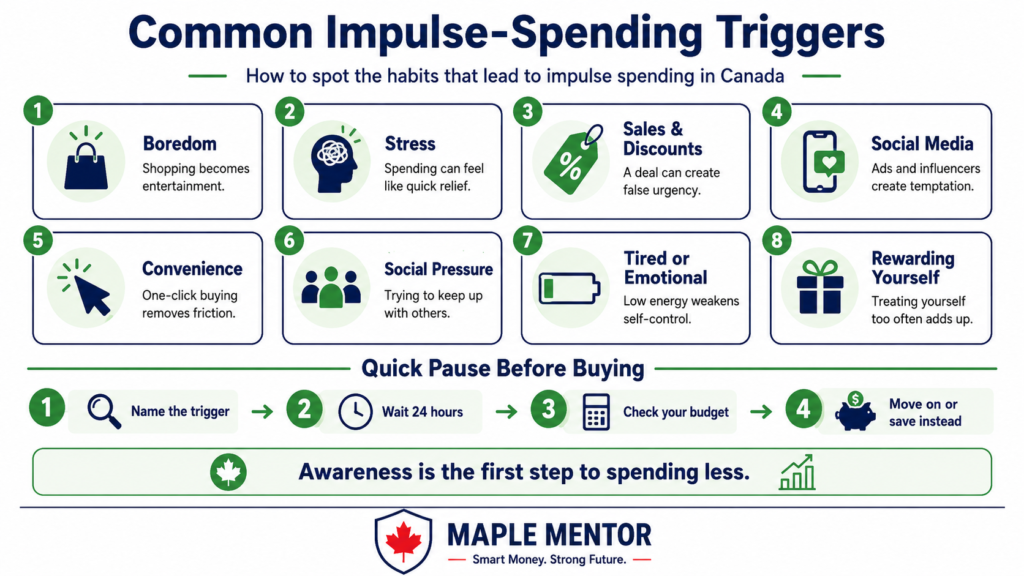
Several emotional triggers can also encourage unplanned spending.
Stress
Buying something can provide a temporary distraction after a stressful day.
However, the positive feeling often disappears quickly, while the cost remains.
Boredom
Scrolling through online stores can become entertainment.
You may begin browsing without planning to buy anything and complete an order simply because something catches your attention.
Sales Pressure
Messages such as “only two remaining,” “sale ends tonight,” or “limited-time offer” create urgency.
That urgency can make you focus on the discount rather than whether you need the product.
Social Media
Influencers, targeted advertisements, and lifestyle content can make ordinary products feel necessary.
You may also compare your belongings or lifestyle with what other people display online.
Convenience
Saved cards, one-click checkout, delivery apps, and digital wallets remove many of the natural barriers that once slowed purchases down.
Feeling Like You Deserve It
Rewarding yourself is not automatically harmful.
However, regularly using spending as a reward for working hard, feeling stressed, or reaching payday can become an expensive habit.
Understanding these triggers matters because you cannot change a spending pattern you have not identified.
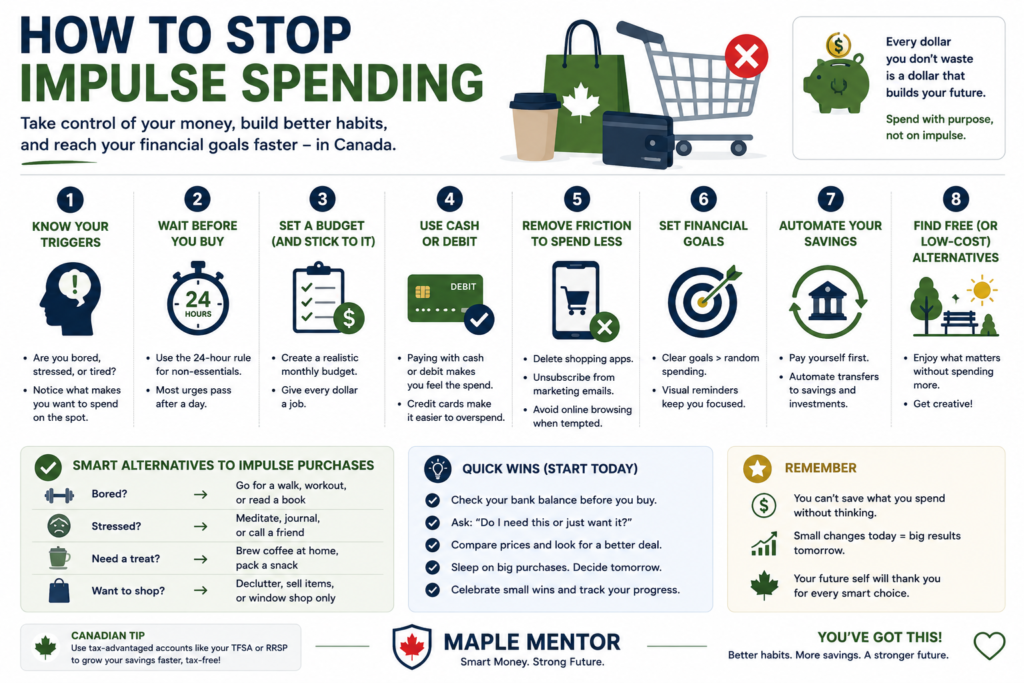
Step 1 Know Your Spending Triggers
The first step is noticing when, where, and why your impulse purchases happen.
Review your recent bank and credit card statements and highlight anything you did not plan to buy.
Then look for patterns.
Common triggers include:
- Shopping late at night
- Scrolling through social media
- Having a difficult day at work
- Receiving a paycheque
- Feeling bored at home
- Opening promotional emails
- Drinking alcohol
- Shopping with certain friends
- Feeling anxious or discouraged
- Seeing free-shipping thresholds
For each purchase, ask yourself:
- What was I doing before I bought it?
- How was I feeling?
- Did I need the item before seeing it?
- Was I influenced by a sale?
- Would I still buy it today?
- Did I use spending to improve my mood?
You do not need to judge yourself for the answers.
The purpose is to gather information. Once you understand your triggers, you can build specific barriers around them.
For example, if you regularly shop online late at night, you might block shopping apps after 9 p.m.
If payday encourages you to overspend, automatically transfer money toward bills and savings before leaving money available for flexible purchases.
If social media is the main trigger, unfollowing shopping accounts may be more effective than repeatedly trying to resist their recommendations.
Step 2 Use a 24-Hour Waiting Rule
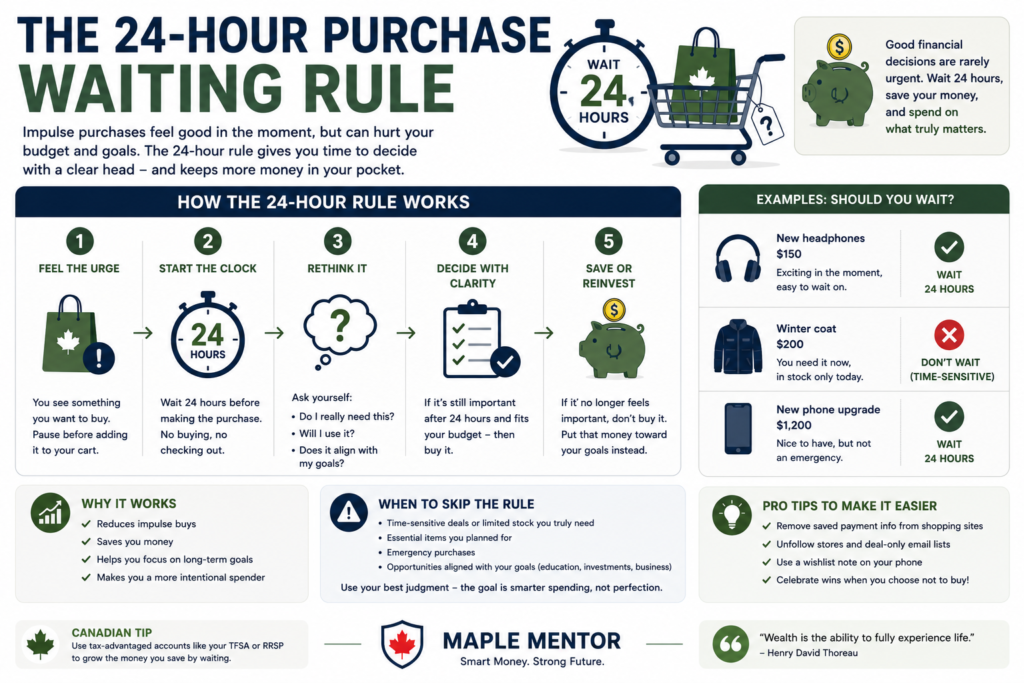
A waiting rule creates time between the urge to buy and the final decision.
For smaller non-essential purchases, wait at least 24 hours before completing the order.
For larger purchases, wait seven days.
You can adjust the rule based on the price:
| Purchase Amount | Suggested Waiting Period |
|---|---|
| Under $50 | 24 hours |
| $50 to $200 | 48 hours |
| $200 to $500 | 7 days |
| More than $500 | 14 to 30 days |
During the waiting period, save the item to a list instead of buying it.
Then ask:
- Do I still want this?
- Can I comfortably afford it?
- Do I already own something similar?
- Where will I keep it?
- How often will I use it?
- What financial goal would this money otherwise support?
- Would I buy it without the discount?
Often, the initial excitement disappears before the waiting period ends.
When that happens, you have avoided spending without needing to feel deprived.
If you still want the item after waiting and it fits within your spending budget, you can buy it more confidently.
The waiting rule is one of the simplest ways to stop impulse spending in Canada because it replaces an emotional decision with a deliberate one.
Step 3 Separate Needs From Wants
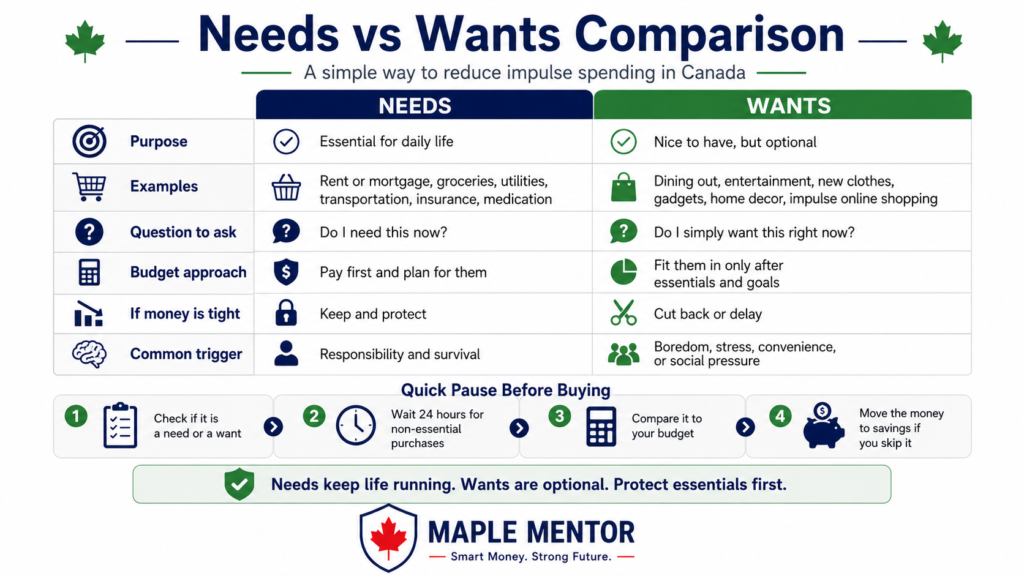
Needs are expenses required for your basic生活, health, work, or financial obligations.
Wants improve your comfort or enjoyment but are not essential.
The distinction is not always perfect, and the same item can fall into either category depending on the situation.
| Need | Want |
|---|---|
| Basic groceries | Restaurant takeout |
| Winter boots when your old pair is damaged | An additional pair of fashionable shoes |
| Your regular phone bill | An unnecessary phone upgrade |
| Transportation to work | Expensive convenience rides |
| Basic home internet | Several overlapping streaming services |
| Replacing a broken appliance | Upgrading a working appliance |
| Necessary work clothing | Trend-driven clothing purchases |
You are allowed to spend money on wants.
A realistic budget should include some enjoyable spending. Otherwise, the plan may become so restrictive that you eventually abandon it.
The goal is to decide how much you can spend on wants before the month begins.
For example, you might set aside:
- $150 for restaurants
- $100 for entertainment
- $75 for clothing
- $50 for hobbies
Once that money is gone, additional purchases wait until the next budgeting period.
This lets you enjoy your money without allowing lifestyle spending to interfere with essential expenses.
Step 4 Create a Spending Account
Keeping all your money in one account can make it difficult to know how much is actually available.
A chequing balance of $3,000 may look like plenty of money. However, much of that amount may already be needed for rent, utilities, insurance, groceries, and upcoming bills.
A separate spending account solves this problem.
Use one account for:
- Bills
- Rent or mortgage payments
- Insurance
- Debt payments
- Essential expenses
Then transfer a predetermined amount into another account for:
- Restaurants
- Entertainment
- Clothing
- Hobbies
- Small personal purchases
You can use a separate debit card or credit card connected only to your flexible spending category.
Once the spending money is gone, stop spending until the next paycheque.
This creates a clear limit without requiring you to calculate your available money before every purchase.
How to Organize Your Bank Accounts in Canada explains how to separate bills, spending, emergency savings, short-term goals, and investments.
You can also use How to Build a Simple Money System in Canada to create an automated structure around your paycheques.
The Financial Consumer Agency of Canada offers a free Budget Planner that can help you compare your income with your expenses and identify areas where you may be overspending.
FCAC also explains that a budget can help guide your spending, identify opportunities to reduce expenses, and make room for financial goals.
Step 5 Unsubscribe From Sales Triggers
Retailers cannot tempt you as easily when their promotions do not reach you.
Look for shopping triggers across your email, phone, internet browser, and social-media accounts.
Remove or disable:
- Promotional emails
- Retail app notifications
- Text-message promotions
- Browser push notifications
- Saved credit cards
- One-click checkout
- Shopping apps
- Influencer shopping content
- Retailer loyalty notifications
- Automatic subscription renewals you do not need
You can also leave items in your online cart without checking out.
Retailers may send reminders, but those messages can be deleted or blocked.
Another useful strategy is to remove saved payment information. Having to find your wallet, enter the card number, and confirm the purchase adds several steps.
Those few steps may be enough to interrupt an impulsive decision.
You can also avoid browsing stores as entertainment. When shopping becomes a recreational activity, buying something can begin to feel like the natural conclusion.
Instead, replace the habit with another low-cost activity, such as:
- Walking
- Exercising
- Reading
- Calling a friend
- Cooking
- Playing a game you already own
- Working on a hobby
- Visiting a library
- Reviewing a financial goal
The objective is simple: make buying less automatic.
Step 6 Avoid Buy-Now-Pay-Later Traps
Buy-now-pay-later plans divide a purchase into several smaller payments.
For example, instead of paying $400 immediately, you might make four payments of $100.
The smaller payment can make the purchase appear more affordable. However, dividing the payments does not reduce the actual cost.
You still spent $400.
In Canada, buy-now-pay-later plans are a form of credit. Depending on the provider and plan, missed payments may lead to fees, interest, collection activity, or other financial consequences. The Financial Consumer Agency of Canada recommends reviewing the payment schedule, fees, interest, cancellation terms, and return policies before using one.
BNPL plans can also become difficult to track when you have several purchases active at the same time.
A $25 payment may seem manageable. However, six different instalment plans can create a much larger obligation every paycheque.
Before using BNPL, ask:
- Would I buy this if I had to pay the full price today?
- Is the full purchase amount already in my budget?
- How many other instalment payments do I have?
- What happens if a payment is late?
- Are there fees or interest?
- What happens if I return the item?
- Will this payment interfere with future bills?
A safer approach is to save the instalment amount before buying.
For example, instead of making four $100 payments after purchasing a $400 item, save $100 four times and buy it once the money is available.
This proves that the payment fits your budget and avoids creating another financial obligation.
Step 7 Track Impulse Purchases Weekly
A weekly spending review helps you notice problems before they grow into an expensive monthly pattern.
Choose one consistent day and spend approximately 10 minutes reviewing your recent transactions.
For each unplanned purchase, ask:
- What did I buy?
- How much did it cost?
- Why did I buy it?
- Was it worth the money?
- What trigger caused the purchase?
- Would I make the same decision again?
- What could I change next week?
You can track the results in a notebook, budgeting app, spreadsheet, or phone note.
A simple table may look like this:
| Purchase | Cost | Trigger | Worth It? | Adjustment |
|---|---|---|---|---|
| Takeout | $32 | Tired after work | Partly | Prepare frozen meal |
| Online clothing | $85 | Sale email | No | Unsubscribe |
| Coffee and snack | $11 | Boredom | No | Bring snack |
| Hobby supplies | $40 | Planned enjoyment | Yes | Keep within budget |
The purpose is not to criticize every non-essential purchase.
Instead, the review helps you distinguish spending that genuinely improves your life from spending you barely remember.
Follow How to Do a Monthly Money Review in Canada for a more complete review of your spending, savings, debt, and upcoming bills.
Tracking spending is also supported by the Government of Canada’s responsible-spending guidance, which recommends paying attention to where, when, how, and what you spend.
What to Do After an Impulse Purchase
Making one unnecessary purchase does not mean your entire financial plan has failed.
Avoid turning one mistake into several more purchases.
Instead, take a practical approach.
Do Not Spiral
Guilt often makes financial habits worse.
You may think, “I already ruined my budget, so the rest of the month does not matter.”
That mindset can turn a $40 mistake into several hundred dollars of overspending.
Return to your plan with the next decision.
Return the Item When Possible
If you regret the purchase and the item is eligible for return, send it back.
Do not keep something you do not want simply because buying it was a mistake.
Check:
- The return deadline
- Whether the item must be unopened
- Whether shipping costs are refundable
- Whether the refund returns to your original payment method
- Whether BNPL payments will stop automatically
Identify the Trigger
Ask what happened immediately before the purchase.
Maybe you were stressed, bored, tired, influenced by a sale, or trying to reward yourself.
The trigger tells you what needs to change.
Adjust the Following Week
Make one practical adjustment.
For example:
- Remove a shopping app.
- Lower your spending-account transfer.
- Prepare easy meals to reduce takeout.
- Block a website.
- Leave your credit card at home.
- Add a longer waiting period.
- Unfollow an influencer.
- Avoid shopping after drinking.
Avoid Using Guilt as Motivation
Guilt may create a short burst of discipline, but it rarely produces a reliable system.
Focus on making the next purchase more deliberate.
The goal is progress, not perfection.
Common Mistakes to Avoid
Several well-intentioned strategies can make impulse spending harder to control.
Trying to Eliminate All Fun Spending
A budget with no room for enjoyment is difficult to maintain.
Set a reasonable amount for restaurants, entertainment, hobbies, or personal purchases.
Planned fun spending is different from uncontrolled impulse spending.
Relying Only on Willpower
Willpower becomes weaker when you are tired, stressed, distracted, or emotional.
Systems are more reliable.
Use automatic transfers, waiting periods, account separation, blocked notifications, and spending limits to reduce the number of decisions you need to make.
Keeping All Your Money in One Account
When bill money and spending money are combined, your account balance can create a false sense of affordability.
Separate accounts show how much you can safely spend.
Ignoring Small Purchases
A $5 or $10 purchase may not matter once.
Repeated daily, however, it can become a major monthly expense.
Focus on frequency as well as price.
Buying Something Because It Is on Sale
A discount only saves money when you were already planning to buy the item.
Spending $80 instead of $100 on something you did not need does not save $20.
It costs $80.
Using Credit Cards Without Tracking Them
Credit cards delay the moment when money leaves your bank account.
That delay can make spending feel less real.
Credit cards are not automatically harmful, but balances should be reviewed regularly and paid in full whenever possible. FCAC warns that credit cards can become an expensive way to borrow when balances are not repaid in full.
If credit cards consistently cause overspending, use debit or a dedicated spending account while rebuilding your habits.
Treating Every Purchase the Same
A meaningful purchase that fits your budget is not the same as an item bought automatically and immediately regretted.
The objective is not to minimize every expense.
It is to direct your money toward what matters most to you.
Final Answer
Learning to stop impulse spending in Canada becomes easier when you stop relying on discipline alone.
Identify your triggers, wait before making non-essential purchases, separate spending money from bill money, and remove shopping prompts from your phone and email.
Be cautious with buy-now-pay-later plans because smaller instalments do not reduce the full purchase price. Review your purchases each week and use mistakes to improve your system rather than giving up.
You do not need to stop enjoying your money to stop impulse spending in Canada. You need a realistic amount for fun spending and enough friction to prevent emotional purchases from interfering with your bills, savings, debt repayment, and long-term goals.
Frequently Asked Questions
How do I stop impulse spending?
Use a waiting rule, remove shopping triggers, separate flexible spending money from your bills, and review your purchases weekly.
To stop impulse spending in Canada, focus on changing your environment and financial system instead of depending entirely on willpower.
Why do I keep impulse buying?
Common reasons include stress, boredom, convenience, sales pressure, social-media influence, and emotional spending habits.
Reviewing what happened before each purchase can help you identify your personal triggers.
Is impulse spending always bad?
No. An occasional spontaneous purchase may be harmless when it fits comfortably within your budget.
It becomes a problem when it interferes with bills, debt repayment, savings, or long-term financial goals.
Should I stop using credit cards?
Not always.
Credit cards can provide convenience, rewards, and purchase protection when used carefully. However, if credit cards regularly make you overspend or carry a balance, consider using debit or a separate spending account until your habits improve.
Does the 24-hour spending rule work?
A waiting period can reduce purchases driven by temporary excitement or sales pressure.
The rule works best when you also remove saved payment details and avoid returning to the product page during the waiting period.
How much fun money should I budget?
There is no universal amount.
Choose an amount that fits after covering your bills, debt payments, savings, and essential expenses. Your fun-money allowance should be realistic enough that you can follow it consistently.