
The best RESP brokerage Canada offers depends on how you want to save for your child’s education, which government grants you’re eligible to receive, and whether you prefer automatic investing or managing your own portfolio.
A Registered Education Savings Plan (RESP) is one of the most valuable savings accounts available to Canadian families. Not only can investments grow tax-deferred inside the account, but eligible contributions can also attract government grants that help increase your child’s education savings.
However, choosing where to open an RESP isn’t always straightforward.
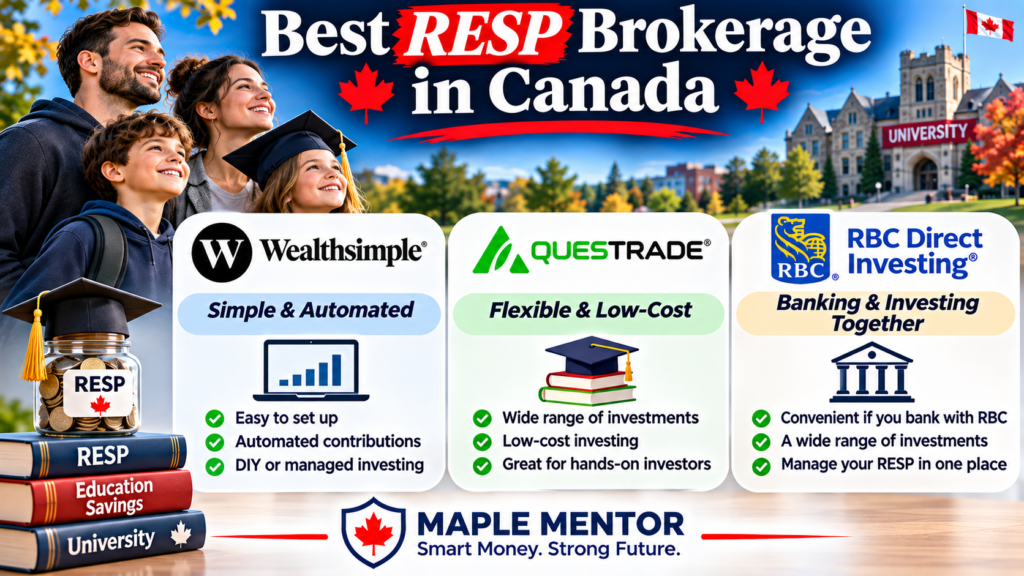
Should you choose Wealthsimple for its simple interface, commission-free investing, and managed portfolios? Is Questrade better because of its broader investment selection? Or does RBC Direct Investing make more sense if you already bank with RBC?
The answer depends on more than trading commissions.
For example, a parent in Quebec should consider whether their RESP provider supports the Quebec Education Savings Incentive (QESI). Meanwhile, a family with a newborn may prioritize long-term ETF investing, while parents whose child is approaching university may prefer access to GICs, bonds, and other conservative investments.
In this guide, we’ll compare the best RESP brokerage Canada options across fees, government grants, investment choices, automatic contributions, family RESP availability, and different education savings timelines.
Quick Answer: Best RESP Brokerage Canada
For most parents who want a straightforward investing experience, Wealthsimple is my preferred choice for simplicity and low-cost ETF investing.
However, Questrade and RBC Direct Investing also have meaningful advantages.
- Wealthsimple: Best for simplicity, commission-free eligible stock and ETF trading, recurring investing, and access to both self-directed and managed RESPs.
- Questrade: Best for parents who want commission-free eligible stock and ETF trading alongside a broader selection of investments, including GICs and bonds.
- RBC Direct Investing: Best for existing RBC customers who prefer a traditional bank-owned brokerage with access to stocks, ETFs, mutual funds, bonds, and GICs.
All three offer RESP accounts and support important government education savings incentives, including the Canada Education Savings Grant (CESG).
However, government-grant administration deserves particular attention.
A brokerage offering free ETF trades isn’t necessarily the best choice if it doesn’t support a grant your child is entitled to receive.
For Quebec families, provincial QESI support can be especially important.
Ultimately, the best RESP brokerage Canada offers is the one that supports your eligible government grants while providing investments appropriate for your child’s education timeline.
Best RESP Brokerage Canada: Comparison at a Glance
Before reviewing each brokerage individually, here’s how their main RESP features compare.
| Feature | Wealthsimple | Questrade | RBC Direct Investing |
|---|---|---|---|
| Self-directed RESP | Yes | Yes | Yes |
| Managed RESP option | Yes | Questwealth Portfolios | Separate RBC solutions |
| Individual RESP | Yes | Yes | Yes |
| Family RESP | Yes | Yes | Yes |
| Standard stock/ETF commissions | $0 | $0 online | Generally $9.95/trade |
| Recurring investing | Yes, eligible securities | Eligible recurring buys | Pre-authorized contributions |
| CESG support | Yes | Yes | Yes |
| Canada Learning Bond support | Yes | Yes | Yes |
| Quebec QESI support | Yes | Yes | Yes |
| GICs and bonds | Platform-dependent | Available | Available |
| Beginner experience | Excellent | Good | Good |
| Traditional brokerage tools | Growing | Broad selection | Broad selection |
| Best suited for | Simplicity | Flexibility | Banking integration |
Brokerage fees, investment eligibility, and government-grant administration can change. Confirm current terms with each institution before opening an account.
According to Wealthsimple’s RESP documentation, investors can choose between self-directed and managed RESP options.
Meanwhile, Questrade’s RESP offering provides access to eligible stocks, ETFs, GICs, bonds, and other investment products.
RBC Direct Investing offers a traditional self-directed RESP with individual and family plan options.
Each platform can be appropriate, but the differences become more important when considering government grants, investment costs, and how soon your child will need the money.
How Does an RESP Work Before Choosing a Brokerage?
Before selecting the best RESP brokerage Canada offers, it’s important to understand how an RESP works.
An RESP is a registered account designed to help Canadians save for a beneficiary’s eligible post-secondary education.
Unlike an RRSP, RESP contributions aren’t tax-deductible.
However, investment income and gains can grow tax-deferred within the plan.
When funds are withdrawn for eligible education expenses, grants and investment earnings are generally taxable to the student, who may have a relatively low income.
Original contributions can generally be withdrawn tax-free, subject to the plan’s rules.
RESP Contribution Limits
According to the Canada Revenue Agency’s RESP contribution rules, the lifetime RESP contribution limit is $50,000 per beneficiary.
There is currently no annual contribution limit.
However, government grants have their own annual and lifetime limits.
This means contributing $20,000 in one year doesn’t necessarily generate grants on the entire amount.
Canada Education Savings Grant (CESG)
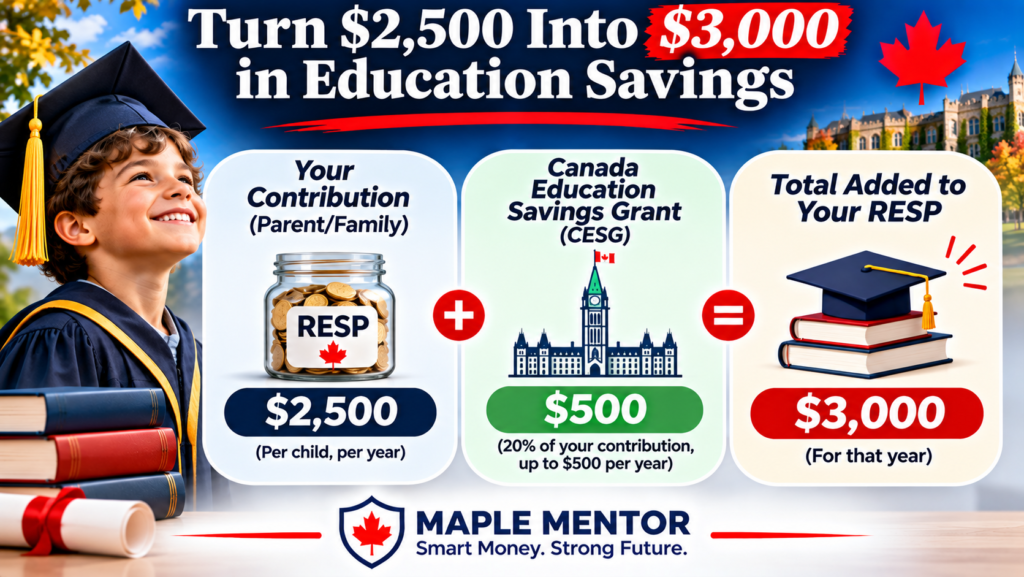
The basic CESG generally adds 20% of the first $2,500 contributed annually for an eligible beneficiary.
For example:
$2,500 contribution x 20% = $500 CESG
That means:
$2,500 contribution + $500 CESG = $3,000 in education savings
The lifetime CESG maximum is $7,200 per beneficiary.
Unused basic CESG entitlement can carry forward, potentially allowing up to $1,000 in basic CESG in a later year when sufficient unused entitlement exists.
The federal government’s education savings grant guidance explains the applicable limits and eligibility rules.
Why RESP Grants Matter So Much
Government grants can make a meaningful difference to education savings.
Suppose a parent contributes $2,500 annually for 14 years.
Their total contributions would be:
$2,500 x 14 = $35,000
If the child receives $500 in basic CESG each year:
$500 x 14 = $7,000
That represents $42,000 in contributions and grants before accounting for investment returns.
Actual grant eligibility depends on factors including the beneficiary’s age, residency, contribution history, and applicable program rules.
For families planning to save over many years, selecting a brokerage that properly administers government grants is essential.
Is Wealthsimple the Best RESP Brokerage Canada Offers?
Wealthsimple is one of the strongest options for parents who want a simple investing experience.
Its biggest advantage is that it offers both self-directed and managed RESP accounts.
This allows parents to choose whether they want to manage investments themselves or delegate portfolio management.
Wealthsimple Self-Directed RESP
Wealthsimple now offers self-directed RESPs.
This allows eligible investors to select their own stocks and ETFs rather than relying exclusively on managed portfolios.
According to Wealthsimple’s self-directed trading fee schedule, standard trading costs include:
- $0 commissions on eligible Canadian-listed stocks and ETFs
- $0 commissions on eligible U.S.-listed stocks and ETFs
- $0 account-opening fee
- $0 inactivity fee
For parents investing regularly, commission-free ETF purchases can help reduce costs.
For example, someone investing $200 every month into an eligible Canadian-listed ETF generally wouldn’t pay a standard trading commission.
Over 12 months:
$200 x 12 = $2,400
That represents $2,400 in annual contributions before government grants and investment returns.
Wealthsimple Managed RESP
Not every parent wants to select individual investments.
Wealthsimple also offers managed RESP portfolios.
With this approach, Wealthsimple selects and manages investments based on the account’s objectives and investor profile.
According to its official RESP account guide, standard management fees are currently:
- 0.5% annually for standard managed accounts
- 0.4% annually for eligible higher-tier accounts
Underlying ETF expenses may also apply.
Wealthsimple also states that management fees are waived for RESP clients receiving the Canada Learning Bond, subject to its applicable conditions.
This can make managed investing particularly appealing for eligible families.
Wealthsimple RESP Government Grants
One of Wealthsimple’s most important features is its government-grant administration.
According to Wealthsimple’s RESP grants documentation, it supports applications for eligible incentives including:
- Basic CESG
- Additional CESG
- Canada Learning Bond
- Quebec Education Savings Incentive
- British Columbia Training and Education Savings Grant
These programs have different eligibility requirements.
For example, the Canada Learning Bond is intended for eligible children from lower-income families.
The Quebec Education Savings Incentive provides additional provincial benefits for eligible Quebec residents.
Having grant administration integrated into the RESP experience can reduce the amount of paperwork parents need to manage.
However, investors should confirm the support and enrollment process for their specific account type.
Wealthsimple Automatic RESP Investing
Wealthsimple supports recurring purchases of eligible securities in supported self-directed accounts.
This can help parents build a consistent investing routine.
For example, someone could arrange recurring contributions and eligible ETF purchases according to a monthly schedule.
For parents who want to automate their investing, this is a meaningful advantage.
Our Automatic ETF Investing in Canada: Wealthsimple vs Questrade guide explains the differences between automatic deposits and recurring investment purchases.
Wealthsimple RESP Drawbacks
Despite its strengths, Wealthsimple isn’t necessarily the best choice for every family.
Its traditional fixed-income investment selection may be more limited than those of Questrade or RBC Direct Investing.
Parents who want to purchase specific GICs or bonds should verify availability before opening an account.
Managed portfolios also involve ongoing fees.
Additionally, the availability of recurring purchases and certain investment features may vary by account type.
Who Should Choose Wealthsimple?
Wealthsimple may be the best RESP brokerage Canada offers for parents who prioritize simplicity, low-cost ETF investing, and straightforward government-grant administration.
Verdict: My preferred choice for parents who want a simple self-directed or managed RESP experience.
For readers comparing platforms more broadly, our Best Investing Platform for Beginners in Canada guide explains how Wealthsimple compares with other Canadian brokerages.
Is Questrade the Best RESP Brokerage Canada Offers?
Questrade is another strong option, particularly for parents who want more control over their RESP investments.
Its biggest advantage is the combination of commission-free eligible stock and ETF trading with a broader selection of traditional investment products.
Questrade RESP Investment Choices
According to Questrade’s RESP information, eligible investors can access products including:
- Stocks
- ETFs
- Options
- Bonds
- GICs
- Mutual funds
Not every investment is suitable for education savings.
However, having a broader selection can be valuable as your child’s education date approaches.
For example, a parent investing for a newborn may prioritize diversified ETFs.
A parent whose child will begin university next year may prefer GICs or other conservative investments.
Questrade RESP Trading Fees
Questrade currently advertises $0 commissions on eligible online stock and ETF trades.
It also generally offers no annual account fees or inactivity fees.
This makes it competitive with Wealthsimple for self-directed ETF investing.
However, other transaction costs may apply depending on the investment and service.
You can review the current details through Questrade’s official pricing information.
Questrade RESP Automatic Contributions
Questrade supports pre-authorized deposits and recurring purchases of eligible securities.
A pre-authorized deposit automatically transfers money into the RESP.
A recurring purchase automatically invests money in an eligible security.
These features are different.
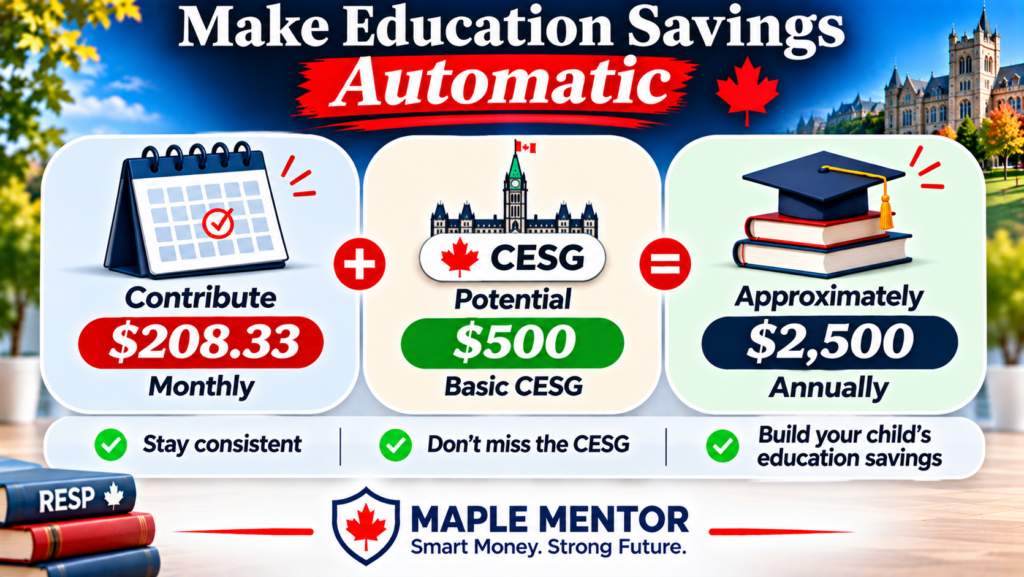
For example, a parent could schedule approximately $208.33 in monthly contributions.
$208.33 x 12 = $2,499.96
That’s approximately $2,500 annually, which can be enough to qualify for the standard maximum basic CESG when the beneficiary meets the applicable conditions.
However, Questrade’s recurring-buy program currently focuses on eligible U.S.-listed fractional stocks and ETFs.
Parents wanting automatic purchases of Canadian-listed ETFs should verify eligibility.
Questrade Self-Directed vs Questwealth RESP
Questrade offers two main approaches to RESP investing.
Self-directed investing allows parents to choose and manage their own eligible investments.
Questwealth Portfolios provides managed investing for parents who prefer portfolio management services.
Questwealth charges management fees in addition to applicable underlying fund expenses.
This gives families a choice between managing investments independently and paying for a managed solution.
Questrade RESP Government Grants
Questrade supports important RESP government incentives, including the CESG and applicable provincial incentives.
For Quebec families, its support for QESI is particularly important.
However, parents should verify grant eligibility, the applicable enrollment process, and any account-specific requirements before opening an RESP.
Questrade RESP Drawbacks
Questrade may feel more complex than Wealthsimple for parents who are completely new to investing.
Its recurring-buy program also has restrictions that may affect automatic purchases of Canadian-listed ETFs.
Additionally, access to a wide range of investments can make portfolio management more complicated for inexperienced investors.
Who Should Choose Questrade?
Questrade could be the best RESP brokerage Canada offers for parents who want commission-free eligible ETF trading, broader investment choices, and the ability to adjust their portfolio as their child approaches post-secondary education.
Verdict: A strong choice for self-directed investors who value flexibility and access to traditional fixed-income investments.
For a broader platform comparison, our Wealthsimple vs Questrade Canada article explains the differences between the two brokerages.
Is RBC Direct Investing the Best RESP Brokerage Canada Offers?
RBC Direct Investing is worth considering for Canadian families who prefer a traditional bank-owned brokerage.
Unlike RBC GoSmart, which focuses on beginner investing through certain registered accounts, RBC Direct Investing provides a broader self-directed RESP experience.
Its main advantages include banking integration, traditional investment products, and access to research tools.
However, standard trading commissions are generally higher than those at Wealthsimple and Questrade.
RBC Individual RESP
RBC Direct Investing offers individual RESPs.
An individual RESP has one beneficiary.
This structure can be useful for parents, grandparents, or other subscribers saving for one child’s education.
The beneficiary doesn’t necessarily need to be related to the subscriber.
RBC Family RESP
RBC also offers family RESPs.
A family RESP can include multiple eligible beneficiaries who are related to the subscriber by blood or adoption, as defined under the applicable rules.
For example, parents with three children may prefer a family RESP rather than maintaining three completely separate individual plans.
A family plan can provide flexibility in allocating eligible education savings among beneficiaries.
However, government-grant limits still apply to each beneficiary.
RBC RESP Investment Choices
According to RBC Direct Investing’s RESP documentation, investors can access a broad selection of eligible investments, including:
- Stocks
- ETFs
- Mutual funds
- GICs
- Bonds
- Options
This broader selection may be valuable for families who want to change their investment strategy as their children get older.
For example, a parent investing for a newborn may prefer a diversified equity ETF.
A parent whose child will begin university in two years may prefer GICs or other conservative investments.
RBC Direct Investing RESP Fees
RBC’s standard online stock and ETF trading commission is generally $9.95 per transaction.
Investors who qualify for active-trader pricing may pay lower commissions.
RBC also offers commission-free trading on a selection of eligible ETFs, so the $9.95 standard commission doesn’t apply to every ETF transaction. RBC Direct Investing+1
For example, suppose you purchase one ETF every month and pay the standard $9.95 commission.
Over one year:
$9.95 x 12 = $119.40
Over ten years:
$119.40 x 10 = $1,194
This excludes potential investment returns on the money spent on commissions.
For someone making frequent small contributions, trading costs can become significant.
However, if your preferred ETF qualifies for commission-free trading, the comparison changes.
RBC RESP Automatic Contributions
RBC supports pre-authorized RESP contributions.
This allows parents to transfer money into the account automatically.
However, automatically contributing money isn’t necessarily the same as automatically purchasing an investment.
In a self-directed RESP, investors generally remain responsible for deciding how to invest their contributions.
RBC also supports dividend reinvestment for eligible securities.
RBC RESP Government Grants
This platform supports federal RESP incentives, including the CESG and Canada Learning Bond, subject to eligibility.
RBC is also listed as a participating provider for Quebec’s QESI program.
The Government of Canada’s RESP promoter list provides information about participating institutions and supported education savings incentives.
RBC RESP Drawbacks
RBC’s main drawback is its standard trading commission.
Parents who make frequent ETF purchases outside the commission-free selection may pay considerably more than they would at Wealthsimple or Questrade.
Its self-directed platform may also feel more complex than Wealthsimple’s beginner-focused interface.
Who Should Choose RBC Direct Investing?
RBC Direct Investing may be the best RESP brokerage Canada offers for existing RBC customers who value banking integration, access to traditional investment products, and a familiar financial institution.
Verdict: A reasonable choice for parents who want broader investment selection and RBC banking integration, although standard trading commissions deserve careful consideration.
Our RBC Direct Investing vs Wealthsimple comparison examines the differences between these platforms in greater detail.

Which RESP Brokerage Is Best for Government Grants?
Government grants are among the most important considerations when choosing an RESP provider.
Unlike a regular investment account, an RESP can receive government contributions when the beneficiary meets the applicable eligibility requirements.
For some families, grant support may matter more than saving a few dollars in trading commissions.
Canada Education Savings Grant (CESG)
The basic CESG generally provides 20% of eligible annual RESP contributions, up to $500 per beneficiary annually.
For example:
$2,500 contribution x 20% = $500 CESG
The lifetime maximum is $7,200 per beneficiary.
However, unused basic CESG entitlement can carry forward.
When sufficient unused entitlement exists, eligible contributions may generate up to $1,000 of basic CESG in a later year.
Additional CESG amounts may also be available depending on adjusted family income.
The federal government’s CESG guidance explains the applicable rules.
Canada Learning Bond (CLB)
The Canada Learning Bond is another federal education savings incentive.
Eligible children from lower-income families may receive up to $2,000.
Importantly, personal RESP contributions aren’t required to qualify for the CLB.
This means an eligible family may be able to receive education savings assistance even if they cannot afford to make regular contributions.
The Government of Canada’s education savings resources explain the program’s eligibility requirements.
Which Brokerage Supports These Grants?
Wealthsimple, Questrade, and RBC Direct Investing all support major federal RESP incentives.
However, parents should confirm the grant application process and account-specific requirements.
For example, Wealthsimple automatically applies for certain eligible grants after the necessary account setup and authorizations are completed.
Other providers may require additional documentation.
Why Grant Processing Matters
Suppose two brokerages offer similar ETF trading fees.
One supports every grant your child qualifies for, while the other doesn’t support a relevant provincial incentive.
The first brokerage may provide significantly greater value, even if its investing interface is slightly less convenient.
This is especially important for Quebec families.
Best RESP Brokerage in Quebec: What About QESI?
For Quebec residents, the Quebec Education Savings Incentive is one of the most important RESP considerations.
The QESI is a provincial incentive administered by Revenu Québec.
It provides additional education savings benefits on top of federal grants.
How Much Is the QESI Worth?
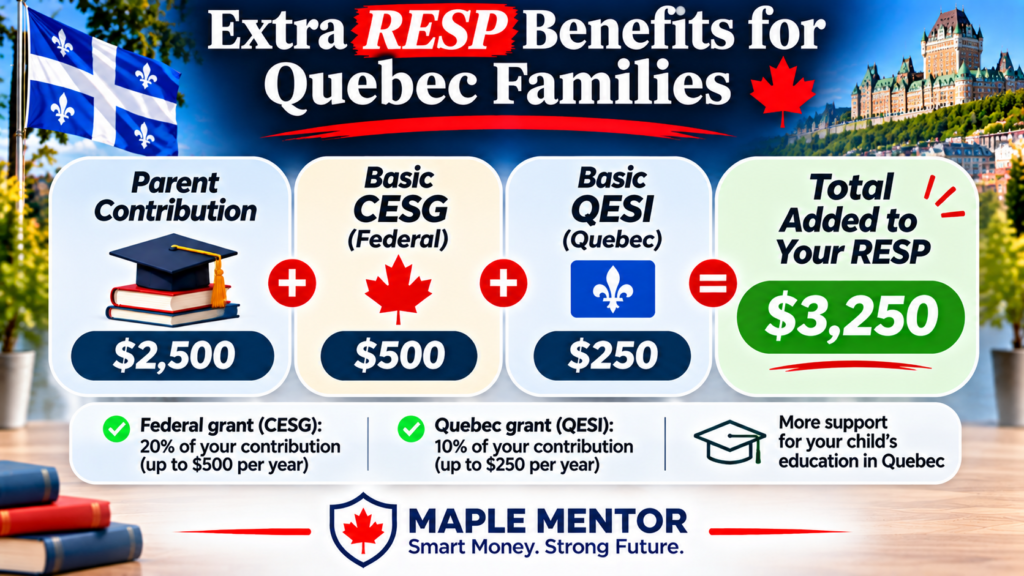
According to Revenu Québec’s education savings incentive information, the basic QESI generally provides 10% of eligible RESP contributions.
This means:
$2,500 contribution x 10% = $250 QESI
Eligible lower-income families may receive an additional amount.
The lifetime QESI maximum is $3,600 per beneficiary.
Combining CESG and QESI
For an eligible Quebec child, a $2,500 annual RESP contribution could generate:
| Source | Amount |
|---|---|
| Parent’s contribution | $2,500 |
| Basic CESG | $500 |
| Basic QESI | $250 |
| Total education savings | $3,250 |
This represents $750 in combined basic federal and provincial incentives on a $2,500 contribution.
That’s equivalent to 30% of the parent’s contribution before investment returns, assuming full eligibility.
However, grant eligibility, timing, and annual limits still apply.
Does Wealthsimple Support QESI?
Yes.
Wealthsimple introduced QESI support in April 2026, expanding its RESP offering for Quebec families.
According to Wealthsimple’s official QESI announcement, eligible Quebec families can apply for the incentive through Wealthsimple.
The application is completed once, after which Wealthsimple processes eligible grants according to the program’s rules.
This is an important development because provincial grant support was previously a limitation for Quebec residents considering Wealthsimple.
Does Questrade Support QESI?
Yes.
Questrade is included on Revenu Québec’s list of participating RESP promoters.
This makes it a viable option for eligible Quebec families seeking provincial education savings incentives.
Does RBC Direct Investing Support QESI?
Yes.
RBC Direct Investing is also listed as a participating RESP promoter.
Its support for QESI makes it another option for Quebec residents.
Revenu Québec maintains an official list of participating RESP providers, which includes Wealthsimple Investments, Questrade, and RBC Direct Investing. Revenu Québec+2
Which RESP Brokerage Is Best for Quebec Residents?
All three brokerages can be considered because they support QESI.
However, investors should still compare trading fees, investment selection, automation, and grant administration.
For a Quebec family investing regularly in Canadian-listed ETFs, Wealthsimple and Questrade may be particularly attractive because of their commission-free eligible trading.
RBC may appeal to parents who already bank there or want access to traditional fixed-income products.
The important point is that QESI support should be verified before opening any RESP in Quebec, especially if you’re considering a provider outside these three options.
Individual RESP vs Family RESP: Which Should You Open?
Another important decision is whether to open an individual RESP or a family RESP.
All three brokerages offer RESP structures suitable for different family situations.
Individual RESP
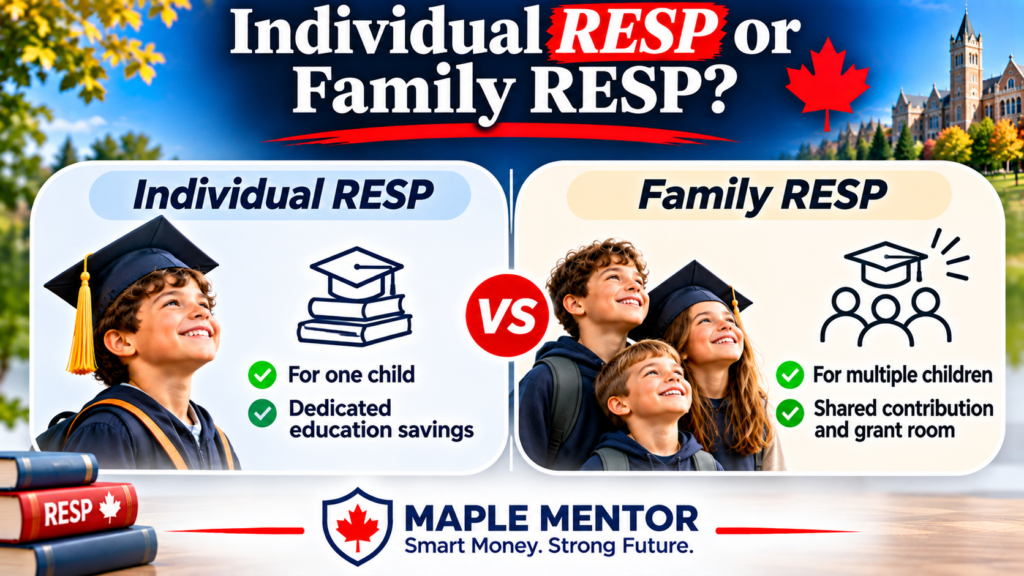
An individual RESP has one beneficiary.
This may be appropriate when:
- You’re saving for one child.
- You want separate accounts for each child.
- The beneficiary isn’t related to you.
- You prefer tracking contributions and grants individually.
Individual RESPs can be straightforward to manage.
Family RESP
A family RESP can include multiple eligible related beneficiaries.
This may be appropriate when:
- You have multiple children.
- You want to manage education savings together.
- You prefer one investment portfolio for several beneficiaries.
- You want some flexibility in allocating eligible education savings.
For example, a family with two children may prefer contributing to one family RESP.
However, contributions and government grants must still be tracked for each beneficiary.
The lifetime RESP contribution limit remains $50,000 per beneficiary.
Which Is Better?
Neither structure is universally better.
A family RESP can be convenient for families with multiple children, while individual RESPs may make contribution tracking simpler.
Before opening a family plan, confirm the brokerage’s beneficiary rules, grant administration, and withdrawal procedures.
Best RESP Brokerage Canada for ETF Investing
For parents who want to build long-term education savings, diversified ETFs can be an attractive option.
Rather than choosing individual companies, an ETF can provide exposure to hundreds or thousands of investments through a single purchase.
However, not every ETF is appropriate for every child’s education timeline.
Wealthsimple for RESP ETFs
Wealthsimple is particularly attractive for parents who want a simple ETF portfolio.
Its commission-free eligible ETF trading helps reduce costs, while recurring investments can simplify regular purchases when supported in the account.
For example, a parent might contribute $200 every month and invest in an eligible diversified ETF.
Questrade for RESP ETFs
Questrade also offers commission-free eligible online ETF trading.
Its broader traditional brokerage functionality may appeal to parents who want additional investment choices.
For investors comfortable placing their own orders, Questrade can be an excellent option.
RBC Direct Investing for RESP ETFs
RBC provides access to a broad selection of ETFs.
However, standard commissions generally apply outside its commission-free ETF selection.
Parents investing small amounts frequently should calculate the impact of those fees.
Which ETFs Should Parents Consider?
Several popular Canadian ETFs provide different types of exposure.
| ETF | Investment Exposure | Main Consideration |
|---|---|---|
| XEQT | Globally diversified equities | 100% stocks |
| VEQT | Globally diversified equities | 100% stocks |
| XGRO | Diversified stocks and bonds | Approximately 80% stocks |
| XBAL | Diversified stocks and bonds | Approximately 60% stocks |
For a young child with many years before post-secondary education, a diversified equity portfolio may be worth considering.
However, parents who cannot tolerate substantial market declines may prefer a more conservative allocation.
As the child approaches university, the investment strategy may need to change.
Our XEQT vs VEQT comparison explains the differences between two popular all-equity ETFs, while our XEQT vs XGRO guide explores how adding bonds changes portfolio risk.
For readers who are completely new to investing, our Best ETFs for Beginners in Canada article provides additional context.
Best RESP Brokerage Canada for Automatic Contributions
Automatic contributions can help parents build education savings consistently.
For example, suppose you want to contribute enough each year to qualify for the standard maximum basic CESG.
You could contribute approximately $208.33 monthly.
$208.33 x 12 = $2,499.96
Alternatively, you could contribute approximately $96.15 every two weeks.
$96.15 x 26 = $2,499.90
Both approaches bring annual contributions close to $2,500.
However, remember that automatically depositing money and automatically investing that money are two separate actions.
Wealthsimple Automatic RESP Investing
Wealthsimple supports recurring investment functionality for eligible securities and accounts.
This can make it convenient for parents who want to invest regularly without manually placing every order.
Parents should confirm that their chosen RESP type and ETF support the recurring-purchase feature.
Questrade Automatic RESP Investing
Questrade offers pre-authorized deposits and recurring buys.
Its recurring-buy program has investment eligibility restrictions, so not every Canadian-listed ETF can necessarily be purchased automatically.
Nevertheless, recurring deposits can simplify contributions even when investment orders must be placed manually.
RBC Automatic RESP Contributions
RBC Direct Investing supports pre-authorized RESP contributions.
This allows parents to transfer money into their account regularly.
However, the self-directed account holder generally remains responsible for purchasing investments.
Which Brokerage Is Best for Automation?
Wealthsimple and Questrade are both worth considering.
Wealthsimple may offer the simpler experience for eligible recurring ETF purchases.
Questrade provides useful deposit automation alongside broader investment choices.
RBC can also automate account funding, although its self-directed investing process may involve more manual steps.
For a detailed explanation, see our Automatic ETF Investing in Canada: Wealthsimple vs Questrade guide.
Best RESP Brokerage Canada When Your Child Is Young
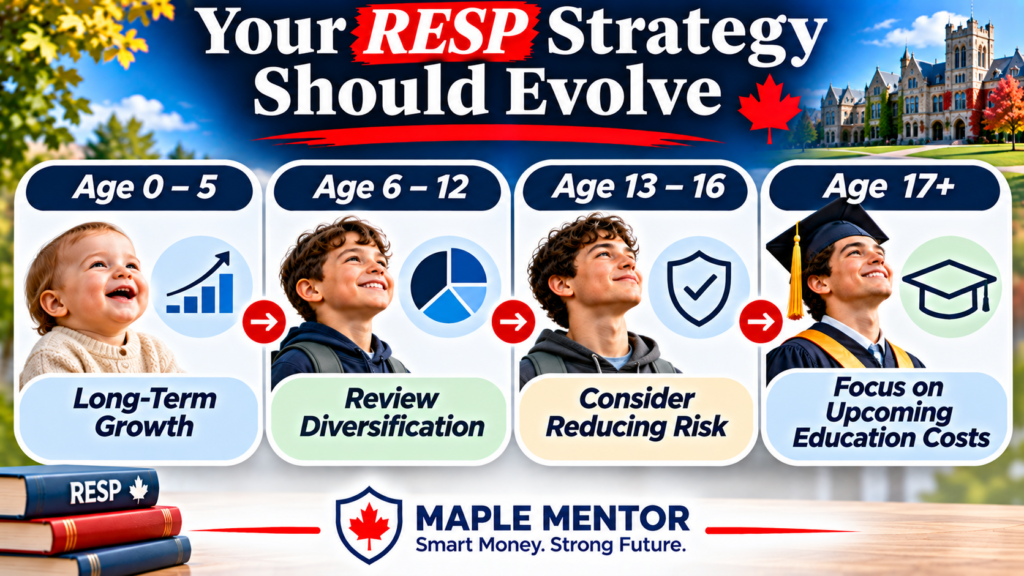
A parent opening an RESP for a newborn has a very different investment horizon from a parent saving for a teenager.
If your child is only one year old, you may have approximately 17 years before they begin post-secondary education.
That longer timeline can provide more flexibility.
Why a Longer Timeline Matters
Stock markets can experience significant declines over short periods.
However, longer investment horizons may provide more opportunities to recover from temporary market downturns.
This doesn’t guarantee positive returns.
Nevertheless, parents with a long timeline may consider diversified equity investments if their financial situation and risk tolerance allow it.
Investing in Diversified ETFs
A diversified ETF can help spread investment exposure across different companies and markets.
For example, an all-equity ETF may provide broad exposure to Canadian, U.S., and international stocks.
However, a 100% equity portfolio can still experience substantial losses.
Parents who prefer less volatility may consider a balanced ETF containing both stocks and bonds.
Consistent Contributions Matter
One of the most effective RESP habits is contributing consistently.
For example, contributing $2,500 annually for 15 years would result in:
$2,500 x 15 = $37,500 in contributions
If the beneficiary qualifies for $500 of basic CESG annually:
$500 x 15 = $7,500 in calculated grant entitlement
However, the CESG lifetime maximum is $7,200, so actual grants would be capped accordingly.
This example illustrates why understanding both annual and lifetime grant limits matters.
Which Brokerage Is Best for a Young Child?
Wealthsimple and Questrade are particularly attractive for parents who want low-cost ETF investing over many years.
Wealthsimple may be preferable for simplicity and eligible automatic purchases.
Questrade may appeal to parents who want broader investment choices and greater portfolio control.
RBC remains an option, especially for families already using its banking services.
Best RESP Brokerage Canada When University Is Getting Close
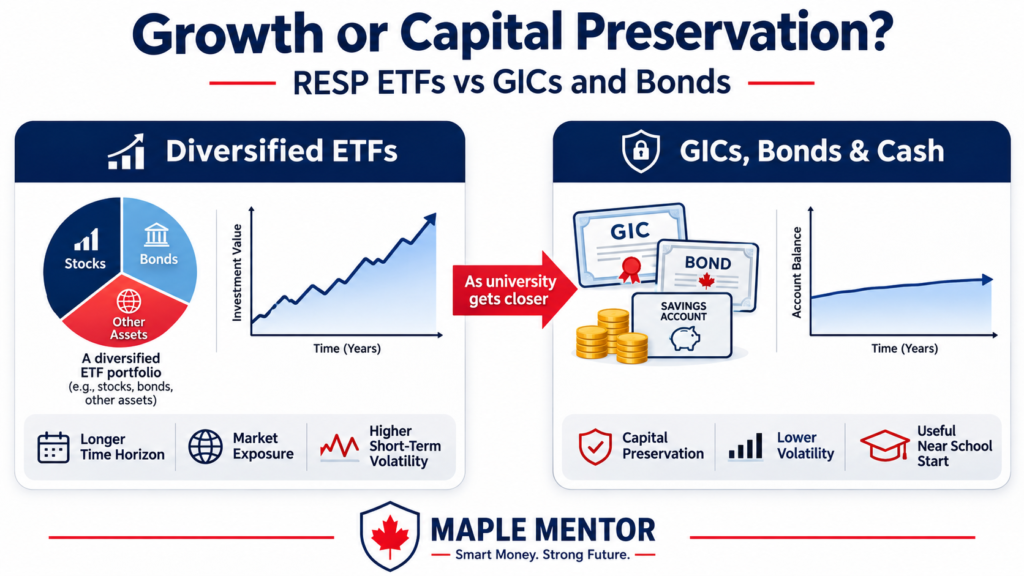
As your child approaches post-secondary education, the purpose of your RESP investments begins to change.
A portfolio designed for long-term growth may no longer be appropriate when the money will be needed soon.
Why Capital Preservation Becomes Important
Imagine an RESP worth $50,000 when your child is 17.
If the portfolio is invested entirely in stocks and markets decline by 25%, the account could fall to approximately $37,500.
$50,000 x 25% = $12,500 loss
That could significantly affect the family’s ability to pay tuition, housing, and other education expenses.
For this reason, parents may gradually reduce investment risk as the withdrawal date approaches.
Conservative RESP Investments to Consider
Depending on the brokerage and account eligibility, conservative choices may include:
- Cash and interest-bearing savings products
- GICs
- Short-term bonds
- Money-market funds
- Lower-volatility fixed-income ETFs
However, these investments have different risk and liquidity characteristics.
For example, a non-redeemable GIC may provide a guaranteed return but restrict access until maturity.
A bond ETF can fluctuate in value as interest rates change.
Why Questrade and RBC May Have an Advantage
Questrade and RBC Direct Investing both offer traditional fixed-income products, including eligible GICs and bonds.
This may be valuable for parents who want to move gradually from growth-oriented investments toward capital preservation.
Wealthsimple may also offer suitable lower-risk options, but parents should verify the exact products available in their RESP.
A Practical Education Savings Timeline
| Time Until Education | Main Consideration |
|---|---|
| 15+ years | Long-term growth and diversification |
| 10–15 years | Growth balanced with risk tolerance |
| 5–10 years | Begin reviewing exposure to market volatility |
| 2–5 years | Greater emphasis on preserving upcoming withdrawals |
| 0–2 years | Liquidity and capital preservation |
This is an illustrative framework, not a universal investment allocation.
For example, a family with substantial savings outside the RESP may be comfortable taking more risk than a family relying entirely on RESP withdrawals to pay tuition.
The best RESP brokerage Canada offers should allow you to adjust your investments as your child’s needs change.
Self-Directed vs Managed RESP: Which Is Better?
Not every parent wants to choose and manage investments personally.
Fortunately, Wealthsimple and Questrade offer both self-directed and managed RESP options.
Self-Directed RESP
A self-directed RESP allows you to choose eligible investments yourself.
This may be appropriate if you:
- Understand basic ETF investing.
- Want to minimize ongoing management fees.
- Are comfortable selecting an asset allocation.
- Can periodically review and adjust the portfolio.
For example, a parent might choose one diversified asset allocation ETF and contribute regularly.
However, the parent remains responsible for ensuring that the investment strategy stays appropriate.
Managed RESP
A managed RESP delegates investment selection and portfolio management to a provider.
This may be appropriate if you:
- Don’t want to research individual investments.
- Prefer professional portfolio management.
- Want assistance with rebalancing.
- Are comfortable paying ongoing management fees.
Wealthsimple Managed RESP
Wealthsimple offers managed RESP portfolios.
Its standard management fee is currently 0.5% annually, with lower fees available for certain eligible clients.
Underlying ETF expenses may also apply.
Questrade Questwealth RESP
Questrade offers Questwealth Portfolios as a managed alternative.
Its management fees currently start at 0.25% annually, with underlying ETF expenses applying separately.
How Much Do Management Fees Matter?
Suppose your RESP has a balance of $40,000.
At a 0.5% annual management fee:
$40,000 x 0.5% = $200 annually
At a 0.25% annual management fee:
$40,000 x 0.25% = $100 annually
These examples exclude underlying fund expenses and assume a constant balance.
Although the difference may appear small, fees compound over time.
However, a managed service may still provide value for parents who prefer delegating portfolio management.
Our ETF vs Robo-Advisor in Canada article explores the trade-offs between self-directed ETF investing and managed portfolios.
Wealthsimple vs Questrade vs RBC: Which RESP Brokerage Should You Choose?
After comparing the available features, the best RESP brokerage Canada offers depends on your investment experience, the grants your child qualifies for, and how long you have before education expenses begin.
| Your Priority | Brokerage to Consider |
|---|---|
| Maximum simplicity | Wealthsimple |
| Commission-free eligible ETF trading | Wealthsimple or Questrade |
| Self-directed and managed RESP options | Wealthsimple or Questrade |
| Broader investment selection | Questrade |
| Traditional GICs and bonds | Questrade or RBC |
| Existing RBC customer | RBC Direct Investing |
| Quebec resident seeking QESI | All three support it |
| Automatic contributions | All three offer funding options |
| Eligible recurring ETF purchases | Wealthsimple or Questrade |
| Traditional bank-owned brokerage | RBC Direct Investing |
| Beginner-friendly experience | Wealthsimple |
| Greater brokerage control | Questrade |
When I Would Choose Wealthsimple
I would lean toward Wealthsimple for parents who want to keep education savings straightforward.
Its combination of eligible commission-free ETF trading, managed investing, and government-grant administration makes it attractive.
It may be particularly convenient for families who want to contribute regularly and avoid unnecessary investment complexity.
When I Would Choose Questrade
I would consider Questrade for parents who want greater investment flexibility.
Its commission-free eligible ETF trading and access to traditional investment products make it useful for both long-term growth and more conservative investing as university approaches.
When I Would Choose RBC Direct Investing
I would consider RBC for families who already bank there and prefer managing their investments through a traditional financial institution.
Its broad investment selection can be valuable.
However, I would carefully compare trading commissions, particularly when making small monthly ETF purchases.
What Matters Most?
For RESP investing, three factors deserve particular attention:
- Government grants: Does the provider support the incentives your child qualifies for?
- Investment costs: How much will you pay in commissions and management fees?
- Education timeline: Can you choose investments that match when your child will need the money?
A brokerage that performs well in these three areas is likely to be a strong candidate.
Common RESP Mistakes Parents Should Avoid
Even after choosing the best RESP brokerage Canada offers for your family, several mistakes can reduce the effectiveness of your education savings strategy.
1. Ignoring Government Grants
The CESG and applicable provincial incentives can substantially increase education savings.
Before opening an RESP, verify which grants your provider supports.
2. Contributing Without Understanding Grant Limits
Although there is no annual RESP contribution limit, government grants have annual and lifetime limits.
Contributing more than $2,500 in a year doesn’t automatically generate additional basic CESG unless the beneficiary has eligible unused grant entitlement.
3. Investing Too Aggressively Near University
A portfolio that made sense when your child was two years old may be inappropriate when they’re 17.
Review investment risk as education expenses approach.
4. Paying Unnecessary Trading Commissions
Frequent small purchases can become expensive at a brokerage charging standard commissions.
Consider whether your preferred investments qualify for commission-free trading.
5. Leaving Contributions Uninvested
Depositing money into a self-directed RESP doesn’t necessarily mean the money is invested.
If you intend to purchase ETFs, make sure the funds are actually invested according to your plan.
6. Forgetting the Lifetime Contribution Limit
The lifetime RESP contribution limit is $50,000 per beneficiary across all RESPs.
Opening multiple plans doesn’t increase that limit.
7. Assuming All RESP Providers Support the Same Grants
Federal and provincial education savings incentives have different eligibility requirements.
Some providers may not support every provincial program.
Always confirm grant availability before opening an account.
Final Verdict: Best RESP Brokerage Canada
Choosing the best RESP brokerage Canada offers requires more than comparing ETF trading commissions.
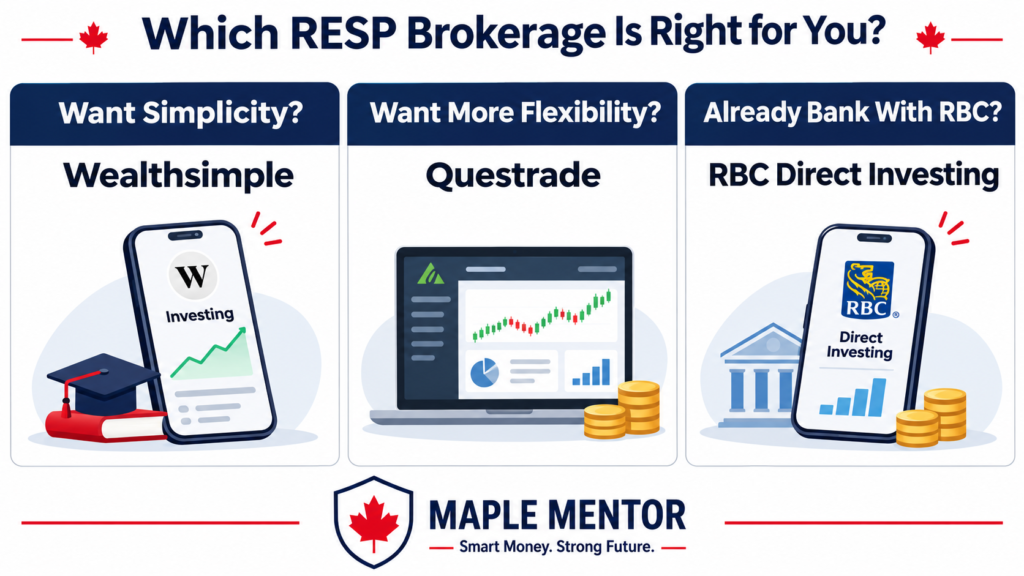
Wealthsimple, Questrade, and RBC Direct Investing all provide useful RESP options, but their strengths differ.
Wealthsimple is my preferred choice for simplicity and low-cost ETF investing.
Its commission-free eligible stock and ETF trading, managed investing options, and government-grant administration make it particularly attractive for parents who want a straightforward experience.
Questrade is my preferred alternative for greater investment flexibility.
Its commission-free eligible trading and broader selection of investment products make it useful for parents who want to manage their portfolios and gradually adjust investment risk.
RBC Direct Investing is worth considering for existing RBC customers.
Its traditional brokerage functionality and access to eligible GICs, bonds, ETFs, and other investments may appeal to families who value banking integration.
However, standard trading commissions can make frequent small ETF purchases more expensive.
For Quebec families, it’s encouraging that all three providers support the Quebec Education Savings Incentive.
Ultimately, the best RESP brokerage Canada offers is the one that supports the grants your child qualifies for while providing an investment strategy that fits their education timeline.
A parent investing for a newborn has different priorities from a parent preparing to pay university tuition next year.
Choose the platform that supports your needs today while allowing your investment strategy to evolve.
Frequently Asked Questions
What Is the Best RESP Brokerage Canada Offers?
Wealthsimple is a strong choice for simplicity, commission-free eligible ETF trading, and managed investing.
Questrade is attractive for parents who want broader investment choices and traditional brokerage functionality.
RBC Direct Investing may be convenient for existing RBC customers who value banking integration.
The best option depends on government-grant support, fees, and your child’s education timeline.
How Much Should I Contribute to an RESP to Get the Full CESG?
Contributing $2,500 annually generally qualifies an eligible beneficiary for the maximum basic annual CESG of $500.
However, unused grant entitlement can carry forward, potentially allowing a larger basic CESG in a later year.
What Is the RESP Lifetime Contribution Limit?
The lifetime RESP contribution limit is $50,000 per beneficiary across all RESPs.
There is currently no annual contribution limit.
Does Wealthsimple Offer a Self-Directed RESP?
Yes.
Wealthsimple offers both self-directed and managed RESP options.
Its self-directed accounts allow eligible investors to choose their own stocks and ETFs.
Does Questrade Offer an RESP?
Yes.
Questrade offers self-directed RESPs and managed Questwealth Portfolios.
Its self-directed platform supports eligible stocks, ETFs, GICs, bonds, mutual funds, and other investment products.
Does RBC Direct Investing Offer a Family RESP?
Yes.
RBC Direct Investing offers both individual and family RESPs.
Family plans can include multiple eligible related beneficiaries.
Can Quebec Residents Receive QESI Through an Online Brokerage?
Yes, provided the RESP provider supports QESI and the beneficiary meets the eligibility requirements.
Wealthsimple, Questrade, and RBC Direct Investing currently support the incentive.
Is Wealthsimple or Questrade Better for an RESP?
Wealthsimple may be more convenient for parents who prioritize simplicity and eligible recurring ETF purchases.
Questrade may be more attractive for parents who want broader investment choices, including traditional fixed-income products.
Both can be appropriate for long-term education savings.
Should I Invest My RESP in Stocks?
That depends on your child’s education timeline and your risk tolerance.
Stocks may be appropriate for some long-term investors, but they can experience substantial short-term declines.
As education expenses approach, parents may want to reduce risk and prioritize capital preservation.
What Happens If My Child Doesn’t Attend University?
An RESP can also be used for various eligible post-secondary education programs beyond university.
If the beneficiary doesn’t pursue eligible education, options may include changing beneficiaries, transferring certain funds to another eligible plan, withdrawing contributions, or making an accumulated income payment under applicable rules.
Government grants may need to be repaid in certain circumstances.