
Automatic ETF investing Canada is becoming easier for Canadians who want to build long-term investment portfolios without manually purchasing ETFs every payday. Both Wealthsimple and Questrade now offer recurring investment features, but their automation capabilities are not identical.
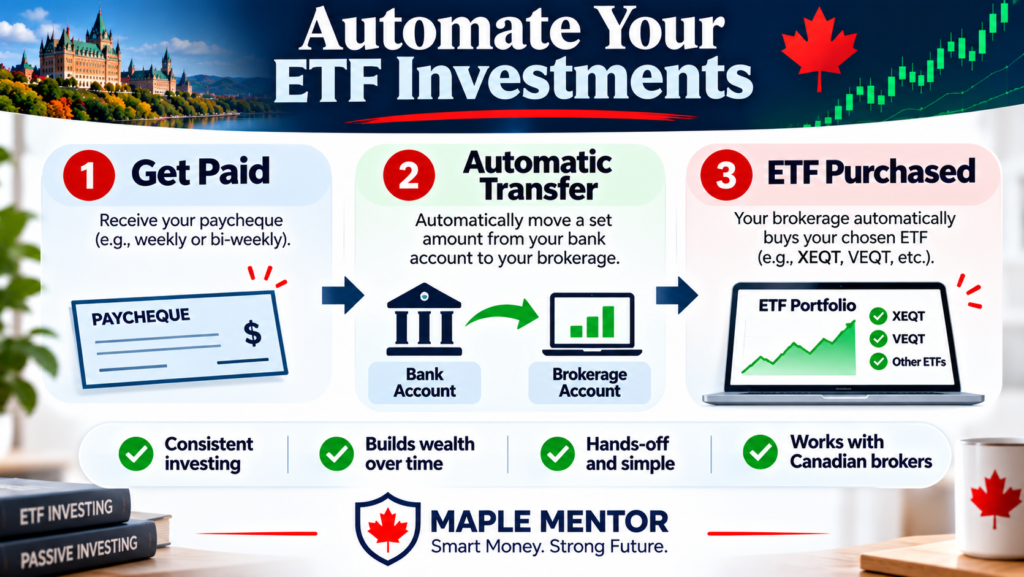
For someone investing $200 every two weeks into an ETF such as XEQT, the ideal setup is straightforward: money enters the investment account, the ETF is purchased automatically, and the investor doesn’t need to log in to place an order.
However, not every Canadian brokerage supports this process for every ETF.
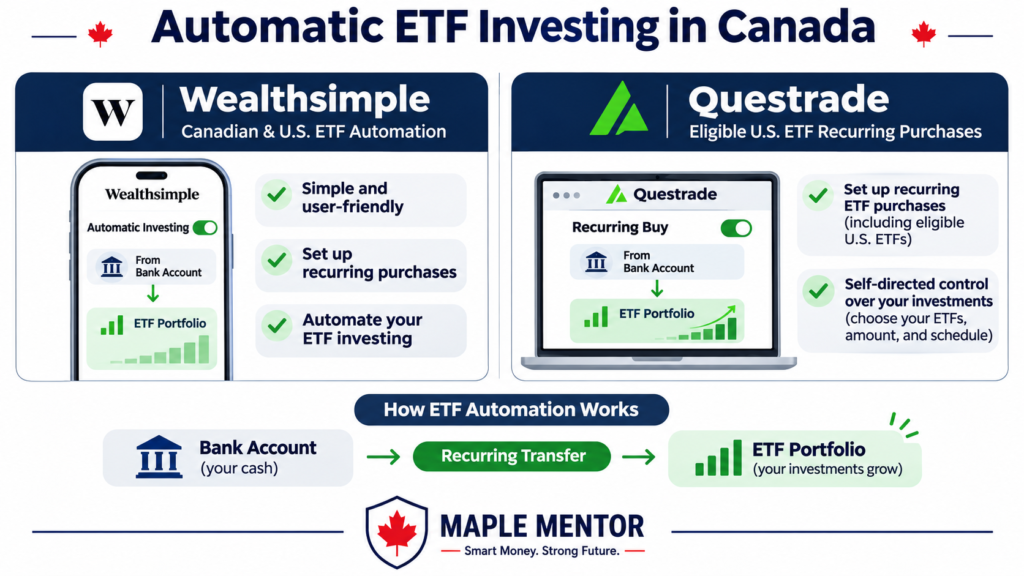
Wealthsimple offers recurring purchases for eligible Canadian- and U.S.-listed ETFs, with flexible schedules and multiple funding methods.
Questrade also supports recurring purchases, but its published recurring-investment program is currently limited to eligible fractional U.S.-listed stocks and ETFs.
That difference is especially important for Canadians who want to automate purchases of popular Canadian-listed ETFs such as XEQT, VEQT, VFV, or XGRO.
In this guide, we’ll compare automatic ETF investing Canada options through Wealthsimple and Questrade, including supported securities, recurring deposits, TFSA and FHSA automation, fractional shares, currency-conversion costs, and practical investment setups.
Quick Answer: Automatic ETF Investing Canada
For investors who want to automate purchases of Canadian-listed ETFs, Wealthsimple currently offers the more flexible recurring-investment system.
It supports scheduled purchases of eligible stocks and ETFs on daily, weekly, biweekly, or monthly schedules. Purchases can be funded through supported Wealthsimple accounts, available trading cash, or linked external bank accounts.
Questrade also supports recurring investments with similar scheduling frequencies. However, its current recurring-buy program focuses on eligible fractional U.S.-listed securities.
For example, someone wanting to automatically buy $200 of XEQT every two weeks would generally find Wealthsimple more suitable.
Someone already using Questrade who wants to automate purchases of an eligible U.S.-listed ETF may be able to use Questrade’s recurring-investment feature instead.
The key distinction is which ETFs can actually be purchased automatically, not simply whether the brokerage advertises recurring investing.
Automatic ETF Investing Canada: Wealthsimple vs Questrade at a Glance
| Feature | Wealthsimple | Questrade |
|---|---|---|
| Recurring ETF purchases | Yes | Yes |
| Canadian-listed ETF recurring purchases | Eligible ETFs supported | Not supported under the described recurring-buy program |
| U.S.-listed ETF recurring purchases | Eligible ETFs supported | Eligible fractional ETFs supported |
| Daily purchases | Yes | Yes |
| Weekly purchases | Yes | Yes |
| Biweekly purchases | Yes | Yes |
| Monthly purchases | Yes | Yes |
| Direct external-bank purchase funding | Supported | Fund brokerage account separately |
| TFSA recurring investments | Supported | Supported for eligible securities |
| RRSP recurring investments | Supported | Supported for eligible securities |
| FHSA recurring investments | Supported for eligible securities | Supported for eligible U.S.-listed securities |
| Fractional investing | Eligible securities | Eligible securities |
| Automatic CAD/USD conversion | Available, fees may apply | Available, generally 1.5% |
| Commission-free eligible ETF trades | Yes | Yes |
Features are subject to account eligibility, security availability, sufficient funding, and brokerage policies.
Wealthsimple’s recurring-investment documentation is available through its official Help Centre.
Questrade explains its program in its recurring investments risk disclosure.
For a broader comparison of the two platforms beyond automation, see our Wealthsimple vs Questrade guide.
What Is Automatic ETF Investing in Canada?
Automatic ETF investing is a strategy where you schedule recurring purchases of an exchange-traded fund instead of manually placing every order.
An ETF holds a collection of investments, such as stocks, bonds, or other securities.
Depending on the fund, one ETF can provide exposure to hundreds or thousands of underlying investments.
With automatic ETF investing, you choose the investment and contribution amount while the brokerage handles eligible recurring purchases.
How Automatic ETF Investing Works
The process generally involves five steps:
- Choose an ETF that fits your investment objectives.
- Select a fixed investment amount.
- Choose a recurring schedule.
- Arrange funding or maintain sufficient cash in the account.
- Allow the brokerage to place scheduled purchases automatically.
For example, you might invest $100 every Friday into a diversified ETF.
Instead of logging in every week, you configure the recurring purchase once and monitor the plan periodically.
Why Canadians Automate ETF Purchases
Automatic investing can help investors maintain consistent habits.
It can also reduce the temptation to delay purchases while waiting for a market decline.
This approach is closely related to dollar-cost averaging, where an investor contributes money at regular intervals regardless of market conditions.
However, dollar-cost averaging doesn’t guarantee profits or protect against investment losses.
For a deeper explanation, see our Dollar-Cost Averaging in Canada guide.
Automatic ETF Investing vs Automatic Savings
There is an important distinction between transferring money and investing it.
An automatic savings transfer moves money into an account.
An automatic investment actually purchases a security.
If you only automate deposits, your money may remain as cash until you manually place an order.
For a fully automated investment routine, you need both funding and recurring purchases configured appropriately.
Wealthsimple Automatic ETF Investing Canada: How It Works
Wealthsimple offers one of the more straightforward recurring-investment systems for Canadians.
Its automation functionality is particularly useful for investors who purchase the same ETFs consistently.
Wealthsimple Recurring Investment Schedules
Wealthsimple allows eligible stock and ETF purchases on the following schedules:
- Daily
- Weekly
- Biweekly
- Monthly
Investors can choose a dollar amount rather than manually purchasing a fixed number of whole shares.
For example, you could schedule a $150 purchase of XEQT every two weeks.
The brokerage would then attempt to purchase the eligible ETF according to your schedule.
How Wealthsimple Funds Recurring ETF Purchases
Wealthsimple supports several funding arrangements, including available cash in the trading account, supported Wealthsimple chequing accounts, and eligible linked external bank accounts.
This can make it possible to coordinate deposits and investments with your payday.
For example:
Payday$200
TFSA Automatic funding
XEQT Recurring purchase
Once configured, the investor doesn’t need to manually place every eligible purchase.
However, the account and funding source must meet the platform’s requirements.
Why Wealthsimple Is Attractive for Passive Investors
Wealthsimple’s biggest advantage is the ability to automate eligible Canadian-listed ETF purchases.
For Canadians investing in funds such as XEQT or VFV, this can simplify the process considerably.
Its recurring investment functionality is also available across many supported trading accounts.
That makes it useful for long-term goals such as retirement, general investing, and saving for a future home.
Verdict: Wealthsimple is a strong choice for Canadians who want a straightforward, largely hands-off ETF investing routine.
Questrade Automatic ETF Investing Canada: How It Works
Questrade also offers recurring investments, but its supported securities differ from Wealthsimple’s.
Its recurring-buy feature allows eligible investors to schedule purchases of certain fractional U.S.-listed stocks and ETFs.
Questrade Recurring Investment Schedules
Questrade’s recurring investment functionality supports:
- Daily purchases
- Weekly purchases
- Biweekly purchases
- Monthly purchases
- Fixed dollar amounts
- Eligible fractional shares
- Purchases starting from $1
- Commission-free eligible recurring orders
These features make Questrade more competitive for investors who want to automate part of their portfolios.
However, security eligibility remains an important limitation.
Questrade’s Canadian ETF Limitation
Under its published recurring-investment program, Questrade currently limits recurring purchases to eligible fractional U.S.-listed stocks and ETFs.
This matters because many popular Canadian ETFs trade on Canadian exchanges.
Examples include:
| Canadian ETF | General Exposure |
|---|---|
| XEQT | Globally diversified equities |
| VEQT | Globally diversified equities |
| VFV | S&P 500 |
| XGRO | Diversified equities and bonds |
Someone wanting to automatically purchase these Canadian-listed ETFs should not assume Questrade’s recurring-buy feature supports them.
Questrade may still allow automatic deposits and manual ETF purchases.
However, automatically transferring money into an account is not the same as automatically buying an ETF.
When Questrade Recurring Investments Make Sense
Questrade’s recurring-investment feature may be useful for Canadians who already use the platform and want to purchase eligible U.S.-listed ETFs.
For example, someone investing in a supported U.S.-listed S&P 500 ETF may be able to automate recurring purchases.
However, Canadians funding those purchases with CAD should consider currency-conversion fees.
Verdict: Questrade offers useful recurring-investment functionality, but its U.S.-listed security limitation makes it less flexible for investors automating Canadian-listed ETFs.
Automatic ETF Investing Canada: Recurring Deposits vs Recurring Purchases
One of the most common misunderstandings about investment automation is assuming that recurring deposits automatically mean recurring investments.
They are different features.
What Is a Recurring Deposit?
A recurring deposit automatically transfers money into your brokerage account.
For example, you might arrange for $250 to move from your bank account into your TFSA every payday.
The money arrives in the investment account, but it may remain as cash.
Unless a recurring investment is also configured, no ETF is necessarily purchased.
What Is a Recurring Investment?
A recurring investment instructs the brokerage to purchase an eligible security automatically.
For example, you might schedule a $250 purchase of XEQT every two weeks.
The brokerage then attempts to execute that purchase using the configured funding source.
Why This Difference Matters
Suppose you automate a $200 monthly transfer into your TFSA but never place any ETF orders.
After one year, you could have $2,400 sitting in cash rather than invested in your intended portfolio.
This may be appropriate if you intentionally want to hold cash.
However, it defeats the purpose if your goal was to invest that money in ETFs.
Wealthsimple vs Questrade Funding Automation
Wealthsimple supports recurring deposits and recurring investments, with supported funding arrangements that can make the process relatively seamless.
Questrade also supports pre-authorized deposits and recurring purchases, but its recurring-buy security eligibility differs.
Before choosing either platform, confirm that both your funding method and desired ETF are supported.
Wealthsimple vs Questrade for Automatic Canadian ETF Purchases
For Canadians investing in Canadian-listed ETFs, Wealthsimple currently offers the more straightforward recurring-investment experience.
This is particularly relevant for investors purchasing diversified ETFs on a fixed schedule.
Automatically Buying XEQT
XEQT is an all-equity asset allocation ETF providing diversified exposure to Canadian, U.S., and international stocks.
A long-term investor might choose to purchase $200 of XEQT every payday.
Wealthsimple’s recurring-investment functionality can support this type of setup when the ETF is eligible.
Questrade’s published recurring-buy program, by contrast, currently focuses on eligible U.S.-listed fractional securities.
For more information about all-equity ETFs, see our XEQT vs VEQT comparison.
Automatically Buying VFV
VFV is a Canadian-listed ETF providing exposure to the S&P 500.
An investor might choose to purchase $100 of VFV each week.
Because VFV trades in Canadian dollars, purchasing it does not require the investor to directly convert CAD into USD at the brokerage.
However, the underlying investment still has exposure to U.S. equities and currency movements.
Our VFV vs XEQT guide explains the differences between U.S. large-cap exposure and a globally diversified portfolio.
Automatically Buying XGRO
XGRO provides diversified exposure to stocks and bonds through an asset allocation ETF.
It may appeal to investors who prefer a portfolio with a fixed-income component rather than an all-equity strategy.
Wealthsimple’s recurring investment functionality can make eligible scheduled XGRO purchases convenient.
For a comparison of different risk profiles, see our XEQT vs XGRO article.
Which Platform Wins for Canadian ETFs?
Wealthsimple currently has the advantage for automatic purchases of eligible Canadian-listed ETFs.
Questrade remains competitive for manual commission-free ETF investing, but its recurring-buy eligibility is more restrictive.
That distinction is especially important for Canadians seeking a simple, long-term ETF strategy.
Automatic ETF Investing Canada in a TFSA
A Tax-Free Savings Account (TFSA) is one of the most popular accounts for Canadian investors building long-term portfolios.
Combining a TFSA with automatic ETF investing can make regular contributions easier to maintain.
Example: Investing $250 Every Two Weeks
Suppose you receive a paycheque every two weeks and decide to invest $250 into XEQT.
Your plan would look like this:
Every 2 weeks$250 contribution
TFSA Account funded
XEQT ETF purchased
Annual contribution
$6,500
26 contributions × $250, excluding investment returns and fees.
Over one year, you would contribute $6,500 if all 26 contributions were completed.
The ETF’s value would fluctuate with market conditions.
Important: TFSA Contribution Limits Still Apply
Automatic investing doesn’t monitor your total TFSA contribution room across financial institutions.
For example, if you have TFSAs at Wealthsimple and another bank, your contribution limit applies to the combined contributions.
The investor remains responsible for tracking deposits and withdrawals.
Overcontributions can trigger CRA penalties.
Wealthsimple vs Questrade for Automated TFSA Investing
Wealthsimple is generally more convenient for recurring purchases of eligible Canadian-listed ETFs.
Questrade supports recurring investments in eligible registered accounts, but its published recurring-buy program currently focuses on U.S.-listed fractional securities. Questrade
For more information on choosing investments inside a TFSA, see our TFSA Investing Strategy for Beginners guide.
Automatic ETF Investing Canada in an RRSP
An RRSP can also benefit from recurring contributions and automatic ETF purchases.
For Canadians saving for retirement, consistent investing can reduce the need to make repeated manual decisions.
Example: Automating Retirement Contributions
Suppose you contribute $100 every week to an RRSP.
Over 52 weeks, your total contributions would equal:
$100 × 52 = $5,200
If you arrange for those contributions to purchase an eligible ETF automatically, your retirement savings routine becomes more consistent.
However, RRSP contribution room must still be monitored.
Wealthsimple RRSP Automation
Wealthsimple supports recurring investments in eligible RRSP trading accounts.
Investors can choose a schedule, investment amount, and supported funding source.
This may be particularly useful for Canadians who want to automate purchases of a diversified Canadian-listed ETF.
Questrade RRSP Automation
Questrade also supports recurring investments in eligible RRSP accounts.
However, its recurring-purchase eligibility remains focused on U.S.-listed fractional securities.
An investor who wants to purchase Canadian-listed ETFs may still need to place those orders manually.
What About Employer RRSP Matching?
If your employer offers an RRSP contribution-matching program, that benefit should be evaluated separately.
Employer matching can provide a valuable incentive to contribute through the employer’s plan.
Automatic self-directed investing doesn’t replace the need to consider available matching contributions.
For additional guidance, see our RRSP Investing Strategy Canada: A Simple Beginner’s Guide.
Automatic ETF Investing Canada in an FHSA
The First Home Savings Account (FHSA) allows eligible Canadians to save for a qualifying first home using tax advantages.
An FHSA can hold eligible investments, including ETFs.
Both Wealthsimple and Questrade offer self-directed FHSAs, but their recurring-investment functionality differs.
Wealthsimple FHSA Recurring Investments
Wealthsimple offers FHSA trading accounts and recurring investment functionality for eligible securities.
For someone investing in Canadian-listed ETFs, this can provide a straightforward automation setup.
However, the investment itself should match the expected home-purchase timeline.
A globally diversified equity ETF may be too volatile for someone planning to purchase a home in the near future.
Questrade FHSA Recurring Investments
Questrade offers FHSAs and pre-authorized deposit functionality.
Its recurring-investment feature also supports eligible registered accounts, but the securities available for automatic purchases are currently limited to qualifying U.S.-listed fractional stocks and ETFs. Questrade
That distinction matters if you want to automate a Canadian-listed investment.
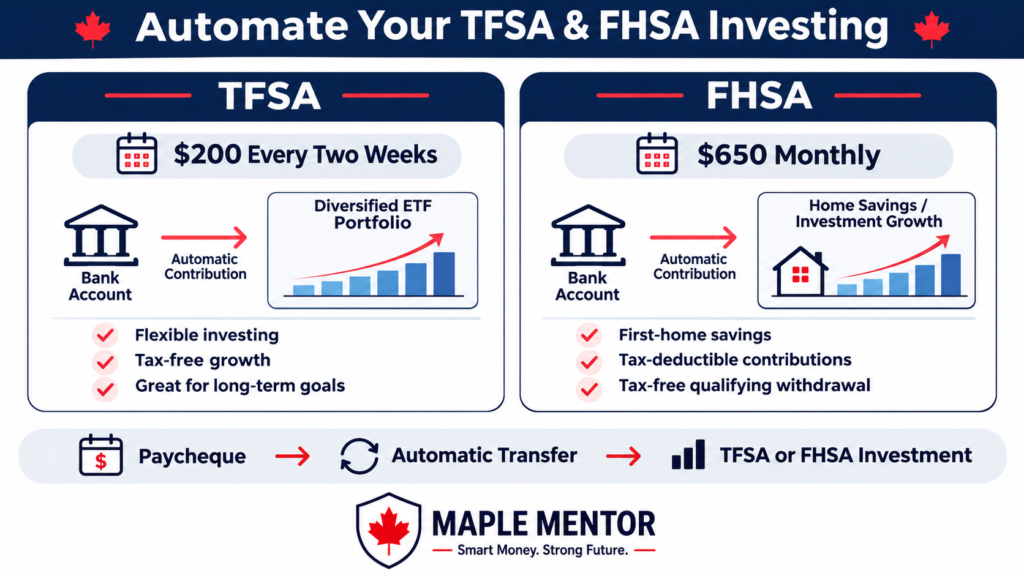
Example: Investing $650 Monthly in an FHSA
Suppose you contribute $650 every month.
Over 12 months:
650$x12=7800$
That would represent $7,800 in annual FHSA contributions, assuming you have sufficient contribution room.
However, an FHSA generally provides $8,000 of new participation room annually, subject to carryforward rules and a $40,000 lifetime contribution limit.
Automatic contributions must remain within your available room.
Should You Invest an FHSA in Equity ETFs?
That depends on your time horizon and tolerance for investment losses.
If you’re purchasing a home in two years, preserving your down payment may be more important than pursuing long-term stock-market growth.
High-interest savings accounts, eligible GICs, or other low-risk holdings may be more suitable.
If your home purchase is much further away, a diversified ETF portfolio may be worth evaluating.
Our FHSA Investing Strategy for First-Time Buyers guide discusses these tradeoffs.
Currency Conversion and Automatic U.S. ETF Investing Canada
Currency conversion is especially important when automatically purchasing U.S.-listed ETFs.
Questrade’s recurring-investment feature currently focuses on eligible U.S.-listed fractional securities.
That means Canadian investors funding their purchases with CAD may need to convert money into USD.
Questrade’s Automatic Currency Conversion
Questrade states that if a recurring purchase requires USD and the account doesn’t hold enough of that currency, it can automatically convert the necessary funds.
Its published conversion fee is 1.5%. Questrade
For example, suppose you automatically invest $500 CAD into a U.S.-listed ETF every month.
At a 1.5% conversion fee, the approximate cost would be:
$500 × 1.5% = $7.50 per month
Over 12 months:
$7.50 × 12 = $90 CAD
This is an illustrative calculation. Actual exchange rates and transaction values may vary.
Wealthsimple Currency Conversion
Wealthsimple can also automatically convert CAD and USD for eligible recurring investments when necessary.
Currency-conversion fees may apply depending on the account configuration and transaction.
Its current recurring-investment documentation explains how automatic conversions are handled. Help Centre
Should You Automatically Buy U.S.-Listed ETFs?
Not necessarily.
For Canadians investing with CAD, Canadian-listed ETFs may offer a more convenient alternative.
For example, someone seeking S&P 500 exposure could consider a Canadian-listed ETF such as VFV instead of automatically purchasing a U.S.-listed ETF.
However, the two approaches may differ in management expenses, withholding-tax treatment, and currency considerations.
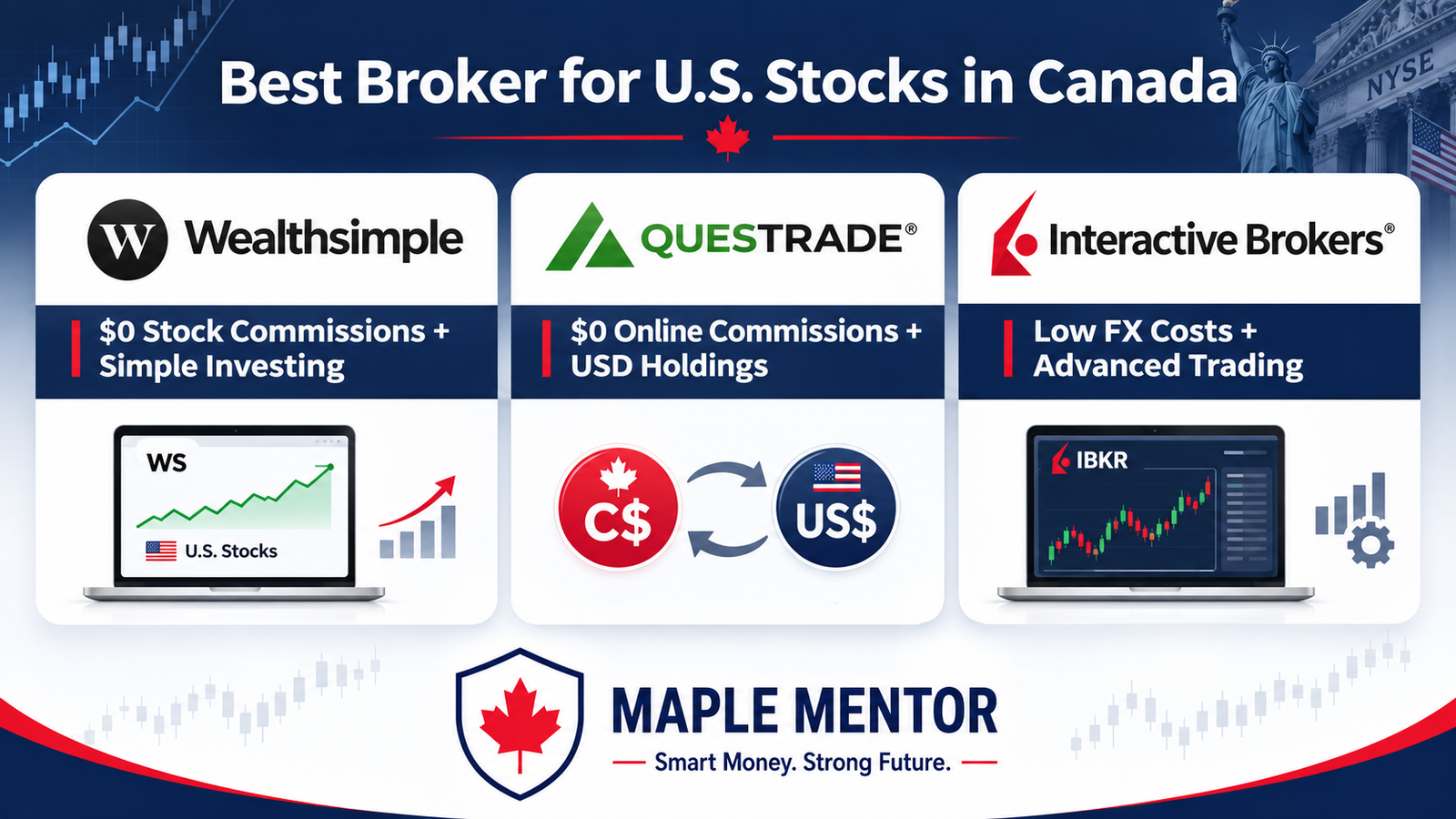
For a broader comparison of U.S. investing costs, see our Best Broker for U.S. Stocks in Canada article.
Fractional Shares and Automatic ETF Investing Canada
Fractional shares make automatic investing more practical.
Instead of requiring enough money to purchase a full share, eligible fractional investing allows investors to purchase a dollar amount.
Example: Investing $100 Every Friday
Suppose an ETF trades for $125 per share.
Without fractional investing, $100 isn’t enough to purchase one full share.
With fractional investing, you could purchase approximately:
100$ / 125$ = 0.8 Shares
This allows more of your intended contribution to be invested.
Wealthsimple Fractional Investing
Wealthsimple supports fractional investing for eligible securities.
Its recurring-investment feature allows investors to specify a dollar amount rather than manually calculating whole shares.
This is useful for investors who want to contribute a fixed amount every payday.
Questrade Fractional Investing
Questrade also supports fractional shares for eligible securities.
Its recurring-investment program permits eligible purchases starting from $1. Questrade
However, fractional-share availability and recurring-purchase eligibility aren’t identical.
Questrade supports fractional trading for selected Canadian and U.S. securities, while its recurring-investment disclosure currently limits automatic purchases to eligible U.S.-listed fractional securities. Questrade+1
Why Fractional Investing Matters
Fractional investing can reduce the amount of uninvested cash left in an account.
It also allows investors to maintain consistent dollar-based contributions.
However, fractional shares don’t eliminate market risk or guarantee favourable execution prices.
What Happens If an Automatic ETF Purchase Fails?
Automatic investing is convenient, but recurring orders aren’t guaranteed to execute.
Insufficient funds, market closures, and security restrictions can interrupt purchases.
Wealthsimple Insufficient Funds
Wealthsimple requires an eligible funding source with sufficient available funds for ordinary recurring investments.
If a margin account lacks sufficient cash, the platform may use available margin under its account rules.
This is an important distinction because borrowing to invest introduces additional risk and interest costs.
Investors using non-margin accounts should ensure their selected funding source has enough available money. Help Centre
Questrade Insufficient Funds
Questrade publishes a specific process for failed recurring purchases.
If there isn’t enough money:
- The scheduled purchase is skipped.
- Questrade notifies the investor.
- The platform retries on the next scheduled date.
- If two consecutive scheduled purchases fail, the recurring plan is automatically cancelled.
This means an investor who doesn’t monitor their account could unintentionally stop investing. Questrade
How to Reduce Failed Purchases
The simplest approach is to ensure funds are available before the scheduled investment date.
For example, you might arrange for your bank transfer to occur before your ETF purchase.
You should also review recurring plans periodically to confirm they remain active.
Are Automatic ETF Purchases Market Orders?
Recurring ETF purchases are generally executed automatically without the investor selecting the exact purchase price.
This creates a difference between recurring investments and manually placed limit orders.
Questrade Market Orders
Questrade explicitly states that recurring purchases execute as market orders during regular market hours.
A market order prioritizes execution rather than guaranteeing a specific price.
Consequently, the final purchase price may differ from the price displayed when the plan was created.
Wealthsimple Recurring Orders
Wealthsimple places eligible recurring purchases according to the investor’s selected schedule.
The investor doesn’t manually select a limit price for each scheduled transaction.
Its published guidance says recurring orders are generally placed starting in the afternoon of the scheduled date. Help Centre
Does Execution Price Matter?
Yes.
Bid-ask spreads, market volatility, and liquidity can affect execution prices.
For highly liquid, diversified ETFs, these differences may be relatively small during ordinary trading conditions.
However, execution prices are not guaranteed.
Investors should understand that automated purchasing prioritizes convenience rather than precise entry-price control.
Automatic ETF Investing Canada: Wealthsimple vs Questrade — Which Is Better?
For Canadians who want to automate ETF purchases, the best platform depends primarily on which ETFs they intend to buy.
| Investor Goal | Platform to Consider |
|---|---|
| Automatically purchase XEQT | Wealthsimple |
| Automatically purchase VEQT | Wealthsimple |
| Automatically purchase VFV | Wealthsimple |
| Automatically purchase XGRO | Wealthsimple |
| Automatically purchase eligible U.S.-listed ETFs | Either |
| Fund recurring purchases directly from an external bank | Wealthsimple |
| Automate eligible U.S. ETF purchases in a TFSA | Either |
| Automate eligible Canadian ETF purchases in an FHSA | Wealthsimple |
| Maintain a traditional brokerage with some automation | Questrade |
| Simplest hands-off Canadian ETF investing | Wealthsimple |
When Wealthsimple Makes More Sense
Wealthsimple is generally more suitable for investors who want a fully automated Canadian ETF portfolio.
Its combination of recurring purchases, flexible funding sources, and support for eligible Canadian-listed ETFs makes it particularly convenient.
For example, someone who wants to invest $200 into XEQT every two weeks could configure the recurring purchase and monitor it periodically.
When Questrade Makes More Sense
Questrade may be suitable for investors who already use its platform and want to automate purchases of eligible U.S.-listed ETFs.
It also offers pre-authorized deposits, fractional investing, and commission-free eligible recurring purchases.
However, its current recurring-buy limitations make it less convenient for someone who specifically wants automatic Canadian-listed ETF purchases.
Overall Winner for Automation
Wealthsimple is the stronger choice for automatic Canadian-listed ETF investing under the currently published features.
Questrade remains competitive for eligible U.S.-listed investments, but the difference in supported securities is significant.
Automatic ETF Investing Canada: Two Practical Examples
Here are two ways Canadians might structure an automatic investment plan.
Example 1: TFSA
Biweekly Contribution
$200
Purchases/year
26
Annual total
$5,200
Illustrative setup: $200 every two weeks into an eligible ETF such as XEQT, assuming sufficient TFSA contribution room.
Example 2: FHSA
Monthly Contribution
$650
Purchases/year
12
Annual total
$7,800
Illustrative setup: $650 monthly into an eligible investment, assuming sufficient FHSA contribution room and an appropriate investment horizon.
These examples demonstrate how automatic ETF investing can turn regular contributions into a consistent routine.
However, investors should review their contribution limits, investment choices, and account balances periodically.
Is Automatic ETF Investing Canada a Good Strategy?
Automatic ETF investing can be useful for Canadians who want to maintain consistent long-term investing habits.
However, automation doesn’t make an unsuitable investment strategy appropriate.
Benefits of Automatic ETF Investing
Consistency: Scheduled contributions can help investors maintain a regular investing routine.
Convenience: Eligible purchases occur without manually placing each order.
Reduced emotional decision-making: Investors may be less tempted to delay purchases while waiting for market declines.
Less uninvested cash: Automatic purchases can reduce the likelihood that deposited money sits unused.
Long-term discipline: Regular investing can encourage investors to focus on their financial goals rather than short-term market movements.
Potential Drawbacks
Contribution limits: Automated deposits can create registered-account overcontributions if contribution room isn’t monitored.
Market risk: ETFs can lose value, and recurring purchases don’t guarantee positive returns.
Currency-conversion fees: Automatic purchases of U.S.-listed ETFs can generate repeated FX charges.
Execution prices: Recurring orders don’t guarantee a specific purchase price.
Investment selection: Automation doesn’t determine whether an ETF is appropriate for your objectives.
Does Automatic Investing Beat Manual Investing?
Not necessarily.
Automatic investing primarily improves convenience and consistency.
An investor who manually purchases the same ETF on the same dates at comparable prices and costs could achieve similar investment results.
The benefit is that automation may make it easier to follow the plan.
Final Verdict: Automatic ETF Investing Canada
Automatic ETF investing Canada has become more accessible as Canadian brokerages introduce recurring investment features.
Both Wealthsimple and Questrade now support automatic purchases of eligible securities.
However, their capabilities remain meaningfully different.
Wealthsimple is my preferred choice for Canadians who want to automatically invest in Canadian-listed ETFs.
Its recurring investment system supports eligible Canadian and U.S. ETFs, flexible schedules, and multiple funding methods.
That makes it particularly convenient for investors purchasing funds such as XEQT, VEQT, VFV, or XGRO.
Questrade is a useful alternative for investors who want to automate eligible U.S.-listed ETF purchases.
Its recurring investment feature supports fractional purchases, flexible schedules, and commission-free eligible orders.
However, its published program currently limits recurring purchases to eligible U.S.-listed fractional securities.
For someone investing in Canadian ETFs every payday, that limitation is important.
Ultimately, the best automatic ETF investing strategy is one that matches your financial goals, investment timeline, and risk tolerance.
Choose an appropriate ETF, configure the funding and recurring purchase schedule, and review the plan periodically.
Automation can make investing easier, but it doesn’t replace the need to choose suitable investments.
Frequently Asked Questions
Can You Automatically Invest in ETFs in Canada?
Yes. Canadian investors can automatically purchase eligible ETFs through brokerages offering recurring investment functionality.
Wealthsimple and Questrade both offer recurring investments, although the eligible securities and funding arrangements differ.
Can Wealthsimple Automatically Buy ETFs?
Yes. Wealthsimple supports recurring purchases of eligible stocks and ETFs on daily, weekly, biweekly, or monthly schedules.
Purchases can be funded through supported account balances or linked funding sources. Help Centre
Does Questrade Have Recurring ETF Purchases?
Yes. Questrade offers recurring purchases of eligible fractional U.S.-listed stocks and ETFs.
Its published program currently excludes Canadian-listed ETFs from recurring purchases. Questrade
Can I Automatically Buy XEQT Every Month?
Wealthsimple supports recurring purchases of eligible Canadian-listed ETFs, including the type of setup used for XEQT.
Questrade’s currently published recurring-investment program is limited to eligible U.S.-listed fractional securities, so XEQT is not supported under that program.
Can I Automate Investments in an FHSA?
Yes. Both Wealthsimple and Questrade offer FHSAs and investment automation features.
However, recurring-purchase eligibility differs.
Investors must also monitor FHSA contribution room and choose investments appropriate for their expected home-purchase timeline.
Is Automatic Investing the Same as a Robo-Advisor?
No.
With self-directed recurring investing, you choose the ETF and configure the purchases.
A robo-advisor generally selects and manages a portfolio based on your investor profile and risk tolerance.
For a detailed comparison, see our ETF vs Robo-Advisor in Canada guide.
Is Automatic ETF Investing Good for Beginners?
Automatic ETF investing can be useful for beginners who have chosen appropriate investments and want to contribute consistently.
However, beginners still need to understand ETF diversification, investment risk, registered-account rules, and applicable fees.
Automation simplifies execution, not investment selection.