
Transportation can quietly become one of the largest expenses in your monthly budget. A car payment might be the most obvious cost, but insurance, fuel, maintenance, tires, parking, registration, and unexpected repairs can add hundreds of dollars more.
Learning how to save money on transportation Canada residents spend each month starts with understanding what transportation actually costs you.
You don’t necessarily need to sell your car or completely change how you commute. Instead, the goal is to identify expensive habits, reduce unnecessary costs, and prepare for predictable expenses before they become financial problems.
This guide covers practical ways to save money on transportation Canada households can use while keeping their transportation realistic for their location, job, and lifestyle.
Quick Answer
To save money on transportation Canada, start by calculating your real monthly transportation cost, then look for ways to reduce car payments, gas, insurance, repairs, parking, rideshares, and unnecessary driving.
The goal is to lower transportation costs without making your life impractical.
Start with these steps:
- Calculate your total transportation costs.
- Avoid taking on excessive car debt.
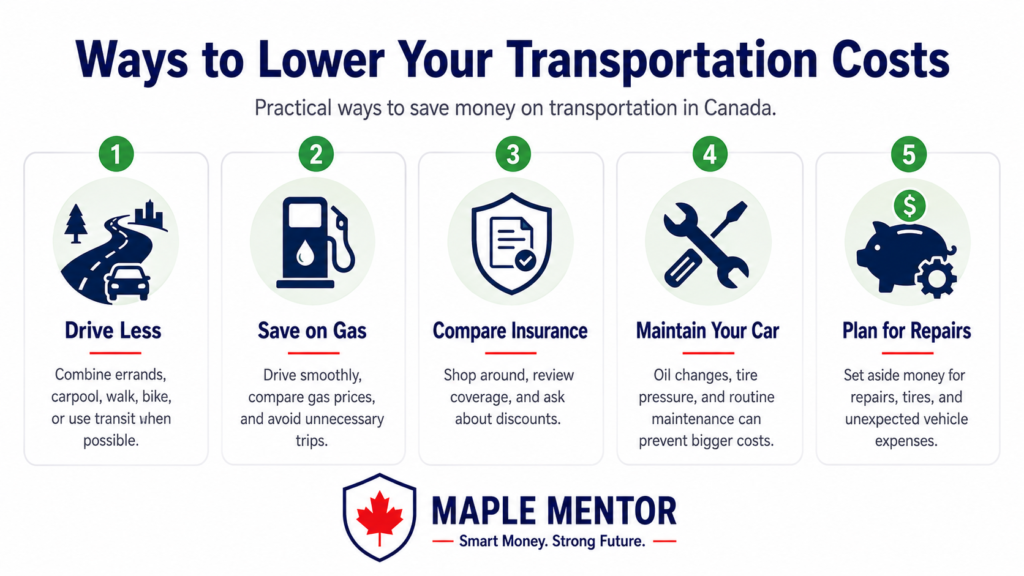
- Compare car insurance periodically.
- Reduce unnecessary fuel consumption.
- Maintain your vehicle properly.
- Consider public transit when practical.
- Limit rideshares and other convenience transportation.
- Save ahead for repairs and maintenance.
Even if you need a vehicle every day, there may still be opportunities to reduce what transportation costs you over an entire year.
Why Transportation Costs Add Up Fast
Transportation is often more expensive than it appears.
Someone might say:
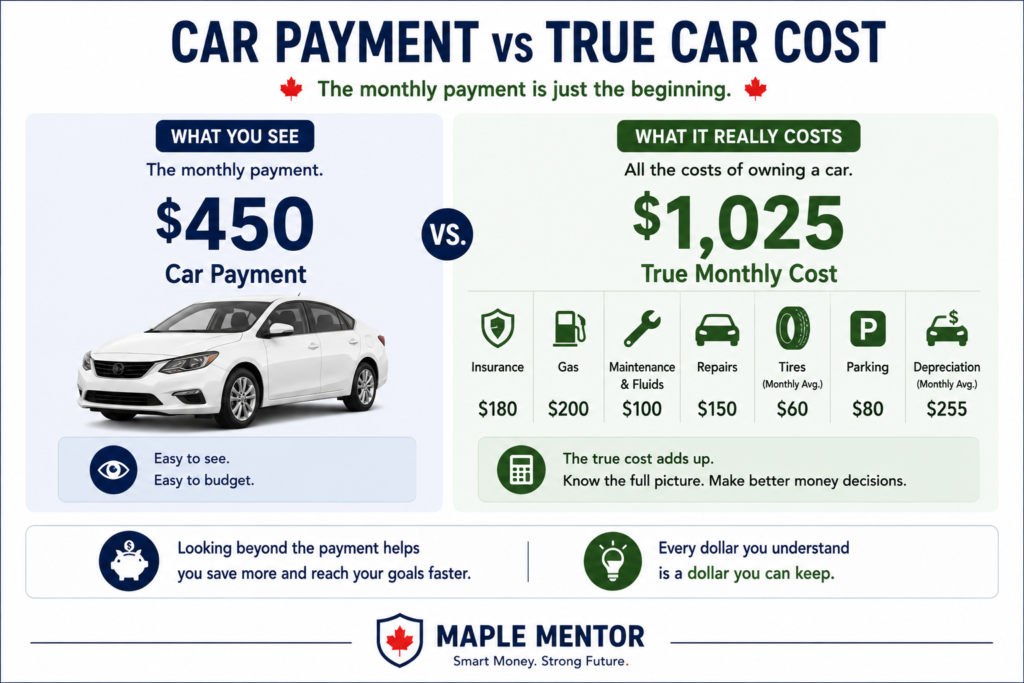
“My car only costs me $450 per month.”
But they’re probably talking only about the loan payment.
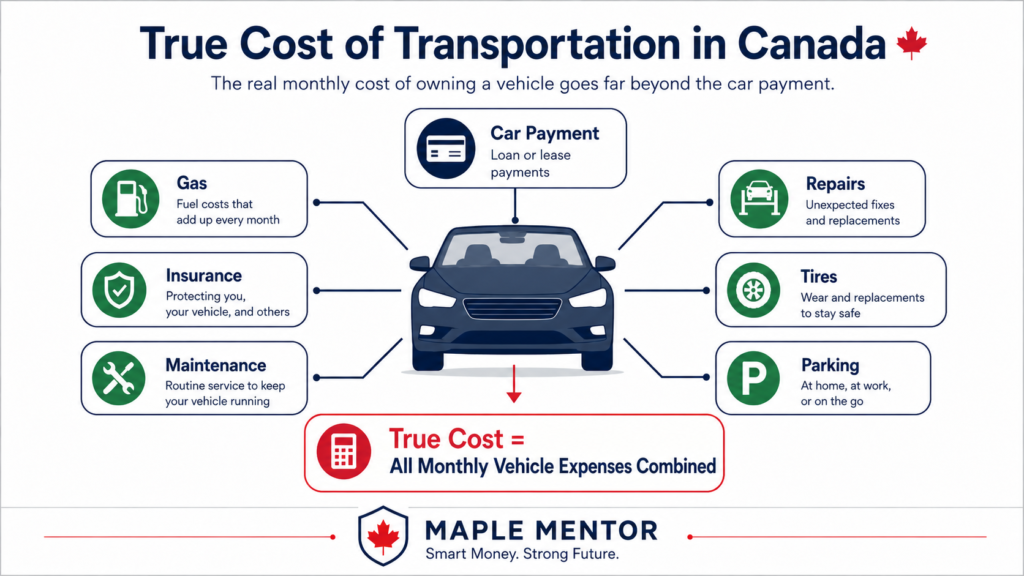
The actual cost could include:
- Car payment
- Gas
- Insurance
- Maintenance
- Repairs
- Winter and summer tires
- Parking
- Registration
- Public transit
- Rideshares
- Tolls
- Depreciation
A $450 car payment can easily become a much larger monthly transportation expense once everything else is included.
This is why transportation deserves its own category in your budget rather than treating gas and your car payment as the only costs.
Statistics Canada includes private transportation costs such as vehicle purchases, gasoline and vehicle insurance when measuring Canadian consumer prices. Its transportation data can also help you understand how these costs change over time.
Step 1 Calculate Your Real Transportation Cost
Before trying to save money on transportation Canada, calculate what you’re currently spending.
If you own a vehicle, start with your monthly:
- Car payment
- Fuel
- Insurance
- Parking
Then add expenses that don’t necessarily happen every month.
These might include:
- Oil changes
- Tires
- Brake service
- Repairs
- Registration
- Seasonal tire changes
- Vehicle inspections
- Other maintenance
For irregular expenses, estimate the annual cost and divide it by 12.
Suppose you spend approximately:
$600 per year on tires and seasonal changes
$600 per year on maintenance
$1,200 per year on repairs
That’s $2,400 annually.
Divide it by 12:
$2,400 ÷ 12 = $200 per month
That $200 belongs in your transportation budget even if you don’t actually spend it every month.
Doing this gives you a much more accurate picture of what your vehicle costs.
Step 2 Avoid Expensive Car Debt
One of the biggest transportation decisions you’ll make is how much vehicle you buy.
A large car payment doesn’t just increase transportation costs. It reduces the amount of monthly income available for everything else.
For example, an additional $300 per month spent on a vehicle is $3,600 per year that can’t go toward:
- Emergency savings
- Debt repayment
- Investing
- Travel
- A home purchase
- Other financial goals
That doesn’t mean you should always buy the cheapest vehicle available. Reliability, safety, maintenance history, fuel consumption, and your actual transportation needs matter too.
However, choosing a vehicle primarily based on the maximum payment a lender approves can create a very tight budget.
Before financing a vehicle, consider the total cost, not simply whether you can make the monthly payment.
The Financial Consumer Agency of Canada recommends comparing factors such as the interest rate, loan length, total financing cost, fees, and vehicle price when financing a car.
If you’re deciding whether extra money should go toward an existing car loan or your portfolio, read Should You Pay Off Debt or Invest in Canada?
For the bigger picture, see How to Build Financial Stability in Canada.
Keeping transportation debt reasonable can make every other part of your financial plan easier.
Step 3 Compare Car Insurance
Car insurance is another recurring expense worth reviewing periodically.
You don’t necessarily need to switch insurers every year. However, comparing your current policy with other available options can help you determine whether your coverage and price are still competitive.
Consider reviewing:
- Premium
- Deductible
- Liability coverage
- Collision coverage
- Comprehensive coverage
- Optional coverage
- Discounts
- Usage assumptions
Your circumstances can also change.
For example, you might:
- Move
- Drive fewer kilometres
- Change vehicles
- Add or remove a driver
- Change how you use your vehicle
These changes can affect insurance.
Don’t reduce important coverage simply to get the lowest possible premium. The goal is to compare equivalent coverage and understand what you’re actually buying.
Insurance is provincially regulated in Canada, so requirements and available options vary depending on where you live.
Step 4 Save on Gas
Fuel is one of the most visible transportation expenses, particularly if you drive frequently.
Fortunately, small changes can reduce unnecessary fuel consumption.
Combine Trips
Instead of making several separate drives, combine errands whenever possible.
For example, groceries, banking, and another errand might all be completed during the same trip.
Avoid Unnecessary Driving
Before automatically taking your car, ask whether walking, cycling, public transit, or combining the trip with something else would work.
This won’t be realistic everywhere in Canada, but even eliminating a few unnecessary trips can help.
Maintain Proper Tire Pressure
Incorrect tire pressure can affect fuel consumption and tire wear.
Natural Resources Canada notes that proper tire inflation, smoother acceleration, maintaining steady speeds, and reducing unnecessary idling can contribute to more fuel-efficient driving.
Drive Smoothly
Rapid acceleration followed by hard braking generally uses more fuel than smoother driving.
Give yourself enough space to accelerate and slow down gradually.
Use Gas Rewards Carefully
Fuel loyalty programs and credit card rewards can reduce costs slightly.
However, don’t drive significantly farther just to earn a few cents per litre.
Compare Nearby Gas Prices
Prices can vary between stations.
If two nearby stations have noticeably different prices, choosing the cheaper option makes sense.
Just don’t spend $5 worth of fuel and 30 minutes of your time trying to save $2.
Step 5 Maintain Your Vehicle Properly
Skipping maintenance can feel like saving money today.
Sometimes it simply creates a larger bill later.
Basic vehicle maintenance can include:
- Oil changes
- Tires
- Brakes
- Fluids
- Battery
- Filters
- Regular inspections
Follow the maintenance recommendations appropriate for your specific vehicle rather than relying on a generic schedule.
Pay attention to unusual:
- Noises
- Vibrations
- Warning lights
- Fluid leaks
- Tire wear
- Braking behaviour
A small problem isn’t guaranteed to become an expensive one, but ignoring obvious issues can increase the risk.
Maintenance also needs to be included in your budget.
If you know you’ll eventually need tires, oil changes, or brake service, those aren’t really emergencies. They’re predictable costs of owning a vehicle.
Step 6 Use Public Transit When It Makes Sense
Public transportation can be substantially less expensive than owning a vehicle in some situations.
However, whether it makes sense depends heavily on where you live.
Someone living near reliable transit in Toronto, Montréal, or Vancouver may have very different options from someone living in a rural area.
Consider:
- Monthly transit pass cost
- Commute time
- Transit availability
- Work schedule
- Distance from stops
- Family responsibilities
- Whether you still need a vehicle
You don’t necessarily have to choose between owning a car and using transit exclusively.
A hybrid approach can sometimes work.
For example, you might own a vehicle but use public transportation for commuting several days per week if doing so saves on fuel and parking.
Alternatively, a household with two vehicles might determine that it can realistically function with one vehicle plus public transit.
The cheapest option isn’t automatically the best option. Transportation needs to work with your actual life.
Step 7 Limit Rideshares and Delivery Apps
Convenience expenses can be easy to overlook because each transaction seems relatively small.
For example:
$18 rideshare
$25 food delivery
$22 rideshare
$30 delivery
Individually, none looks disastrous.
Repeated several times every week, however, they can become a significant monthly expense.
Suppose you spend $40 per week on rideshares you could reasonably avoid.
That’s approximately:
$160 per month
or:
$1,920 per year
You don’t necessarily need to eliminate rideshares. They’re useful when you need them.
Instead, decide when convenience is worth paying for.
If convenience purchases frequently appear throughout your budget, read How to Stop Impulse Spending in Canada.
Reducing repeated convenience costs is one of the simpler ways to save money on transportation Canada residents can implement without changing vehicles.
Step 8 Plan Ahead for Car Repairs
Car repairs are unpredictable in timing, but they aren’t unpredictable in existence.
If you own a vehicle long enough, something will eventually need replacing.
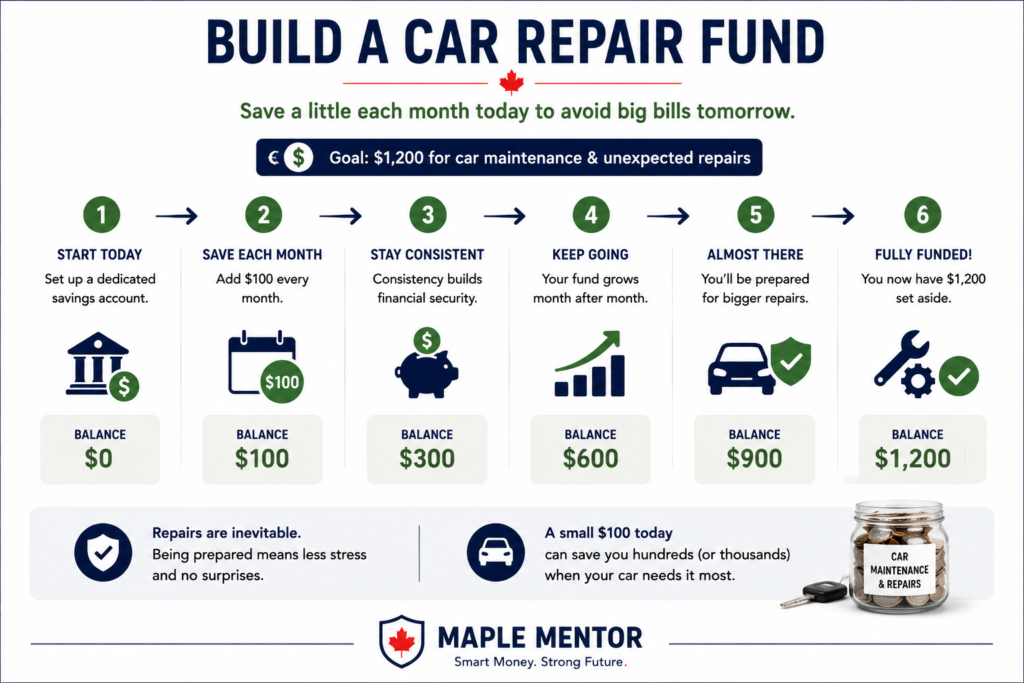
Instead of treating every repair as a financial emergency, build a vehicle maintenance fund.
Suppose you decide to save:
$100 per month
After one year, you’ll have:
$1,200
If your car needs an $800 repair, you can pay for it from the vehicle fund rather than immediately reaching for a credit card.
If you don’t use the money, leave it there.
Eventually, you may need:
- Tires
- Brakes
- Suspension work
- Battery replacement
- Other repairs
Learn how to turn irregular bills into monthly savings targets in How to Plan for Annual Expenses in Canada.
You can also keep your car fund separate from your emergency savings.
See how to structure those savings buckets in How to Use Multiple Savings Accounts in Canada.
This distinction matters because regular maintenance and eventual repairs are normal parts of vehicle ownership.
Transportation Cost Example Table
Here’s what the true monthly cost of a vehicle might look like:
| Expense | Monthly Estimate |
|---|---|
| Car payment | $450 |
| Insurance | $150 |
| Gas | $250 |
| Maintenance/repairs | $100 |
| Parking | $75 |
| Total | $1,025 |
At first glance, this person might think they have a $450 car.
In reality, transportation is costing approximately $1,025 per month before accounting for other possible expenses such as registration or depreciation.
That’s:
$12,300 per year
This doesn’t automatically mean the vehicle is unaffordable.
The point is to make financial decisions using the complete number.
Look at the Cost Per Year, Not Just Per Month
Monthly payments can make expensive purchases look more manageable.
A better approach is to calculate the annual cost.
For example:
$800/month transportation cost × 12 = $9,600/year
Now compare that amount with your after-tax income.
If you bring home $48,000 annually:
$9,600 ÷ $48,000 = 20%
That means one-fifth of your take-home income is going toward transportation.
Seeing the annual number can make it much easier to decide whether a more expensive vehicle, parking arrangement, or commute is worth the cost.
Common Mistakes to Avoid
Only Budgeting for Gas
Fuel is only one component of transportation.
Include insurance, maintenance, repairs, tires, registration, parking, and car payments.
Buying Too Much Car
Don’t judge affordability based only on whether a lender will approve you.
Consider how the total transportation cost fits into your overall financial plan.
Ignoring Maintenance
Delaying routine maintenance may create additional problems later.
Budget for vehicle upkeep from the beginning.
Not Comparing Insurance
Insurance premiums and personal circumstances change.
Review your policy periodically and compare equivalent coverage when appropriate.
Using Rideshares Too Often
Occasional rideshares can be useful.
Repeated convenience trips can quietly become a substantial monthly expense.
Relying on Credit Cards for Repairs
If every repair goes onto a credit card, vehicle ownership can create recurring high-interest debt.
Build a separate maintenance fund whenever possible.
Forgetting Winter Tires and Seasonal Costs
Canadian vehicle ownership can involve additional seasonal expenses.
Depending on your province, vehicle, and driving conditions, you may need to budget for winter tires, seasonal tire changes, storage, winter maintenance, and other cold-weather costs.
Plan for them throughout the year rather than waiting until winter arrives.
Final Answer
Learning to save money on transportation Canada doesn’t necessarily mean giving up your vehicle.
Start by calculating what your transportation actually costs—including your payment, fuel, insurance, maintenance, repairs, parking, tires, and other recurring expenses.
Then look for the largest opportunities.
Avoid taking on more car debt than your budget can comfortably handle. Compare insurance periodically, maintain your vehicle properly, combine trips, and reduce unnecessary driving when practical.
Most importantly, plan ahead for repairs.
A separate vehicle fund can turn an $800 repair from a credit card problem into an expense you’ve already prepared for.
Ultimately, the best way to save money on transportation Canada households can follow is to make transportation decisions based on the total cost rather than the monthly car payment alone.
FAQ
How can I save money on transportation in Canada?
To save money on transportation Canada, calculate your full transportation cost, reduce unnecessary driving, compare insurance, maintain your vehicle, limit convenience transportation, and avoid excessive car debt.
Planning ahead for maintenance and repairs can also reduce your reliance on credit.
Is owning a car expensive in Canada?
It can be.
The true cost of owning a vehicle can include the purchase or financing payment, fuel, insurance, maintenance, repairs, tires, registration, parking, and depreciation.
The total varies significantly depending on the vehicle, location, driving habits, and financing arrangement.
Should I use public transit to save money?
Public transit can reduce transportation costs if it works with your location and schedule.
However, it isn’t practical for everyone. Compare the financial savings with commute times, transit availability, work requirements, and your other transportation needs.
How much should I budget for car repairs?
There isn’t one amount that works for every vehicle.
Repair costs depend on age, mileage, reliability, condition, driving habits, and the specific model.
Review your previous maintenance and repair expenses to create an initial annual estimate. Then divide that number by 12 and save monthly into a separate vehicle fund.
Is it cheaper to keep an older car?
Sometimes, but not always.
An older paid-off vehicle eliminates a monthly loan payment, but repair and maintenance costs may increase with age.
Compare the expected annual cost of keeping your current vehicle with the full cost of replacing it, including financing, insurance, depreciation, taxes, and fees.