
Building financial stability Canada residents can maintain starts with getting the basics right. You do not need a six-figure salary, a perfect investment portfolio, or thousands of dollars sitting in the bank before you can begin.
Instead, financial stability is built in layers. First, understand where your money goes. Next, create a small cash buffer, control expensive debt, and organize your finances. Once that foundation is solid, you can start investing more confidently for the future.
In this guide, you’ll learn how to build financial stability Canada households can realistically work toward one step at a time.
Quick Answer
To build financial stability in Canada, start by knowing your numbers, covering essentials, building a small emergency fund, reducing high-interest debt, organizing your accounts, and investing only after your basic foundation is stable.
A simple order is:
- Know your income and expenses.
- Cover essential bills.
- Build $500 to $1,000 in emergency savings.
- Reduce high-interest debt.
- Organize your bank accounts.
- Automate good financial habits.
- Start investing for long-term goals.
- Review your progress regularly.
The objective isn’t to become wealthy overnight. It’s to make your financial situation stronger and less vulnerable month after month.
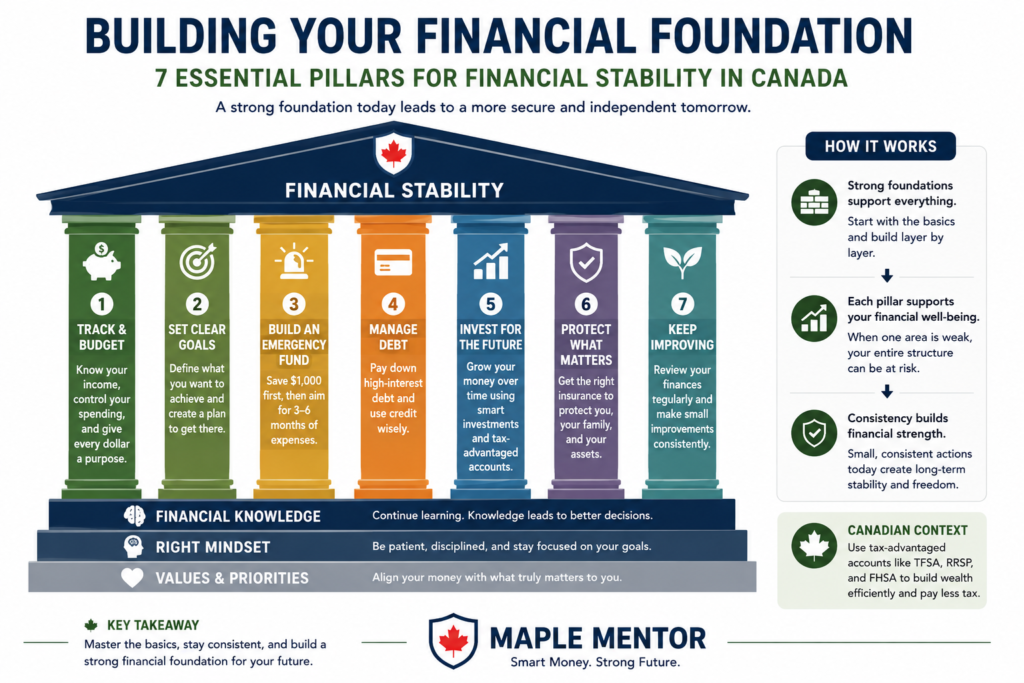
What Does Financial Stability Mean?
Financial stability means being able to manage your regular expenses without constantly worrying about the next bill.
Someone who is financially stable can generally:
- Pay bills on time.
- Handle smaller emergencies.
- Avoid regularly relying on credit cards.
- Make progress on debt.
- Save consistently.
- Invest toward future goals.
- Absorb reasonable financial setbacks.
Financial stability doesn’t necessarily mean being debt-free or wealthy.
You might still have a mortgage, student loan, or other financial obligations. However, those payments fit within your budget rather than controlling it.
Ultimately, financial stability Canada households should aim for is less about reaching a specific net worth and more about having enough financial margin to handle normal life without every unexpected expense becoming a crisis.
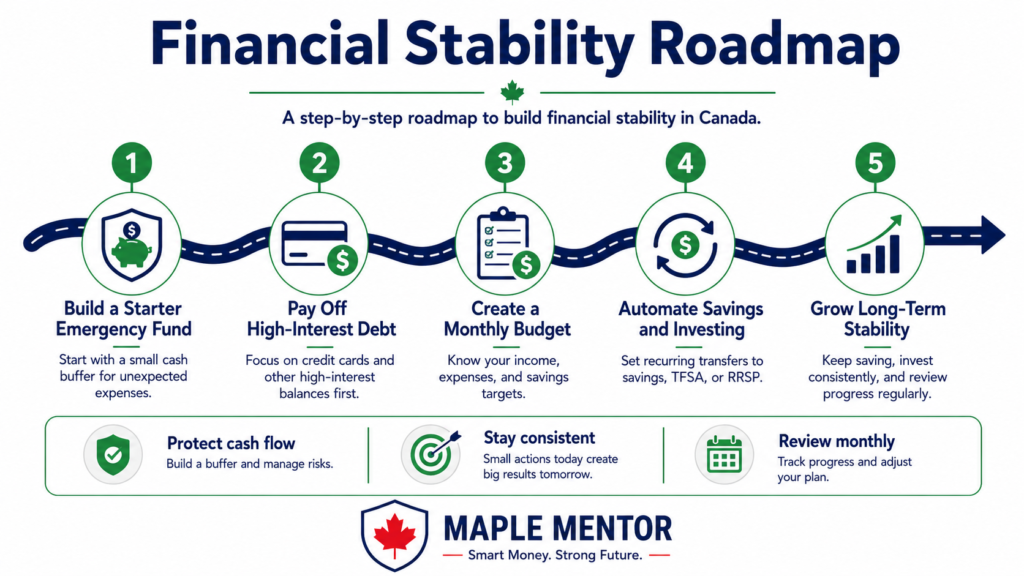
Step 1 Know Your Monthly Numbers
Before improving your finances, you need to understand them.
Start by writing down your monthly:
- Income
- Fixed bills
- Flexible spending
- Debt payments
- Savings contributions
- Upcoming expenses
Your numbers don’t need to be perfectly accurate immediately. A reasonable estimate gives you somewhere to start.
Income
Use your normal after-tax income rather than your highest-earning month.
If your income changes frequently, consider using a conservative monthly average.
Fixed Bills
These include expenses such as:
- Rent or mortgage
- Insurance
- Phone
- Internet
- Utilities
- Loan payments
Flexible Spending
Track categories such as:
- Groceries
- Gas
- Restaurants
- Entertainment
- Shopping
Once everything is visible, you can see whether your current lifestyle actually fits your income.
If you don’t already have a spending plan, start with How to Create a Monthly Budget in Canada.
The Financial Consumer Agency of Canada also provides a free Budget Planner that can help Canadians organize income and expenses.
Step 2 Cover Essentials First
When your finances feel scattered, prioritize the expenses that keep your life functioning.
Start with:
- Housing
- Groceries
- Utilities
- Transportation
- Insurance
- Minimum debt payments
Entertainment, restaurants, subscriptions, and other discretionary expenses come afterward.
This becomes especially important when money is tight.
For example, trying to invest aggressively while struggling to pay rent or relying on a credit card for groceries isn’t a sustainable wealth-building strategy.
Stability comes first.
Once essential expenses consistently fit within your income, you can begin directing more money toward savings, debt repayment, and investing.
Step 3 Build a Starter Emergency Fund
Emergency savings are one of the foundations of financial stability Canada residents can build relatively quickly.
You don’t need three or six months of expenses immediately.
Start with:
First target: $500
Then:
Second target: $1,000
Even $1,000 can help cover many common surprises, including:
- Car repairs
- Veterinary bills
- Urgent travel
- Dental costs
- Reduced work hours
- Unexpected home expenses
Without emergency savings, these expenses often end up on a credit card.
With a starter fund available, you have another option.
Follow the complete plan in How to Build a $1,000 Emergency Fund in Canada.
The Financial Consumer Agency of Canada also recommends gradually building an emergency fund to help handle unexpected expenses without relying heavily on credit.
Eventually, you can work toward three to six months of essential expenses depending on your income stability and personal circumstances.
Step 4 Reduce High-Interest Debt
After establishing a small cash buffer, high-interest debt should usually become one of your biggest priorities.
Credit cards and payday loans can make financial progress extremely difficult because interest accumulates quickly.
Focus especially on:
- Credit card balances
- Payday loans
- High-interest personal loans
- Expensive store financing
You don’t necessarily need to eliminate every mortgage, car loan, or student loan before investing.
However, carrying debt at 20% or more while aggressively investing usually creates an uphill financial battle.
At minimum:
- Make every minimum payment.
- Avoid creating new balances.
- Choose a debt repayment strategy.
- Direct extra cash toward expensive debt.
Learn how to accelerate repayment with How to Pay Off Credit Card Debt Faster in Canada.
Reducing high-interest debt does more than save interest. It also frees up monthly cash flow that can eventually go toward savings and investments.
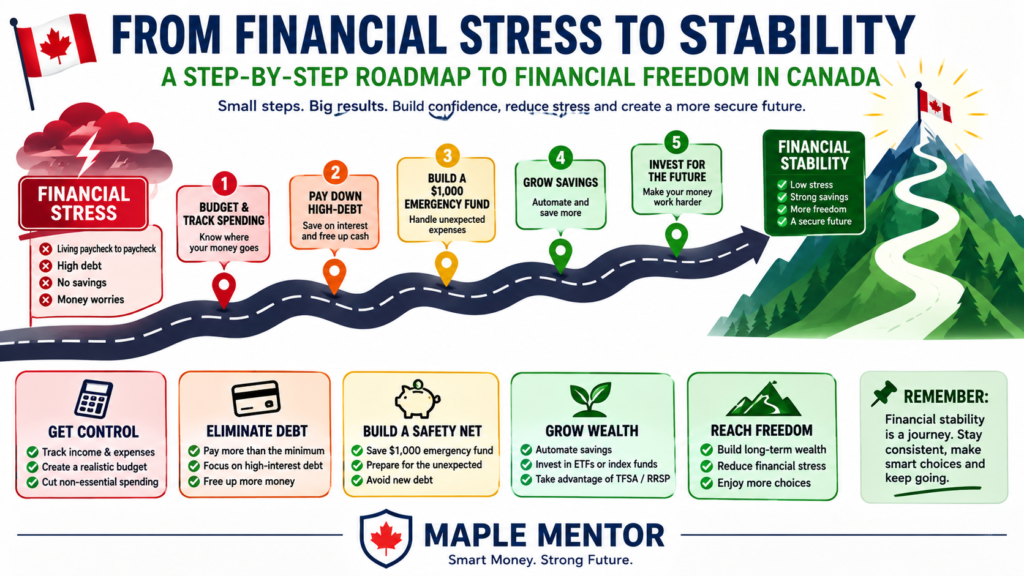
Step 5 Organize Your Bank Accounts
Keeping every dollar in one bank account can make managing money unnecessarily difficult.
Your chequing balance might look high, but some of that money may already be needed for rent, utilities, credit cards, or annual bills.
Instead, separate money based on its purpose.
A simple setup might include:
Bills Account
For rent, utilities, insurance, phone bills, and debt payments.
Spending Account
For groceries, gas, restaurants, entertainment, and other flexible spending.
Emergency Savings Account
For genuine unexpected expenses.
Short-Term Savings Account
For predictable expenses like vacations, furniture, annual bills, or car maintenance.
This structure creates clearer boundaries around your money.
See a complete setup in How to Organize Your Bank Accounts in Canada.
You don’t need five different banks or a complicated spreadsheet. The point is simply to know what each dollar is meant to accomplish.
Step 6 Automate Good Money Habits
Once your financial system works manually, automate as much of it as possible.
Automation reduces the amount of motivation required to stay consistent.
You could automate:
- Rent or mortgage payments
- Utility bills
- Credit card minimum payments
- Emergency fund transfers
- Debt repayments
- TFSA contributions
- RRSP contributions
For example, suppose you’re paid every second Friday.
Your system might automatically transfer:
- $50 to emergency savings
- $100 toward debt
- $50 toward investing
before you begin spending the remainder.
Even small transfers can produce meaningful results when they happen consistently.
Build your setup with How to Automate Your Finances in Canada.
Automation is particularly useful for building financial stability Canada because it turns good intentions into recurring actions.
Step 7 Start Investing Once Stable
Investing is an important part of long-term wealth building, but it works much better when your short-term finances are reasonably secure.
Before investing aggressively, ideally you should have:
- Essential bills covered.
- A starter emergency fund.
- High-interest debt under control.
- Stable enough cash flow.
- Money you can leave invested for years.
Once those foundations are established, you can begin investing consistently.
For many Canadians, the main account options include:
TFSA
Useful for flexible, tax-free long-term investing.
Learn more in TFSA Investing Strategy for Beginners.
RRSP
Potentially attractive for retirement savings, particularly when the tax deduction is valuable.
Read RRSP Investing Strategy Canada.
Diversified ETFs
For beginners, broad-market ETFs can provide diversification without requiring you to choose individual stocks.
Compare simple options in Best ETFs for Beginners in Canada.
The key is not trying to find the perfect investment.
Instead, build a diversified strategy that fits your risk tolerance and stay consistent.
Simple Financial Stability Checklist
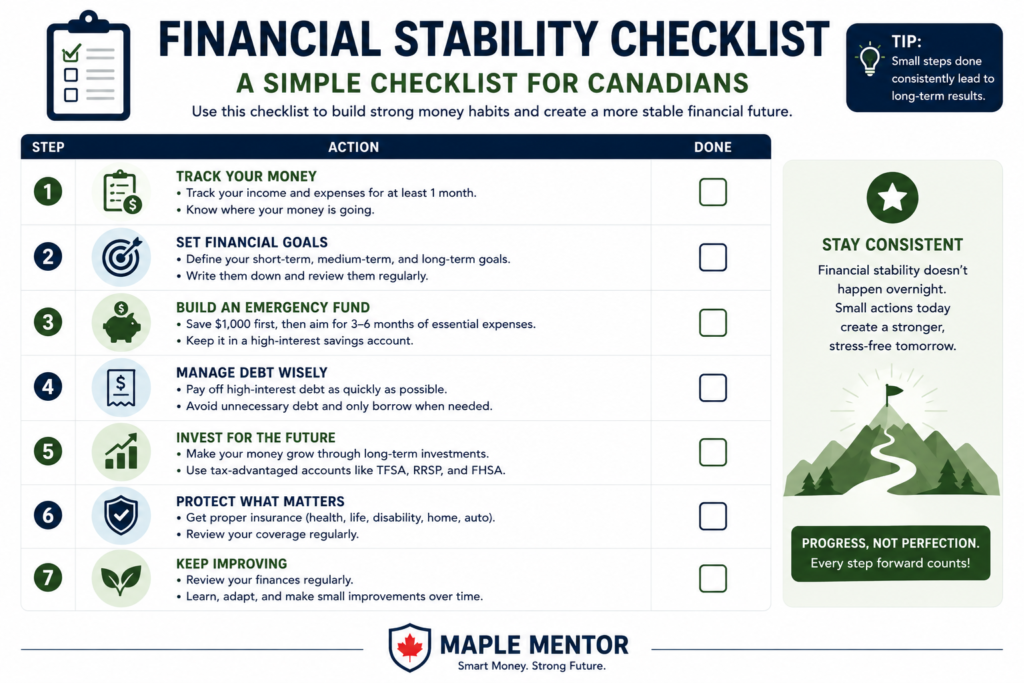
You don’t need to complete every stage immediately.
If you’re currently at the budgeting stage, focus there first.
Then move to the next layer.
This gradual approach makes financial stability Canada much more achievable than trying to change your entire financial life at once.
Common Mistakes to Avoid
Investing Before Having Cash Savings
Investing without an emergency fund can create problems.
If an unexpected expense arrives during a market downturn, you may need to sell investments at a bad time or use high-interest debt.
Build some cash protection first.
Ignoring Credit Card Debt
Investment returns are uncertain.
Credit card interest charges aren’t.
Pay attention to expensive debt before chasing investment returns.
Not Tracking Spending
You don’t need to track every penny forever.
However, if you regularly wonder where your money went, reviewing your spending is essential.
Keeping All Your Money in One Account
Mixing bill money, spending money, and savings makes your account balance difficult to interpret.
Give different categories clear purposes.
Relying Only on Motivation
Motivation changes.
Automated systems continue working when you’re tired, busy, or distracted.
Copying Someone Else’s Financial Plan
Your income, debt, responsibilities, goals, and risk tolerance are different from everyone else’s.
Use financial rules as guidelines rather than rigid requirements.
Never Reviewing Your Progress
Your financial situation changes over time.
Income increases, expenses change, debt disappears, and new goals appear.
Review your finances at least monthly or quarterly so your strategy stays relevant.
Final Answer
Building financial stability Canada residents can maintain happens in layers.
Start with control: understand your income, expenses, and bills.
Next, create a starter emergency fund and reduce high-interest debt. Organize your accounts so every dollar has a purpose, then automate your good financial habits.
Once that foundation is strong, begin investing consistently for long-term goals.
The goal isn’t to become rich overnight. It’s to stop feeling financially fragile.
Over time, a stronger cash buffer, lower debt, better organization, and consistent investing can turn basic financial stability into long-term wealth.
FAQ
What is financial stability?
Financial stability means being able to cover your bills, manage debt, handle reasonable unexpected expenses, and make steady progress toward your financial goals.
It doesn’t necessarily mean being wealthy or completely debt-free.
How much emergency savings do I need to be financially stable?
Start with $500 to $1,000 if you currently have nothing saved.
Afterward, work toward three to six months of essential expenses depending on your income stability, responsibilities, and risk level.
Should I pay off debt or save first?
If you have no savings, building a small starter emergency fund first can help prevent another unexpected expense from creating new debt.
Then, high-interest debt should generally receive significant attention.
Should I invest before becoming financially stable?
Usually, building emergency savings and controlling high-interest debt first creates a stronger foundation.
However, an employer RRSP match can be an important exception because matching contributions can provide significant immediate value.
How long does it take to become financially stable?
There is no universal timeline.
Someone with relatively low debt and stable income may improve their situation within months, while someone carrying significant high-interest debt may need several years.
Focus on progress rather than a specific deadline.