
Putting off money tasks is incredibly common. Many Canadians know they should create a budget, pay down debt, review their investments, or build an emergency fund, but weeks or even months pass before they take action.
The problem is that delaying financial decisions rarely makes them easier. In most cases, procrastination leads to more stress, missed opportunities, and larger problems down the road.
The good news is that you don’t need to overhaul your finances overnight. Learning how to overcome financial procrastination Canada starts with taking one small action and building momentum from there.
In this guide, you’ll learn practical strategies to beat financial procrastination Canada, stop avoiding important money tasks, and build simple habits that last.
Quick Answer
To stop financial procrastination Canada, stop trying to fix everything at once.
Start with one small money task:
- Check your bank accounts
- List your bills
- Make one debt payment
- Automate one savings transfer
- Review your budget for 10 minutes
The goal is momentum, not perfection.
Quick Actions
- Complete one small money task today.
- List your bills and debts.
- Pick one financial priority.
- Break large tasks into smaller ones.
- Automate one financial habit.
- Schedule a weekly money check-in.
What Is Financial Procrastination?
Financial procrastination means delaying money-related tasks even though you know they are important.
Instead of dealing with your finances, you tell yourself you’ll do it tomorrow, next week, or after you’re “less busy.”
Examples include:
- Avoiding your online banking
- Ignoring credit card balances
- Delaying your budget
- Not opening bills
- Waiting to start investing
- Putting off filing your taxes
- Delaying important financial decisions
These delays may seem harmless individually, but together they can create unnecessary stress and cost you money.
Learning to overcome financial procrastination Canada isn’t about becoming perfect with money. It’s about consistently taking small actions before small problems become larger ones.
Why People Procrastinate With Money
Many people assume procrastination is caused by laziness.
In reality, it’s usually driven by emotion.
Common reasons include:
Stress
Money problems already feel overwhelming.
Looking at account balances or debt may increase that feeling temporarily, so people avoid it.
Shame
Someone carrying debt or struggling financially may feel embarrassed about their situation.
Ignoring it often feels easier than confronting it.
Confusion
Financial topics like investing, taxes, mortgages, and retirement planning can seem complicated.
When people don’t know where to begin, they often do nothing.
Fear of Bad News
Some people avoid checking their bank account because they’re afraid the balance is lower than expected.
Others delay opening bills because they fear another payment is due.
Too Many Choices
Should you save?
Invest?
Pay off debt?
Open a TFSA?
Contribute to an RRSP?
Too many options often lead to no action at all.
Not Knowing Where to Start
Many Canadians aren’t taught personal finance in school.
Without a clear starting point, financial tasks can feel much larger than they actually are.
The important thing to remember is this:
Avoiding money almost always makes the problem feel bigger than it really is.
Step 1 Start With One Small Task
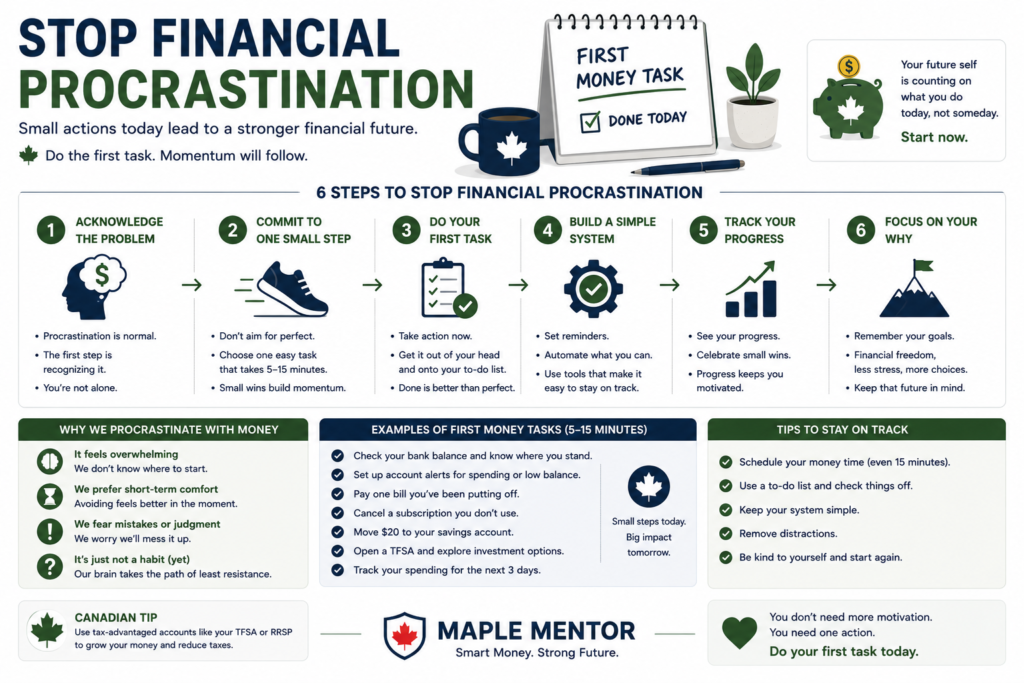
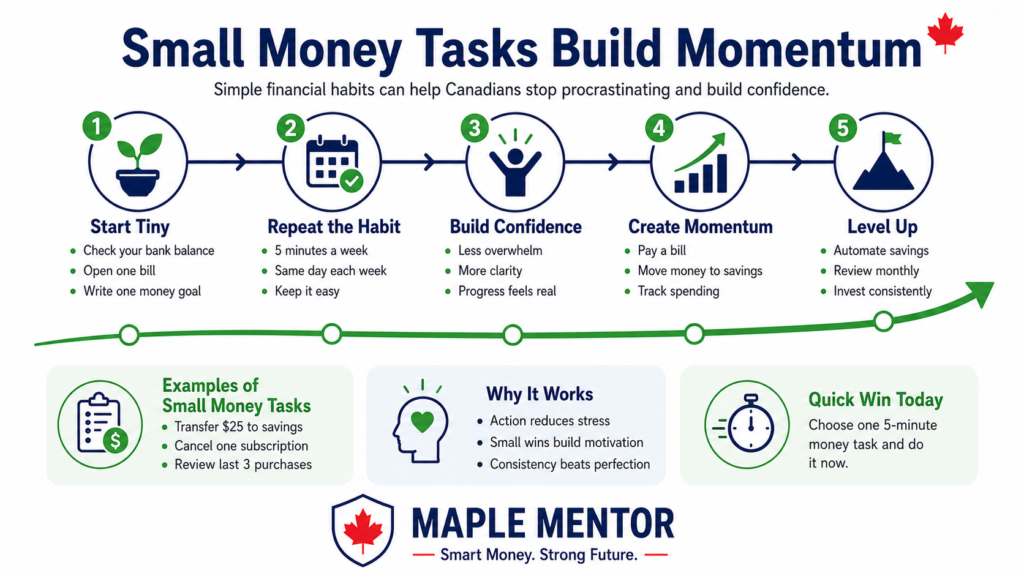
One of the biggest causes of financial procrastination Canada is trying to fix everything at once.
Instead of creating a massive to-do list, complete one small task.
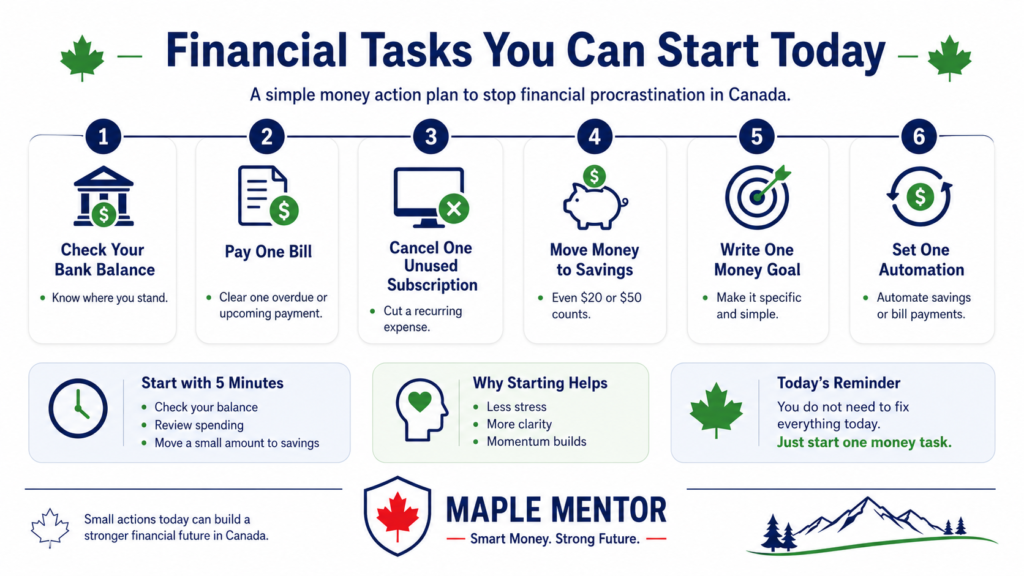
Examples include:
- Check your bank account balance.
- Open one unpaid bill.
- List one debt.
- Cancel one unused subscription.
- Transfer $25 into savings.
- Set one payment reminder.
- Review one credit card statement.
Most of these tasks take less than 10 minutes.
Finishing one small task builds momentum for the next one.
Progress creates motivation, not the other way around.
Step 2 Get a Clear Picture of Your Money
Once you’ve completed one small task, spend a little time understanding your current financial situation.
List your:
- Monthly income
- Regular bills
- Debt balances
- Savings
- Minimum debt payments
- Upcoming expenses
You don’t need a perfect spreadsheet.
A simple notebook or phone note works perfectly.
The objective is clarity.
Once you know where your money stands today, making future decisions becomes much easier.
If money feels overwhelming, read How to Handle Financial Stress in Canada for practical strategies to reduce anxiety while improving your finances.
The Financial Consumer Agency of Canada recommends understanding your income, expenses, debts, and savings before making financial decisions.
Step 3 Choose One Money Priority
Trying to improve everything at once usually creates more procrastination.
Instead, choose one priority.
Examples include:
- Paying bills on time
- Building a starter emergency fund
- Paying off credit card debt
- Starting to invest
- Reducing monthly spending
- Organizing your bank accounts
Once you’ve chosen one goal, ignore the others temporarily.
Focusing on one improvement is far more effective than making slow progress on five different goals.
Read How to Choose Between Saving, Investing, and Paying Off Debt in Canada if you’re unsure which financial priority should come first.
Step 4 Make the Task Smaller
Large goals often create fear because they feel impossible.
Instead of saying:
“I need to fix my finances.”
Break it into something you can finish today.
For example:
| Large Goal | Smaller Task |
|---|---|
| Fix my budget | Review spending for 10 minutes |
| Pay off debt | Make one extra $50 payment |
| Start investing | Compare one ETF |
| Improve savings | Transfer $25 |
| Organize finances | Check TFSA contribution room |
| Lower banking fees | Compare one chequing account |
Small wins reduce financial procrastination Canada because they feel achievable.
You don’t need an entire weekend.
Sometimes 15 minutes is enough to move forward.
Step 5 Automate One Good Money Habit
One of the easiest ways to reduce financial procrastination Canada is to remove the need to remember every financial task.
Automation allows good financial habits to happen automatically, even when you’re busy or unmotivated.
Start by automating just one thing.
For example:
- Automatic bill payments
- Automatic savings transfers
- Automatic TFSA or RRSP contributions
- Automatic debt payments
- Automatic transfers to your emergency fund
You don’t need to automate everything at once.
Even a recurring transfer of $25 or $50 after each paycheque can help you build momentum without requiring constant effort.
Automation also reduces decision fatigue because your money moves before you’re tempted to spend it elsewhere.
Learn how to build an automated money system in How to Automate Your Finances in Canada.
The Financial Consumer Agency of Canada recommends setting up automatic payments and transfers to help stay on top of bills and savings.
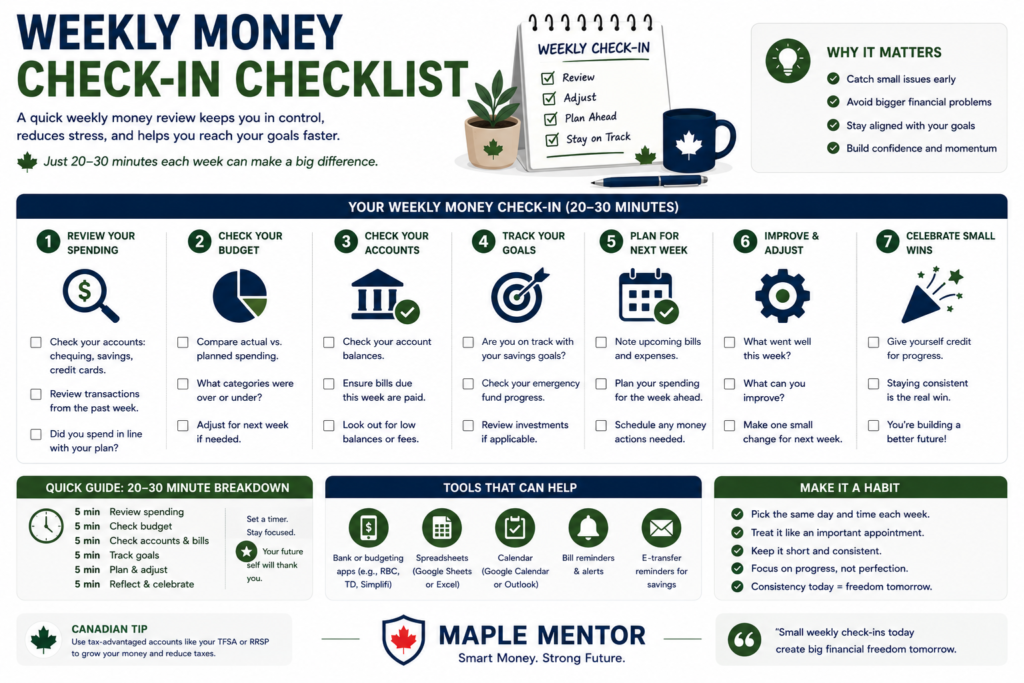
Step 6 Create a Weekly Money Check-In
Many people only think about money when something goes wrong.
Instead, schedule a short weekly money check-in.
Spend 10 to 15 minutes reviewing:
- Bank account balances
- Bills due soon
- Recent spending
- Debt balances
- Savings progress
- Upcoming expenses
A short review each week prevents small problems from becoming larger ones.
It also makes your finances feel familiar instead of intimidating.
The goal isn’t to judge yourself.
It’s simply to stay aware.
For a more complete monthly review, read How to Do a Monthly Money Review in Canada.
Step 7 Stop Waiting Until You Feel Ready
One of the biggest myths about money is that you’ll eventually wake up feeling motivated enough to fix everything.
Unfortunately, that rarely happens.
Most people don’t suddenly feel ready to budget, invest, or tackle debt.
Confidence comes from taking action—not waiting for confidence to appear first.
Think about other areas of life.
You don’t become fit before going to the gym.
You don’t become organized before cleaning your home.
Money works the same way.
Every small financial task you complete makes the next one feel easier.
If you’ve been struggling with financial procrastination Canada, remember that action creates momentum.
Start before you feel ready.
Common Financial Tasks People Delay
Some financial tasks are postponed far more often than others.
Here’s a simple way to make each one easier to start.
| Task People Delay | Small First Step |
|---|---|
| Budgeting | Track one week of spending |
| Paying off debt | List all debt balances |
| Saving money | Transfer $25 to savings |
| Investing | Learn the difference between a TFSA and RRSP |
| Paying bills | Set calendar reminders |
| Filing taxes | Collect documents in one folder |
Notice that every first step is simple.
The objective isn’t to finish the entire project.
The objective is to begin.
Common Mistakes to Avoid
Avoiding these mistakes can help you overcome financial procrastination Canada much faster.
Trying to Fix Everything in One Day
Financial progress is built through consistency.
Trying to overhaul your entire financial life in one weekend often leads to burnout.
Ignoring Bills
Unopened bills don’t disappear.
Reviewing them early gives you more time to plan and avoid late fees.
Waiting for the Perfect Budgeting App
No budgeting app will fix your finances by itself.
A simple spreadsheet, notebook, or banking app is enough to get started.
Comparing Yourself to Other People
Everyone’s financial journey is different.
Comparing your progress to someone else’s often creates discouragement instead of motivation.
Focus on improving compared to last month, not compared to someone else.
Avoiding Debt Balances
Many people know they have debt but avoid looking at the actual numbers.
Listing your balances may feel uncomfortable initially, but it also gives you a clear starting point.
Making the Plan Too Complicated
Complex financial systems often fail because they’re difficult to maintain.
Simple systems usually last longer.
Relying Only on Motivation
Motivation changes every day.
Instead, rely on routines, reminders, automation, and weekly check-ins.
Systems outperform motivation over the long term.
Final Answer
Overcoming financial procrastination Canada isn’t about becoming perfectly organized overnight.
It’s about making financial tasks small enough that you stop avoiding them.
Choose one simple action today.
Check your bank account.
Transfer a small amount to savings.
Review one bill.
Automate one payment.
Each small step builds confidence and reduces stress.
The sooner you stop delaying financial decisions, the easier they become.
If you’re struggling with financial procrastination Canada, remember that progress is built one small action at a time—not through perfect planning.
Frequently Asked Questions
How do I stop procrastinating with money?
Start with one small task, such as checking your account balance, listing your debts, or setting up one automatic savings transfer.
Small actions create momentum and make larger financial tasks feel more manageable.
Why do I avoid looking at my finances?
Many people avoid money because of stress, shame, confusion, or fear of discovering bad news.
Ironically, avoiding your finances often increases anxiety because the uncertainty continues to grow.
What money task should I do first?
Begin by checking your bank accounts and listing your income, bills, debts, savings, and upcoming expenses.
Understanding your current financial situation makes it much easier to decide what to improve next.
Can automation help financial procrastination?
Yes.
Automating bills, savings, debt payments, and investing reduces the number of financial decisions you need to make manually and helps good habits happen consistently.