
Learning how to lower your monthly bills in Canada can make a surprisingly large difference to your finances. While cutting an occasional coffee might save a few dollars, reducing a recurring bill saves money every single month.
A $20 monthly reduction is $240 per year. Cut $100 from several recurring expenses, and you’re keeping an extra $1,200 annually without needing to earn more money.
Fortunately, you don’t have to completely change your lifestyle. In this guide, you’ll learn how to lower your monthly bills in Canada by reviewing recurring payments, eliminating unnecessary expenses, and finding better deals on services you already use.
Quick Answer
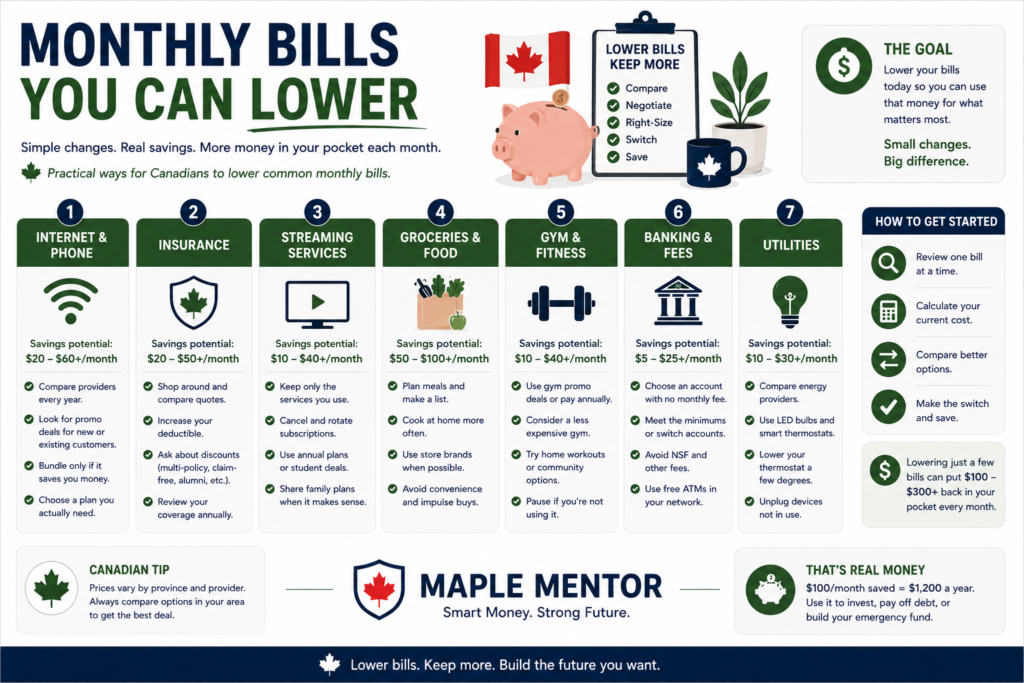
To lower your monthly bills in Canada, start by listing every recurring payment, then look for easy cuts: unused subscriptions, bank fees, expensive phone plans, insurance, groceries, and automatic payments you forgot about.
The goal is to reduce fixed expenses so your budget has more breathing room every month.
Quick Ways to Lower Your Monthly Bills
- Cancel subscriptions you don’t use.
- Compare phone and internet plans.
- Eliminate unnecessary banking fees.
- Compare insurance quotes annually.
- Reduce takeout and food waste.
- Review automatic payments.
- Watch for promotional rates expiring.
- Plan ahead for annual expenses.
Even finding $10 or $20 of savings in several categories can produce meaningful results over an entire year.
Why Monthly Bills Matter So Much
Monthly bills quietly control a large portion of your budget because they repeat automatically.
Suppose you’re paying:
- $20 too much for your phone
- $15 in banking fees
- $30 for subscriptions you barely use
- $25 more than necessary for internet
That’s $90 per month.
Over one year, those relatively small expenses cost $1,080.
More importantly, reducing recurring expenses doesn’t require you to repeatedly make the same sacrifice. Cancel a $15 subscription once, and you continue saving $15 every month until something changes.
That’s why recurring bills are one of the first places to look when trying to improve your cash flow.
Step 1 List Every Monthly Bill
Before you can reduce your bills, you need to know exactly what you’re paying.
Review the last two or three months of your bank and credit card statements.
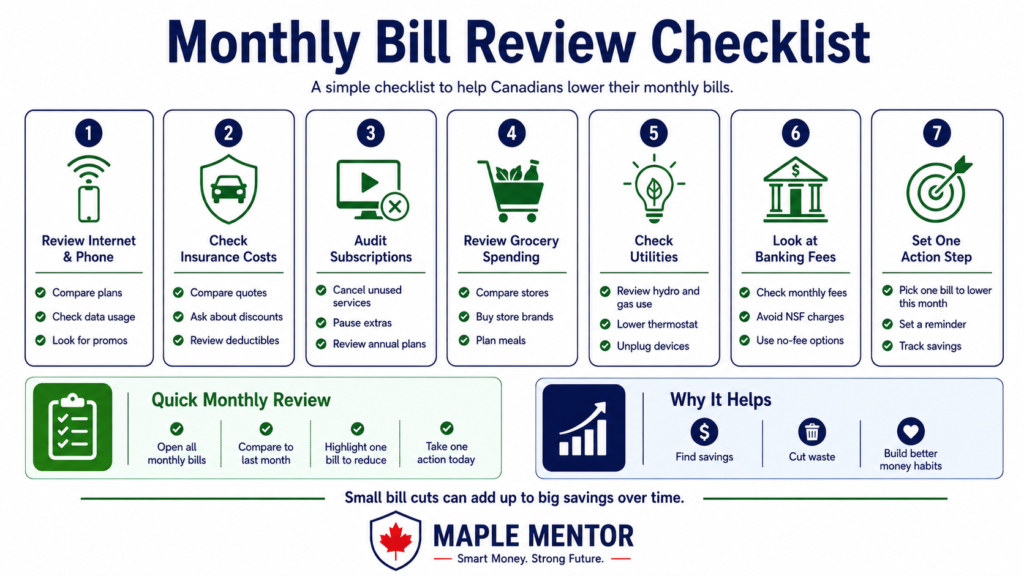
Write down every recurring expense, including:
- Rent or mortgage
- Phone
- Internet
- Insurance
- Electricity and utilities
- Subscriptions
- Banking fees
- Debt payments
- Gym memberships
- Streaming services
- Software
- Cloud storage
- Parking
- Childcare
- Other memberships
Don’t rely entirely on memory.
Automatic payments are easy to forget, especially subscriptions that cost only a few dollars per month.
Next, divide your expenses into three categories:
Essential: expenses you probably can’t eliminate.
Negotiable: expenses you need but might be able to reduce.
Optional: expenses you could cancel without significantly affecting your life.
Start with the optional and negotiable categories.
Step 2 Cancel Unused Subscriptions
Subscriptions are one of the easiest places to start.
Individually, they often seem inexpensive. However, several subscriptions can quietly become a substantial monthly expense.
Look for:
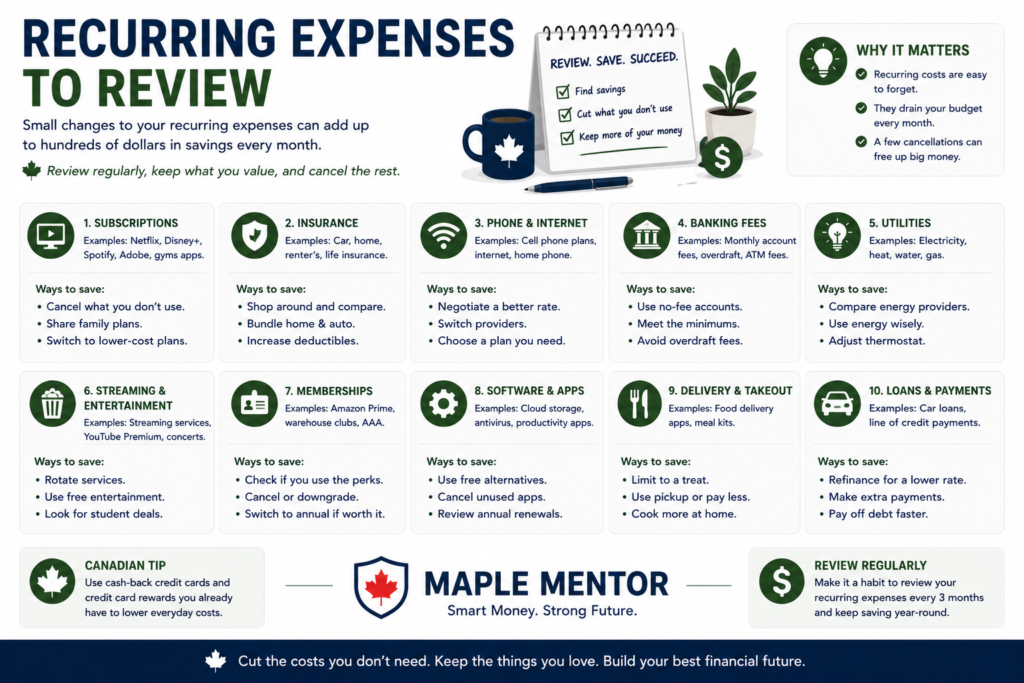
- Streaming services
- Music subscriptions
- Mobile apps
- Gym memberships
- Gaming subscriptions
- Software
- Cloud storage
- Premium memberships
- News subscriptions
- Free trials that became paid plans
Ask yourself one simple question:
Would I subscribe to this again today?
If the answer is no, consider cancelling it.
You don’t necessarily need to eliminate every subscription either. Rotating streaming services can be an effective compromise. Instead of maintaining four platforms throughout the year, keep one or two and switch when there’s something specific you want to watch.
Additionally, check your Apple App Store or Google Play subscriptions. Small recurring app charges are particularly easy to overlook.
Step 3 Review Your Phone and Internet Plans
Phone and internet costs can take a significant portion of a Canadian household budget.
However, don’t automatically assume your current plan is still competitive simply because it was a good deal when you signed up.
First, check how much data and internet speed you actually use.
You may discover that you’re paying for:
- Mobile data you rarely use
- International features you don’t need
- Internet speeds significantly above your needs
- Device financing
- Add-ons you’ve forgotten about
Then compare competing plans.
You can also contact your existing provider and ask whether cheaper plans or retention offers are available.
Before changing providers, however, check whether you’re financing a phone or have other contractual obligations.
The CRTC provides information about Canadian wireless contracts, cancellation rules, roaming charges, and consumer protections under the Wireless Code.
Reviewing these expenses once or twice per year can help you lower your monthly bills in Canada without changing how you actually use your phone or internet.
Step 4 Reduce Banking Fees
Paying $10 to $20 every month for a bank account might not seem significant.
However, a $16 monthly account fee costs $192 per year.
Fortunately, Canadians have access to several no-fee banking options.
Depending on your needs, you may be able to eliminate monthly account fees entirely.
Compare your options in Best No-Fee Chequing Accounts in Canada.
For savings, see Best No-Fee Savings Accounts in Canada.
If you want to compare traditional and online options, read Best Chequing Accounts in Canada.
Before switching accounts, check:
- Monthly fees
- Transaction limits
- ATM access
- Interac e-Transfer limits
- Minimum balance requirements
- NSF fees
- Foreign transaction fees
The Financial Consumer Agency of Canada also provides an official Account Comparison Tool for comparing chequing and savings accounts.
Eliminating unnecessary banking fees is particularly useful because the savings repeat automatically every month.
Step 5 Compare Insurance Costs
Insurance is another recurring expense worth reviewing periodically.
Depending on your situation, you may pay for:
- Car insurance
- Home insurance
- Tenant insurance
- Life insurance
- Other insurance products
You shouldn’t simply choose the cheapest policy available. Coverage, deductibles, exclusions, and limits matter too.
However, comparing equivalent coverage can reveal opportunities to save.
Consider getting new quotes:
- Once per year
- Before your policy renews
- After moving
- After buying or selling a vehicle
- After major lifestyle changes
You can also ask your current insurer whether combining home and auto insurance provides a discount.
Before changing providers, compare the actual coverage—not just the monthly premium.
The Financial Consumer Agency of Canada provides additional information about shopping for insurance and understanding coverage.
Step 6 Lower Grocery and Food Spending
Food is different from a phone bill because it isn’t completely fixed.
Nevertheless, it’s a major recurring expense and one of the easiest areas to accidentally overspend.
You don’t need to survive on rice and beans to reduce your food budget.
Instead, focus on reducing waste and unnecessary convenience spending.
Plan Your Meals
Decide what you’ll eat before grocery shopping.
This makes it easier to buy ingredients you’ll actually use.
Buy Basic Ingredients
Prepared and individually packaged foods often cost more than basic ingredients.
Compare unit prices instead of package prices when possible.
Reduce Takeout
You don’t necessarily need to eliminate restaurants completely.
However, reducing takeout from three times per week to once can create substantial monthly savings.
Check Flyers
Plan some meals around discounted meat, produce, and pantry staples.
Reduce Food Waste
Throwing away unused groceries means paying for food twice: once when you buy it and again when you replace it.
Check your refrigerator before shopping and use food that’s approaching its expiry date first.
Compare Stores
Some grocery stores may consistently offer better prices for the products you buy.
However, driving across town to save $2 isn’t necessarily worthwhile. Focus on meaningful differences.
For more strategies, read How to Save Money Fast in Canada.
Canada’s Food Price Report also tracks changes in Canadian food prices and provides annual forecasts that can help put grocery-cost increases into perspective.
Step 7 Watch for Annual Bills Turned Monthly
Not every recurring expense arrives every month.
Some of the biggest budget surprises happen annually.
Examples include:
- Insurance renewals
- Annual subscriptions
- Professional memberships
- Vehicle registration
- Car maintenance
- Holiday spending
- Property taxes
- Income tax payments
A $600 annual expense is effectively a $50 monthly expense, even if you only receive the bill once per year.
Instead of waiting for the bill, divide predictable annual costs by 12 and save that amount each month.
For example:
$1,200 annual insurance bill ÷ 12 = $100 per month
Setting aside $100 every month means the money should already be available when the bill arrives.
Read How to Plan for Annual Expenses in Canada for a complete sinking-fund strategy.
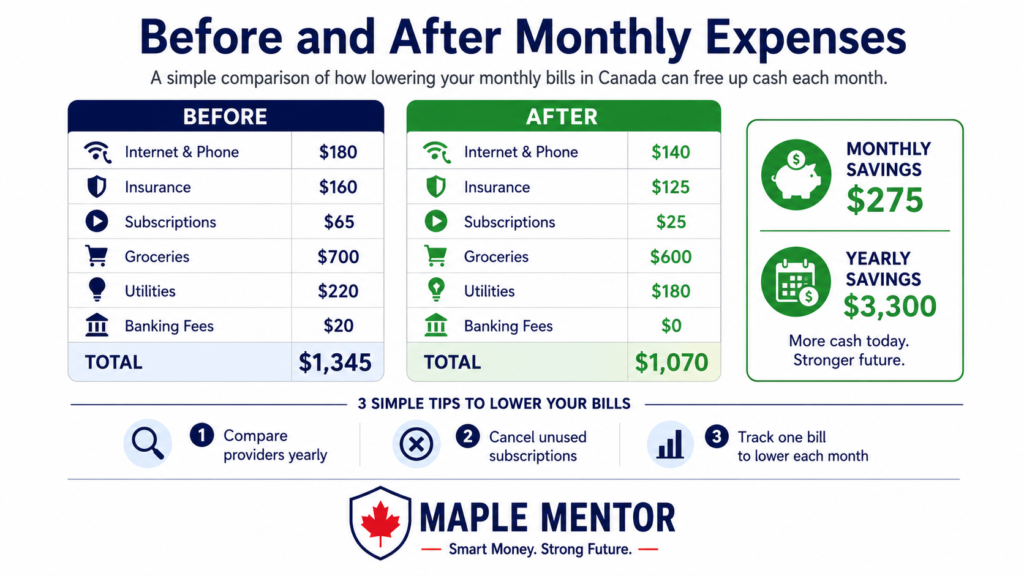
Simple Monthly Bills Review Table
Use a simple table like this when reviewing your recurring expenses:
| Bill | Current Cost | Can You Lower It? |
|---|---|---|
| Phone | $70 | Compare cheaper plans |
| Internet | $85 | Call provider or switch |
| Subscriptions | $60 | Cancel unused ones |
| Bank fees | $16 | Use no-fee banking |
| Insurance | $150 | Compare yearly |
| Total | $381 | Review regularly |
Now imagine reducing these expenses by:
- Phone: $20
- Internet: $15
- Subscriptions: $30
- Banking: $16
- Insurance: $20
That’s $101 per month.
Over one year, you would save $1,212.
This is why learning how to lower your monthly bills in Canada can sometimes produce better results than obsessing over every small discretionary purchase.
Common Mistakes to Avoid
Only Cutting Small Purchases
Coffee and occasional treats receive a lot of attention in personal finance.
However, reducing a $100 recurring bill can have a much larger impact than eliminating a $4 purchase once per week.
Start with your biggest recurring expenses.
Ignoring Fixed Bills
People often assume fixed expenses can’t be changed.
Some can’t.
Others can be negotiated, replaced, downgraded, or eliminated.
Review them before assuming they’re permanent.
Forgetting Annual Increases
Insurance, internet, phone plans, subscriptions, and other services can increase in price over time.
A bill you’ve ignored for three years may no longer be competitive.
Keeping Unused Subscriptions
If you haven’t used a service in months, cancel it.
You can usually subscribe again later if you genuinely miss it.
Paying Bank Fees Without Comparing Alternatives
A traditional bank account may still be worth paying for if you use services that justify the cost.
However, don’t pay monthly fees automatically when no-fee alternatives may meet your needs.
Not Reviewing Bills After Promotions Expire
Introductory phone and internet prices don’t always last forever.
Set a calendar reminder for the month before your promotion expires. Then compare alternatives or contact your provider.
Final Answer
Learning how to lower your monthly bills in Canada is one of the most practical ways to improve your cash flow without increasing your income.
Start by reviewing every recurring payment. Then cancel what you don’t use, compare phone and internet plans, eliminate unnecessary banking fees, review insurance costs, and look for realistic ways to reduce food spending.
Most importantly, don’t treat this as a one-time exercise.
Review your recurring expenses every few months, especially when contracts, promotions, or insurance policies are approaching renewal.
Even saving $50 to $100 per month can make a meaningful difference. Once you’ve learned how to lower your monthly bills in Canada, that extra money can go toward emergency savings, debt repayment, investing, or other financial goals instead.
Frequently Asked Questions
How can I lower my monthly bills in Canada?
Start by listing every recurring payment, then review subscriptions, phone plans, internet, insurance, banking fees, and food spending.
The easiest way to lower your monthly bills in Canada is often to target recurring expenses you can eliminate or negotiate once and continue saving on every month.
What bills are easiest to reduce?
Subscriptions, banking fees, phone plans, internet plans, and takeout are often among the easiest expenses to review.
However, the biggest opportunity depends on your individual spending.
Should I switch banks to save money?
It can make sense if you’re paying monthly account fees and don’t use features that justify the cost.
Compare transaction limits, ATM access, e-Transfers, customer service, and other features before switching solely because an account is free.
How often should I review my bills?
Review your recurring bills every three to six months.
You should also review them before phone or internet promotions expire and before insurance policies renew.