
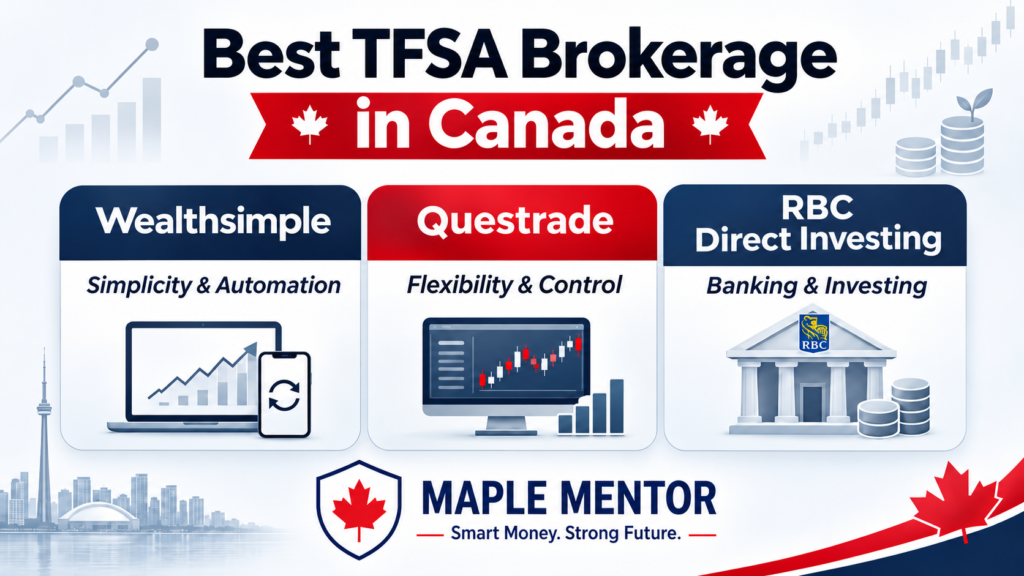
Choosing the best TFSA brokerage in Canada can help you reduce investment costs, simplify your finances, and build long-term wealth more efficiently.
However, with Canadian brokerages increasingly offering commission-free trading, choosing the right platform is no longer simply about finding the lowest trading fees.
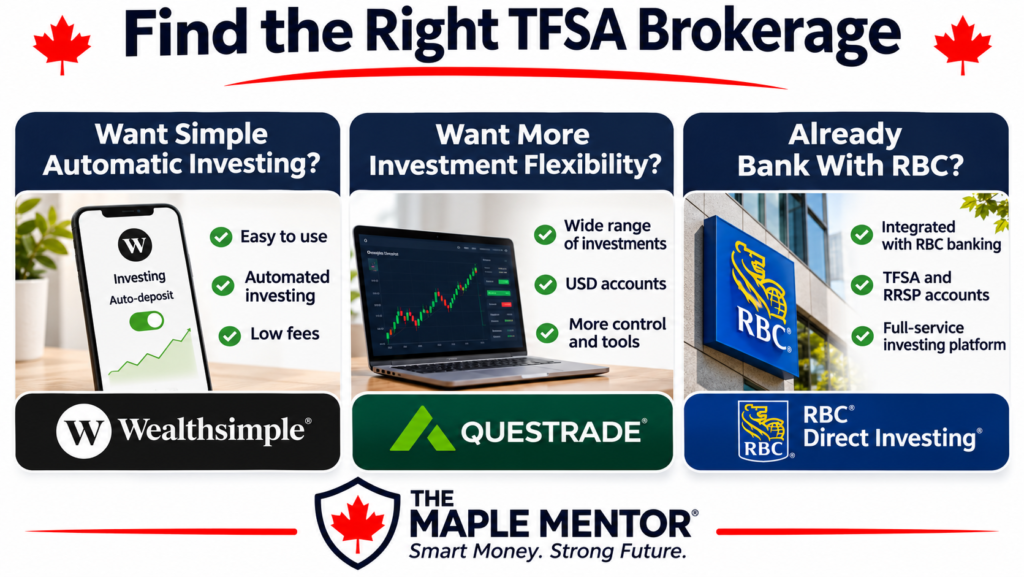
Wealthsimple offers a straightforward investing experience with fractional shares and automatic investments. Questrade combines commission-free stock and ETF trading with traditional brokerage functionality. Meanwhile, RBC Direct Investing offers both a beginner-focused platform through RBC GoSmart and a more comprehensive self-directed brokerage.
Each platform has advantages depending on what you plan to hold inside your Tax-Free Savings Account (TFSA).
Whether you’re investing your first $500, building a diversified ETF portfolio, or managing a six-figure investment account, this guide compares the features that matter most.
Affiliate Disclosure: This article may contain affiliate links. The Maple Mentor may earn a commission if you open an account through one of these links, at no additional cost to you.
Quick Answer: Best TFSA Brokerage in Canada
For most Canadians building a straightforward, long-term ETF portfolio, Wealthsimple is my preferred choice because of its simplicity, commission-free eligible trading, and automatic investing functionality.
However, Questrade and RBC Direct Investing may be better suited to certain investors.
- Wealthsimple: Best for beginners, passive ETF investors, fractional investing, and automatic investment purchases.
- Questrade: Best for investors who want greater brokerage functionality, commission-free eligible stock and ETF trading, and free dual-currency account functionality.
- RBC GoSmart: Best for newer investors who already bank with RBC and want a simplified investing experience.
- RBC Direct Investing Full Suite: Best for investors who prefer a traditional bank-owned brokerage with broader investment selection and research tools.
The competition between these platforms is considerably closer than it was several years ago.
Commission-free trading is becoming increasingly common. As a result, currency-conversion costs, automation, investment selection, and platform functionality are becoming more important differentiators.
Ultimately, the best TFSA brokerage in Canada depends on how you intend to invest.
Wealthsimple vs Questrade vs RBC TFSA at a Glance
| Feature | Wealthsimple | Questrade | RBC GoSmart | RBC Full Suite |
|---|---|---|---|---|
| Self-directed TFSA | Yes | Yes | Yes | Yes |
| Standard stock commissions | $0 | $0 online | 50 free trades annually | $9.95 |
| ETF commissions | $0 | $0 online | Selected free ETFs and annual trade allowance | $9.95 standard; selected free ETFs |
| Recurring investments | Eligible stocks and ETFs | Eligible U.S.-listed securities | Selected all-in-one ETFs | More limited |
| Fractional investing | Yes | Yes, eligible securities | More limited | More limited |
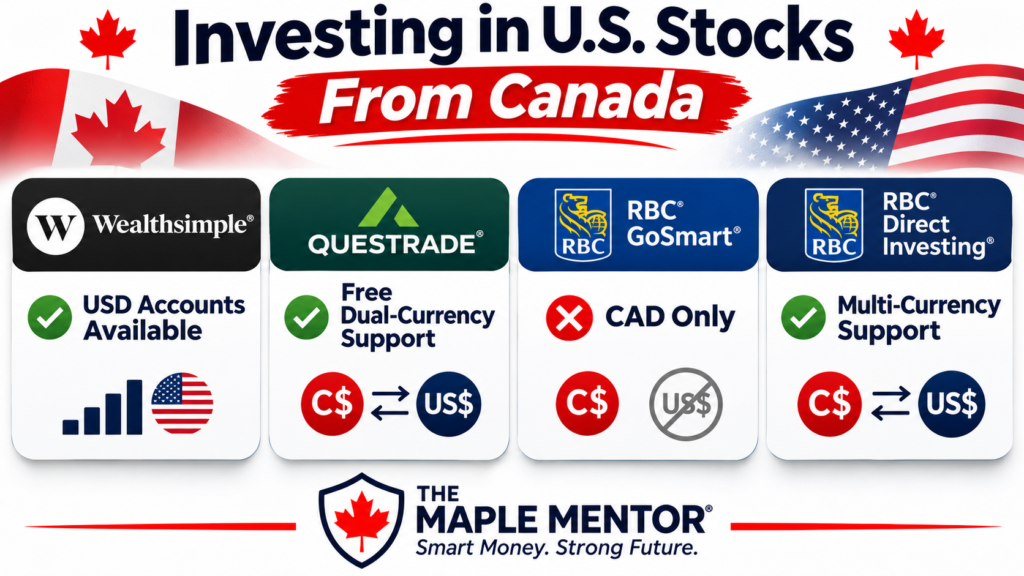
| Hold USD directly | With USD account feature | Yes | No | Yes |
| Managed investing | Yes | Questwealth | Separate RBC services | Separate RBC services |
| Beginner-friendly | Excellent | Good | Excellent | Good |
| Traditional brokerage tools | Growing | Strong | Limited | Strong |
| GICs and individual bonds | More limited | Available | Limited | Available |
| Best suited for | Simplicity and automation | Flexibility | New RBC investors | Traditional investing |
Fees and account features are subject to change. Additional transaction charges, currency-conversion costs, and investment eligibility restrictions may apply.
Although all four investing experiences can support a long-term TFSA strategy, their differences become more noticeable when you start investing regularly or purchasing U.S.-listed securities.
How a TFSA Works Before Choosing a Brokerage
Before choosing the best TFSA brokerage in Canada, it’s important to understand that a TFSA is an account type rather than an investment itself.
Depending on your financial institution, a TFSA can hold eligible investments such as stocks, ETFs, mutual funds, GICs, bonds, and cash.
Its primary advantage is that investment growth and withdrawals are generally tax-free in Canada.
TFSA Contribution Limit for 2026
The annual TFSA dollar limit for 2026 is $7,000.
However, your actual available contribution room may be higher depending on your unused contribution room and previous withdrawals.
Important TFSA rules include:
- Unused contribution room carries forward.
- Contributions aren’t tax-deductible.
- Eligible investment growth is generally tax-free.
- Withdrawals are generally tax-free.
- Withdrawn amounts are added back to your contribution room on January 1 of the following calendar year.
You can review the official contribution rules through the Canada Revenue Agency at https://www.canada.ca/en/revenue-agency/services/tax/individuals/topics/tax-free-savings-account/contributing/calculate-room.html.
Be Careful When Withdrawing and Recontributing
Suppose you’ve already used all your available TFSA contribution room.
You withdraw $5,000 from your Wealthsimple TFSA in June and immediately deposit that money into a Questrade TFSA.
Because the withdrawal doesn’t restore your contribution room until the following calendar year, the new deposit could create an overcontribution.
Excess TFSA contributions are generally subject to a tax of 1% per month on the highest excess amount during that month.
This is particularly important when switching brokerages.
For a more detailed explanation of how to invest inside this account, our TFSA Investing Strategy for Beginners guide covers investment selection, contribution strategies, and long-term portfolio construction.
1. Wealthsimple TFSA
Best TFSA brokerage for simplicity and automatic investing
Wealthsimple has become one of Canada’s most recognizable investing platforms by making self-directed investing accessible to everyday Canadians.
Its biggest advantage is that investors can build a diversified portfolio without navigating a particularly complicated brokerage interface.
Wealthsimple currently offers several approaches to TFSA investing:
- Self-directed trading.
- Managed investing.
- Automated investing.
- Registered savings options.
This flexibility allows Canadians to use their TFSA for different financial objectives.
Wealthsimple Self-Directed TFSA
A Wealthsimple self-directed TFSA allows investors to purchase eligible Canadian and U.S. stocks, ETFs, and certain options.
Its standard commission-free trading structure makes it particularly attractive for investors making frequent small contributions.
For example, suppose you invest $150 every week into a Canadian-listed ETF.
$150 x 52 = $7,800 annually
At a brokerage charging $9.95 per purchase, 52 annual transactions could cost $517.40.
At Wealthsimple, eligible commission-free ETF purchases would avoid those standard trading commissions.
However, investors must ensure their contributions remain within their available TFSA contribution room.
Wealthsimple’s official TFSA documentation explains its available account features at https://help.wealthsimple.com/hc/en-ca/articles/4404053510299-Open-a-TFSA.
Wealthsimple Fractional Investing
Fractional investing allows you to purchase a portion of an eligible stock or ETF instead of purchasing an entire share.
For example, suppose an eligible ETF trades at $60 per share and you have $100 available.
Without fractional investing, you could purchase one share and leave $40 uninvested.
With fractional investing, you could invest approximately the entire $100.
Although the difference may seem small, fractional investing can help investors use their available cash more efficiently.
It’s particularly useful for beginners investing smaller amounts regularly.
Wealthsimple Automatic Investing
One of Wealthsimple’s strongest features is its recurring investment functionality.
Eligible investment purchases can be scheduled:
- Daily.
- Weekly.
- Biweekly.
- Monthly.
For example, an investor could automatically contribute $250 every two weeks and purchase an eligible diversified ETF.
$250 x 26 = $6,500 annually
This creates a straightforward investment routine without requiring the investor to manually place every trade.
For long-term investors, reducing the number of financial decisions they need to make can help improve consistency.
Our Automatic ETF Investing in Canada: Wealthsimple vs Questrade guide explores the differences between automatic deposits and automatic investment purchases.
Wealthsimple TFSA for U.S. Stocks
Wealthsimple allows eligible TFSA investors to access USD accounts.
However, the cost depends on the client’s account tier.
Under its published USD-account pricing structure:
| Client Tier | USD Account Subscription |
|---|---|
| Core | $10 CAD per month |
| Premium | Included for eligible clients |
| Generation | Included for eligible clients |
For Core clients, the subscription represents $120 annually.
Investors should therefore consider whether they trade U.S.-listed securities frequently enough to justify the additional cost.
Holding USD can help avoid repeated currency conversions, but it doesn’t eliminate the initial cost of converting Canadian dollars into U.S. dollars.
You can review Wealthsimple’s USD-account terms at https://help.wealthsimple.com/hc/en-ca/articles/4414660979355-Upgrade-to-USD-accounts-for-trading.
Wealthsimple TFSA Advantages and Disadvantages
| Advantages | Disadvantages |
|---|---|
| Commission-free eligible stock and ETF trading | USD subscription fee for Core clients |
| Beginner-friendly interface | More limited traditional fixed-income selection |
| Strong recurring investing functionality | Fewer advanced brokerage tools than some competitors |
| Fractional investing | Currency-conversion costs may apply |
| Managed and self-directed options | Certain investments and features have eligibility restrictions |
Who Should Choose Wealthsimple?
Wealthsimple may be the best TFSA brokerage in Canada for investors who want to:
- Build a passive ETF portfolio.
- Automate regular investments.
- Start investing with a small amount.
- Minimize standard trading commissions.
- Avoid unnecessary platform complexity.
Verdict: My preferred choice for most beginners and passive Canadian ETF investors.
2. Questrade TFSA
Best TFSA brokerage for investment flexibility
Questrade has long been a popular choice among Canadian self-directed investors.
Its combination of traditional brokerage functionality, dual-currency accounts, and commission-free eligible online stock and ETF trading makes it a strong competitor to Wealthsimple.
While Wealthsimple focuses heavily on accessibility and simplicity, Questrade may appeal to investors who want more control over their portfolios.
Questrade TFSA Trading Fees
Questrade currently advertises:
- $0 commissions on eligible online stock trades.
- $0 commissions on eligible online ETF trades.
- No annual account fee.
- No inactivity fee.
- Free dual-currency account functionality.
Other charges can still apply, including currency-conversion fees, certain transaction charges, and optional services.
You can review its official pricing structure at https://www.questrade.com/pricing-fees.
The introduction of commission-free stock and ETF trading makes Questrade particularly competitive for Canadian investors who previously preferred Wealthsimple primarily because of its trading fees.
Questrade Investment Selection
A Questrade self-directed TFSA provides access to a broad range of eligible investments.
These may include:
- Canadian and U.S. stocks.
- ETFs.
- Mutual funds.
- GICs.
- Bonds.
- Certain options.
This broader selection can be valuable for investors who use their TFSA for several financial goals.
For example, someone might hold diversified equity ETFs for retirement while using GICs for money they expect to need sooner.
Questrade TFSA for U.S. Stocks
One of Questrade’s most important advantages is its dual-currency functionality.
Investors can hold Canadian and U.S. dollars directly inside their TFSA without paying a separate monthly USD-account subscription.
This can be useful when purchasing U.S.-listed securities or receiving U.S.-dollar investment proceeds.
For example, if you sell a U.S. stock, you can generally retain the proceeds in USD rather than automatically converting them back into Canadian dollars.
You could then use those funds to purchase another U.S.-listed investment.
However, free dual-currency functionality doesn’t mean currency conversion is free.
Questrade’s published currency-conversion fee is generally 1.5%.
For example, converting $10,000 CAD at a 1.5% conversion fee represents approximately $150 in conversion costs, excluding exchange-rate movements and any other applicable charges.
You can find more information at https://www.questrade.com/pricing/self-directed-commissions-plans-fees/transaction.
Questrade Automatic Investing
Questrade offers both recurring deposits and recurring investment purchases.
However, there’s an important distinction.
Recurring deposits allow investors to automatically transfer money into their brokerage accounts.
Recurring investments automatically purchase eligible securities.
Questrade’s recurring-purchase functionality currently focuses on eligible fractional U.S.-listed stocks and ETFs.
Consequently, Canadian-listed ETFs such as XEQT or VEQT may not be eligible for automatic purchases through this feature.
An investor can still automate deposits and manually purchase their preferred Canadian ETF.
For current investment eligibility, consult https://www.questrade.com/learning/using-questrade/understanding-recurring-investments.
Questrade TFSA Advantages and Disadvantages
| Advantages | Disadvantages |
|---|---|
| Commission-free eligible online stock and ETF trading | More complex interface for beginners |
| Free CAD/USD account functionality | Currency-conversion fees still apply |
| Broader traditional investment selection | Recurring purchases have security restrictions |
| Strong brokerage tools | Some investment products involve additional fees |
| Self-directed and managed options | May require more manual portfolio management |
Who Should Choose Questrade?
Questrade may be the best TFSA brokerage in Canada for investors who want:
- Free dual-currency account functionality.
- Greater control over their investments.
- Access to traditional fixed-income products.
- More comprehensive brokerage tools.
- Commission-free eligible stock and ETF trading.
Verdict: My preferred alternative to Wealthsimple, particularly for investors who regularly hold U.S. dollars or want broader investment functionality.
Our Wealthsimple vs Questrade Canada comparison provides a more detailed breakdown of the differences between these platforms.
3. RBC Direct Investing TFSA
Best TFSA brokerage for traditional banking integration
RBC Direct Investing is particularly relevant to Canadians who already bank with RBC and prefer managing their finances through one financial institution.
However, RBC now offers two distinct self-directed investing experiences.
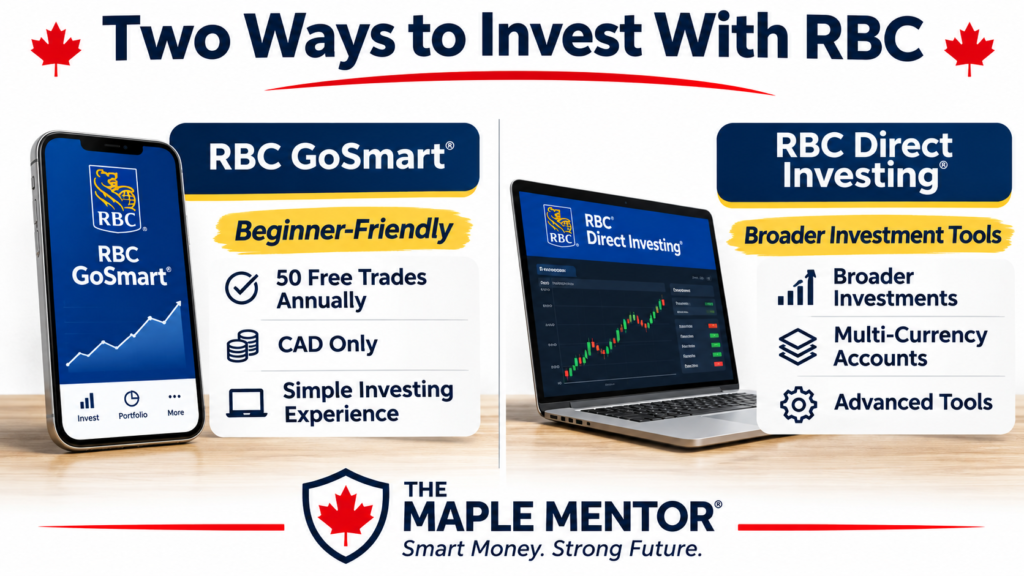
RBC GoSmart provides a simplified platform for newer investors, while full-suite RBC Direct Investing offers broader investment choices and more comprehensive brokerage functionality.
Understanding the differences between these two products is essential before opening a TFSA.
RBC GoSmart TFSA
RBC GoSmart is specifically designed for investors who want a straightforward, mobile-first investing experience.
Its main features include:
- No minimum investment requirement.
- No account maintenance fee.
- 50 commission-free stock and ETF trades annually across your GoSmart accounts.
- Unlimited commission-free trading on selected ETFs.
- Recurring investments into four eligible all-in-one ETFs.
- Integration with the RBC Mobile app.
For someone who already has an RBC chequing account, GoSmart can make the transition from saving to investing relatively straightforward.
Additionally, its commission-free trading allowance may be sufficient for someone making monthly or biweekly investments.
Recurring investments into eligible all-in-one ETFs don’t count toward the annual allowance of 50 free trades.
You can explore the platform through RBC’s official GoSmart page at https://www.rbcdirectinvesting.com/gosmart-for-new-investors/index.html. Commission-Free Trading & Investing+1
RBC GoSmart Limitations
Despite its advantages, GoSmart has several important limitations.
The account operates exclusively in Canadian dollars.
Although investors can purchase eligible U.S.-listed stocks and ETFs, they cannot maintain a USD cash balance.
Consequently, currency conversion applies when trading U.S.-dollar securities.
GoSmart also doesn’t support mutual funds, traditional fixed-income products, options, or incoming in-kind securities transfers.
For someone purchasing Canadian-listed ETFs exclusively, these limitations may not matter.
However, investors who expect their portfolios to become more complex may eventually prefer another platform.
Full-Suite RBC Direct Investing TFSA
RBC’s full brokerage offers a more comprehensive investing experience.
Its investment selection includes eligible stocks, ETFs, mutual funds, GICs, bonds, and options.
It also supports multiple currencies and provides additional research and portfolio management tools.
However, its standard trading commissions are generally higher than those at Wealthsimple and Questrade.
RBC’s standard online and mobile stock and ETF commission is $9.95 per trade for investors making fewer than 150 trades per quarter.
Importantly, RBC also offers unlimited commission-free trading on a selection of more than 50 ETFs across its account types.
This means that not every ETF transaction incurs the standard commission.
You can review RBC’s current pricing at https://www.rbcdirectinvesting.com/pricing/index.html. RBC Direct Investing+1
RBC GoSmart vs Full-Suite RBC Direct Investing
| Feature | RBC GoSmart | RBC Full Suite |
|---|---|---|
| Minimum investment | None | None |
| Maintenance fee | $0 | $0 |
| Standard trading structure | 50 free trades annually | Generally $9.95 per trade |
| Selected commission-free ETFs | Yes | Yes |
| Hold USD | No | Yes |
| GICs and bonds | No | Yes |
| Mutual funds | No | Yes |
| Options | No | Yes |
| Incoming in-kind transfers | No | Supported, subject to eligibility |
| Advanced research tools | Limited | More comprehensive |
| Ideal investor | Beginner | Established investor |
For newer investors, GoSmart may provide everything necessary to start building a diversified TFSA portfolio.
However, the full brokerage offers functionality that may become more valuable as investment needs evolve.
RBC Direct Investing Advantages and Disadvantages
| Advantages | Disadvantages |
|---|---|
| Integration with RBC banking | Standard commissions on full-suite trades outside eligible free ETFs |
| Beginner-friendly GoSmart option | GoSmart cannot hold USD |
| Selected commission-free ETFs | GoSmart has limited investment selection |
| Traditional fixed-income products through the full platform | Less flexible recurring investing |
| More comprehensive research tools through the full platform | Potential currency-conversion costs |
Who Should Choose RBC Direct Investing?
RBC may be the best TFSA brokerage in Canada for existing RBC customers who value banking integration, a familiar financial institution, and access to traditional investment products.
GoSmart is particularly attractive for newer investors, while the full platform may be more suitable for experienced investors.
Verdict: A competitive choice for existing RBC customers, particularly when its commission-free ETF selection matches their investment strategy.
Our RBC Direct Investing vs Wealthsimple comparison explores these differences in greater detail.
Best TFSA Brokerage in Canada for ETF Investing
For many Canadians, exchange-traded funds (ETFs) are among the simplest investments to hold inside a TFSA.
A diversified ETF can provide exposure to hundreds or thousands of underlying investments through a single purchase.
However, choosing the right brokerage can affect both the cost and convenience of investing regularly.
Popular ETFs for Canadian TFSA Investors
| ETF | Investment Exposure | Risk Consideration |
|---|---|---|
| XEQT | Globally diversified stocks | 100% equity allocation |
| VEQT | Globally diversified stocks | 100% equity allocation |
| XGRO | Diversified stocks and bonds | Approximately 80% equities |
| XBAL | Diversified stocks and bonds | Approximately 60% equities |
| VFV | S&P 500 companies | Concentrated in U.S. large-cap stocks |
These ETFs serve different investment objectives.
For example, XEQT and VEQT may appeal to long-term investors who can tolerate considerable market volatility.
Meanwhile, XGRO and XBAL include bonds, which may reduce portfolio volatility but don’t eliminate investment risk.
VFV provides exposure primarily to large American companies rather than a globally diversified portfolio.
The appropriate choice depends on your investment timeline, financial objectives, and risk tolerance.
Our Best ETFs for TFSA in Canada guide provides a more comprehensive breakdown of investment options.
Comparing Annual ETF Trading Costs
Suppose you contribute $500 per month to your TFSA and purchase one Canadian-listed ETF each time.
Your annual contributions would total:
$500 x 12 = $6,000
Here’s how standard trading commissions could compare.
| Brokerage | Annual Purchases | Annual Standard Commissions |
|---|---|---|
| Wealthsimple | 12 | $0 |
| Questrade | 12 | $0 |
| RBC GoSmart | 12 | $0 within allowance |
| RBC Full Suite | 12 | $119.40 |
This example assumes eligible online transactions, sufficient GoSmart free-trade allowance, and an ETF outside RBC’s unlimited commission-free selection for the full-suite account.
If the ETF qualifies for RBC’s unlimited commission-free trading, its annual standard trading commissions would also be $0.
Consequently, investors should compare the costs of purchasing their actual preferred investments rather than relying exclusively on headline commission rates.
Which Brokerage Wins for ETF Investing?
Wealthsimple has an advantage for investors who want commission-free eligible trading, fractional purchases, and automatic Canadian ETF investing.
Questrade is equally competitive in terms of standard eligible ETF commissions, while providing broader brokerage functionality.
RBC GoSmart can also be a cost-effective option for investors who remain within its free-trading allowance or purchase eligible commission-free ETFs.
Winner for straightforward passive ETF investing: Wealthsimple.
Winner for broader ETF investing flexibility: Questrade.
Best TFSA Brokerage in Canada for Automatic Investing
Automatic investing can make long-term wealth accumulation more manageable.
Instead of manually transferring money and purchasing investments every payday, you can establish a financial system that handles much of the process automatically.
However, not every brokerage provides the same level of automation.
Wealthsimple Automatic TFSA Investing
Wealthsimple supports recurring purchases of eligible Canadian and U.S. stocks and ETFs.
For example, an investor could arrange to purchase $125 of an eligible diversified ETF every week.
$125 x 52 = $6,500 annually
This could create a consistent investment routine without requiring manual weekly purchases.
The combination of fractional investing and recurring purchases is particularly useful when investing predetermined dollar amounts.
Questrade Automatic TFSA Investing
Questrade supports automatic account funding through recurring deposits.
It also offers recurring purchases of eligible fractional U.S.-listed securities.
However, investors who want to automatically purchase Canadian-listed ETFs may need to place those orders manually.
For someone who doesn’t mind spending a few minutes managing their portfolio every month, this limitation may be relatively insignificant.
RBC GoSmart Automatic TFSA Investing
RBC GoSmart allows recurring investments into four eligible all-in-one ETFs.
This provides a useful option for investors who want a diversified portfolio without frequently placing manual trades.
However, the selection is narrower than Wealthsimple’s recurring-investment offering.
Automatic Deposits vs Automatic Investments
One common mistake is assuming that an automatic deposit automatically purchases investments.
In reality, these are two different processes.
An automatic deposit transfers money into your TFSA.
An automatic investment uses available funds to purchase an eligible stock or ETF.
Without the second step, your contributions may remain uninvested as cash.
Winner for automatic Canadian ETF investing: Wealthsimple.
Best TFSA Brokerage in Canada for U.S. Stocks
Canadians who regularly purchase American stocks or U.S.-listed ETFs should pay particular attention to how their brokerage handles foreign currencies.
A brokerage can offer commission-free trading while still charging substantial currency-conversion fees.
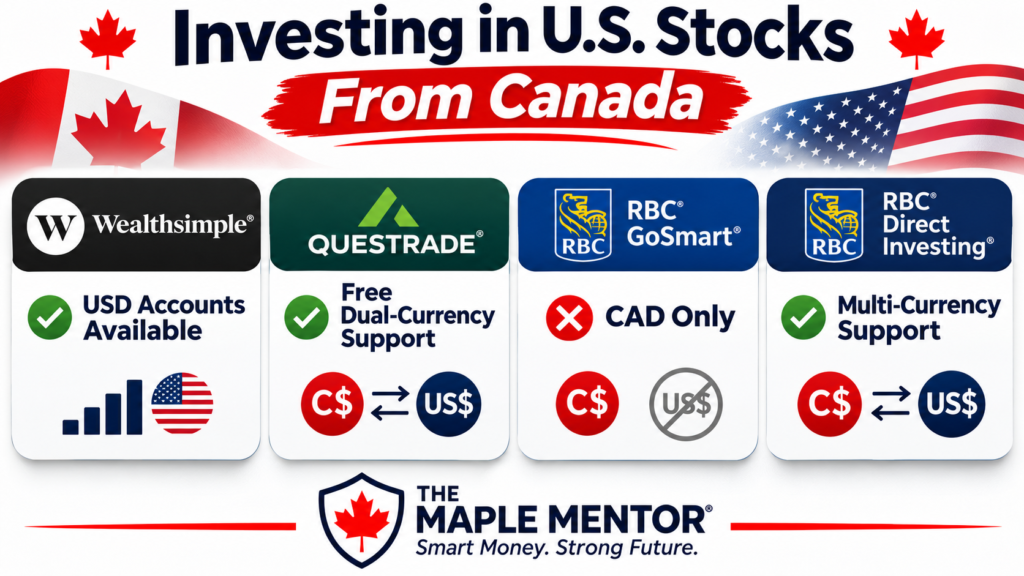
Comparing USD Account Functionality
| Brokerage | Can Hold USD? | Separate USD Subscription |
|---|---|---|
| Wealthsimple | Yes, with USD accounts | $10 monthly for Core clients |
| Questrade | Yes | None |
| RBC GoSmart | No | Not available |
| RBC Full Suite | Yes | None for standard multi-currency functionality |
For someone holding Canadian-listed ETFs exclusively, these differences may have little impact.
However, an investor who regularly buys and sells U.S. stocks may benefit from maintaining a USD balance.
Why Holding USD Matters
Imagine you convert Canadian dollars into U.S. dollars to purchase an American stock.
Several months later, you sell that stock and purchase another American company.
At a CAD-only brokerage, the proceeds may need to be converted back into Canadian dollars before being converted into USD again for your next purchase.
Repeated conversions can increase investment costs.
With a dual-currency account, you can generally retain eligible U.S.-dollar proceeds and use them to purchase another U.S.-listed investment.
However, the initial currency-conversion cost still matters.
Are U.S. Stocks Tax-Free Inside a TFSA?
Investment growth and withdrawals are generally tax-free in Canada when investments are held inside a TFSA.
Nevertheless, foreign withholding taxes can still apply.
For example, dividends paid by U.S. companies to Canadian TFSA investors are generally subject to a 15% withholding tax under applicable treaty rules.
Unlike certain directly held U.S. investments inside an RRSP, a TFSA generally doesn’t qualify for the same retirement-account withholding-tax exemption.
Additionally, foreign withholding taxes incurred inside a TFSA generally cannot be recovered through a Canadian foreign tax credit.
This distinction is important for investors purchasing U.S. dividend stocks.
For a more detailed comparison of currency handling and investing costs, see our Best Broker for U.S. Stocks in Canada guide.
Winner for free dual-currency functionality among these brokerages: Questrade.
Best TFSA Brokerage in Canada for Beginners
Opening your first investment account can feel overwhelming.
Between account types, investment products, market orders, management fees, and financial terminology, there are many decisions to make.
Fortunately, beginners don’t necessarily need a sophisticated investment platform.
The most useful features are often straightforward pricing, ease of use, diversified investment options, and automatic contributions.
Wealthsimple for Beginners
Wealthsimple is particularly attractive because of its accessible interface and straightforward investment process.
New investors can start with relatively small amounts, purchase eligible fractional shares, and establish recurring investments.
This makes it possible to begin building a diversified portfolio without having thousands of dollars available.
Questrade for Beginners
Questrade is also a competitive choice for beginners.
Its commission-free eligible stock and ETF trading makes it affordable for investors with smaller portfolios.
However, its broader range of tools and investment products may require more time to understand.
The advantage is that investors can continue using the platform as their investing knowledge develops.
RBC GoSmart for Beginners
RBC GoSmart offers a simplified investing experience within the RBC ecosystem.
For someone who already uses RBC Mobile, this familiarity may reduce the perceived complexity of opening an investment account.
Its commission-free trading allowance and selected recurring ETF investments can support a straightforward investment strategy.
Our Best Investing Platform for Beginners in Canada guide compares these platforms specifically from a beginner’s perspective.
Winner for most beginners: Wealthsimple.
Best TFSA Brokerage If You’re Starting With $500
One of the biggest misconceptions about investing is that you need a substantial amount of money to get started.
In reality, $500 can be enough to begin building an investment portfolio.
However, investment costs become particularly important when you’re starting with a small amount.
Why Trading Commissions Matter for Small Portfolios
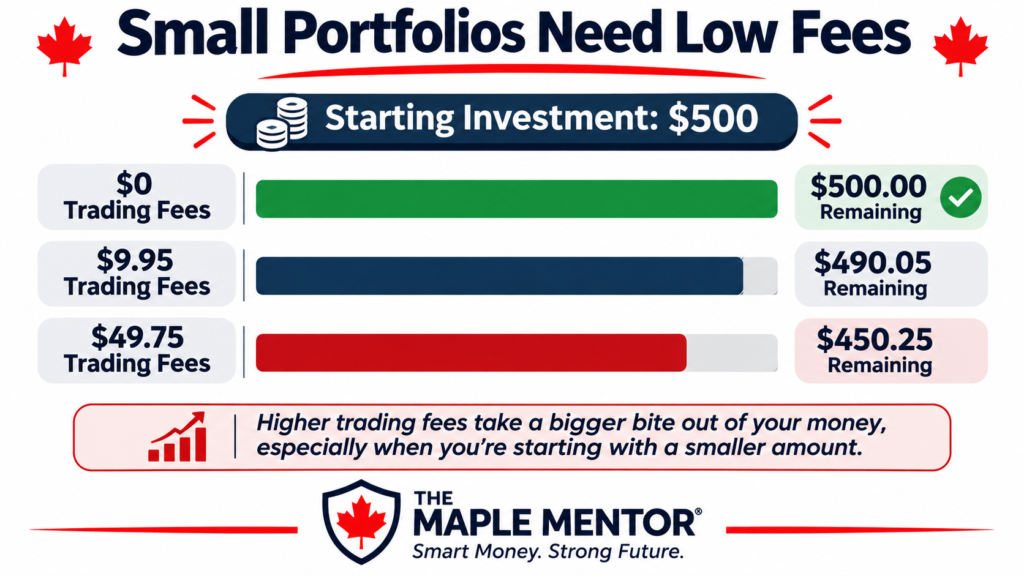
Suppose you have $500 available to invest.
A $9.95 trading commission would represent approximately 1.99% of your starting capital.
If you were to divide your money between five investments, each carrying a $9.95 commission, your total trading costs would reach $49.75.
That represents nearly 10% of your original investment.
| Starting Investment | Trading Costs | Percentage of Capital |
|---|---|---|
| $500 | $0 | 0% |
| $500 | $9.95 | 1.99% |
| $500 | $29.85 | 5.97% |
| $500 | $49.75 | 9.95% |
This example assumes standard commissions apply to every transaction.
It illustrates why commission-free investing can be particularly valuable when you’re beginning with a small portfolio.
A Simple $500 TFSA Strategy
Someone beginning with $500 could consider the following approach:
- Confirm their available TFSA contribution room.
- Establish sufficient emergency savings.
- Choose a brokerage with low investment costs.
- Select an investment appropriate for their risk tolerance and timeline.
- Establish regular contributions.
- Avoid unnecessary trading and portfolio complexity.
For example, someone investing for retirement could consider a diversified asset allocation ETF rather than purchasing numerous individual stocks.
However, someone who needs the money next year may be better served by an appropriate savings product or GIC.
How Much Could Regular Investing Build?
Starting with $500 is only the beginning.
Suppose you invest an initial $500 and contribute an additional $100 per month.
Assuming a hypothetical 7% nominal annual return compounded monthly, with contributions made at the end of each month:
| Investment Period | Total Contributions | Hypothetical Portfolio Value |
|---|---|---|
| 5 years | $6,500 | $7,867 |
| 10 years | $12,500 | $18,313 |
| 20 years | $24,500 | $54,087 |
| 30 years | $36,500 | $125,976 |
These are approximate illustrative projections. Actual investment returns fluctuate, and future performance isn’t guaranteed. The example excludes investment fees and assumes all contributions remain within available TFSA room.
The main takeaway is that consistent contributions can matter considerably more than the amount you initially invest.
Winner for investors starting with $500: Wealthsimple, with Questrade and RBC GoSmart also offering competitive low-cost alternatives.
Best TFSA Brokerage in Canada for Large Portfolios
As your TFSA grows, your investment needs may change.
Someone managing a $150,000 portfolio may have different priorities from someone investing their first $500.
Although commission-free trading remains valuable, other features can become increasingly important.
Factors Worth Considering for Larger TFSAs
- Canadian and U.S. dollar functionality.
- Investment research and portfolio analysis.
- Availability of GICs and bonds.
- Dividend reinvestment options.
- Portfolio automation.
- Account transfer functionality.
- Customer support.
- Advanced order types.
Wealthsimple for Larger TFSAs
Wealthsimple shouldn’t be viewed exclusively as a beginner platform.
Its commission-free eligible trading, automation, and broader financial ecosystem can also appeal to investors with substantial portfolios.
Additionally, eligible higher-tier clients receive USD account functionality without the standard Core subscription fee.
For someone maintaining a simple diversified ETF portfolio, Wealthsimple may remain appropriate regardless of portfolio size.
Questrade for Larger TFSAs
Questrade’s traditional brokerage functionality may become more valuable as a portfolio grows.
Its dual-currency accounts, broader investment selection, and additional trading tools can be particularly useful for investors with more specialized needs.
RBC Direct Investing for Larger TFSAs
RBC’s full brokerage may appeal to investors who want access to traditional investment products, multi-currency functionality, additional research, and banking integration.
However, investors should evaluate whether these features justify any applicable transaction or service costs.
Do You Need to Switch Brokerages as Your TFSA Grows?
Not necessarily.
A straightforward investment strategy remains straightforward even when the amount invested becomes substantial.
Someone managing $250,000 through diversified ETFs doesn’t automatically need more advanced brokerage tools than someone managing $25,000 through the same investments.
The best TFSA brokerage in Canada is the platform that continues to meet your needs, regardless of account size.
Self-Directed vs Managed TFSA: Which Is Better?
Choosing a brokerage also involves deciding whether you want to manage your own investments.
Self-Directed TFSA
A self-directed TFSA allows you to select your own investments.
This approach may be suitable for Canadians who understand basic investing principles and are comfortable managing their portfolio.
For example, an investor could purchase a single diversified asset allocation ETF and contribute regularly.
The main advantage is that self-directed investing can involve relatively low ongoing costs.
However, you’re responsible for selecting suitable investments and maintaining an appropriate portfolio.
Managed TFSA
A managed TFSA delegates portfolio management to an investment service.
This can be useful for people who prefer professional investment selection, portfolio monitoring, and rebalancing.
However, managed investment services generally charge ongoing management fees in addition to applicable underlying investment expenses.
Wealthsimple Automated Investing
Wealthsimple also offers a separate Automated Investing service.
Unlike traditional managed investing, this service allows investors to select their own portfolio holdings and target allocations while automating certain investment activities.
The annual service fee is currently 0.25%, capped at $250 per account per calendar year.
| Portfolio Value | Annual Automated Investing Service Fee |
|---|---|
| $10,000 | $25 |
| $25,000 | $62.50 |
| $50,000 | $125 |
| $100,000 | $250 |
| $200,000 | $250 |
These examples assume a constant portfolio balance and exclude underlying investment expenses or other applicable costs.
Wealthsimple explains this service at https://help.wealthsimple.com/hc/en-ca/articles/50568864719899-Get-started-with-Automated-Investing. Help Centre
It’s important to distinguish this paid portfolio automation service from ordinary recurring investment purchases and traditional managed portfolios.
Questrade Questwealth Portfolios
Questrade offers managed investing through Questwealth Portfolios.
This provides an alternative for Canadians who prefer delegating portfolio management rather than purchasing individual investments themselves.
RBC Managed Investing
RBC GoSmart and full-suite RBC Direct Investing are self-directed platforms.
However, RBC provides separate managed investment services elsewhere within its financial ecosystem.
The appropriate choice depends on the investor’s desired level of involvement, investment knowledge, and willingness to pay for portfolio management.
Can You Have More Than One TFSA Brokerage?
Yes. Canadians can maintain TFSAs at multiple financial institutions.
For example, someone could have:
- A Wealthsimple TFSA for long-term ETF investing.
- A Questrade TFSA for U.S.-listed investments.
- A bank TFSA containing GICs or savings.
However, opening additional accounts doesn’t create additional contribution room.
TFSA Contribution Room Is Shared Across All Accounts
Suppose you have $7,000 in available contribution room.
You contribute $4,000 to Wealthsimple and $2,000 to Questrade.
Your remaining contribution room would be:
$7,000 − $4,000 − $2,000 = $1,000
Opening another TFSA at RBC wouldn’t provide additional contribution room.
This is why maintaining your own contribution records is particularly important when using multiple financial institutions.
The CRA’s online contribution-room figure may not immediately reflect your latest transactions. Its official guidance recommends checking financial institution records when calculating your remaining room. Gouvernement du Canada+1
How to Transfer a TFSA Between Brokerages
If you want to switch brokerages, you generally have two options.
Option 1: Direct TFSA transfer
The receiving financial institution arranges a registered transfer from your existing TFSA.
A properly completed direct transfer generally doesn’t affect your contribution room.
However, transfer fees and processing delays may apply.
Option 2: Withdraw and recontribute
You withdraw money from your existing TFSA and deposit it into another account.
This can create an overcontribution if you don’t have sufficient unused contribution room.
The withdrawn amount normally becomes available again on January 1 of the following calendar year.
Example of a TFSA Transfer Mistake
Imagine you’ve used all your available contribution room and have $30,000 invested at RBC.
You withdraw the entire balance and immediately deposit it into a Wealthsimple TFSA during the same calendar year.
Without sufficient contribution room, this could create a $30,000 excess contribution.
At a monthly excess-contribution tax rate of 1%, that could represent $300 per month while the full excess persists.
A properly arranged direct registered transfer could generally avoid this problem.
Before moving investments, confirm whether the receiving brokerage supports in-kind transfers or requires the investments to be sold and transferred as cash.
Important TFSA Brokerage Mistakes to Avoid
Even after finding the best TFSA brokerage in Canada, several mistakes can undermine your investment strategy.
1. Choosing a Brokerage Based Only on Trading Commissions
Commission-free trading doesn’t necessarily mean investing is completely free.
Foreign-exchange fees, investment product expenses, management fees, and transfer charges can still apply.
Evaluate the total cost of your investment strategy.
2. Leaving Contributions Uninvested
Depositing money into an investment TFSA doesn’t automatically mean you’ve purchased investments.
Unless you’re intentionally holding cash, make sure your contributions are invested according to your strategy.
3. Treating a TFSA Like a Day-Trading Account
Despite its name, a TFSA isn’t universally exempt from taxation in every circumstance.
If the CRA determines that a TFSA is carrying on a business through its trading activities, the trust can be subject to tax on business income.
The determination depends on the circumstances rather than a single fixed number of trades.
Consequently, Canadians should be cautious about using their TFSA for business-like trading activity.
4. Taking Too Much Investment Risk
The tax-free nature of a TFSA can make higher-growth investments seem particularly attractive.
However, speculative investments can also produce substantial losses.
If you contribute $10,000 and your investment loses $6,000 in value, that investment loss doesn’t restore $6,000 of contribution room.
Choose investments that match your financial objectives and risk tolerance.
5. Ignoring Your Investment Timeline
A TFSA can be used for retirement, emergency savings, a future home purchase, or other financial goals.
However, money needed within the next year shouldn’t necessarily be invested the same way as money intended for retirement in 30 years.
Choose the investments first according to your financial needs, then select a brokerage that supports those investments efficiently.
6. Overcomplicating Your Financial Accounts
Although Canadians can have multiple TFSAs, using several brokerages isn’t always beneficial.
Additional accounts can make it harder to track contributions, understand your total portfolio allocation, and monitor financial progress.
For many investors, one well-organized TFSA is sufficient.
Wealthsimple vs Questrade vs RBC: Which TFSA Brokerage Should You Choose?
After comparing the available options, the best TFSA brokerage in Canada depends largely on what you plan to hold inside your account.
| Your Investment Priority | Brokerage to Consider |
|---|---|
| Complete beginner | Wealthsimple or RBC GoSmart |
| Automatic Canadian ETF investing | Wealthsimple |
| Passive ETF investing | Wealthsimple or Questrade |
| Starting with $500 | Wealthsimple or Questrade |
| Free CAD/USD account functionality | Questrade |
| Regular U.S. investing | Questrade or RBC Full Suite |
| Existing RBC customer | RBC GoSmart |
| Traditional brokerage tools | Questrade or RBC Full Suite |
| GICs and bonds | Questrade or RBC Full Suite |
| Managed and self-directed choices | Wealthsimple or Questrade |
| Selected all-in-one ETF automation | Wealthsimple or RBC GoSmart |
When I Would Choose Wealthsimple
I would choose Wealthsimple for someone who wants to invest consistently through a straightforward, diversified ETF portfolio.
For example, someone purchasing XEQT every payday may benefit more from automatic investing and fractional purchases than from advanced brokerage tools.
Wealthsimple’s biggest advantage is its ability to make consistent investing relatively easy.
When I Would Choose Questrade
I would consider Questrade for someone who wants more investment flexibility.
Its commission-free eligible online trading, free dual-currency functionality, and broader traditional investment selection make it particularly attractive.
It may also be useful for investors who expect their financial needs to become more complex over time.
When I Would Choose RBC GoSmart
I would consider RBC GoSmart for someone who already banks with RBC and wants to begin investing without opening an account at a separate financial institution.
Its commission-free trading allowance and selected ETF automation can be sufficient for a straightforward investment strategy.
When I Would Choose RBC Full Suite
I would consider full-suite RBC Direct Investing for someone who values traditional investment products, multi-currency accounts, broader research capabilities, and banking integration.
However, I would carefully evaluate trading commissions and other applicable costs.
Frequently Asked Questions
What Is the Best TFSA Brokerage in Canada?
Wealthsimple is a strong choice for beginners, passive ETF investors, and Canadians who prioritize automatic investing.
Questrade is particularly attractive for investors who want free dual-currency functionality and traditional brokerage tools.
RBC GoSmart and full-suite RBC Direct Investing may be suitable for existing RBC customers with different investment needs.
Does Wealthsimple Charge Fees for a TFSA?
Wealthsimple generally charges no standard trading commissions on eligible stocks and ETFs through its self-directed investing platform.
However, currency-conversion fees, optional USD account subscriptions, managed investing fees, and other service costs may apply.
Does Questrade Charge Fees for a TFSA?
Questrade currently advertises no annual account fee, no inactivity fee, and $0 commissions on eligible online stock and ETF trades.
Foreign-exchange fees and certain other transaction charges can still apply.
Is RBC GoSmart Good for a TFSA?
Yes. RBC GoSmart can be a competitive option for beginners, especially existing RBC customers.
It offers 50 commission-free trades annually across GoSmart accounts, unlimited trading on selected commission-free ETFs, and recurring investment functionality for eligible all-in-one ETFs.
However, it cannot hold USD cash and has a more limited investment selection than the full RBC brokerage.
Can I Hold U.S. Dollars in a TFSA?
Yes, depending on the brokerage.
Questrade supports dual-currency TFSAs without a separate USD subscription.
Wealthsimple offers USD account functionality for eligible TFSA investors, while full-suite RBC Direct Investing supports multiple currencies.
RBC GoSmart doesn’t support holding USD cash directly.
What Is the TFSA Contribution Limit for 2026?
The annual TFSA dollar limit for 2026 is $7,000.
Your personal contribution room may be higher depending on unused room from previous years and previous-year withdrawals.
Can I Have TFSAs at Multiple Brokerages?
Yes. Canadians can maintain multiple TFSAs.
However, contribution room is shared across every TFSA you own.
Opening additional accounts doesn’t increase your total contribution limit.
Is Wealthsimple or Questrade Better for TFSA ETFs?
Wealthsimple may be more convenient for investors who want automatic purchases of eligible Canadian-listed ETFs.
Questrade offers commission-free eligible online ETF trading and free dual-currency functionality.
Both are competitive options for long-term passive investing.
Can I Transfer My TFSA Without Losing Contribution Room?
Yes. A properly completed direct registered transfer between financial institutions generally doesn’t affect TFSA contribution room.
However, withdrawing money personally and recontributing it during the same calendar year can create an overcontribution if you have insufficient available room.
How Much Money Do I Need to Start Investing in a TFSA?
You don’t necessarily need thousands of dollars.
Depending on the brokerage and investment eligibility, you can begin investing with relatively small amounts.
Fractional investing can make it particularly accessible for investors who don’t have enough money to purchase a full share.
Final Verdict: Best TFSA Brokerage in Canada
Choosing the best TFSA brokerage in Canada is ultimately about matching your investment strategy with the platform that supports it most efficiently.
Wealthsimple, Questrade, and RBC Direct Investing all offer competitive features, but their advantages differ.
Wealthsimple is my preferred choice for most beginner and passive ETF investors.
Its combination of eligible commission-free trading, fractional investing, and recurring purchases makes it particularly convenient for Canadians building long-term wealth.
Questrade is my preferred alternative for investors who want greater flexibility.
Its commission-free eligible online stock and ETF trading, free dual-currency functionality, and broader investment selection make it a strong choice for self-directed investors.
RBC GoSmart is worth considering for existing RBC customers who prioritize convenience.
Its commission-free trading allowance and selected recurring ETF purchases can support a straightforward investment strategy.
RBC Direct Investing Full Suite is better suited to investors who value traditional brokerage functionality.
Its broader investment selection and multi-currency features can be useful, although standard trading commissions deserve careful consideration.
Ultimately, someone investing $100 into XEQT every week has different needs from someone managing a large portfolio of individual U.S. stocks.
The best TFSA brokerage in Canada isn’t necessarily the one with the most features.
It’s the one that allows you to invest consistently, minimize unnecessary costs, and maintain an investment strategy that matches your financial goals.