
Choosing between Questrade and Interactive Brokers isn’t as simple as comparing stock-trading commissions.
Both platforms offer Canadian investors access to stocks, ETFs, registered accounts, and advanced trading features. However, they serve somewhat different types of investors.
Questrade has become particularly competitive after introducing $0 online commissions for Canadian- and U.S.-listed stocks and ETFs. That makes it an attractive option for Canadians who want to build a long-term investment portfolio without paying commissions on every eligible trade.
Interactive Brokers Canada (IBKR), meanwhile, is known for its low currency-conversion costs, extensive international market access, and sophisticated trading tools.
For someone buying XEQT every month, Questrade’s straightforward commission structure may be more appealing.
For someone regularly converting Canadian dollars into U.S. dollars, trading options, or investing internationally, Interactive Brokers could be the stronger choice.
In this Questrade vs Interactive Brokers comparison, we’ll examine trading fees, currency conversion, account types, ETFs, options, global markets, and platform usability to help you decide which brokerage fits your investing strategy.
Quick Answer: Questrade vs Interactive Brokers
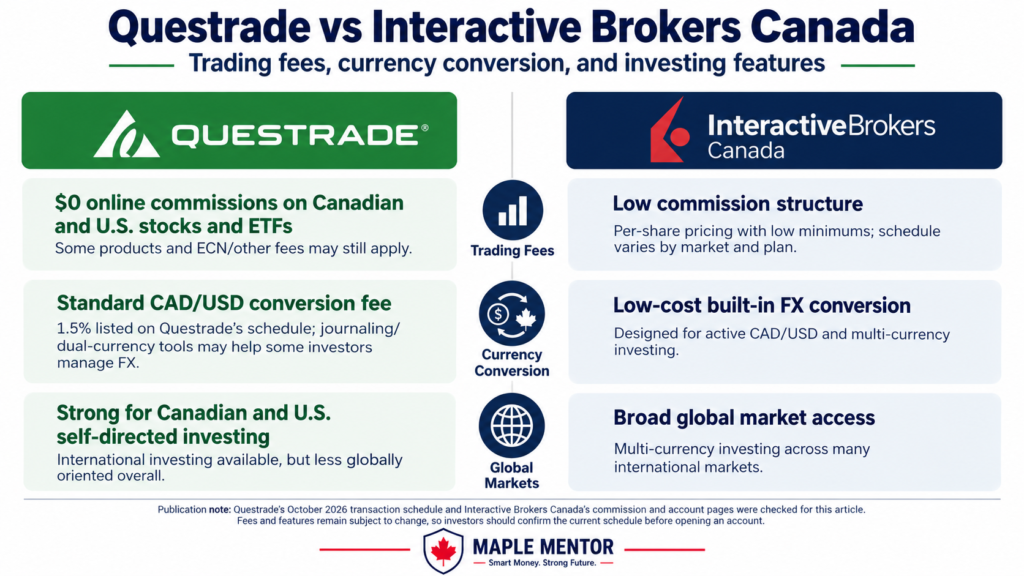
Questrade is likely the better fit for many everyday Canadian investors, especially those who prioritize commission-free online stock and ETF trading, registered accounts, and a relatively straightforward investing experience.
Interactive Brokers is particularly compelling for active and internationally focused investors, especially those who regularly exchange currencies, trade options, or need advanced trading tools.
Here’s the central trade-off:
- Choose Questrade if you primarily buy Canadian- or U.S.-listed stocks and ETFs, want a broad selection of Canadian registered accounts, and prefer a simpler commission structure.
- Choose Interactive Brokers if currency conversion, international markets, sophisticated orders, or advanced trading capabilities are important to your strategy.
Neither brokerage is universally cheaper.
For example, a Questrade investor purchasing a Canadian-listed ETF online might pay $0 in trading commissions.
An Interactive Brokers investor making a large CAD-to-USD conversion might save substantially on foreign-exchange costs, even after paying a stock-trading commission.
The right comparison is your total investing cost, not just the commission advertised on the homepage.
Questrade vs Interactive Brokers at a Glance
| Feature | Questrade | Interactive Brokers Canada |
|---|---|---|
| Canadian stocks | $0 online commission | Per-share commissions |
| Canadian-listed ETFs | $0 online commission | Per-share commissions |
| U.S. stocks | $0 online commission | Low per-share commissions |
| U.S.-listed ETFs | $0 online commission | Low per-share commissions |
| CAD/USD conversion | Generally 1.5% | Low-cost FX trading |
| TFSA | Yes | Yes |
| RRSP | Yes | Yes |
| FHSA | Yes | Yes |
| RESP | Yes | Not listed among standard IBKR Canada registered accounts |
| LIRA | Yes | Not listed among standard IBKR Canada registered accounts |
| Hold USD | Yes | Yes |
| International markets | More limited | Extensive |
| Options trading | Yes | Yes |
| Advanced trading tools | Available | Extensive |
| Automatic ETF investing | Available for supported investments | Features vary |
| Beginner friendliness | Generally easier | More complex |
| Best suited for | Canadian long-term investors | Active and global investors |
Fees and account availability reflect the published pricing structures discussed below. Exchange fees, market-data charges, regulatory fees, and other conditions may apply.
For a broader comparison that also includes Wealthsimple, see our Questrade vs Wealthsimple vs Interactive Brokers comparison.
Questrade vs Interactive Brokers Trading Fees
Trading commissions are one of the biggest factors investors consider when choosing an online brokerage.
However, Questrade and Interactive Brokers use fundamentally different pricing structures.
Questrade Trading Fees in Canada
Questrade has significantly changed its commission structure.
Its current published pricing advertises $0 online commissions for eligible Canadian- and U.S.-listed stocks and ETFs.
That includes both purchases and sales.
| Investment | Questrade Online Commission |
|---|---|
| Canadian-listed stocks | $0 |
| Canadian-listed ETFs | $0 |
| U.S.-listed stocks | $0 |
| U.S.-listed ETFs | $0 |
| U.S. equity options | $0 contract fee under applicable pricing |
| Canadian options | CAD $0.99 per contract |
This is a substantial improvement for investors who remember Questrade’s older pricing model.
Previously, Questrade was particularly well known for commission-free ETF purchases, while ETF sales generally incurred commissions.
Under its newer structure, eligible online ETF purchases and sales are commission-free.
That makes Questrade much more competitive for long-term investors who periodically rebalance their portfolios.
However, $0 commission doesn’t necessarily mean every transaction is completely free.
Depending on the investment and transaction, other fees may apply, including currency-conversion charges, certain exchange or regulatory fees, and charges for services outside the standard online trading structure.
You can review the latest details on Questrade’s official pricing page.
Interactive Brokers Canada Trading Fees
Interactive Brokers takes a different approach.
Instead of advertising blanket commission-free stock trading, IBKR generally charges low per-share commissions.
Its pricing depends on several factors, including the exchange, investment type, trade size, and whether you use fixed or tiered pricing.
For Canadian-listed stocks, its published tiered pricing starts around CAD $0.004 per share for the first volume tier, subject to a CAD $1 minimum.
For U.S.-listed stocks, tiered pricing can range from approximately USD $0.0005 to $0.0035 per share, depending on monthly trading volume.
Fixed U.S. stock pricing is generally USD $0.005 per share, subject to applicable minimums.
| Investment | Interactive Brokers Pricing |
|---|---|
| Canadian stocks/ETFs | Tiered commissions starting around CAD $0.004/share |
| U.S. stocks/ETFs | Tiered commissions around USD $0.0005–$0.0035/share |
| U.S. fixed stock pricing | USD $0.005/share |
| U.S. options | Tiered pricing around USD $0.15–$0.65/contract |
| Inactivity fee | No standard inactivity fee for regular individual accounts |
| Minimum account balance | No general minimum for regular individual accounts |
Minimum commissions and third-party charges can affect the final amount.
The difference between fixed and tiered pricing is also important.
Fixed pricing generally provides a more predictable commission structure, while tiered pricing varies with trading volume and may include separately passed-through exchange or other charges.
You can review the official details through Interactive Brokers Canada’s commissions page.
Example: Buying $1,000 of a Canadian ETF
Suppose you want to invest $1,000 in a Canadian-listed ETF.
At Questrade, an eligible online purchase would currently cost:
$0 in trading commissions.
At Interactive Brokers, the same purchase would generally incur a commission under the applicable Canadian stock pricing schedule.
For a small transaction, the minimum commission may apply.
If you’re investing $500 or $1,000 every payday, those small commissions can accumulate over time.
That’s why Questrade’s current pricing is particularly attractive for Canadians making frequent, relatively small ETF purchases.
Example: Buying $10,000 of U.S. Stocks
Now suppose you want to purchase $10,000 worth of U.S. stocks.
Questrade’s eligible online stock commission would be $0.
Interactive Brokers would charge a commission based on the applicable pricing schedule.
However, if you need to convert Canadian dollars into U.S. dollars first, the comparison changes substantially.
That’s where Interactive Brokers can have a major advantage.
Questrade vs Interactive Brokers Currency Conversion Fees
For Canadian investors purchasing U.S. investments, currency conversion can be more expensive than stock-trading commissions.
This is arguably the most important difference in the Questrade vs Interactive Brokers comparison.
Questrade Currency Conversion Fees
Questrade currently lists a CAD/USD currency-conversion fee of approximately 1.5%.
For example, converting CAD $10,000 into U.S. dollars at a 1.5% conversion cost represents approximately:
$150 in conversion costs.
That’s a significant amount compared with a $0 stock-trading commission.
However, Questrade allows investors to hold U.S. dollars directly in eligible accounts, including registered accounts.
That means you don’t necessarily need to convert currencies every time you purchase a U.S.-listed security.
You can convert funds once, hold the resulting USD balance, and use those dollars for future purchases.
What About Norbert’s Gambit?
Canadian investors sometimes use a technique called Norbert’s Gambit to reduce currency-conversion costs.
The strategy generally involves purchasing an eligible security listed in both Canadian and U.S. dollars, journaling the shares between currency denominations, and selling in the desired currency.
Questrade supports journaling eligible securities, although processing times, trading costs, spreads, and service fees can apply.
Norbert’s Gambit can be useful for larger conversions, but it introduces extra steps and execution risk.
For someone converting a few hundred dollars, the effort may not be worthwhile.
For someone converting tens of thousands of dollars, it may be worth investigating.
Interactive Brokers Currency Conversion Fees
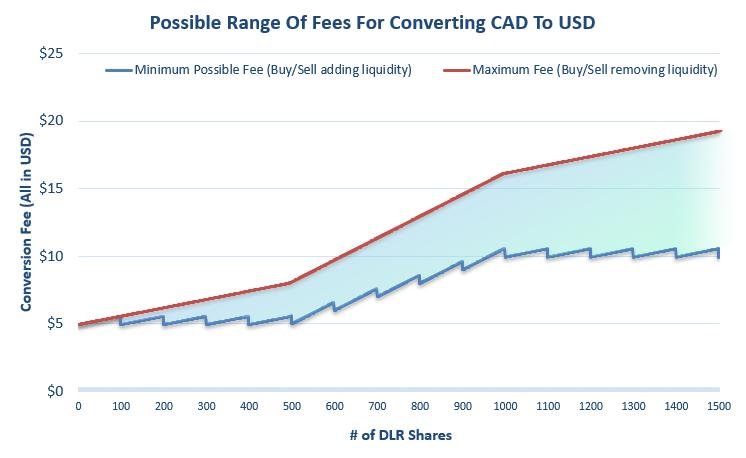
Interactive Brokers offers direct foreign-exchange trading with very low published commission rates.
Its spot-currency commission schedule has listed approximately 0.08–0.20 basis points of trade value, depending on trading volume, subject to minimum commissions.
One basis point equals 0.01%.
Therefore, 0.20 basis points equals 0.002%.
However, the minimum commission matters significantly for smaller conversions.
A typical manually executed spot-FX transaction may be subject to a minimum commission of approximately USD $2.
IBKR also offers automatic currency conversion in certain circumstances, with different pricing mechanics.
It’s important not to confuse those automatic conversion arrangements with manually executed spot-FX trades.
When Currency Conversion Matters Most
Consider two investors.
Investor A contributes $500 monthly and purchases a Canadian-listed ETF such as XEQT.
They don’t need to convert Canadian dollars into U.S. dollars.
For this investor, Questrade’s commission-free ETF trading is likely more relevant than IBKR’s foreign-exchange advantage.
Investor B regularly converts $5,000 or $10,000 into USD to purchase U.S.-listed stocks and ETFs.
For this investor, currency-conversion costs may dominate the comparison.
IBKR’s lower FX costs could outweigh the commissions charged on stock trades.
The lesson is simple:
Don’t choose a brokerage based solely on stock commissions if currency conversion is a major part of your strategy.
Questrade vs Interactive Brokers for Canadian and U.S. Stocks
Both brokers let Canadians invest in Canadian and American companies, but their pricing and trading experiences differ.
Questrade for Canadian Stocks
For someone primarily investing in Canadian stocks, Questrade offers a straightforward proposition.
Eligible online trades of Canadian-listed stocks cost $0 in commissions.
You can purchase individual Canadian companies, dividend-paying stocks, or diversified ETFs without paying a standard stock-trading commission.
This is particularly useful for investors who make relatively small purchases.
For example, if you invest $250 every week into Canadian stocks, paying even $1 per transaction would represent approximately $52 annually.
Questrade’s commission-free structure eliminates that standard commission on eligible online trades.
If you’re comparing other Canadian brokerages, our RBC Direct Investing vs Wealthsimple comparison examines another approach to stock-trading fees.
Interactive Brokers for Canadian Stocks
Interactive Brokers charges commissions on Canadian stock transactions.
For an investor who makes only a few small purchases each month, Questrade may therefore be cheaper.
However, IBKR offers sophisticated order types, market data, trading tools, and execution infrastructure that may matter more to active traders.
For someone placing complex orders or trading across multiple markets, a small commission might be an acceptable trade-off.
Questrade vs Interactive Brokers for U.S. Stocks
The comparison becomes more complicated with American stocks.
Questrade offers $0 online commissions on eligible U.S.-listed stocks.
Interactive Brokers charges low per-share commissions.
But Canadians purchasing U.S. stocks often need to convert CAD into USD.
If you’re investing existing U.S. dollars, Questrade’s commission-free trading can be especially attractive.
If you’re regularly converting Canadian dollars into U.S. dollars, Interactive Brokers may have a substantial total-cost advantage.
The better broker depends on your currency-conversion frequency, trade size, and account setup.
Interactive Brokers vs Questrade for Global Markets
International investing is one of Interactive Brokers’ strongest advantages.
Most Canadian investors can build globally diversified portfolios without directly buying securities on foreign exchanges.
For example, Canadian-listed ETFs can provide exposure to U.S., European, Japanese, and emerging-market companies.
However, some investors want direct access to individual securities listed internationally.
That’s where Interactive Brokers becomes particularly compelling.
Interactive Brokers Global Market Access
IBKR advertises access to approximately 175 markets across 40 countries, although availability depends on the account, jurisdiction, product, and trading permissions.
Its platform supports a broad range of investments, including stocks, ETFs, bonds, options, futures, and currencies.
It also provides advanced order types and market-specific trading functionality.
For example, an investor might want to buy a company listed directly on the London Stock Exchange or another international exchange.
Interactive Brokers is designed to accommodate this type of investing.
Questrade International Investing
Questrade provides access to Canadian and U.S. securities and certain international investments.
However, its international trading capabilities are more limited, and direct international equity transactions can be expensive.
Questrade’s published pricing lists international equity transactions at 1% of trade value, with a USD $195 minimum.
That’s considerably different from its commission-free online Canadian and U.S. stock trading.
For most Canadians buying globally diversified ETFs, direct international trading may be unnecessary.
But if your strategy involves purchasing foreign-listed individual stocks, Interactive Brokers has a clear advantage.
For global market access and currency conversion, Interactive Brokers is generally the more capable platform.
Questrade vs Interactive Brokers for Options Trading
Options trading deserves its own comparison because both brokerages offer substantially more functionality than a basic stock-investing app.
However, options involve additional risks, including the possibility of losing the entire premium paid and, for certain strategies, losses exceeding the initial amount invested.
Questrade Options Fees
Questrade’s pricing has changed substantially, making older comparisons unreliable.
Its current published schedule lists:
| Options Transaction | Questrade Pricing |
|---|---|
| U.S. equity options | $0 standard commission and contract fee |
| Canadian options | CAD $0.99 per contract |
| U.S. index options | USD $0.99 per contract |
| Options exercise | $24.95 |
| Options assignment | $0 |
Other applicable fees can still apply.
The low contract fees make Questrade more competitive than its older pricing structure might suggest.
However, traders should consider more than commissions.
Exercise fees, market data, order functionality, and platform capabilities can materially affect the trading experience.
Interactive Brokers Options Fees
Interactive Brokers uses a more detailed options commission schedule.
Its published U.S. options pricing generally includes:
- Tiered commissions of approximately USD $0.15–$0.65 per contract
- Fixed commissions of approximately USD $0.65 per contract
- Applicable minimums and third-party fees
Pricing depends on factors such as contract characteristics, volume, and the selected pricing structure.
IBKR also provides sophisticated options tools, advanced order types, and trading infrastructure designed for more complex strategies.
Which Broker Is Better for Options?
For a casual investor occasionally trading straightforward options, Questrade’s newer pricing may be attractive.
For someone actively trading multi-leg strategies, analyzing options positions, or requiring sophisticated execution tools, Interactive Brokers may offer more functionality.
The distinction is important.
Questrade can be cheaper for certain options transactions, while Interactive Brokers may provide more sophisticated trading capabilities.
The right choice depends on both trading costs and the features required for your strategy.
Questrade vs Interactive Brokers Account Types
Account availability is an important consideration for Canadian investors.
Both platforms support popular registered accounts, but Questrade offers a broader selection of Canadian account types.
Questrade Account Types
Questrade offers accounts including:
- Tax-Free Savings Account (TFSA)
- Registered Retirement Savings Plan (RRSP)
- First Home Savings Account (FHSA)
- Registered Education Savings Plan (RESP)
- Locked-In Retirement Account (LIRA)
- Registered Retirement Income Fund (RRIF)
- Life Income Fund (LIF)
- Cash and margin accounts
- Certain business and corporate accounts
You can review the available accounts through Questrade’s account types page.
This range is useful for investors who want to manage several financial goals through one brokerage.
For example, someone might have a TFSA for long-term investing, an RRSP for retirement, an FHSA for a future home purchase, and an RESP for a child’s education.
Questrade can accommodate all four.
Interactive Brokers Canada Account Types
Interactive Brokers Canada lists several account structures, including individual and joint taxable accounts, TFSAs, RRSPs, spousal RRSPs, and FHSAs.
Its standard Canadian registered-account offering does not list RESPs or LIRAs.
Investors should also confirm the availability of any additional retirement or entity account they require.
Which Broker Has Better Registered Accounts?
For someone who only needs a TFSA, RRSP, or FHSA, both platforms deserve consideration.
For someone who wants an RESP, LIRA, or other specialized Canadian registered account, Questrade may be more practical.
However, account availability shouldn’t be the only consideration.
The investments you intend to hold, the currencies you’ll use, and the fees associated with your trading strategy also matter.
Questrade vs Interactive Brokers for Beginners
For many beginners, Questrade is likely the easier starting point.
Its current commission structure is straightforward for eligible Canadian and U.S. stocks and ETFs.
It also provides Canadian-oriented account options and investing tools.
Someone who wants to open a TFSA, contribute monthly, and purchase a diversified ETF may not need sophisticated order types or international market access.
Why Questrade May Be Easier
A beginner can focus on a relatively simple process:
- Open a suitable investment account.
- Transfer money into the account.
- Choose an investment that fits their goals and risk tolerance.
- Purchase it and continue contributing over time.
The $0 commission structure reduces the need to calculate trading costs for every eligible stock or ETF purchase.
For investors still learning the basics, that simplicity has value.
Our Best Online Brokers in Canada guide provides a broader comparison of platforms for different investing styles.
Is Interactive Brokers Too Complicated for Beginners?
Not necessarily.
Interactive Brokers has introduced more accessible platforms alongside its advanced trading tools.
Investors can use interfaces such as IBKR Desktop, mobile applications, and the Client Portal rather than relying exclusively on Trader Workstation.
A motivated beginner who wants to invest internationally or regularly convert currencies may find IBKR worthwhile.
However, its pricing structure and extensive functionality require more effort to understand.
Questrade gets the edge for simplicity, but Interactive Brokers remains a reasonable option for beginners with specific needs.
Questrade vs Interactive Brokers for Active Traders
The comparison changes significantly for active traders.
Someone purchasing an ETF once a month has very different needs from someone trading individual stocks, options, or international securities every day.
Interactive Brokers Trading Tools
Interactive Brokers offers Trader Workstation (TWS), a sophisticated trading platform designed for advanced market analysis and order execution.
Its broader technology offering includes:
- Advanced order types and algorithms
- Multi-asset trading
- Options analysis
- International exchange access
- Market-data subscriptions
- Margin trading
- Sophisticated portfolio and risk-management tools
IBKR also offers access to more than 100 order types and algorithms, according to its published platform information.
These capabilities can be valuable for experienced traders.
However, they can also introduce complexity and additional costs.
Market-data subscriptions, exchange fees, and margin interest should be included when comparing platforms.
Questrade for Active Trading
Questrade also provides more advanced trading tools through its dedicated trading platforms.
Its commission-free stock and ETF pricing may be attractive for active investors trading eligible Canadian and U.S. securities.
However, Interactive Brokers generally provides broader international market access and more extensive professional trading infrastructure.
For a trader whose strategy depends on sophisticated execution, options analytics, or multiple asset classes, those features can outweigh the difference in stock-trading commissions.
Margin Trading Considerations
Both platforms offer margin trading in eligible accounts.
Margin allows investors to borrow money against eligible securities, increasing their purchasing power.
However, borrowing also magnifies potential losses.
Interest costs, maintenance requirements, and the possibility of forced liquidation make margin trading considerably riskier than investing with cash.
Interactive Brokers is known for competitive margin pricing, but rates depend on the currency, balance, and current schedule.
Always compare the actual borrowing rate available to your account.
Questrade vs Interactive Brokers for ETFs
For passive Canadian investors, this is one of the most important sections.
A diversified ETF portfolio doesn’t necessarily require an expensive or complicated brokerage.
Many Canadians invest through a TFSA or RRSP and purchase one or two ETFs regularly.
Questrade for ETF Investing
Questrade’s newer pricing makes it particularly competitive for this strategy.
Eligible online purchases and sales of Canadian- and U.S.-listed ETFs currently have $0 commissions.
This means an investor can contribute regularly without paying a standard commission on each eligible ETF trade.
For example, you might invest $500 per month into XEQT, an all-equity ETF that provides diversified global stock exposure.
Or you might choose XGRO, which targets approximately 80% stocks and 20% bonds.
Both approaches can be implemented through Canadian-listed ETFs.
Read our XEQT vs XGRO comparison to understand how adding bonds changes portfolio risk.
For another comparison of diversified all-equity funds, see XEQT vs VEQT.
Interactive Brokers for ETF Investing
Interactive Brokers can also be a good platform for ETF investors.
However, its commissions mean that small, frequent purchases may incur transaction costs.
That doesn’t necessarily make IBKR expensive.
For investors making larger purchases or using U.S.-listed ETFs, its low FX costs can be more important than its trading commissions.
For example, someone who regularly purchases U.S.-listed ETFs using converted Canadian dollars may benefit from IBKR’s currency-conversion pricing.
Canadian-Listed vs U.S.-Listed ETFs
This distinction matters.
A Canadian investor can purchase Canadian-listed ETFs that hold U.S. stocks without converting CAD into USD personally.
For example, VFV provides exposure to the S&P 500 while trading in Canadian dollars.
A U.S.-listed S&P 500 ETF generally trades in U.S. dollars.
The investments may provide similar market exposure, but the currency-conversion process and account-specific tax considerations can differ.
Our VFV vs XEQT comparison explains how U.S. large-cap exposure compares with a globally diversified equity portfolio.
If you’re building a TFSA portfolio, you can also explore Best ETFs for TFSA in Canada.
Which Brokerage Is Better for Passive ETF Investors?
For Canadians buying Canadian-listed ETFs with Canadian dollars, Questrade is particularly attractive because of its $0 eligible online commissions.
Interactive Brokers remains competitive when currency conversion or access to foreign-listed investments becomes important.
For someone who simply buys a diversified Canadian-listed ETF every payday, Questrade may be the more straightforward choice.
Questrade vs Interactive Brokers: Which Is Better for U.S. Investing?
U.S. investing is where the answer can shift significantly toward Interactive Brokers.
Both platforms allow eligible Canadian investors to hold U.S.-listed securities and U.S. dollars.
However, their currency-conversion pricing differs considerably.
Example: A Canadian Investing $20,000 in U.S. Stocks
Suppose you have CAD $20,000 and want to purchase U.S.-listed stocks.
At Questrade, converting the entire amount at 1.5% would represent approximately:
$300 in conversion costs.
Your eligible online U.S. stock trades would have $0 standard commissions.
At Interactive Brokers, manually converting a similar amount through its spot-FX service could incur a much smaller conversion commission, subject to the applicable minimum and trading conditions.
You would then pay IBKR’s stock-trading commissions.
For a relatively small number of stock trades, those commissions could be substantially less than Questrade’s standard conversion cost.
What If You Already Have U.S. Dollars?
This changes the comparison.
If you already hold USD in your brokerage account, you may not need to pay a currency-conversion fee.
Questrade’s $0 online U.S. stock commissions then become more attractive.
IBKR’s currency advantage is less relevant when no conversion is necessary.
What If You Trade U.S. Options?
Interactive Brokers offers sophisticated options functionality and low per-contract commissions.
Questrade’s newer U.S. equity options pricing is also competitive.
Your choice should account for trading frequency, order complexity, data needs, execution features, and applicable exercise or assignment charges.
The U.S. Investing Verdict
Interactive Brokers is particularly compelling for Canadians who regularly convert CAD into USD.
Questrade can be very competitive for Canadians who already hold USD and primarily trade eligible U.S. stocks and ETFs online.
Neither brokerage automatically wins every U.S. investing scenario.
Questrade vs Interactive Brokers: Which Should You Choose?
The right platform depends on what you actually invest in and how you trade.
| Investor Type | Likely Better Fit | Main Reason |
|---|---|---|
| Beginner Canadian investor | Questrade | Simpler pricing |
| Passive Canadian ETF investor | Questrade | $0 eligible online ETF commissions |
| Investor needing an RESP | Questrade | RESP availability |
| Investor needing a LIRA | Questrade | Broader Canadian account selection |
| Frequent CAD/USD converter | Interactive Brokers | Lower FX costs |
| International stock investor | Interactive Brokers | Global exchange access |
| Advanced options trader | Interactive Brokers | Sophisticated trading tools |
| Active multi-asset trader | Interactive Brokers | Trading infrastructure |
| Investor holding existing USD | Depends | Questrade’s $0 commissions may be attractive |
| Investor wanting simple pricing | Questrade | Straightforward stock and ETF commissions |
These are general recommendations, not absolute rules.
An investor who regularly converts currencies might prefer Interactive Brokers even if they consider themselves a beginner.
Likewise, an experienced investor who only purchases Canadian-listed ETFs may find Questrade perfectly adequate.
The most useful way to evaluate Questrade vs Interactive Brokers is to estimate your actual annual costs and identify the tools you genuinely need.
Final Verdict: Questrade vs Interactive Brokers Canada
Both brokerages are competitive, but they’re built around different priorities.
Questrade is particularly attractive for ordinary Canadian investors who want commission-free online stock and ETF trading and a broad selection of Canadian registered accounts.
Its pricing improvements have made it much more compelling than older brokerage comparisons might suggest.
For investors buying Canadian-listed ETFs, building TFSA or RRSP portfolios, or managing several Canadian registered accounts, Questrade offers a practical combination of cost and simplicity.
Interactive Brokers stands out for investors who need low-cost currency conversion, international markets, sophisticated trading tools, and advanced execution capabilities.
Its stock-trading commissions aren’t necessarily a disadvantage when other costs are considered.
For example, an investor converting $20,000 into USD could potentially save far more through IBKR’s currency pricing than they would spend on stock-trading commissions.
Before making your decision, ask yourself:
- Will I primarily buy Canadian-listed stocks and ETFs?
- How frequently will I convert CAD into USD?
- Do I need specialized registered accounts such as an RESP or LIRA?
- Will I trade international securities or options?
- Do I actually need advanced trading tools?
- What will my total annual trading, currency-conversion, and account costs be?
For many long-term Canadian investors, Questrade is likely the simpler choice.
For active traders, international investors, and frequent currency converters, Interactive Brokers may provide substantially more value.
Ultimately, the winner in Questrade vs Interactive Brokers depends less on which platform advertises the lowest commission and more on which platform best supports your investing strategy.
Frequently Asked Questions
Is Questrade better than Interactive Brokers?
Questrade may be better for beginner and long-term Canadian investors who prioritize commission-free online stock and ETF trading, simple pricing, and access to Canadian registered accounts.
Interactive Brokers may be better for active traders, international investors, and customers who frequently convert Canadian dollars into foreign currencies.
The best platform depends on your investing needs.
Is Interactive Brokers cheaper than Questrade?
It depends on the transactions you make.
Questrade currently charges $0 standard online commissions for eligible Canadian- and U.S.-listed stocks and ETFs.
Interactive Brokers charges low per-share commissions but offers substantially different foreign-exchange pricing.
For investors regularly converting large amounts between CAD and USD, Interactive Brokers can be significantly cheaper overall.
For investors buying Canadian-listed ETFs with Canadian dollars, Questrade may be cheaper.
Is Questrade or Interactive Brokers better for U.S. stocks?
Questrade offers $0 online commissions on eligible U.S.-listed stock trades.
Interactive Brokers charges low trading commissions but provides very competitive currency-conversion pricing.
If you already hold USD, Questrade’s commission-free trading can be attractive.
If you frequently convert CAD into USD, Interactive Brokers may offer lower total costs.
Can I have a TFSA with Interactive Brokers Canada?
Yes.
Interactive Brokers Canada offers TFSAs, RRSPs, spousal RRSPs, and FHSAs, subject to eligibility and account restrictions.
However, its standard Canadian registered-account lineup does not include every account type available through Questrade.
Does Questrade charge commissions on ETFs?
Questrade currently advertises $0 commissions for eligible online purchases and sales of Canadian- and U.S.-listed ETFs.
Other charges may still apply depending on the transaction, including currency conversion, certain exchange fees, and additional services.
Is Interactive Brokers good for beginners?
Interactive Brokers can be suitable for beginners, particularly those interested in international investing or low-cost currency conversion.
However, its commission schedules and advanced trading tools can be more complicated to understand.
For investors seeking a simpler Canadian stock and ETF investing experience, Questrade may be easier to start with.