
EQ Bank and Wealthsimple are two popular Canadian financial platforms offering alternatives to traditional chequing accounts.
Both offer no-monthly-fee accounts, interest on eligible balances, digital banking features, and payment cards. But their approaches to everyday banking are slightly different.
EQ Bank’s Personal Account combines chequing and savings features, allowing Canadians to earn interest while paying bills, receiving direct deposits, and managing everyday expenses.
Wealthsimple Chequing, formerly known as Wealthsimple Cash, provides similar everyday banking functionality while offering interest rates and benefits that can depend on your Wealthsimple client tier and qualifying direct deposits.
So, which one should you choose?
The EQ Bank vs Wealthsimple comparison comes down to interest rates, account features, cash access, and how you prefer to manage your money.
Let’s examine both accounts and determine which makes more sense for Canadian banking customers.
EQ Bank vs Wealthsimple: Quick Answer
Both EQ Bank and Wealthsimple offer competitive alternatives to conventional chequing accounts.
EQ Bank Personal Account combines everyday transactions with an interest-paying account. It may appeal to Canadians who want straightforward banking, competitive savings interest, and ATM withdrawal flexibility.
Wealthsimple Chequing offers everyday banking features, a payment card, and interest on eligible balances. Its benefits can be especially appealing to customers who already qualify for higher Wealthsimple client tiers.
Wealthsimple Chequing was previously known as Wealthsimple Cash. The name change reflects its positioning as an everyday banking account rather than simply a place to hold cash.
You can review the account directly through Wealthsimple Chequing.
The main differences are:
Choose EQ Bank if: You want an interest-paying Personal Account, value its direct-deposit interest bonus, and rarely need to deposit physical cash.
Choose Wealthsimple if: You already use Wealthsimple, qualify for attractive account benefits, or want access to its supported cash-deposit options.
Consider both if: Each account provides a feature you genuinely need, such as a particular interest rate, payment card benefit, or banking service.
Neither account is automatically better for everyone.
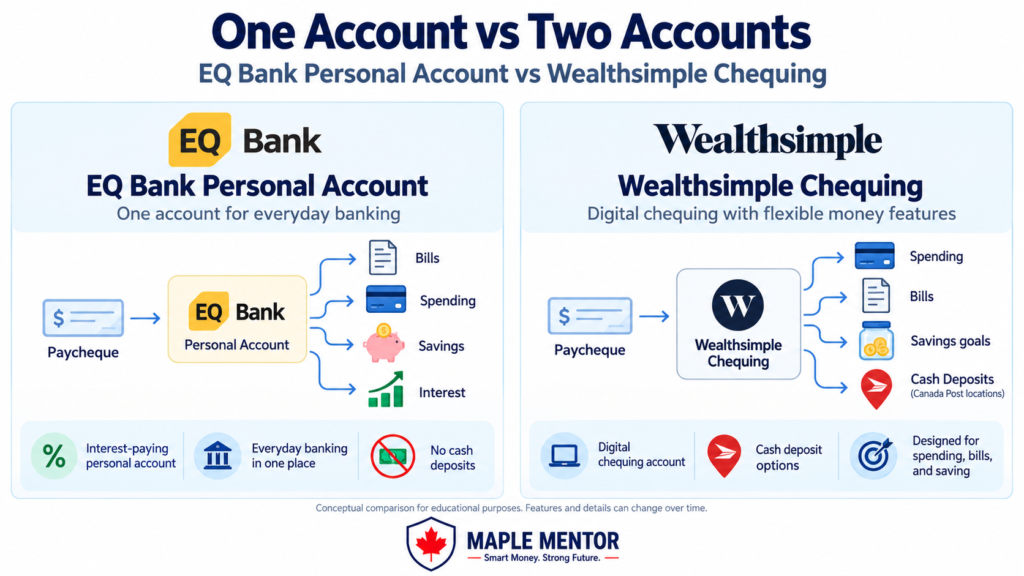
EQ Bank vs Wealthsimple at a Glance
| Feature | EQ Bank Personal Account | Wealthsimple Chequing |
|---|---|---|
| Monthly account fee | $0 | $0 |
| Minimum balance | $0 | $0 |
| Interest | Base rate + qualifying direct-deposit bonus | Rate depends on current account terms, client tier, and eligible bonuses |
| Direct deposit | Yes | Yes |
| Bill payments | Yes | Yes |
| Pre-authorized payments | Yes | Yes |
| Interac e-Transfers | Free | Free |
| Payment card | Prepaid reloadable Mastercard | Wealthsimple prepaid Mastercard |
| Card rewards | Cash back on eligible purchases | Cash back on eligible purchases |
| Canadian ATM withdrawals | ATM fees reimbursed within applicable limits | ATM fee reimbursements subject to account terms |
| Cash deposits | Not supported | Supported at eligible Canada Post locations |
| Mobile cheque deposits | Yes | Yes |
| Joint accounts | Available | Available |
| Quebec availability | Personal Account available | Chequing available |
| Main advantage | Interest-paying everyday banking | Integrated everyday banking and cash-deposit options |
Account features, interest rates, reimbursement limits, and eligibility requirements can change. Verify current terms before opening an account.
Official account information:
For another comparison of Canadian digital banking accounts, see our EQ Bank vs Tangerine guide.
Interest Rates: Compare What You Actually Qualify For
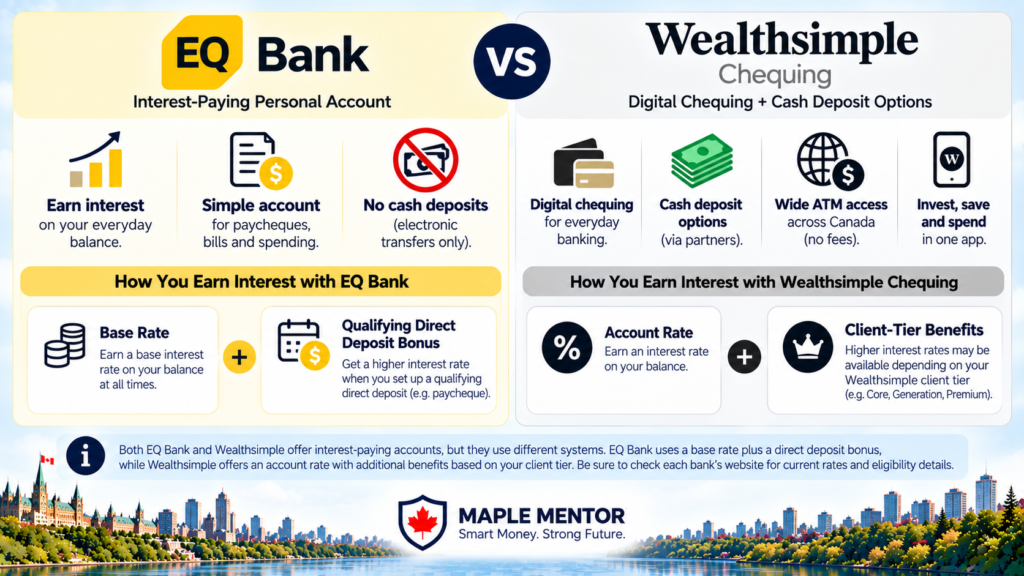
Interest is one of the biggest reasons Canadians consider alternatives to traditional chequing accounts.
At many conventional banks, money sitting in a chequing account earns little or no interest.
EQ Bank and Wealthsimple take a different approach.
Both allow eligible customers to earn interest on money held in their everyday accounts.
However, comparing the advertised rates without examining the conditions can lead to misleading conclusions.
EQ Bank Personal Account Interest
EQ Bank’s Personal Account uses a relatively straightforward interest structure.
Its published rates have included:
1.00% base interest
and
2.75% interest with qualifying recurring direct deposits of at least $2,000 per month.
The higher rate combines the base interest rate with a conditional bonus.
To qualify, customers must meet EQ Bank’s applicable direct-deposit requirements.
For example, transferring $2,000 manually from another bank doesn’t necessarily satisfy the recurring direct-deposit condition.
Eligible payroll and other qualifying recurring deposits are treated according to EQ’s current terms.
Check the latest conditions through EQ Bank’s official rates page.
The advantage is that money held in your Personal Account can earn interest while remaining available for everyday transactions.
Wealthsimple Chequing Interest
Wealthsimple also pays interest on eligible Chequing balances.
However, its rate structure can depend on factors such as:
- Your Wealthsimple client tier
- Qualifying direct deposits
- Current promotional or bonus-rate conditions
- Other applicable account terms
Wealthsimple’s client tiers are generally based on qualifying assets held with the platform.
This means a customer with a substantial Wealthsimple relationship may qualify for different benefits than someone opening their first account.
That’s an important distinction.
A higher advertised rate isn’t necessarily available to every customer.
Before comparing Wealthsimple with EQ Bank, determine which rate you personally qualify for.
You can review the latest account information through Wealthsimple’s official website.
$10,000 Interest Comparison
Let’s illustrate why the actual rate matters.
Suppose you maintain an average balance of $10,000 for one year.
We’ll use EQ Bank’s previously published 1.00% base rate and 2.75% qualifying direct-deposit rate.
For Wealthsimple, we’ll illustrate two hypothetical rates rather than presenting an unverified current rate as fact.
| Account Scenario | Annual Rate | Approximate Annual Interest |
|---|---|---|
| EQ Bank base rate | 1.00% | $100 |
| EQ Bank qualifying direct-deposit rate | 2.75% | $275 |
| Wealthsimple hypothetical scenario A | 1.00% | $100 |
| Wealthsimple hypothetical scenario B | 2.00% | $200 |
Illustrative one-year comparison on a constant $10,000 balance, assuming rates remain unchanged and excluding compounding and taxes. Wealthsimple’s figures are hypothetical, not verified current offers.
The difference between earning 1.00% and 2.75% on $10,000 is approximately:
$175 per year.
That’s worth considering.
But the difference may become less important if you typically maintain only a small balance in your everyday account.
For example, an additional 1% interest on $1,000 represents approximately $10 annually.
That means convenience, payment features, and cash access may matter more than a small interest-rate difference.
Should You Keep All Your Savings in a Chequing Account?
Not necessarily.
Even when an everyday account pays interest, it may not offer the highest available savings rate.
Depending on your goals, you might prefer a separate high-interest savings account or another suitable savings product.
Our Best High-Interest Savings Accounts in Canada guide compares additional options for earning interest on cash.
The key is to compare ongoing rates rather than selecting an account based entirely on a temporary promotion.
Everyday Banking: Payroll, Bills, and Transfers
An interest-paying account is useful only if it can handle your everyday financial needs.
Fortunately, both EQ Bank and Wealthsimple provide many of the essential services Canadians expect from a primary account.
Direct Deposits
Both accounts support direct deposits.
This means you can generally arrange for eligible payments, such as employment income, to be deposited directly into your account.
Direct deposit is especially relevant because it may affect your interest-rate eligibility.
EQ Bank’s higher Personal Account rate requires qualifying recurring direct deposits.
Wealthsimple may also offer benefits connected to qualifying deposits.
Before switching your payroll, confirm the current requirements and whether your particular payments qualify.
Bill Payments
Both platforms support bill payments to eligible Canadian payees.
That allows customers to pay expenses such as:
- Credit cards
- Utilities
- Internet services
- Mobile phone bills
- Other supported billers
For most everyday expenses, either account can function similarly to a traditional digital chequing account.
However, not every biller or payment type is necessarily supported.
If you have unusual payment requirements, verify compatibility before closing your existing bank account.
Pre-Authorized Payments
Both accounts support pre-authorized payment arrangements.
These are useful for recurring expenses such as insurance, subscriptions, loan payments, and other eligible bills.
If you’re switching banks, remember that updating direct deposit information doesn’t automatically update existing pre-authorized payments.
You’ll need to change the payment information with each applicable provider.
Interac e-Transfers
Both EQ Bank and Wealthsimple support Interac e-Transfers.
These are particularly useful for sending money to friends, paying rent when accepted, or moving money between eligible accounts.
However, daily, weekly, and monthly transaction limits can differ.
Customers should verify current limits before relying on either account for unusually large transfers.
Transfers Between Financial Institutions
Both platforms allow customers to move money between supported external accounts.
However, electronic transfers aren’t always instantaneous.
Depending on the transfer method, institution, and transaction, funds may take several business days to become available.
Incoming deposits may also be subject to holds.
This matters if you’re using one account for bills and another for savings.
For example, transferring money into your spending account on the same day your mortgage or rent payment is due could create problems if the funds aren’t available immediately.
A better approach is to maintain a sufficient buffer for upcoming expenses.
Can Either Replace Your Main Bank?
For many Canadians, yes.
If your banking consists primarily of direct deposits, card purchases, bill payments, and Interac e-Transfers, either account may handle most of your needs.
However, customers who regularly require cash deposits, bank drafts, physical branches, or specialized payment services should examine the limitations carefully.
A no-fee digital account isn’t necessarily a complete replacement for every traditional banking service.
Cards, ATM Access, and Cash Deposits
This is where the EQ Bank vs Wealthsimple comparison becomes particularly practical.
Both accounts offer payment cards, but their features and cash-handling arrangements differ.
EQ Bank Card
EQ Bank offers a prepaid reloadable Mastercard.
You load money onto the card and use the available card balance for eligible purchases.
The card is connected to your EQ banking setup, but it isn’t identical to a conventional debit card that directly accesses your entire account balance for every purchase.
EQ has offered features including:
- Cash back on eligible purchases
- No additional foreign transaction fee charged by EQ
- Canadian ATM withdrawals
- Eligible ATM fee reimbursements
- Interest on eligible card balances
You can review the current details through EQ Bank Card fees and features.
Wealthsimple Chequing Card
Wealthsimple also offers a prepaid Mastercard associated with its everyday banking services.
It supports eligible purchases and provides access to card-related benefits under Wealthsimple’s current terms.
These may include cash back, foreign-currency transaction benefits, and ATM fee reimbursements.
Because these features can change, it’s important to review the current conditions rather than assuming all customers receive identical benefits.
One practical consideration is how your available Chequing balance is accessed for card spending.
Customers should understand the card’s funding arrangements, transaction limits, and any applicable restrictions before relying on it as their primary payment method.
Foreign Currency Purchases
Both cards may appeal to Canadians who travel internationally.
EQ Bank advertises no additional foreign transaction fee charged by EQ on eligible card purchases.
Wealthsimple also offers foreign-currency transaction benefits through its card.
However, avoiding an additional foreign transaction fee doesn’t eliminate currency conversion.
Purchases made in foreign currencies still need to be converted into Canadian dollars using the applicable exchange-rate methodology.
ATM operators abroad may also charge their own fees.
If you travel frequently, compare the complete terms rather than focusing only on the advertised foreign transaction fee.
ATM Withdrawals
EQ Bank provides Canadian ATM access and reimburses eligible third-party ATM fees within its published limits.
Wealthsimple also offers ATM fee reimbursement benefits, subject to current account conditions.
These arrangements can be convenient because customers aren’t necessarily restricted to one bank’s ATM network.
However, reimbursement limits matter.
Check whether the reimbursement applies to Canadian withdrawals only, how much can be reimbursed, and whether any transaction or account conditions apply.
Cash Deposits: An Important Difference
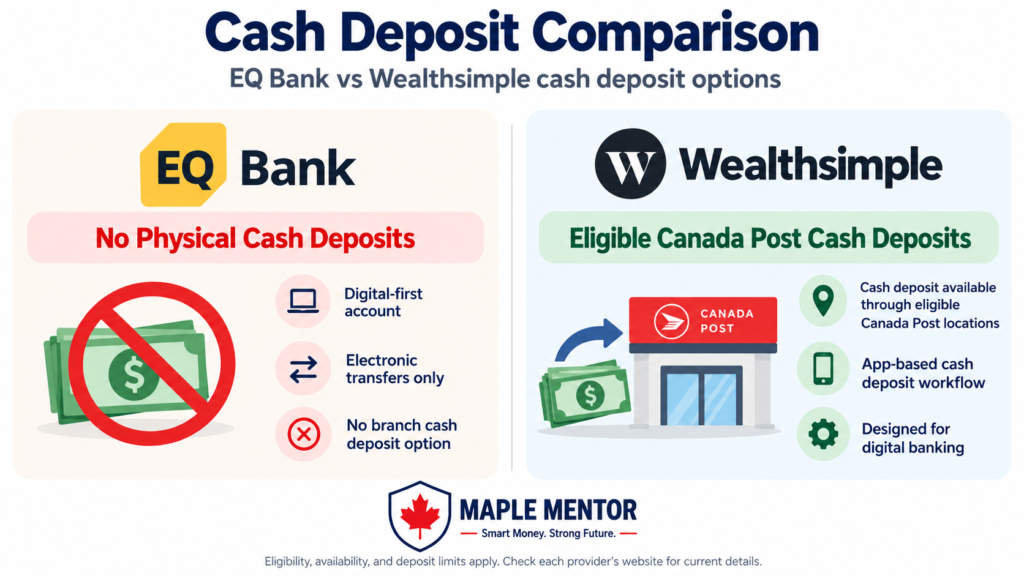
EQ Bank doesn’t currently support physical cash deposits into its Personal Account.
That can be inconvenient for customers who receive cash regularly.
Wealthsimple Chequing has introduced cash deposits through participating Canada Post locations.
This is an important distinction because older comparisons may incorrectly state that neither platform accepts cash.
According to Wealthsimple’s official support information, eligible customers can deposit cash through supported Canada Post locations using the prescribed process.
Wealthsimple — Deposit cash at a Canada Post location
Before relying on this feature, confirm the current deposit limits, eligible locations, identification requirements, fees, and availability.
Cash deposits through Canada Post aren’t necessarily identical to depositing money at a conventional bank ATM.
What About Cheque Deposits?
Both platforms support mobile cheque deposits for eligible cheques.
This allows customers to deposit supported cheques using their phones rather than visiting a branch.
However, deposit holds and eligibility requirements may apply.
If you frequently receive large cheques, compare the applicable limits and hold periods before switching your main banking account.
How Is Your Money Protected?
Deposit protection is an important consideration when comparing financial institutions.
EQ Bank and Wealthsimple use different structures.
EQ Bank Deposit Insurance
EQ Bank is a trade name of Equitable Bank, a federally regulated Canadian bank.
Equitable Bank is a member of the Canada Deposit Insurance Corporation (CDIC).
Eligible deposits held with Equitable Bank are protected under CDIC rules.
CDIC generally protects eligible deposits up to $100,000 per depositor, per insurance category, at each member institution, including eligible principal and interest.
However, coverage depends on the legal institution holding the deposit and the applicable insurance category.
For example, simply opening two accounts at the same member institution doesn’t necessarily create two separate $100,000 insurance limits.
You can review the official rules through Canada Deposit Insurance Corporation.
Wealthsimple Deposit Protection
Wealthsimple isn’t structured like a conventional bank.
Its Chequing service uses arrangements involving partner financial institutions.
Eligible client cash may be held through accounts at CDIC member institutions, subject to the applicable deposit-protection structure.
Wealthsimple has advertised access to substantial combined eligible deposit protection through its partner-bank arrangements.
However, it’s important to understand that this isn’t the same as Wealthsimple itself being a CDIC member bank.
Coverage depends on where the money is actually held, the applicable legal arrangements, eligibility, and CDIC’s aggregation rules.
Customers should review Wealthsimple’s current deposit-protection disclosures before relying on any advertised maximum.
Deposits vs Investments
One final distinction matters.
CDIC deposit insurance protects eligible deposits within its limits and rules.
It doesn’t protect investments such as stocks or ETFs against market losses.
If you hold investments through Wealthsimple, those assets are subject to different custody and investor-protection arrangements.
For this comparison, we’re focusing specifically on cash held through Wealthsimple Chequing and EQ Bank’s Personal Account.
Quebec Availability and Account Limitations
Both EQ Bank Personal Account and Wealthsimple Chequing are available to eligible Quebec residents.
However, that doesn’t mean every product offered by either financial institution is available in Quebec.
EQ Bank in Quebec
EQ Bank’s Personal Account is available in Quebec.
Eligible residents can use its core everyday banking features.
However, several other EQ products have historically been restricted in Quebec, including certain registered savings products, Notice Savings Accounts, and additional banking services.
If you’re considering EQ Bank for more than its Personal Account, check the availability of each product individually.
Wealthsimple Chequing in Quebec
Wealthsimple Chequing is available to eligible Quebec residents.
Its core everyday banking features can therefore be considered alongside EQ Bank’s Personal Account.
However, specific services, promotions, and account features may have separate eligibility requirements.
For Quebec customers, the important point is that both accounts under review are available.
The differences come down to features, rates, and individual banking needs rather than a blanket provincial restriction.
EQ Bank vs Wealthsimple: Which Should You Choose?
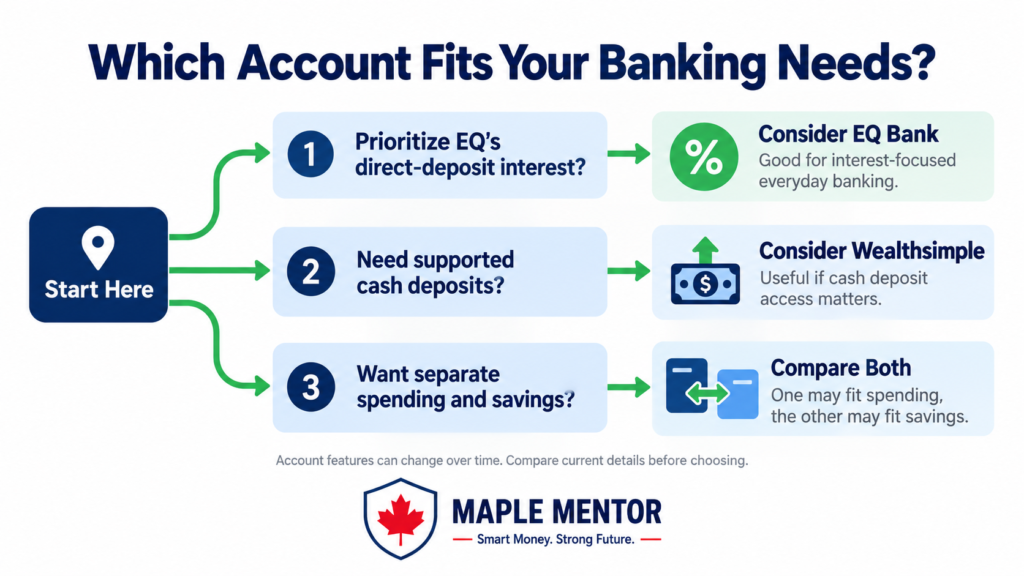
The best account depends on how you actually manage your money.
Let’s look at a few common situations.
Best for Customers Who Qualify for EQ’s Direct-Deposit Rate
EQ Bank can be attractive if you meet its qualifying recurring direct-deposit requirements.
Its Personal Account has offered a 2.75% rate under those conditions.
That can make it useful for customers who want to earn interest on money they keep available for everyday expenses.
However, compare that rate with the Wealthsimple rate you’re personally eligible to receive.
Don’t assume EQ automatically pays more.
Best for Existing Wealthsimple Customers
Wealthsimple Chequing may be convenient if you already use the platform.
You can manage everyday banking through the same broader financial ecosystem.
Depending on your qualifying assets and account conditions, you may also receive benefits associated with your Wealthsimple client tier.
But convenience alone shouldn’t determine your choice.
Compare the interest rate, card benefits, transfer features, and cash-access options.
Best for Cash Deposits
Wealthsimple has the advantage between these two accounts.
Its supported Canada Post cash-deposit service provides an option that EQ Bank doesn’t currently offer.
However, customers who regularly handle substantial amounts of cash should verify the deposit limits and operational requirements.
A conventional bank with ATM cash deposits may still be more practical.
Our EQ Bank vs Tangerine comparison examines another alternative for customers who want access to cash deposits through a major Canadian ATM network.
Best for Customers Prioritizing Savings Interest
This depends on your eligibility.
EQ Bank’s direct-deposit bonus can make its Personal Account attractive.
Wealthsimple may offer different interest rates depending on client tier and qualifying account conditions.
The correct comparison is between the rates you actually qualify for, not the maximum advertised rate from each provider.
For larger savings balances, even a modest difference can become meaningful.
For smaller everyday balances, the difference may be relatively minor.
Should You Use Both EQ Bank and Wealthsimple?
You can, but there’s considerable overlap.
Both accounts provide digital everyday banking, interest on eligible balances, payment cards, and electronic transfers.
Using both may make sense if:
- One account pays a meaningfully better rate on your balance.
- You want Wealthsimple’s supported cash-deposit feature.
- You prefer a particular card benefit.
- You want to separate spending money from savings.
- You want a backup account at another institution.
However, opening both accounts without a clear purpose may simply create additional administrative work.
If your main goal is separating money for different financial objectives, you may not need two institutions.
Read How to Use Multiple Savings Accounts in Canada for a practical approach to organizing savings without unnecessarily complicating your finances.
Final Verdict
The EQ Bank vs Wealthsimple decision is relatively straightforward once you identify your priorities.
Choose EQ Bank if you want an interest-paying Personal Account, qualify for an attractive direct-deposit rate, and don’t need physical cash deposits.
Choose Wealthsimple Chequing if you already benefit from Wealthsimple’s client-tier structure, prefer its card features, or value the ability to deposit cash through eligible Canada Post locations.
Consider both if each account solves a different banking problem.
For most Canadians, the best everyday banking account isn’t necessarily the one advertising the highest possible interest rate.
It’s the one that provides the services you need, charges reasonable fees, pays a competitive rate on your actual balance, and makes managing your money straightforward.
FAQ
Is EQ Bank or Wealthsimple better for everyday banking?
Both offer useful everyday banking features, including direct deposits, bill payments, Interac e-Transfers, payment cards, and interest on eligible balances.
EQ Bank may appeal to customers who qualify for its higher Personal Account interest rate.
Wealthsimple may be more attractive to existing clients who qualify for additional benefits or need its supported cash-deposit service.
The better choice depends on your individual banking needs.
Is Wealthsimple Chequing the same as Wealthsimple Cash?
Wealthsimple Chequing is the newer name for the everyday banking product previously known as Wealthsimple Cash.
The account’s branding has changed, and features may evolve over time.
Customers should review the current Chequing terms rather than relying on older Wealthsimple Cash comparisons.
Which account pays more interest without direct deposit?
That depends on the current published rates and your Wealthsimple client tier.
EQ Bank has offered a 1.00% base Personal Account rate without qualifying direct deposits.
Wealthsimple’s rate can depend on its current account structure and client eligibility requirements.
Because rates change, compare the current base rate available to you at each institution before deciding.
Can you deposit cash and cheques into both accounts?
Both accounts support eligible mobile cheque deposits.
However, cash deposits differ.
EQ Bank doesn’t currently support physical cash deposits into its Personal Account.
Wealthsimple supports eligible cash deposits through participating Canada Post locations, subject to applicable requirements and limits.
Are both accounts available in Quebec?
Yes.
EQ Bank’s Personal Account and Wealthsimple Chequing are available to eligible Quebec residents.
However, certain other products and services offered by EQ Bank may not be available in Quebec.
Always verify eligibility for the specific account or service you’re considering.
Does it make sense to use both EQ Bank and Wealthsimple?
It can, but only if each account has a clear purpose.
For example, you might prefer one account for everyday spending and the other for savings.
You might also value a particular card feature or cash-deposit option.
However, both accounts offer similar core digital banking functions.
For many customers, choosing one primary account may be simpler than maintaining both.