
EQ Bank and Tangerine are two popular alternatives to traditional Canadian banks, but they approach everyday banking differently.
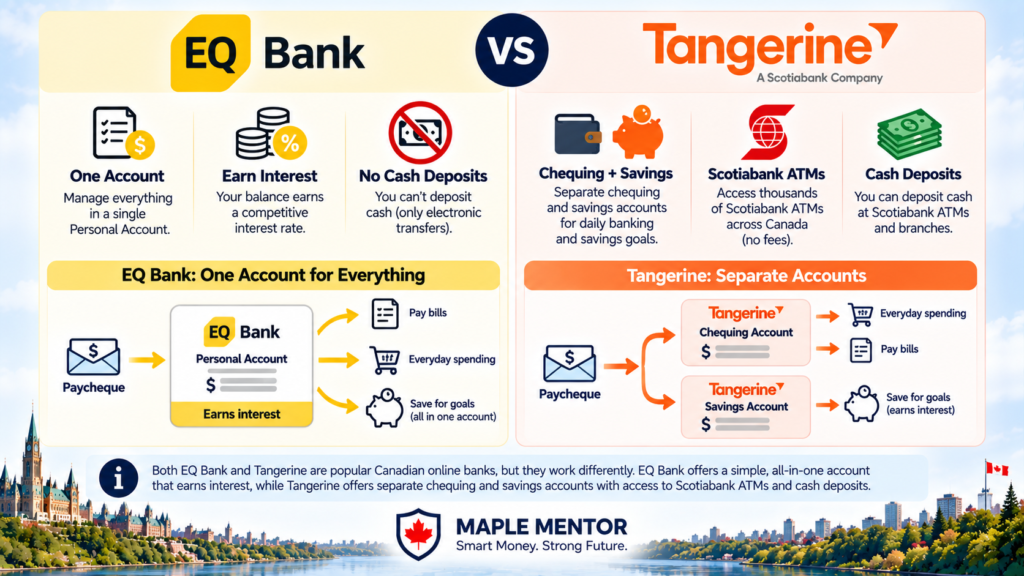
EQ Bank’s Personal Account combines many chequing and savings features into a single interest-paying account. Tangerine takes a more traditional approach, offering a separate no-fee Chequing Account and Savings Account.
That makes the EQ Bank vs Tangerine decision more interesting than simply comparing two interest rates.
Do you want one account where your everyday money can earn a relatively competitive rate? Or would you rather separate your spending and savings while gaining access to cash deposits and the Scotiabank ATM network?
You could also use both.
EQ Bank vs Tangerine: Quick Answer
EQ Bank currently has a compelling setup for Canadians who want their everyday balance to earn interest.
Its Personal Account has no everyday banking fees and currently pays a 1.00% base interest rate. Customers who maintain qualifying recurring direct deposits of at least $2,000 per month can currently earn 2.75% instead. It supports direct deposits, pre-authorized debits, bill payments, and unlimited free Interac e-Transfers.
Tangerine separates everyday spending from savings.
Its Chequing Account has no monthly account fee, no minimum balance, unlimited everyday transactions, and free Interac e-Transfers. Tangerine’s regular Savings Account currently pays 0.30%, although eligible new clients may receive temporary promotional rates.
The simplest way to think about EQ Bank vs Tangerine is this:
EQ Bank may fit better if you want everyday banking and savings combined, rarely deposit physical cash, and value a higher ongoing interest rate on money sitting in your main account.
Tangerine may fit better if you want a more conventional chequing-and-savings setup, need to deposit cash, or value access to Scotiabank ATMs.
Using both can also make sense. Tangerine can handle cash and conventional everyday banking while EQ Bank holds savings at a higher ongoing rate.
Best Online Banks in Canada covers additional alternatives if neither setup is quite right.
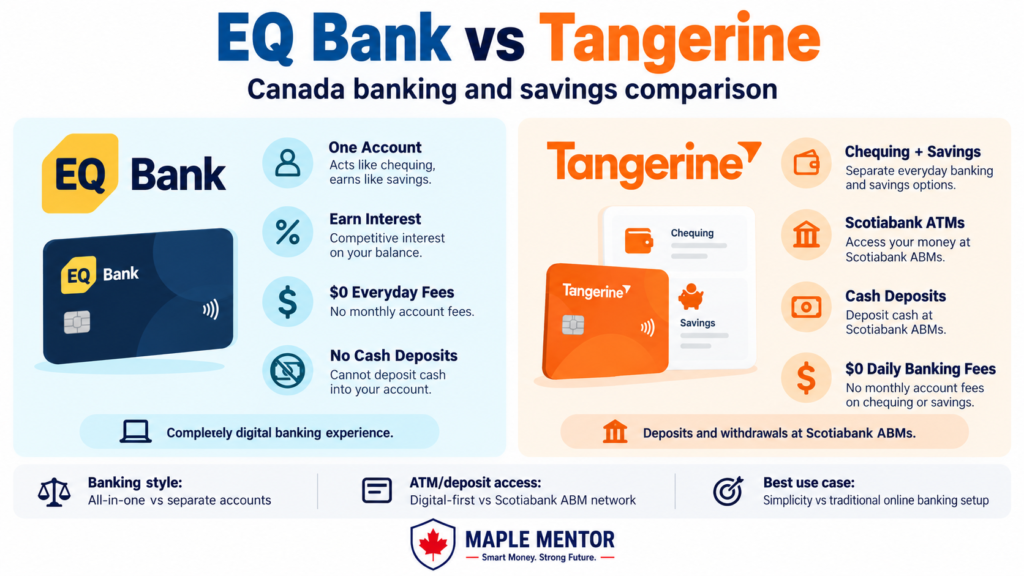
EQ Bank vs Tangerine at a Glance
| Feature | EQ Bank | Tangerine |
|---|---|---|
| Main everyday account | Personal Account | Chequing Account |
| Account structure | Spending + interest in one account | Separate chequing and savings |
| Monthly everyday banking fee | $0 | $0 |
| Minimum balance | $0 | $0 |
| Regular interest | 1.00% Personal Account base rate | 0.30% regular Savings Account rate |
| Conditional interest | 2.75% with qualifying $2,000/month recurring direct deposits | Promotional savings offers may apply |
| Interac e-Transfers | Free | Free |
| Bill payments | Free | Free |
| Direct deposit | Yes | Yes |
| Card | Prepaid reloadable Mastercard | Visa Debit |
| Canadian ATM withdrawals | EQ charges $0; eligible ATM fees reimbursed within limits | Free at 3,500+ Scotiabank ATMs |
| Cash deposits | No | Yes, at eligible Scotiabank ATMs |
| Mobile cheque deposit | Yes | Yes |
| Personal Account available in Quebec | Yes | Yes |
| Some products restricted in Quebec | Yes | Core products discussed here are available |
| Best fit | Interest on everyday cash | More traditional digital chequing setup |
Rates and features can change. The figures above were checked against official bank information in October 2026.
Everyday Banking: Can Either Replace Your Main Bank?
For many Canadians, yes.
Both EQ Bank and Tangerine support most of the transactions you would expect from a primary digital bank, but there are important differences.
EQ Bank Personal Account
EQ Bank describes its Personal Account as combining chequing-style functionality with interest.
It supports direct deposits, pre-authorized debits, free Interac e-Transfers, free bill payments, electronic transfers between linked bank accounts, mobile cheque deposits, and ATM withdrawals through the EQ Bank Card.
There are no everyday banking fees and no minimum balance requirement.
This creates an interesting setup.
Suppose your paycheque enters your account on Friday and you gradually spend it over the next few weeks.
At many banks, money sitting in a chequing account earns little or nothing. At EQ Bank, your Personal Account balance earns interest while remaining available for everyday banking.
That’s especially attractive if you qualify for the higher direct-deposit rate.
Tangerine Chequing Account
Tangerine operates more like a conventional bank account, just without the monthly chequing fee.
Its Chequing Account includes no monthly account fee, no minimum balance, unlimited debit purchases, unlimited bill payments, unlimited pre-authorized transactions, free Interac e-Transfers, direct deposit, mobile cheque deposit, Visa Debit, and ATM access through Scotiabank.
Tangerine also provides a first book of 50 cheques for free. Additional cheque books and certain occasional services have fees.
That highlights one limitation of EQ Bank.
EQ specifically notes that its Personal Account isn’t designed for customers who need services such as cheques, bank drafts, in-branch support, or cash deposits.
For someone who almost never handles physical money, that might not matter.
For someone who regularly deposits cash or occasionally needs more traditional banking services, it can matter significantly.
Tangerine vs Simplii Financial is worth reading if you want to compare Tangerine with another no-fee everyday banking option.
Savings Interest: Standard Rates vs Conditional and Promotional Rates
This is where EQ Bank vs Tangerine currently has one of its largest differences.
But we need to separate three types of rates: standard rates, conditional rates, and promotional rates.
They aren’t interchangeable.
EQ Bank Personal Account Rate
As of October 2026, EQ Bank lists its Personal Account at:
1.00% base interest
or
2.75% with qualifying recurring direct deposits.
To receive the higher rate, customers currently need to add and maintain qualifying recurring direct deposits totalling at least $2,000 per month to a Personal or Joint Account.
The 2.75% consists of the 1.00% base rate plus a 1.75% bonus. Conditions apply.
This isn’t the same thing as a three or five months new-client promotion. It’s conditional on meeting the direct-deposit requirements.
Tangerine Savings Rate
Tangerine currently lists its regular non-registered Savings Account rate at:
0.30%
with no monthly fee and no minimum balance.
However, Tangerine frequently uses promotional savings rates.
Eligible new clients may receive a substantially higher temporary rate, subject to Tangerine’s eligibility requirements, maximum eligible balances, and promotional period.
That’s why comparing a temporary Tangerine promotional rate directly with EQ Bank’s ongoing rate can be misleading.
After a Tangerine promotion expires, the applicable posted rate takes over.
$10,000 Example
Suppose you keep exactly $10,000 untouched for one full year.
For simplicity, we’ll use the current rates as if they remained unchanged for the entire comparison period and ignore compounding.
At EQ Bank’s 1.00% base rate:
$10,000 × 1.00% = approximately $100 per year
At EQ Bank’s 2.75% qualifying direct-deposit rate:
$10,000 × 2.75% = approximately $275 per year
At Tangerine’s 0.30% regular rate:
$10,000 × 0.30% = approximately $30 per year
That’s a meaningful difference between the current ongoing rates.
A temporary Tangerine promotional rate could produce a very different result during its promotional period.
The correct comparison therefore depends on whether you’re asking:
“Where should I put my money for the next few months?”
or
“Where should I keep my money without continually chasing promotions?”
Those are different questions.
Rates can change at any time, so verify them before moving significant savings.
Best High-Interest Savings Accounts in Canada compares other places to keep your cash.
What About EQ Bank’s Notice Savings Account?
Outside Quebec, EQ also offers Notice Savings Accounts that can pay higher interest in exchange for advance notice before withdrawals.
The available rates and notice periods can change, so check EQ Bank’s current rates before opening one.
The important distinction is that these accounts sacrifice some immediate liquidity for a potentially higher rate.
They are also among the EQ products that aren’t currently available in Quebec.
For emergency savings, liquidity matters just as much as the headline interest rate.
See Where to Keep Your Emergency Fund in Canada: HISA, TFSA, GIC, or Chequing Account? before putting emergency money somewhere with withdrawal restrictions.
Payment Cards, ATM Withdrawals, and Cash Deposits
This is probably the biggest practical difference between EQ Bank and Tangerine.
EQ Bank Card
The EQ Bank Card isn’t a traditional debit card.
It’s a prepaid reloadable Mastercard connected to your EQ banking setup.
You load money onto the card and can use it for purchases wherever Mastercard is accepted.
EQ currently provides features including cash back on purchases, no additional foreign transaction fee charged by EQ, and Canadian ATM access.
For Canadian ATM withdrawals, EQ doesn’t charge its own withdrawal fee.
EQ also currently reimburses eligible fees charged by Canadian ATM operators, subject to its reimbursement limits and terms.
That means EQ isn’t tied to one particular Canadian ATM network in the same way Tangerine is.
But there’s a major limitation.
You Can’t Deposit Cash at EQ Bank
EQ Bank doesn’t support physical cash deposits into its Personal Account.
You can fund the account through methods such as direct deposit, electronic transfers, Interac e-Transfer, linked accounts, and mobile cheque deposits.
But you can’t walk up to an ATM with $500 in cash and deposit it directly into EQ Bank.
For some people, that’s irrelevant.
For others, it’s a deal-breaker.
Tangerine Visa Debit
Tangerine’s Client Card is a Visa Debit card connected directly to its Chequing Account.
You can use it for in-store purchases, online purchases, mobile wallet payments, ATM withdrawals, ATM deposits, and recurring card payments.
Tangerine clients currently have free access to more than 3,500 Scotiabank ATMs across Canada.
More importantly for cash users, Tangerine supports deposits through eligible Scotiabank ATMs.
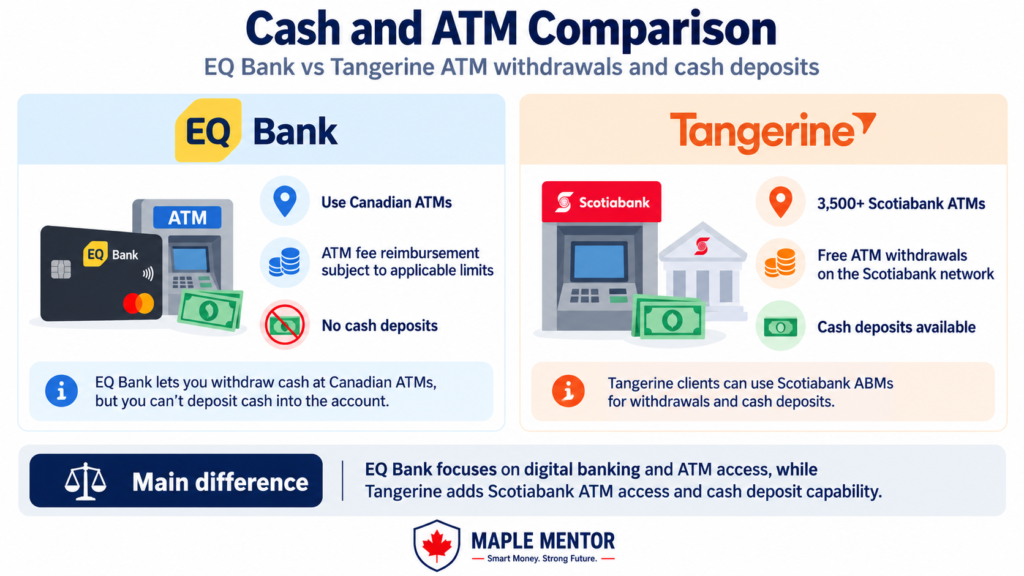
Which ATM Setup Is Better?
For withdrawing cash, EQ’s reimbursement model can be convenient because you aren’t restricted to finding one specific bank’s ATM, although reimbursement limits apply.
For depositing cash, Tangerine has the clear advantage because EQ doesn’t support cash deposits.
If you almost never touch physical cash, EQ’s limitation may barely matter.
If you receive cash regularly, it matters a lot.
EQ Bank vs Tangerine for Quebec Residents
This comparison requires more nuance than simply saying EQ Bank is or isn’t available in Quebec.
EQ Bank’s Personal Account is available to Quebec residents.
However, EQ currently excludes several other products and services from Quebec.
Depending on the current product lineup, Quebec restrictions can affect products such as certain registered savings accounts, Notice Savings Accounts, U.S.-dollar banking, international money transfers, and business products.
That means a Quebec resident can use EQ Bank for its core Personal Account but shouldn’t assume every product advertised by EQ is available in the province.
Tangerine offers its core Chequing and Savings Accounts in Quebec.
That can make Tangerine more convenient for a Quebec customer who wants more of their banking products under one institution.
But if your main goal is an interest-paying everyday account, EQ Bank’s Personal Account remains an option in Quebec.
Should You Use Both EQ Bank and Tangerine?
For some Canadians, this may actually be the strongest setup.
There’s no rule saying your chequing account and savings need to be at the same bank.
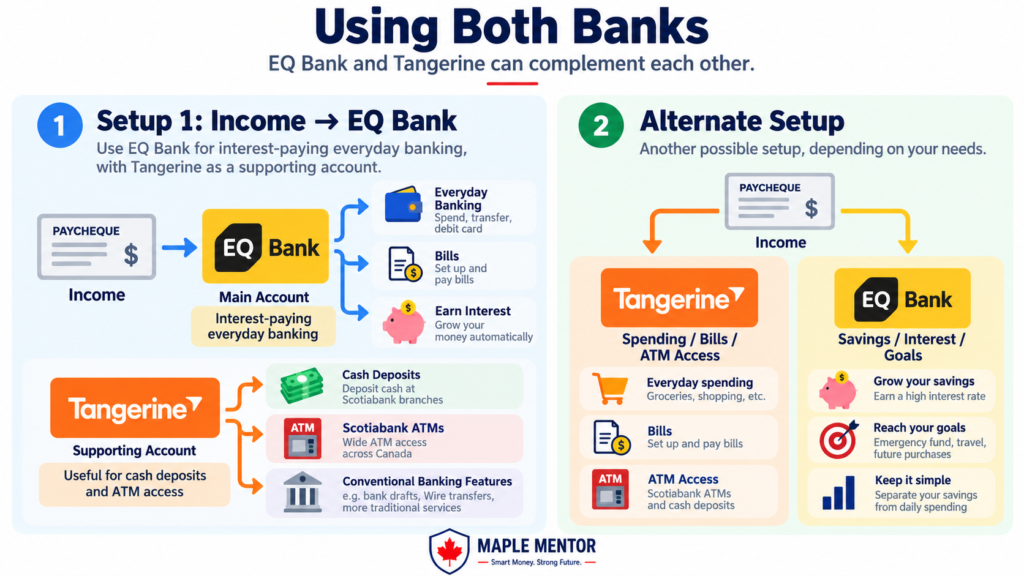
One possible setup is:
Tangerine → everyday spending and cash handling
EQ Bank → savings
Your pay could enter Tangerine. You could use Tangerine for debit purchases, bills, cash deposits, and Scotiabank ATM access.
Then you could automatically transfer a predetermined amount into EQ Bank for savings.
Alternatively, if you qualify for EQ’s higher direct-deposit rate, you could reverse the setup:
EQ Bank → payroll + everyday money + savings
Tangerine → cash deposits and occasional traditional banking needs
This arrangement could let you take advantage of EQ’s higher Personal Account interest while retaining access to Tangerine’s cash-deposit infrastructure.
The Downside of Using Two Banks
More accounts aren’t automatically better.
You now have two logins, two apps, transfers between institutions, more statements, and more accounts to monitor.
Transfers between different financial institutions can also take time.
Interac e-Transfers can make smaller transfers faster, subject to each institution’s transaction limits.
If you’re earning an extra $20 per year but constantly moving money between accounts, the added complexity may not be worthwhile.
The goal should be a banking system that’s both financially efficient and easy to maintain.
How to Use Multiple Savings Accounts in Canada explains how separate accounts can be used for emergency savings, travel, taxes, home savings, and other goals.
EQ Bank vs Tangerine: Final Verdict
There’s no universal winner in EQ Bank vs Tangerine because these banks are optimized for slightly different customers.
Choose EQ Bank If You Want Interest on Everyday Money
EQ Bank’s Personal Account is particularly interesting if you want to combine spending and saving.
You currently earn a 1.00% base rate, with a higher 2.75% rate available when qualifying recurring direct-deposit requirements are met.
You also get free everyday transactions, Interac e-Transfers, bill payments, and flexible Canadian ATM withdrawals through the EQ Bank Card.
The major compromise is physical banking.
You can’t deposit cash, and EQ doesn’t provide all the conventional services someone might expect from a traditional chequing account.
Choose Tangerine If You Want a More Complete Everyday Banking Setup
Tangerine’s Chequing Account behaves more like a conventional chequing account.
You get no monthly fee, unlimited everyday transactions, free Interac e-Transfers, Visa Debit, Scotiabank ATM access, cash deposits, cheques, and separate savings accounts.
Its weakness is that the regular Savings Account rate is currently much lower than EQ Bank’s Personal Account rate.
Promotional rates can temporarily reverse that comparison.
For Cash Users
Tangerine is the stronger choice.
EQ Bank doesn’t accept cash deposits.
For Savings-Focused Customers
EQ Bank currently has the stronger ongoing rate structure for immediately accessible non-registered money, especially if you qualify for the direct-deposit bonus.
However, Tangerine promotional offers can temporarily pay substantially more.
Always compare the rate you’ll receive after the promotion ends.
For Someone Who Wants One Main Account
EQ Bank is appealing if you rarely use cash and like the idea of combining everyday banking with interest.
Tangerine is more practical if you want something closer to a traditional chequing account without paying a monthly fee.
For Someone Willing to Use Two Banks
Using both can be reasonable.
You could use Tangerine for cash deposits and conventional chequing features while keeping savings at EQ Bank.
Or you could make EQ your primary account to qualify for its direct-deposit rate and keep Tangerine as your cash-access backup.
Don’t add a second bank simply because you can.
Add it only if it solves a specific problem.
That’s ultimately the most useful way to approach EQ Bank vs Tangerine: choose the banking structure that fits how you actually receive, spend, and save your money, not whichever bank happens to advertise the largest temporary bonus.
FAQ
Is EQ Bank or Tangerine better for everyday banking?
Both can handle most everyday digital banking.
EQ Bank may be better for people who want their everyday balance to earn a competitive interest rate, while Tangerine offers a more traditional chequing setup with Visa Debit, cheques, cash deposits, and Scotiabank ATM access.
The better option depends largely on whether you handle physical cash and whether you qualify for EQ’s higher direct-deposit interest rate.
Can EQ Bank replace a chequing account?
For many Canadians, yes.
EQ’s Personal Account supports direct deposits, pre-authorized debits, Interac e-Transfers, bill payments, mobile cheque deposits, and ATM withdrawals.
However, it won’t completely replace a conventional chequing account for everyone because of limitations such as cash deposits, cheques, bank drafts, and branch access.
Which bank pays more savings interest after promotions end?
As of October 2026, EQ Bank’s Personal Account pays a 1.00% base rate or 2.75% for customers meeting its qualifying recurring direct-deposit requirements.
Tangerine’s regular non-registered Savings Account currently pays 0.30%.
Based on those current rates, EQ Bank pays more without relying on a temporary new-client promotion.
Rates can change, so always check the current posted rates before opening or moving an account.
Can you deposit cash at EQ Bank and Tangerine?
You can deposit cash with Tangerine through eligible Scotiabank ATMs.
EQ Bank doesn’t support cash deposits into its Personal Account.
Both banks support mobile cheque deposits.
Are both banks available in Quebec?
Their core everyday accounts are.
EQ Bank’s Personal Account is currently available in Quebec, although several other EQ products aren’t available to Quebec residents.
Tangerine’s core Chequing and Savings Accounts are also available in Quebec.
Quebec residents should therefore compare specific EQ products rather than assuming the entire EQ Bank product lineup is available.
Does it make sense to use both banks?
It can.
One approach is to use Tangerine for everyday banking and cash deposits while keeping savings at EQ Bank.
Another is to use EQ as your primary account to qualify for its direct-deposit interest rate while keeping Tangerine for cash deposits and occasional banking needs.
Using both makes sense when each account has a clear purpose. Otherwise, maintaining two banks may simply create unnecessary complexity.