
Finding the best non-registered brokerage Canada has to offer requires looking beyond trading commissions. Currency conversion, margin borrowing, investment selection, tax reporting, and account flexibility can all influence your long-term investment costs.
Unlike a Tax-Free Savings Account (TFSA) or Registered Retirement Savings Plan (RRSP), a non-registered investment account has no government-imposed contribution limit. However, investment income and realized capital gains may create taxable income.
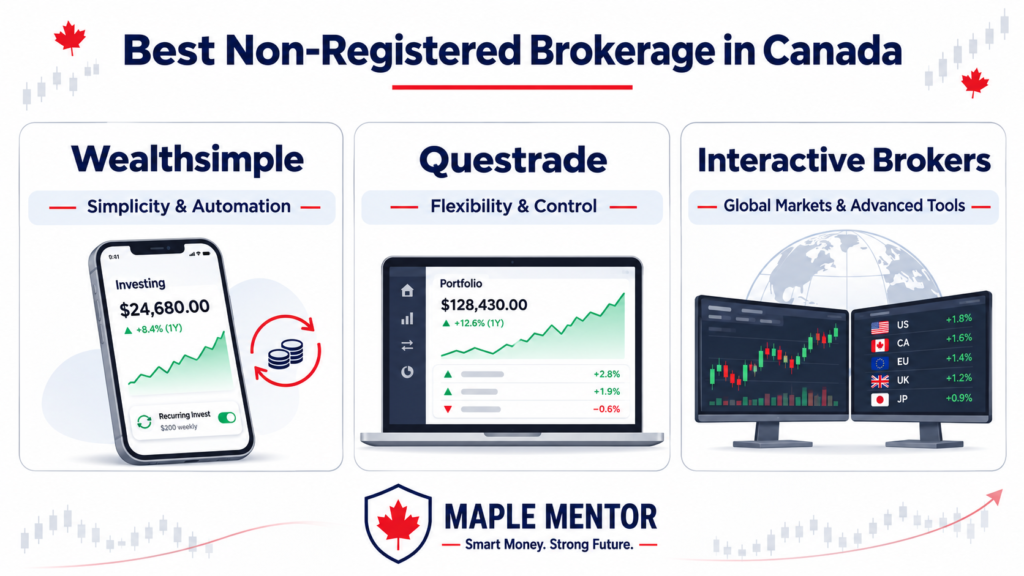
Wealthsimple, Questrade, and Interactive Brokers are three competitive options for Canadians looking to invest outside registered accounts.
While Wealthsimple focuses on simplicity and automation, Questrade provides greater traditional brokerage flexibility. Meanwhile, Interactive Brokers stands out for international investing, currency conversion, and advanced trading functionality.
This guide compares all three platforms to help you determine which brokerage best suits your investment strategy.
Quick Answer: Best Non-Registered Brokerage in Canada
The right brokerage depends primarily on what you plan to invest in and how frequently you intend to trade.
- Wealthsimple — Best overall for beginners and passive investors: Commission-free eligible stock and ETF trading, fractional shares, automatic investing, and straightforward individual and joint accounts.
- Questrade — Best for investment flexibility: Commission-free eligible stock and ETF trading, free dual-currency functionality, traditional brokerage tools, and margin access.
- Interactive Brokers — Best for advanced and international investors: Competitive currency-conversion costs, international markets, sophisticated trading tools, and margin functionality.
For most Canadians purchasing diversified Canadian-listed ETFs regularly, Wealthsimple or Questrade will likely provide everything they need.
However, Interactive Brokers becomes increasingly attractive when investors regularly convert currencies, access international markets, or require advanced trading functionality.
Unlike registered accounts, taxable investment accounts also require investors to pay closer attention to investment income, realized capital gains, and transaction records.
Consequently, the best brokerage isn’t necessarily the one advertising the lowest trading commission.
Wealthsimple vs Questrade vs Interactive Brokers at a Glance
| Feature | Wealthsimple | Questrade | Interactive Brokers |
|---|---|---|---|
| Individual non-registered account | Yes | Yes | Yes |
| Joint account | Yes | Yes | Yes |
| Standard stock commissions | $0 | $0 online | Low per-share commissions |
| Standard ETF commissions | $0 | $0 online | Low per-share commissions |
| Hold CAD and USD | Yes, with USD functionality | Yes | Yes |
| Margin investing | Available | Available | Available |
| Recurring investments | Strong | Eligible securities | Eligible securities |
| Fractional shares | Yes | Yes | Yes |
| International markets | More limited | More limited | Extensive |
| Managed investing | Available | Questwealth | Primarily self-directed |
| Beginner-friendly | Excellent | Good | More complex |
| Advanced trading tools | Growing | Strong | Excellent |
| Best suited for | Passive investors | Flexible investing | Advanced and global investors |
Account features, investment eligibility, trading commissions, and additional charges are subject to change.
All three platforms can support a long-term taxable investment portfolio. However, their differences become more significant when currency conversion, margin borrowing, and international investments are involved.
What Is a Non-Registered Investment Account?
A non-registered investment account is an investment account that doesn’t receive the special tax treatment associated with Canadian registered accounts.
Unlike a TFSA, RRSP, FHSA, or RESP, a standard non-registered investment account doesn’t have an annual or lifetime government contribution limit.
You can generally deposit and withdraw money whenever you want, subject to settlement periods, brokerage requirements, and any outstanding borrowing obligations.
Depending on the brokerage, a non-registered account can hold:
- Canadian and international stocks.
- Exchange-traded funds (ETFs).
- Mutual funds.
- Bonds.
- Guaranteed Investment Certificates (GICs).
- Certain options and other investment products.
Many Canadians begin using non-registered accounts after maximizing their available registered contribution room.
However, taxable accounts can also be useful when unrestricted access, margin borrowing, or broader investment functionality is important.
How Non-Registered Investments Are Taxed
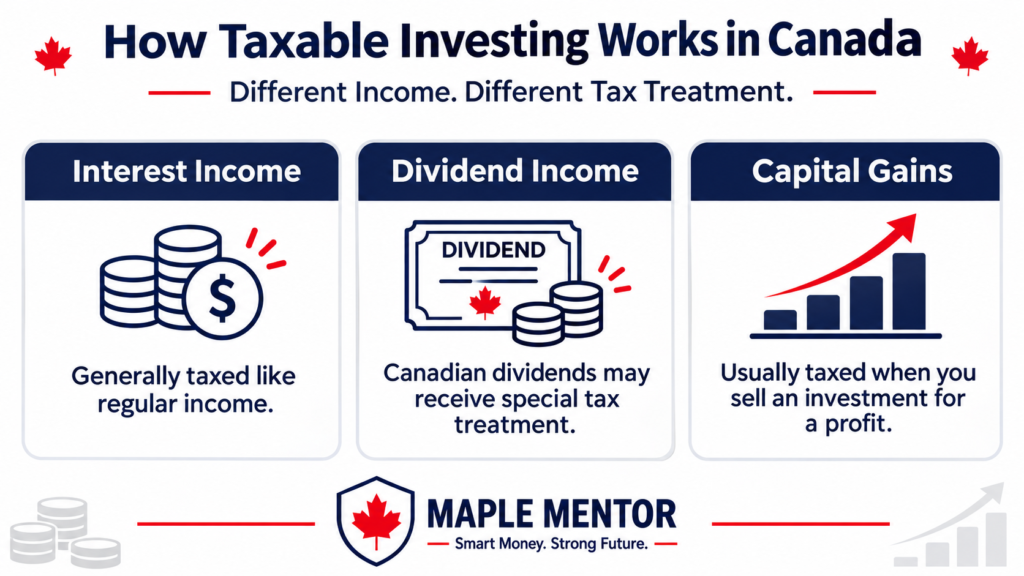
There are three primary forms of taxable investment income Canadians should understand.
| Investment Income | General Canadian Tax Treatment |
|---|---|
| Interest | Generally fully included in taxable income |
| Canadian dividends | May qualify for dividend gross-up and tax credits |
| Foreign dividends | Generally taxable as foreign investment income |
| Capital gains | A portion of realized gains is included in taxable income under applicable rules |
Unlike a TFSA, selling an investment for a profit inside a non-registered account can create a taxable capital gain.
Additionally, dividends and interest may be taxable even if you reinvest them rather than withdraw the money.
This distinction makes investment selection and record-keeping particularly important.
If you’re unsure whether a taxable investment account is appropriate for your financial situation, our TFSA vs Non-Registered Account guide explains the differences in greater detail.
1. Wealthsimple Non-Registered Account
Best non-registered brokerage for simplicity and automatic investing
Wealthsimple has become one of Canada’s most accessible investment platforms by simplifying the process of buying stocks, ETFs, and other eligible investments.
Its non-registered account offering is particularly attractive for Canadians who want to build a long-term investment portfolio without navigating complicated brokerage tools.
Wealthsimple offers individual and joint non-registered accounts, self-directed investing, managed portfolios, dedicated margin accounts, and USD account functionality.
Wealthsimple Non-Registered Trading Fees
They currently offers $0 standard trading commissions on eligible Canadian and U.S.-listed stocks and ETFs.
This can be especially valuable for investors making frequent contributions.
Suppose you invest $200 every week into a diversified Canadian-listed ETF.
$200 x 52 = $10,400 annually
At a brokerage charging $9.95 per transaction, 52 purchases could generate $517.40 in annual trading commissions.
With eligible commission-free purchases, those standard trading commissions would be avoided.
However, investment management expenses, foreign-exchange fees, and other applicable charges may still exist.
Wealthsimple publishes its trading fee structure at https://www.wealthsimple.com/en-ca/legal/fees/trade.
Wealthsimple Automatic Investing
One of Wealthsimple’s strongest advantages is its recurring investment functionality.
Investors can schedule purchases of eligible stocks and ETFs at regular intervals.
For example, someone who has already maximized their TFSA could automatically invest $500 every two weeks into a non-registered account.
$500 x 26 = $13,000 annually
Because the account has no government contribution ceiling, the investor doesn’t need to stop contributing after reaching a particular annual limit.
Fractional investing can also help ensure that more of each contribution is invested rather than remaining as unused cash.
Our Automatic ETF Investing in Canada guide explains how recurring investment functionality differs between Wealthsimple and Questrade.
Wealthsimple Joint Non-Registered Accounts
Wealthsimple supports joint taxable investment accounts, which can be useful for couples managing shared financial goals.
Both account holders can generally view transactions, deposit money, and withdraw funds.
However, joint ownership rules differ depending on where you live.
According to Wealthsimple’s account documentation, joint non-registered accounts in Quebec are structured as Tenants in Common, while accounts in other provinces generally use Joint With Rights of Survivorship.
These structures can have different estate-planning implications.
Importantly, joint ownership doesn’t automatically mean investment income can be divided equally between account holders for tax purposes.
Canadian tax attribution rules may apply depending on who contributed the money and the circumstances surrounding those contributions.
Wealthsimple explains its individual and joint account structures at https://help.wealthsimple.com/hc/en-ca/articles/4404717261467-Open-an-individual-or-joint-non-registered-account.
Wealthsimple USD Investing
Although Wealthsimple offers commission-free eligible U.S. stock trading, currency-conversion costs can still apply.
Its USD account functionality allows eligible investors to maintain U.S.-dollar balances rather than repeatedly converting investment proceeds back into Canadian dollars.
Core clients generally pay a $10 CAD monthly subscription for USD account functionality, while eligible Premium and Generation clients can access it without that subscription fee.
For investors primarily purchasing Canadian-listed ETFs, this additional functionality may be unnecessary.
However, someone regularly purchasing American stocks should carefully evaluate the total cost of currency conversion and USD account access.
Wealthsimple Advantages and Disadvantages
| Advantages | Disadvantages |
|---|---|
| Commission-free eligible stock and ETF trading | Currency-conversion costs |
| Simple and accessible interface | USD subscription fee for Core clients |
| Strong recurring investing | More limited international market access |
| Fractional shares | Fewer sophisticated trading tools |
| Individual and joint accounts | More limited traditional investment selection |
| Managed and self-directed options | Not ideal for every advanced trading strategy |
Who Should Choose Wealthsimple?
Wealthsimple may be the best non-registered brokerage in Canada for beginners, passive ETF investors, couples building shared investments, and Canadians who prioritize automation.
Verdict: My preferred choice for most Canadians building a straightforward, long-term taxable investment portfolio.
2. Questrade Non-Registered and Margin Accounts
Best non-registered brokerage for investment flexibility
Questrade provides a more traditional brokerage experience while remaining accessible to Canadian self-directed investors.
Unlike Wealthsimple, which distinguishes between standard non-registered trading accounts and dedicated margin accounts, Questrade primarily uses its margin account structure for non-registered self-directed investing.
However, opening a margin account doesn’t mean you must borrow money.
You can simply deposit your own funds and purchase investments without using leverage.
Questrade Non-Registered Trading Fees
Questrade currently advertises:
- $0 commissions on eligible online Canadian stock trades.
- $0 commissions on eligible online U.S. stock trades.
- $0 commissions on eligible online ETF purchases and sales.
- No annual account fee.
- No inactivity fee.
- Free dual-currency functionality.
Other transaction charges, foreign-exchange costs, and optional service fees may still apply.
Questrade’s official pricing information is available at https://www.questrade.com/pricing-fees.
The introduction of commission-free eligible stock and ETF trading has made Questrade considerably more competitive with Wealthsimple.
As a result, choosing between these two brokerages increasingly depends on functionality rather than standard trading commissions alone.
Questrade Dual-Currency Accounts
One of Questrade’s most important advantages is its ability to hold Canadian and U.S. dollars without requiring a separate monthly USD account subscription.
This can be particularly useful for Canadians investing regularly in American companies.
For example, if you sell a U.S.-listed stock, you can generally retain the proceeds in USD and use them to purchase another American investment.
This helps avoid unnecessary repeated currency conversions.
However, converting Canadian dollars into U.S. dollars still carries a cost.
Questrade’s standard currency-conversion fee is generally 1.5%.
Converting $20,000 CAD at that rate would represent approximately $300 in conversion costs.
For larger portfolios, these expenses can become considerably more important than trading commissions.
Understanding Questrade Margin Accounts
A margin account allows eligible investors to borrow money from the brokerage using their investment portfolio as collateral.
However, investors aren’t required to use this functionality.
Suppose you deposit $10,000 into a Questrade margin account.
You could invest only that $10,000 and avoid borrowing altogether.
Alternatively, subject to approval and applicable margin requirements, you could borrow additional funds to purchase investments.
Borrowing introduces additional risks, including interest expenses, amplified losses, and the possibility of forced liquidation.
For most passive investors, margin borrowing isn’t necessary to build long-term wealth.
Questrade explains how its margin accounts operate at https://www.questrade.com/learning/options-active-trading/margin-accounts.
Questrade Investment Selection
It provides access to a broader selection of traditional investment products than many simplified investing platforms.
Depending on account eligibility, investors can access stocks, ETFs, mutual funds, GICs, bonds, and options.
This can be useful for Canadians managing several financial objectives through the same brokerage.
For example, an investor could maintain a long-term equity portfolio while holding GICs for shorter-term financial goals.
Questrade Advantages and Disadvantages
| Advantages | Disadvantages |
|---|---|
| Commission-free eligible stock and ETF trading | More complex interface |
| Free CAD/USD account functionality | Currency-conversion fees still apply |
| Individual and joint ownership | Recurring purchases have eligibility restrictions |
| Broad traditional investment selection | Margin functionality introduces potential risks |
| Strong brokerage tools | Less straightforward automation for Canadian ETFs |
| Access to margin and advanced strategies | Some investment products involve additional charges |
Who Should Choose Questrade?
Questrade may be the best non-registered brokerage Canada offers for investors who want commission-free trading without sacrificing traditional brokerage functionality.
It’s particularly attractive for investors holding both Canadian and U.S. investments, managing joint portfolios, or seeking broader investment selection.
Verdict: An excellent alternative to Wealthsimple for investors who prioritize flexibility and control.
Our Wealthsimple vs Questrade comparison explores the differences between these platforms in greater detail.
3. Interactive Brokers Non-Registered Account
Best non-registered brokerage for advanced and international investors
Interactive Brokers, commonly known as IBKR, takes a different approach from Wealthsimple and Questrade.
Rather than focusing primarily on simplified Canadian investing, Interactive Brokers provides access to a broad international brokerage ecosystem.
Its platform is particularly attractive for investors who regularly trade across currencies, access international stock exchanges, or use sophisticated investment strategies.
Interactive Brokers Account Types
Interactive Brokers Canada offers several non-registered account structures, including individual accounts, joint accounts, cash accounts, and margin accounts.
Its ordinary individual and joint accounts generally have no minimum account balance requirement or inactivity fee.
You can explore its available account structures at https://www.interactivebrokers.ca/en/accounts/account-guide.php.
Unlike a margin account, a cash account generally restricts investors to using available funds rather than borrowing money.
This distinction can be useful for investors who want access to IBKR’s international markets without introducing leverage.
Interactive Brokers Trading Commissions
Interactive Brokers generally charges small trading commissions rather than offering universal commission-free stock and ETF trading to Canadian clients.
Its pricing can vary depending on the market, order size, security, and selected pricing structure.
For example, Canadian and U.S. stock commissions may be calculated on a per-share basis, subject to minimum transaction charges.
Although these costs may be higher than a $0 trading commission at Wealthsimple or Questrade, the overall investment cost can still be lower in certain circumstances.
This is particularly true when substantial currency conversions are involved.
Interactive Brokers Currency Conversion
Currency conversion is one of Interactive Brokers’ most significant competitive advantages.
Its foreign-exchange pricing is generally based on a relatively small commission rather than a large percentage-based retail conversion fee.
However, minimum commissions and different pricing arrangements for automatic currency conversion can apply.
This means investors should distinguish between manually placed foreign-exchange transactions and automatic conversions performed by the platform.
For someone converting substantial amounts of Canadian dollars into U.S. dollars, IBKR’s pricing structure can potentially produce meaningful savings.
Interactive Brokers International Markets
While Wealthsimple and Questrade primarily appeal to Canadians investing in North American securities, Interactive Brokers offers broader international market access.
Depending on account permissions and investment eligibility, investors may access securities listed in Europe, Asia, and other international markets.
This can be useful for investors who want to purchase foreign companies directly rather than obtaining international exposure exclusively through Canadian-listed ETFs.
Nevertheless, international investing can introduce additional currency risk, tax considerations, market-specific fees, and reporting obligations.
Interactive Brokers Advanced Trading Tools
IBKR provides sophisticated brokerage functionality, including advanced order types, portfolio analytics, options tools, margin monitoring, and multi-currency management.
These features can be valuable for experienced investors.
However, someone purchasing XEQT once a month may find much of this functionality unnecessary.
A more sophisticated platform doesn’t automatically produce better investment results.
Interactive Brokers Advantages and Disadvantages
| Advantages | Disadvantages |
|---|---|
| Competitive currency-conversion pricing | More complicated interface |
| Extensive international market access | Standard trading commissions apply |
| Advanced trading functionality | More complex pricing structure |
| Multi-currency accounts | Additional learning curve |
| Cash and margin account options | Potentially more complicated tax reporting |
| Sophisticated portfolio analytics | May be excessive for simple ETF portfolios |
Who Should Choose Interactive Brokers?
Interactive Brokers may be the best non-registered brokerage in Canada for experienced investors, frequent currency converters, active traders, and Canadians who require direct access to international markets.
Verdict: My preferred choice among these three platforms for sophisticated international investing and advanced brokerage functionality.
Best Non-Registered Brokerage for Canadian ETFs
Canadians building long-term wealth through diversified Canadian-listed ETFs don’t necessarily need sophisticated brokerage functionality.
Instead, their priorities should generally include low investment costs, convenient contributions, reliable transaction records, and ease of use.
Popular ETFs for Non-Registered Accounts
| ETF | Investment Exposure | Portfolio Allocation |
|---|---|---|
| XEQT | Globally diversified equities | 100% stocks |
| VEQT | Globally diversified equities | 100% stocks |
| XGRO | Globally diversified stocks and bonds | Approximately 80% stocks |
| VFV | S&P 500 companies | 100% stocks |
| XBAL | Globally diversified stocks and bonds | Approximately 60% stocks |
These ETFs offer different levels of diversification and investment risk.
However, investing through a taxable account introduces considerations that may be less relevant inside a TFSA.
For example, ETF distributions may include Canadian dividends, foreign income, interest, capital gains, and return of capital. Each can have different tax consequences.
Consequently, investors should consider both the investment’s suitability and its potential tax implications.
Wealthsimple for Canadian ETFs
Wealthsimple combines commission-free eligible ETF trading with recurring purchases and fractional investing.
Someone purchasing $300 of XEQT every two weeks could automate much of their investment strategy without manually placing each transaction.
This makes Wealthsimple particularly convenient for investors who prefer a hands-off approach.
Questrade for Canadian ETFs
Questrade also offers commission-free eligible online ETF trading.
Its broader investment selection and traditional brokerage tools provide additional flexibility.
However, automatic investment purchases currently have security eligibility restrictions. Investors purchasing Canadian-listed ETFs may need to automate their deposits and manually complete their purchases.
Interactive Brokers for Canadian ETFs
Interactive Brokers offers relatively low trading commissions, sophisticated tools, and extensive market access.
Nevertheless, these additional capabilities may provide limited benefits for someone exclusively purchasing diversified Canadian-listed ETFs.
For this type of investor, simplicity and commission-free trading may be more valuable.
Winner for automatic Canadian ETF investing: Wealthsimple.
Winner for broader brokerage flexibility: Questrade.
Best Non-Registered Brokerage for U.S. Stocks
When comparing the best non-registered brokerage Canada offers for U.S. stocks, currency-conversion costs deserve particular attention.
Many investors focus exclusively on trading commissions while overlooking the cost of exchanging Canadian dollars for U.S. dollars.
However, foreign-exchange fees can sometimes exceed the cost of executing dozens of stock trades.
Wealthsimple for U.S. Stocks
Wealthsimple offers commission-free eligible U.S. stock trading.
However, its standard currency-conversion fee is 1.5% for conversions under $10,000 between eligible CAD and USD accounts.
Larger individual conversions qualify for lower fees under its published USD-account pricing structure.
| Conversion Amount | Currency-Conversion Fee |
|---|---|
| Under $10,000 | 1.5% |
| $10,000–$24,999.99 | 1.0% |
| $25,000–$99,999.99 | 0.5% |
| $100,000 or more | 0% |
These fees apply to conversions between eligible CAD and USD accounts. Without upgraded USD functionality, the standard conversion fee is generally 1.5%.
Additionally, Wealthsimple’s corporate exchange rate includes a spread that may vary depending on market conditions.
Its complete fee disclosure is available at https://www.wealthsimple.com/en-ca/legal/fees/trade. Wealthsimple+1
Questrade for U.S. Stocks
Questrade offers commission-free eligible online U.S. stock trading and allows investors to maintain USD balances without a separate monthly subscription.
This can make it attractive for investors who already have U.S. dollars or regularly reinvest U.S.-dollar proceeds.
However, currency conversion itself isn’t free.
Investors should distinguish between free dual-currency functionality and free foreign-exchange transactions.
Interactive Brokers for U.S. Stocks
Interactive Brokers charges relatively small commissions on stock transactions but offers competitive foreign-exchange pricing.
Its published spot currency commission starts at 0.002% of the transaction value, subject to a minimum commission of US$2 or the currency equivalent.
Different pricing applies to automatic currency conversions.
You can review IBKR’s official currency-conversion pricing at https://www.interactivebrokers.ca/en/pricing/commissions-spot-currencies.php. Interactive Brokers Canada Inc.+1
For larger currency conversions, this pricing structure can potentially outweigh the advantage of commission-free stock trading elsewhere.
Comparing Currency-Conversion Costs
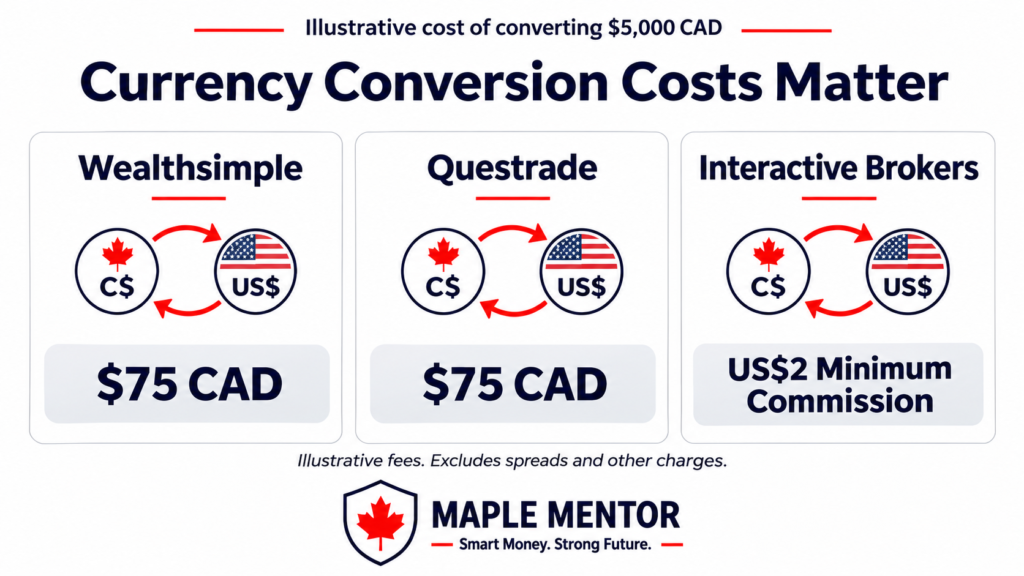
Suppose a Canadian investor wants to convert $5,000 CAD into U.S. dollars.
| Brokerage | Applicable Pricing | Illustrative Conversion Fee |
|---|---|---|
| Wealthsimple | 1.5% | $75 CAD |
| Questrade | 1.5% | $75 CAD |
| Interactive Brokers | 0.002%, minimum commission applies | US$2 minimum |
This example assumes standard currency conversions at Wealthsimple and Questrade and a manually executed eligible spot currency transaction at IBKR.
It excludes exchange-rate spreads, stock trading commissions, subscriptions, and other applicable costs.
Nevertheless, it demonstrates why looking exclusively at stock trading commissions can be misleading.
What About Canadian-Listed ETFs Holding U.S. Stocks?
Investors don’t necessarily need to convert currencies to obtain exposure to American companies.
Canadian-listed ETFs such as VFV trade in Canadian dollars while providing exposure to U.S. equities.
This means someone can invest in the S&P 500 without directly converting their Canadian dollars into USD.
However, purchasing a Canadian-listed ETF in Canadian dollars doesn’t necessarily eliminate underlying currency exposure or foreign withholding taxes.
The appropriate approach depends on your investment strategy, preferred investment products, and overall costs.
Our Best Broker for U.S. Stocks in Canada guide explores these differences in greater detail.
Winner for frequent currency conversions and direct U.S. investing: Interactive Brokers.
Best alternative for investors who already hold USD: Questrade.
Best Brokerage for a Joint Non-Registered Account
Unlike a TFSA or RRSP, a non-registered investment account can generally be opened under joint ownership.
This can be particularly useful for married couples, common-law partners, or other eligible individuals managing shared financial objectives.
Wealthsimple Joint Accounts
Wealthsimple offers straightforward joint non-registered accounts with shared access.
This can be convenient for couples who want to automate contributions and build a diversified investment portfolio together.
Its accessible interface may also make it easier for both account holders to monitor their investments.
Questrade Joint Accounts
Questrade allows joint ownership through its non-registered margin account structure.
This provides couples with access to dual-currency functionality, broader investment selection, and traditional brokerage tools.
Importantly, joint account holders don’t need to borrow money simply because the account supports margin.
Interactive Brokers Joint Accounts
Interactive Brokers supports joint accounts with several possible ownership structures, subject to jurisdictional requirements.
It may appeal to couples managing larger portfolios, international investments, or more complex financial arrangements.
Joint Accounts and Canadian Tax Attribution Rules
One common misconception is that opening a joint investment account automatically allows both individuals to report 50% of its investment income.
In reality, Canadian tax reporting can depend on who contributed the money and whether attribution rules apply.
For example, transferring money to a spouse who earns less doesn’t necessarily allow the higher-income spouse to avoid paying tax on investment income generated by that money.
The appropriate treatment depends on the circumstances, including the source of funds and applicable tax legislation.
Couples should maintain records of their respective contributions and consult a qualified Canadian tax professional when necessary.
| Joint Account Priority | Brokerage to Consider |
|---|---|
| Simplicity and automation | Wealthsimple |
| Dual-currency functionality | Questrade |
| International investing | Interactive Brokers |
| Advanced portfolio management | Interactive Brokers |
| Traditional brokerage flexibility | Questrade |
Winner for most couples building a straightforward investment portfolio: Wealthsimple.
Best Non-Registered Brokerage for Margin Investing
Margin investing is one of the major differences between non-registered brokerage accounts and traditional Canadian registered investment accounts.
A margin account allows eligible investors to borrow money from their brokerage to purchase investments.
The securities held in the account generally serve as collateral for the loan.
Although margin can increase purchasing power, it also introduces significant financial risks.
Wealthsimple Margin Accounts
Wealthsimple offers dedicated non-registered margin accounts.
Its simplified interface may appeal to experienced investors who want access to borrowing without using a particularly complex trading platform.
Its margin functionality is separate from its ordinary non-registered investment accounts.
Questrade Margin Accounts
Questrade incorporates margin functionality directly into its standard non-registered self-directed account structure.
Investors can use their own cash without borrowing or access margin when eligible.
Its broader brokerage functionality may appeal to investors who use more advanced trading strategies.
Interactive Brokers Margin Accounts
Interactive Brokers offers margin accounts and sophisticated risk-monitoring functionality.
Its borrowing structures, international market access, and advanced trading tools make it particularly relevant to experienced investors.
However, access to more advanced financial products doesn’t necessarily make margin investing appropriate for everyone.
How Margin Magnifies Investment Gains and Losses
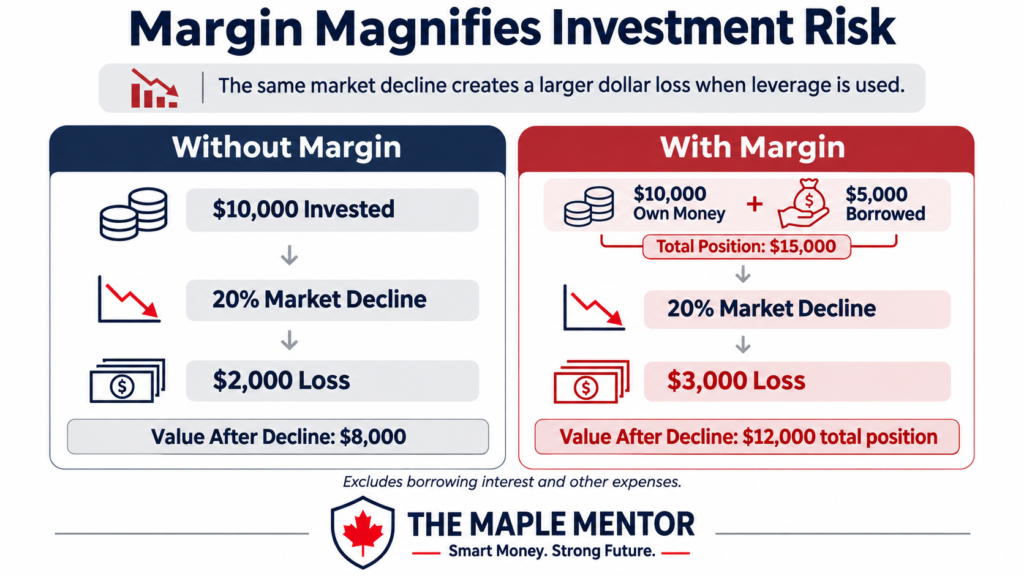
Suppose you have $10,000 of your own money and borrow an additional $5,000 from your brokerage.
Your total investment exposure becomes $15,000.
Here’s how a 20% market movement could affect your investment.
| Investment Scenario | Without Margin | With Margin |
|---|---|---|
| Your own money | $10,000 | $10,000 |
| Borrowed money | $0 | $5,000 |
| Total invested | $10,000 | $15,000 |
| Profit if investments rise 20% | $2,000 | $3,000 |
| Loss if investments decline 20% | $2,000 | $3,000 |
| Return on your original capital if market rises | 20% | 30% |
| Loss on your original capital if market declines | 20% | 30% |
This simplified example excludes borrowing interest and other investment expenses.
While margin increases potential profits, it also increases potential losses.
Furthermore, the brokerage may require additional collateral or liquidate investments if account equity falls below applicable margin requirements.
In severe circumstances, investors can lose more than their original investment.
For most Canadians building long-term wealth through diversified ETFs, borrowing money to invest isn’t necessary.
Which Brokerage Has the Lowest Margin Rates?
Comparing margin borrowing costs can be more complicated than comparing stock trading commissions.
Margin interest rates frequently change in response to benchmark interest rates, brokerage pricing policies, and borrowing amounts.
Consequently, a brokerage offering the lowest advertised rate may not necessarily offer the lowest rate for your specific balance.
Wealthsimple Margin Rates
Wealthsimple currently determines standard margin rates using total borrowing amounts and its applicable prime rates.
Larger borrowing balances generally qualify for lower interest rates under its published pricing structure.
Investors can review its current margin rates at https://www.wealthsimple.com/en-ca/trade/margin. Help Centre+1
Questrade Margin Rates
Questrade calculates margin borrowing costs using its applicable prime rate plus a markup.
The markup can vary depending on the currency and borrowing balance.
You can review its current margin interest schedule at https://www.questrade.com/pricing/self-directed-commissions-plans-fees/margin-interest.
Interactive Brokers Margin Rates
Interactive Brokers uses benchmark-based interest pricing with different borrowing tiers.
This structure can make it particularly competitive for investors who maintain substantial margin balances.
Its current borrowing rates are available at https://www.interactivebrokers.ca/en/trading/margin-rates.php.
Why Even Small Interest Rate Differences Matter
Suppose an investor borrows $50,000 for one year.
| Hypothetical Annual Interest Rate | Annual Interest Expense |
|---|---|
| 4% | $2,000 |
| 5% | $2,500 |
| 6% | $3,000 |
| 7% | $3,500 |
| 8% | $4,000 |
The difference between borrowing at 4% and 8% represents $2,000 annually.
This simplified example assumes a constant borrowing balance and interest rate throughout the year, excluding compounding.
Importantly, borrowing costs continue even when investments decline in value.
Interactive Brokers deserves particular consideration when comparing margin borrowing costs. However, investors should obtain current rates from all three platforms rather than relying on historical comparisons.
Taxes in a Non-Registered Brokerage Account
Choosing the best non-registered brokerage Canada offers involves more than selecting an affordable trading platform.
Unlike registered accounts, taxable investment accounts require investors to manage their tax obligations.
Depending on their investments, Canadians may need to report capital gains and losses, dividends, interest, and foreign investment income.
Capital Gains
A capital gain generally occurs when you dispose of an investment for more than its adjusted cost base, after accounting for applicable selling expenses.
For example:
- Purchase cost: $10,000
- Selling proceeds: $15,000
- Capital gain: $5,000
A portion of the realized capital gain is included in taxable income according to the applicable capital gains inclusion rules.
Unlike a TFSA, selling an investment inside a non-registered account can trigger tax consequences even if the proceeds remain inside the brokerage account.
Canadian Dividends
Canadian dividends may qualify for federal and provincial dividend tax credits.
However, eligible and non-eligible Canadian dividends receive different tax treatment.
The actual amount of tax payable depends on your province, income, and other circumstances.
Foreign Dividends
Dividends received from foreign companies are generally treated as foreign investment income.
Foreign withholding taxes may also apply.
Depending on the circumstances, Canadian investors may qualify for a foreign tax credit to help reduce double taxation.
Interest Income
Interest earned from savings products, bonds, GICs, and certain investment funds is generally fully included in taxable income.
Consequently, interest-generating investments may have different after-tax returns inside registered and non-registered accounts.
You can learn more about Canadian investment income reporting through the CRA at https://www.canada.ca/en/revenue-agency/services/tax/individuals/topics/about-your-tax-return/tax-return/completing-a-tax-return/personal-income/investment-income.html.
Understanding Adjusted Cost Base (ACB)
Adjusted cost base, commonly known as ACB, is one of the most important concepts for Canadians investing through taxable brokerage accounts.
Your adjusted cost base helps determine the capital gain or loss when you sell an investment.
Tracking your ACB can become more complicated when you purchase the same investment repeatedly, reinvest distributions, receive returns of capital, or hold identical investments at multiple brokerages.
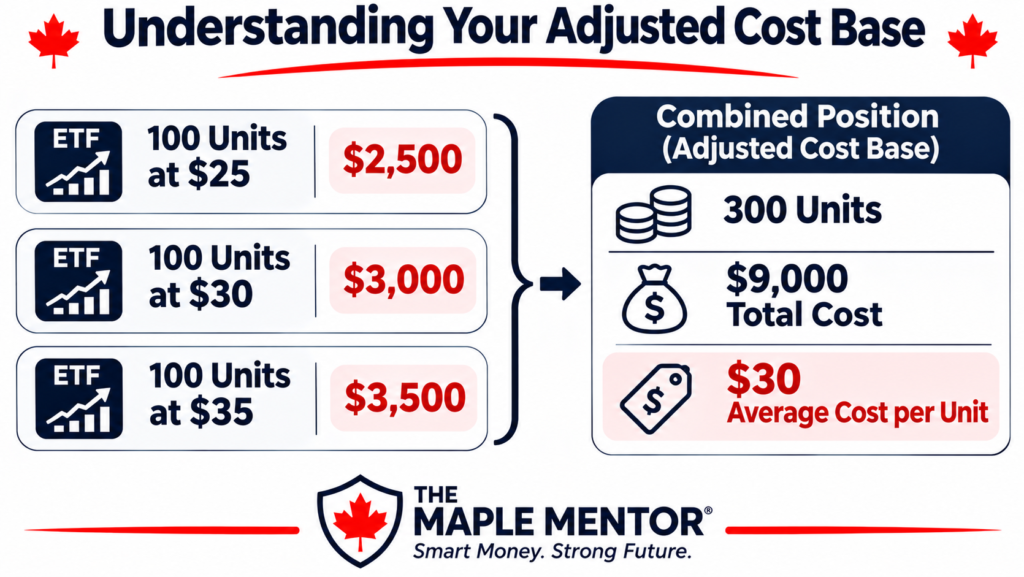
Adjusted Cost Base Example
Suppose you purchase shares of the same ETF on three separate occasions.
| Purchase | Units Purchased | Price per Unit | Total Cost |
|---|---|---|---|
| First purchase | 100 | $25 | $2,500 |
| Second purchase | 100 | $30 | $3,000 |
| Third purchase | 100 | $35 | $3,500 |
| Total | 300 | — | $9,000 |
Your average adjusted cost base per unit would be:
$9,000 ÷ 300 = $30 per unit
Now suppose you sell 100 units for $40 each.
Selling proceeds:
100 x $40 = $4,000
Adjusted cost base of the sold units:
100 x $30 = $3,000
Capital gain:
$4,000 − $3,000 = $1,000
This example excludes commissions and other ACB adjustments for simplicity.
Holding the Same ETF at Multiple Brokerages
Suppose you purchase XEQT through Wealthsimple and later purchase additional XEQT units through Questrade.
For Canadian tax purposes, identical investments held by the same taxpayer across taxable accounts generally need to be considered together when calculating their adjusted cost base.
Your brokerage may not know about investments you hold at another financial institution.
Consequently, relying exclusively on each brokerage’s displayed book value can create inaccurate tax records.
This is why maintaining independent transaction records becomes increasingly important when using multiple taxable investment accounts.
Reinvested Distributions and Return of Capital
ETF distributions can also affect adjusted cost base.
For example, reinvested taxable distributions may increase your ACB, while returns of capital generally decrease it.
Failing to account for these adjustments can result in inaccurate capital gains calculations.
Our Capital Gains Tax Explained for Canadians guide provides additional information about investment taxation and realized gains.
Which Brokerage Is Best for Tax Reporting?
Tax reporting is an important consideration that is frequently overlooked when comparing Canadian investment platforms.
Although brokerages provide tax documents and transaction records, investors remain responsible for accurately reporting their taxable investment activity.
Wealthsimple Tax Reporting
Wealthsimple makes applicable investment tax documents accessible through its platform.
Its straightforward interface may be particularly useful for passive investors with relatively simple investment portfolios.
For Canadians holding only a few diversified ETFs, tax documentation may be relatively manageable.
Questrade Tax Reporting
Questrade provides applicable tax slips, transaction histories, and account statements.
These records can be useful for investors managing multiple investments, currencies, and taxable accounts.
However, investors should still maintain their own ACB records when necessary.
Interactive Brokers Tax Reporting
Interactive Brokers offers detailed account statements and reporting functionality.
Its comprehensive reporting tools may appeal to experienced investors and individuals managing complex portfolios.
Nevertheless, international investing and multi-currency transactions can introduce additional reporting requirements.
For example, Canadian investors generally need to calculate capital gains and losses in Canadian dollars using appropriate exchange rates.
Brokerage Tax Documents You May Receive
| Tax Document | General Purpose |
|---|---|
| T3 | Trust income and distributions |
| T5 | Certain investment income, including interest and dividends |
| T5008 | Securities transactions |
| T5013 | Partnership income, where applicable |
| Account statements | Transaction histories and investment records |
Not every investor will receive every document.
Additionally, Quebec residents may receive applicable provincial tax slips.
A T5008 slip doesn’t necessarily contain a complete or accurate adjusted cost base for Canadian tax purposes.
Investors should therefore verify their calculations instead of automatically assuming that brokerage-generated figures are correct.
Foreign Property Reporting
Canadians holding certain foreign investments may also need to file Form T1135 when the total cost amount of their specified foreign property exceeds $100,000 CAD at any time during the year.
This requirement can apply even when foreign securities are held through a Canadian brokerage.
However, certain investments are excluded, including eligible investments held inside registered accounts.
The threshold is based on applicable cost amounts rather than simply the current market value of your portfolio.
The CRA provides additional information at https://www.canada.ca/en/revenue-agency/services/forms-publications/forms/t1135.html.
Verdict: Wealthsimple may offer the most accessible reporting experience for straightforward portfolios, while Interactive Brokers provides more comprehensive tools for complex international portfolios.
However, no brokerage completely eliminates your responsibility to maintain accurate tax records.
Best Non-Registered Brokerage for a Large Taxable Portfolio
The best non-registered brokerage Canada offers may depend partly on the size and complexity of your investment portfolio.
Someone investing their first $1,000 may prioritize entirely different features from someone managing $500,000 outside registered accounts.
As a taxable portfolio grows, currency conversion, investment selection, tax efficiency, and account administration can become more significant.
Wealthsimple for Large Taxable Portfolios
Wealthsimple remains competitive for investors managing substantial portfolios through diversified ETFs.
A large portfolio doesn’t automatically require sophisticated trading tools.
For example, someone holding $300,000 across two diversified ETFs may still benefit from Wealthsimple’s simplicity, recurring investments, and commission-free eligible trading.
Eligible higher-tier clients can also access USD functionality without the standard Core subscription fee.
Questrade for Large Taxable Portfolios
Questrade may become increasingly attractive when investors require broader investment products and greater brokerage flexibility.
Its dual-currency functionality, traditional brokerage tools, and commission-free eligible stock and ETF trading can support more complex portfolios.
Additionally, investors can maintain substantial taxable investments without being limited by government-imposed contribution ceilings.
Interactive Brokers for Large Taxable Portfolios
Interactive Brokers is particularly relevant for large portfolios involving international investments, significant currency conversions, sophisticated order types, or borrowing.
Even relatively small differences in transaction expenses can become meaningful when substantial amounts of capital are involved.
For example, consider the potential cost of different percentage-based currency-conversion fees on a $100,000 transaction.
| Hypothetical Currency-Conversion Fee | Conversion Expense |
|---|---|
| 1.5% | $1,500 |
| 1.0% | $1,000 |
| 0.5% | $500 |
| 0.1% | $100 |
| 0.002% | $2 |
This is a mathematical illustration rather than a direct comparison of current brokerage fees. Actual costs depend on conversion tiers, minimum commissions, spreads, and the transaction method.
It demonstrates why foreign-exchange pricing becomes increasingly important as transaction sizes increase.
Should You Switch Brokerages as Your Portfolio Grows?
Not necessarily.
Changing brokerages can involve transfer fees, administrative work, and potential investment sales if particular securities aren’t supported by the receiving institution.
A direct in-kind transfer between non-registered accounts with the same beneficial ownership generally doesn’t require selling the underlying investments.
However, selling investments to complete a cash transfer can trigger capital gains or losses.
Before switching brokerages, confirm whether your investments can be transferred directly and retain your original ACB records.
The best platform is the one that supports your investment strategy efficiently—not necessarily the platform with the greatest number of features.
Should You Max Your TFSA and RRSP Before Using a Non-Registered Account?
For many Canadians, using registered investment accounts before taxable accounts is worth considering.
Registered accounts provide tax advantages that can improve long-term after-tax investment returns.
Nevertheless, the optimal order depends on your financial situation.
Advantages of Maximizing a TFSA First
A TFSA generally provides tax-free investment growth and withdrawals.
For Canadians with available contribution room, these advantages can make it particularly attractive for long-term investing.
For example, an investor who purchases an ETF inside a TFSA generally doesn’t need to report its annual investment income or realized capital gains on their tax return.
Holding the same investment in a taxable account can create ongoing tax obligations.
Our Best TFSA Brokerage in Canada guide compares platforms specifically for tax-free investing.
Advantages of Investing Through an RRSP
Eligible RRSP contributions can generally reduce taxable income, while investment growth is tax-deferred.
However, withdrawals are generally taxable.
An RRSP can be particularly attractive for individuals who expect their marginal tax rate to be lower when withdrawing money than when contributing.
Nevertheless, RRSP withdrawals generally don’t restore contribution room, making the account less flexible for certain financial objectives.
Our Best RRSP Brokerage in Canada guide explores the platforms available for retirement investing.
When a Non-Registered Account Makes Sense
A non-registered account may be appropriate when:
- Your TFSA is fully funded.
- Your RRSP is fully funded or intentionally isn’t your current priority.
- You need additional investment capacity.
- You want unrestricted access without registered-account withdrawal consequences.
- Your investment strategy requires taxable account functionality.
- You need access to eligible margin or other advanced investment strategies.
Registered vs Non-Registered Accounts
| Feature | TFSA | RRSP | Non-Registered |
|---|---|---|---|
| Government contribution limit | Yes | Yes | No |
| Tax-deductible contributions | No | Generally yes | No |
| Investment growth | Generally tax-free | Tax-deferred | Taxable |
| Withdrawals | Generally tax-free | Generally taxable | No separate withdrawal tax |
| Withdrawals restore contribution room | Following calendar year | Generally no | Not applicable |
| Conventional margin borrowing | No | No | Available at eligible brokerages |
| Investment income reporting | Generally not required | Generally not required | Generally required |
It is also worth considering an FHSA if you’re an eligible first-time homebuyer.
Rather than following a universal account order, evaluate your income, financial objectives, available contribution room, and investment timeline.
Common Non-Registered Investing Mistakes to Avoid
Even after choosing the best non-registered brokerage Canada has available for your needs, several common mistakes can undermine your financial progress.
1. Focusing Exclusively on Commission-Free Trading
A brokerage advertising $0 stock trading commissions can still charge currency-conversion fees, borrowing interest, account subscriptions, and other transaction expenses.
Evaluate the total cost of your investment strategy rather than focusing on a single advertised feature.
2. Ignoring Adjusted Cost Base
Failing to track your adjusted cost base can result in inaccurate capital gains calculations.
This becomes particularly important when purchasing the same investment repeatedly or holding identical investments across multiple taxable accounts.
3. Assuming Reinvested Dividends Are Tax-Free
Automatically reinvesting dividends doesn’t necessarily eliminate the associated tax obligations.
Investment income received inside taxable accounts may be reportable even when it is immediately reinvested.
4. Accidentally Borrowing on Margin
Some investors purchase U.S. securities inside a dual-currency margin account without first converting their Canadian dollars.
Depending on the brokerage’s settlement policies, this can create a negative USD balance and unexpected borrowing costs.
Review both your CAD and USD cash balances before and after placing transactions.
5. Using Too Much Leverage
Margin borrowing can magnify investment losses and introduce ongoing interest expenses.
Additionally, forced liquidation during a market decline can permanently damage an investment portfolio.
Access to borrowing shouldn’t be confused with the need to borrow.
6. Selling Investments Without Considering Taxes
Selling appreciated investments can trigger capital gains.
Although selling may be appropriate for rebalancing or changing investment strategies, investors should consider the potential tax consequences before making their decisions.
However, avoiding taxes shouldn’t be the only reason to continue holding an unsuitable investment.
7. Ignoring Registered Contribution Room
Some Canadians invest through taxable accounts despite having substantial unused TFSA, RRSP, or FHSA contribution room.
While this can be appropriate in certain circumstances, it’s worth evaluating whether registered accounts could provide a more tax-efficient alternative.
Wealthsimple vs Questrade vs Interactive Brokers: Which Should You Choose?
Finding the best non-registered brokerage Canada offers ultimately depends on your investment strategy, preferred level of complexity, and financial goals.
| Investor Profile | Brokerage to Consider |
|---|---|
| Complete beginner | Wealthsimple |
| Passive Canadian ETF investor | Wealthsimple or Questrade |
| Wants automatic investing | Wealthsimple |
| Wants a joint taxable account | Any of the three |
| Wants $0 eligible stock and ETF commissions | Wealthsimple or Questrade |
| Wants free dual-currency functionality | Questrade |
| Frequently converts CAD into USD | Interactive Brokers |
| Invests directly in international markets | Interactive Brokers |
| Active trader | Interactive Brokers |
| Wants margin functionality | Compare all three |
| Wants the simplest investing experience | Wealthsimple |
| Wants traditional brokerage flexibility | Questrade |
| Manages a complex international portfolio | Interactive Brokers |
When I Would Choose Wealthsimple
I would choose Wealthsimple for someone who has maximized their registered accounts and wants to continue investing through a straightforward taxable portfolio.
For example, someone purchasing a diversified Canadian-listed ETF every payday may benefit considerably from recurring investments and commission-free eligible trading.
Wealthsimple’s biggest advantage is making consistent investing relatively easy.
When I Would Choose Questrade
I would choose Questrade for investors who want commission-free eligible stock and ETF trading alongside more traditional brokerage functionality.
Its free dual-currency structure makes it particularly attractive to investors who want to hold Canadian and U.S. dollars without paying a separate monthly subscription.
It also provides access to a broader range of investment products and strategies.
When I Would Choose Interactive Brokers
I would choose Interactive Brokers for an experienced investor who regularly converts currencies, invests directly in international markets, or requires sophisticated trading functionality.
Although its interface and pricing structure are more complicated, its capabilities can provide meaningful advantages for certain investment strategies.
However, for someone simply purchasing XEQT every month, those additional features may offer limited practical value.
Frequently Asked Questions
What Is the Best Non-Registered Brokerage in Canada?
Wealthsimple is my preferred choice for most beginner and passive ETF investors.
Questrade is particularly attractive for Canadians who want commission-free eligible trading and traditional brokerage functionality.
Interactive Brokers stands out for international investing, competitive currency-conversion costs, and advanced trading tools.
Is a Non-Registered Investment Account Taxable?
Yes. Investment income received inside a non-registered account may be taxable.
This includes interest, Canadian dividends, foreign dividends, and realized capital gains.
Investors may need to report this income even when they reinvest it instead of withdrawing it.
Is There a Contribution Limit on a Non-Registered Account?
No. Unlike a TFSA, RRSP, FHSA, or RESP, a standard non-registered investment account doesn’t have a government-imposed contribution ceiling.
However, brokerage-specific deposit policies and account requirements may apply.
Does Wealthsimple Offer Joint Non-Registered Accounts?
Yes. Wealthsimple supports both individual and joint non-registered investment accounts.
Joint accounts can be useful for couples managing shared financial goals.
However, account ownership doesn’t automatically determine how investment income must be reported for Canadian tax purposes.
Is a Questrade Margin Account the Same as a Non-Registered Account?
Questrade’s margin account is its standard non-registered self-directed investment account.
Although it provides access to eligible borrowing functionality, investors aren’t required to borrow money.
You can deposit and invest your own funds without intentionally using leverage.
Does Interactive Brokers Offer Joint Accounts in Canada?
Yes. Interactive Brokers Canada offers individual and joint accounts, along with cash and margin account functionality.
Available ownership structures and trading permissions depend on account eligibility and jurisdictional requirements.
Should I Use a TFSA Before a Non-Registered Account?
For many Canadians, a TFSA is worth prioritizing because it generally provides tax-free investment growth and withdrawals.
However, the appropriate decision depends on your contribution room, investment objectives, tax situation, and need for particular brokerage functionality.
Can I Have Multiple Non-Registered Brokerage Accounts?
Yes. Canadians can maintain taxable investment accounts with multiple financial institutions.
However, doing so can complicate investment administration and adjusted cost base calculations.
Investors holding identical securities across multiple taxable accounts generally need to consider those holdings together for ACB purposes.
Is Interactive Brokers Better Than Wealthsimple for U.S. Stocks?
Interactive Brokers may be more cost-effective for investors who regularly convert Canadian dollars into U.S. dollars or access international markets.
Wealthsimple may be more convenient for investors who prioritize commission-free eligible stock trading and simplicity.
The better choice depends on total transaction costs and investment frequency.
Can I Withdraw Money From a Non-Registered Account Without Paying Tax?
Withdrawing available cash from a non-registered account doesn’t generally create a separate withdrawal tax.
However, selling investments to generate that cash may trigger capital gains or losses.
Additionally, investment income received while the money was invested may already be taxable.
Can I Transfer a Non-Registered Account Without Selling My Investments?
In many circumstances, yes.
An eligible in-kind transfer between taxable accounts with the same beneficial ownership generally allows investments to move without being sold.
However, account transfer fees, unsupported securities, and ownership changes can complicate the process.
Always retain your investment cost records when transferring assets.
Do I Have to Pay Taxes If I Reinvest My Dividends?
Generally, reinvesting dividends inside a taxable account doesn’t eliminate the associated income tax obligations.
Canadian investors should report applicable investment income and adjust their investment cost records when necessary.

Final Verdict: Best Non-Registered Brokerage in Canada
Choosing the best non-registered brokerage Canada has to offer requires evaluating considerably more than standard stock trading commissions.
Currency-conversion costs, margin rates, joint-account functionality, tax reporting, and investment selection can all influence your investing experience.
Wealthsimple is my preferred choice for most passive and beginner investors.
Its commission-free eligible trading, fractional investing, recurring purchases, and accessible interface make it particularly suitable for Canadians building long-term wealth through diversified ETFs.
Questrade is my preferred alternative for investors who want greater flexibility.
Its commission-free eligible stock and ETF trading, free dual-currency functionality, broader investment selection, and margin account structure make it a competitive all-around brokerage.
Interactive Brokers is my preferred choice for sophisticated and international investors.
Its competitive foreign-exchange pricing, international market access, and advanced trading capabilities can provide meaningful advantages for investors with more complex requirements.
Ultimately, the best brokerage depends on what you’re actually investing in.
Someone automatically purchasing Canadian ETFs every payday has different needs from someone converting substantial amounts of money into USD or managing an international investment portfolio.
Choose a platform that allows you to minimize unnecessary expenses, maintain accurate tax records, and invest consistently without introducing unnecessary complexity.
Over the long term, your savings rate, investment discipline, portfolio suitability, and after-tax returns will likely matter considerably more than the brokerage you choose.