
VFV and VSP give Canadian investors exposure to essentially the same underlying group of large U.S. companies. Both are Vanguard ETFs, both follow versions of the S&P 500 Index, both trade in Canadian dollars on the Toronto Stock Exchange, and both currently report a 0.08% MER. Vanguard Canada
So why can their returns differ?
Currency hedging.
The central question in VFV vs VSP is whether you want your S&P 500 investment exposed to movements between the Canadian and U.S. dollars.
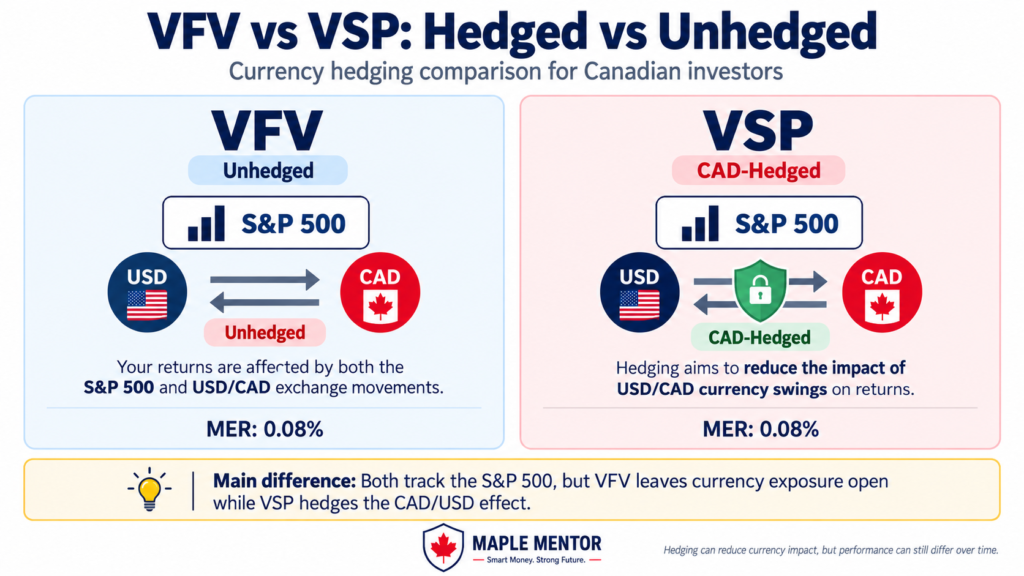
VFV leaves that currency exposure unhedged.
VSP uses derivatives in an attempt to hedge its U.S. dollar exposure back to Canadian dollars. Vanguard Canada
That distinction can meaningfully affect your Canadian-dollar returns even when the underlying U.S. stocks perform identically.
VFV vs VSP: Quick Answer
VFV and VSP are extremely similar from a stock-exposure perspective.
Vanguard says both invest primarily in the U.S.-domiciled Vanguard S&P 500 ETF. The difference is that VSP seeks to hedge its U.S. dollar exposure back to Canadian dollars, while VFV does not. Vanguard Canada
In simple terms:
VFV: S&P 500 + exposure to movements in the U.S. dollar relative to the Canadian dollar.
VSP: S&P 500 + an attempt to reduce that CAD/USD currency effect through hedging.
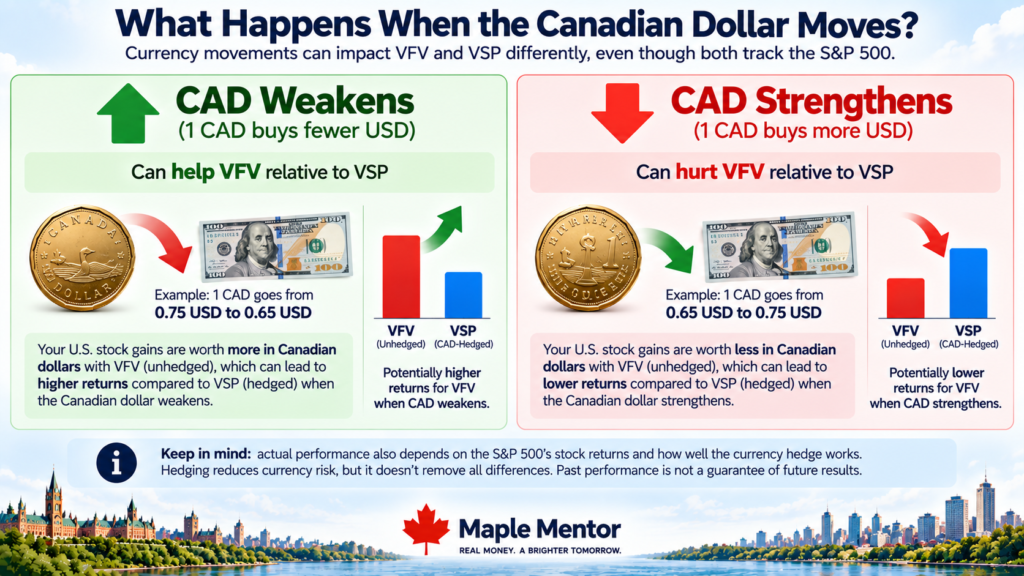
If the Canadian dollar weakens against the U.S. dollar, VFV’s unhedged currency exposure can boost its Canadian-dollar return.
If the Canadian dollar strengthens, that same exposure can reduce VFV’s Canadian-dollar return.
VSP attempts to reduce both effects.
That doesn’t automatically make VSP better or safer. You’re choosing how much currency exposure you want—not choosing between a good ETF and a bad ETF.
VFV vs VSP at a Glance
| Feature | VFV | VSP |
|---|---|---|
| Provider | Vanguard | Vanguard |
| Exposure | S&P 500 | S&P 500 |
| Primary underlying ETF | U.S.-domiciled Vanguard S&P 500 ETF | U.S.-domiciled Vanguard S&P 500 ETF |
| Currency hedging | No | Yes, seeks to hedge USD exposure to CAD |
| Trading currency | CAD | CAD |
| Current MER | 0.08% | 0.08% |
| Distribution frequency | Quarterly | Quarterly |
| Stock-market exposure | Large U.S. companies | Large U.S. companies |
| Main additional variable | CAD/USD movements | Hedging effectiveness |
| Portfolio role | Unhedged U.S. large-cap exposure | CAD-hedged U.S. large-cap exposure |
Vanguard currently lists a 0.08% management fee and 0.08% MER for both ETFs, so the choice isn’t currently about paying a higher published MER for the hedged version. Both also distribute income quarterly. Vanguard Canada
How Currency Hedging Works
Currency hedging sounds more complicated than the basic idea actually is.
Suppose you live in Canada and invest in U.S. stocks.
Those businesses are priced in U.S. dollars, while you measure your wealth and eventually spend much of your money in Canadian dollars.
Your Canadian-dollar return can therefore be affected by two things:
1. What happens to the stocks
2. What happens between CAD and USD
VFV leaves the second component largely intact.
VSP attempts to reduce it.
Vanguard states that VSP uses derivative instruments to seek to hedge the U.S. dollar exposure of the securities in the S&P 500 back to the Canadian dollar.
A Simplified Hedging Example
Imagine the S&P 500 rises 10% in U.S.-dollar terms.
Without currency movements, your Canadian-dollar return would also be roughly 10% before fees and other differences.
But suppose the Canadian dollar simultaneously strengthens significantly against the U.S. dollar.
For an unhedged Canadian investor, converting those U.S.-dollar assets back into stronger Canadian dollars reduces the return.
VSP’s hedge attempts to offset that currency effect.
The reverse applies when the Canadian dollar weakens.
VFV can benefit because the U.S.-dollar assets become more valuable when measured in Canadian dollars.
VSP’s hedge attempts to offset that benefit too.
Buying VFV in Canadian Dollars Doesn’t Eliminate Currency Exposure
This is an important misconception.
Both VFV and VSP are listed on the Toronto Stock Exchange and trade in Canadian dollars. Vanguard lists CAD as both funds’ listed currency. Vanguard Canada
But the currency you use to buy the ETF isn’t necessarily the same as the currency exposure of the investments inside the ETF.
You buy VFV using Canadian dollars.
But VFV invests primarily in a U.S.-domiciled Vanguard S&P 500 ETF and remains economically exposed to U.S. equities and the U.S. dollar. Vanguard Canada
VSP holds similar underlying exposure but adds the currency hedge.
That’s why two Canadian-dollar ETFs tracking essentially the same stocks can produce different Canadian-dollar returns.
For more background on the index itself, read How to Start Investing in the S&P 500 from Canada.
What Happens When the Canadian Dollar Rises or Falls?
A simple hypothetical example makes VFV vs VSP easier to understand.
We’ll use the exchange-rate convention:
1 USD = X CAD
We’ll assume the S&P 500 gains 10% in U.S.-dollar terms and ignore fees, distributions, taxes, tracking differences, and imperfect hedging.
Example 1: The Canadian Dollar Weakens
Suppose you invest the equivalent of CAD $10,000 when:
1 USD = CAD $1.25
Your investment is therefore worth:
USD $8,000
The S&P 500 rises 10%.
Your investment becomes:
USD $8,800
But during the same period, the Canadian dollar weakens and the exchange rate moves to:
1 USD = CAD $1.35
Your USD $8,800 is now worth:
CAD $11,880
That’s an approximate Canadian-dollar gain of:
18.8%
The stocks only gained 10%, but the weakening Canadian dollar added to the unhedged Canadian investor’s return.
That environment would generally favour VFV relative to a successfully hedged VSP.
Example 2: The Canadian Dollar Strengthens
Start with the same:
CAD $10,000
at:
1 USD = CAD $1.25
Again, that’s:
USD $8,000
The S&P 500 rises 10%, giving you:
USD $8,800
But now suppose the Canadian dollar strengthens and the exchange rate moves to:
1 USD = CAD $1.15
Your investment becomes:
CAD $10,120
Despite the U.S. stocks gaining 10%, your approximate Canadian-dollar gain is only:
1.2%
The stronger Canadian dollar offset most of the stock-market return.
That environment would generally favour a successfully hedged VSP relative to VFV.
What VSP Is Trying to Do
VSP attempts to reduce this exchange-rate effect.
In our simplified examples, its goal is to give the Canadian investor something closer to the underlying stock return rather than having CAD/USD movements significantly amplify or reduce it.
Real-world hedging isn’t perfect.
Actual results can differ because of hedge implementation, timing, transaction effects, fund expenses, tracking differences, distributions, and other factors.
So don’t interpret currency hedging as a guarantee that VSP will precisely match the S&P 500’s U.S.-dollar return.
VFV vs VSP Performance: How to Compare Fairly
Looking at historical charts can make one of these ETFs appear clearly superior.
But you need to understand why.
Because VFV and VSP provide very similar stock exposure, a meaningful portion of their performance difference can come from currency movements and the implementation of VSP’s hedge.
Suppose VFV strongly outperforms VSP during a period when the Canadian dollar weakens substantially.
That doesn’t necessarily prove that:
“Unhedged ETFs are better.”
It may simply show that holding U.S.-dollar exposure happened to help Canadian investors during that period.
If the Canadian dollar later strengthens significantly, the relative result can move in the other direction.
Compare the Same Periods
If you compare historical performance, use:
- Identical start dates
- Identical end dates
- Canadian-dollar returns
- Total returns
- Reinvested distributions
- The same measurement method
Both VFV and VSP launched in November 2012, making matched-period comparisons easier. Vanguard Canada
More importantly, don’t choose your future currency policy simply by selecting whichever fund had the higher trailing return.
Exchange rates fluctuate.
You don’t know whether CAD will strengthen or weaken against USD over your next investing period.
A historical winner isn’t necessarily a future winner.
Does Currency Hedging Make VSP Safer?
Not necessarily.
VSP reduces a specific type of exposure:
CAD/USD currency movements.
It doesn’t remove the much larger fact that you’re investing in stocks.
Both VFV and VSP track versions of the S&P 500 and provide exposure to large U.S. companies. Vanguard currently reports their market allocation as essentially 100% United States. Vanguard Canada
If the S&P 500 falls 30%, currency hedging doesn’t magically protect VSP from the stock-market decline.
Hedging Removes One Variable, Not Market Risk
Imagine U.S. stocks fall sharply while the Canadian dollar barely moves.
Both funds could experience substantial losses.
Now imagine U.S. stocks fall while the Canadian dollar also weakens significantly.
VFV’s unhedged U.S.-dollar exposure could partially offset the stock decline when measured in Canadian dollars.
VSP’s hedge could reduce that currency benefit.
Conversely, if Canadian stocks fall alongside U.S. stocks while CAD strengthens against USD, VSP’s hedging could help relative to VFV.
The point isn’t that one approach is safer in every scenario.
It’s that their currency exposures behave differently.
Hedging Can Sometimes Reduce Volatility, and Sometimes Not
It may seem intuitive that eliminating currency fluctuations should always reduce portfolio volatility.
That’s too simplistic.
Currencies can sometimes move in ways that offset equity-market movements.
In other periods, they can amplify them.
So VSP should be viewed as currency hedged, not as a guaranteed “lower-risk VFV.”
Both remain equity ETFs capable of substantial losses.
Should You Hold VFV, VSP, or Both?
You can hold both.
But doing so doesn’t provide much additional stock diversification.
The underlying equity exposure is fundamentally similar: large U.S. companies represented by the S&P 500.
The primary thing you’re changing is the percentage of that exposure that’s currency hedged.
100% VFV
This is the straightforward unhedged approach.
You’re comfortable allowing CAD/USD movements to affect your Canadian-dollar returns.
100% VSP
This is the straightforward hedged approach.
You’re intentionally trying to reduce the effect of CAD/USD movements on your S&P 500 exposure.
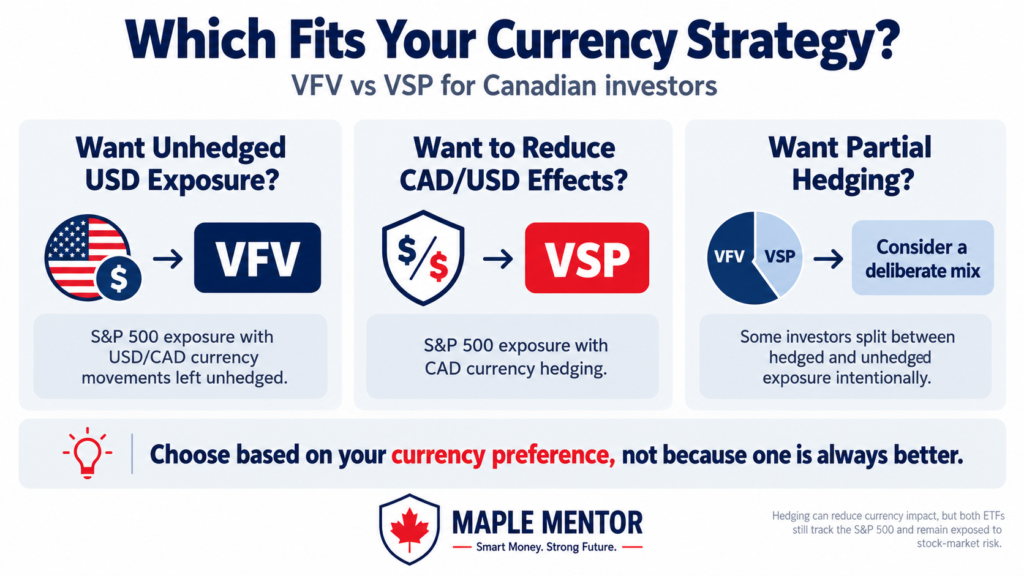
50% VFV + 50% VSP
This creates an approximate partial hedge.
Half of your S&P 500 allocation would be held through the unhedged fund and half through the hedged fund.
That can be reasonable if you deliberately want something between fully hedged and fully unhedged.
But it isn’t adding a new stock market.
You’re still effectively investing in the S&P 500.
Don’t Confuse Currency Diversification With Geographic Diversification
This is where another comparison becomes important.
VFV versus VSP asks:
Should my U.S. equity exposure be currency hedged?
VFV versus a globally diversified ETF asks:
How much of my portfolio should be invested in the United States in the first place?
Those are completely different decisions.
Read VFV vs XEQT if you’re deciding between concentrated S&P 500 exposure and a globally diversified all-equity portfolio.
And if you’re considering all-in-one global portfolios, see XEQT vs VEQT.
VFV vs VSP: Final Verdict
The VFV vs VSP decision is unusually straightforward once you strip away short-term performance.
The ETFs provide essentially the same underlying U.S. large-cap stock exposure.
They currently have the same 0.08% MER.
Both trade in Canadian dollars.
They both distribute income quarterly.
The key difference is currency hedging. Vanguard Canada
VFV leaves your U.S. dollar exposure unhedged.
VSP uses derivatives in an attempt to hedge that U.S. dollar exposure back to Canadian dollars.
Before choosing, ask yourself:
- Do I intentionally want USD exposure?
- Do I want CAD/USD movements influencing my Canadian-dollar returns?
- Do I already have significant unhedged foreign investments elsewhere?
- Do I prefer hedged, unhedged, or partially hedged U.S. exposure?
- Am I comfortable sticking with that policy instead of switching based on exchange-rate predictions?
- Is the S&P 500 itself the exposure I actually want?
That final question may be the most important.
Choosing VSP instead of VFV doesn’t solve geographic concentration. Both are still primarily S&P 500 investments.
If you want broader global diversification, you need to look beyond currency hedging and reconsider the portfolio itself.
For TFSA portfolio ideas beyond these two ETFs, see Best ETFs for TFSA in Canada.
The practical takeaway from VFV vs VSP is therefore simple:
Choose your desired currency exposure deliberately rather than trying to predict the Canadian dollar.
FAQ
What is the main difference between VFV and VSP?
The main difference is currency hedging.
Both primarily invest in Vanguard’s U.S.-domiciled S&P 500 ETF, but VSP uses derivatives to seek to hedge its U.S.-dollar exposure back to Canadian dollars. VFV doesn’t use that CAD currency hedge. Vanguard Canada
Both currently have a 0.08% MER.
Why does VFV have currency exposure if it trades in Canadian dollars?
Because trading currency and investment exposure aren’t the same thing.
You purchase VFV in Canadian dollars on the Toronto Stock Exchange, but the fund invests primarily in a U.S.-domiciled S&P 500 ETF holding U.S. companies. Vanguard Canada
As a result, changes in the value of USD relative to CAD can affect VFV’s Canadian-dollar return.
Is VSP safer than VFV?
Not automatically.
VSP seeks to reduce CAD/USD currency exposure, but both ETFs remain equity investments tracking versions of the S&P 500.
Currency hedging doesn’t prevent losses when U.S. stocks fall.
Should I hold both VFV and VSP?
You can.
Holding both can create partially hedged S&P 500 exposure. For example, a 50/50 allocation would place roughly half of your exposure in the hedged version and half in the unhedged version.
However, holding both doesn’t meaningfully increase stock diversification because their underlying equity exposure is substantially the same.
Is VFV or VSP better for long-term investing?
Neither is universally better.
VFV may appeal to long-term investors who are comfortable maintaining unhedged U.S.-dollar exposure.
VSP may appeal to investors who deliberately want to reduce the impact of CAD/USD movements on their S&P 500 allocation.
The better choice depends on your currency policy, existing portfolio, and investment goals, not a prediction about which currency will strengthen next.