
Sometimes your regular budget isn’t enough.
You might lose your job, have your hours reduced, face an unexpected expense, or simply realize that your monthly obligations have become too difficult to manage.
That’s where a bare-bones budget Canada households can use becomes valuable.
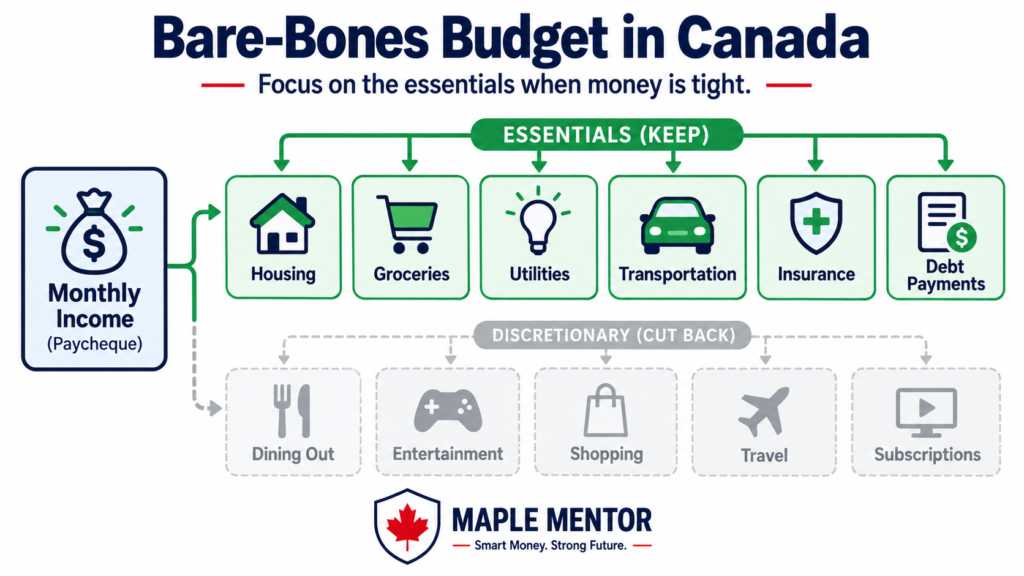
A bare-bones budget temporarily strips your spending down to necessities. Housing, groceries, utilities, transportation, insurance, and required debt payments stay. Most discretionary spending gets paused.
The objective isn’t to live this way forever. It’s to protect your finances during a difficult period until your income or cash flow improves.
Quick Answer
A bare-bones budget Canada residents can create is a temporary budget that focuses almost entirely on essential expenses.
You continue paying for necessities such as:
- Rent or mortgage
- Groceries
- Utilities
- Basic phone and internet
- Transportation
- Insurance
- Minimum debt payments
- Necessary medical expenses
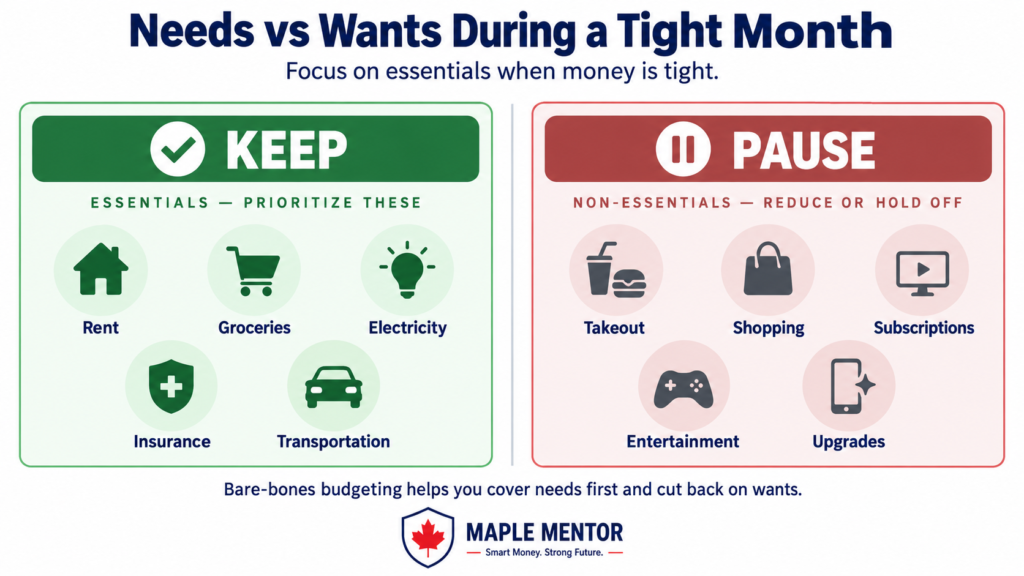
Meanwhile, you temporarily reduce or eliminate discretionary categories such as takeout, entertainment, shopping, subscriptions, upgrades, and convenience purchases.
Your priority becomes simple:
Keep essential expenses below the income and cash you have available.
The Financial Consumer Agency of Canada recommends separating needs from wants when building a budget and regularly comparing your planned spending with what you actually spend.
What Is a Bare-Bones Budget?
A bare-bones budget is your financial survival plan.
Instead of budgeting for your ideal lifestyle, you ask:
What expenses do I genuinely need to pay to keep my household functioning?
That usually means protecting:
- Housing
- Food
- Essential utilities
- Transportation
- Insurance
- Required debt payments
- Health-related necessities
Everything else gets reviewed.
The important word is temporary.
A bare-bones budget isn’t designed to eliminate every enjoyable expense from your life indefinitely. Maintaining an extremely restrictive budget for years may be unnecessary and difficult to sustain.
Instead, think of it as a financial mode you can activate when circumstances become difficult.
Once your finances stabilize, you can gradually rebuild your normal budget.
When Should You Use a Bare-Bones Budget?
You don’t need to wait until you’ve completely run out of money.
In fact, implementing one earlier may give you more options.
Job Loss
Losing your primary source of income is an obvious reason to immediately review spending.
If you’ve recently lost your job, you may also want to check whether you’re eligible for Employment Insurance. The Government of Canada recommends applying for EI as soon as you stop working and notes that delaying a claim by more than four weeks after your last day of work may cause you to lose benefits.
Reduced Hours
You may still be employed but suddenly earn considerably less.
Reducing spending quickly can help your budget adapt to your new income.
High Debt Payments
Large minimum payments can leave very little room in your monthly budget.
A temporary spending reduction may create breathing room while you develop a longer-term debt strategy.
Emergency Expenses
A major vehicle repair, home repair, or another unexpected expense can temporarily disrupt your finances.
Irregular Income
Self-employed workers, contractors, seasonal workers, and commission-based employees can experience large fluctuations in monthly income.
A bare-bones budget can show you the minimum income your household needs each month.
Preparing for a Recession or Income Uncertainty
You don’t necessarily need to wait until something bad happens.
If you’re concerned about job stability or a potential reduction in income, calculating your minimum monthly expenses can help you understand how much emergency savings you actually need.
Step 1 List Your Essential Expenses
Start your bare-bones budget Canada plan by listing everything you genuinely need to pay.
Don’t estimate from memory.
Review your:
- Bank statements
- Credit card statements
- Bills
- Loan payments
- Insurance premiums
Then identify the necessities.
Housing
Include your rent or mortgage payment and essential housing-related costs.
Groceries
You still need to eat.
However, your bare-bones grocery budget might involve more meal planning, fewer convenience foods, and less food waste.
How to Save Money on Groceries in Canada can help reduce this category without simply trying to buy the cheapest food possible.
Utilities
Electricity, heating, water, and other essential household services belong in the budget.
Phone and Internet
These may be necessities, particularly if you need them for work or job searching.
However, premium plans and unnecessary add-ons may not be.
Insurance
Include essential insurance premiums.
Don’t automatically cancel important coverage simply because you’re trying to reduce expenses.
Transportation
Include the transportation necessary for work, groceries, medical appointments, and other essential activities.
That could include:
- Gas
- Public transit
- Car insurance
- Necessary vehicle maintenance
- Car payment
Minimum Debt Payments
Include at least the required payments on your debts.
Missing payments can have financial consequences, so don’t simply remove debt from the budget because money is tight.
Once everything is listed, add it together.
That number is approximately what it costs to maintain your essential lifestyle each month.
Step 2 Pause Non-Essential Spending
Now review everything that didn’t make your essentials list.
Possible categories include:
- Takeout
- Restaurants
- Streaming services
- Unnecessary subscriptions
- Online shopping
- Clothes you don’t currently need
- Entertainment
- Hobby purchases
- Technology upgrades
- Convenience purchases
- Vacations
You don’t necessarily need to eliminate every discretionary expense.
However, if your income no longer covers your necessities, discretionary spending should be one of the first areas you review.
Suppose you’re spending:
$80 on subscriptions
$200 on restaurants
$150 on shopping
$100 on entertainment
That’s:
$530 per month
Reducing most of those expenses could immediately create several hundred dollars of additional breathing room.
If small purchases repeatedly undermine your budget, read How to Stop Impulse Spending in Canada.
You can also use a temporary no-spend challenge to make this transition easier rather than trying to change every habit indefinitely.
Step 3 Protect Your Emergency Fund
Emergency savings exist for periods when something genuinely goes wrong.
Job loss, necessary vehicle repairs, urgent home repairs, or an unexpected interruption in income may justify using the fund.
Lifestyle spending usually doesn’t.
The Financial Consumer Agency of Canada defines an emergency fund as money reserved for unexpected expenses and specifically lists situations such as job loss and car repairs. It also recommends keeping emergency savings accessible and separate from everyday spending.
If you’re currently building your first cash buffer:
Read How to Build a $1,000 Emergency Fund in Canada.
If you already have emergency savings but aren’t sure where they should sit:
See Where to Keep Your Emergency Fund in Canada: HISA, TFSA, GIC, or Chequing Account?
A bare-bones budget and emergency fund work together.
The budget reduces how quickly you’re spending money, while the emergency fund gives you cash to handle genuine financial shocks.
Step 4 Deal With Debt Carefully
Debt becomes particularly difficult when income drops.
During a normal month, you might aggressively pay extra toward credit cards or loans.
During a financial emergency, your priorities may need to change.
Start by ensuring you can cover necessities and required debt payments.
Then determine whether you have enough room for additional debt repayment.
For example, suppose you have:
$2,700 available
and your essential expenses plus minimum debt payments equal:
$2,600
Sending another $500 toward a credit card wouldn’t be realistic.
You’d create a $400 cash-flow deficit and potentially need to borrow again to cover necessities.
The Financial Consumer Agency of Canada recommends listing your debts, minimum payments and interest rates and comparing your monthly expenses with your income before choosing a repayment strategy.
Once your essentials are covered and you have room for additional payments, How to Pay Off Credit Card Debt Faster in Canada can help you develop a repayment strategy.
If you’re struggling to make required payments, don’t simply ignore them. Contact your lender or financial institution as early as possible to discuss what options may be available. FCAC specifically recommends being proactive when financial difficulties make payments challenging.
Step 5 Lower Bills Where Possible
Once you’ve removed obvious discretionary purchases, examine recurring bills.
Look at:
- Phone
- Internet
- Bank fees
- Insurance
- Subscriptions
- Groceries
- Transportation
- Other recurring services
Ask three questions for each expense:
Do I still need this?
Could I use a cheaper plan?
Could I get comparable service elsewhere for less?
For example, you may discover you’re paying for a larger mobile data plan than you use.
Or perhaps you’re paying monthly banking fees when a lower-cost account would meet your needs.
Small recurring reductions can matter because they continue every month.
Reducing a bill by $30 per month saves:
$360 per year
Reduce three recurring expenses by similar amounts and the effect becomes much more meaningful.
Go through the full process in How to Lower Your Monthly Bills in Canada.
The objective isn’t to spend hours negotiating a $2 bill reduction. Focus first on the expenses with enough potential savings to make a meaningful difference.
Step 6 Calculate Your Monthly Survival Number
Once you’ve reduced your budget, add everything together.
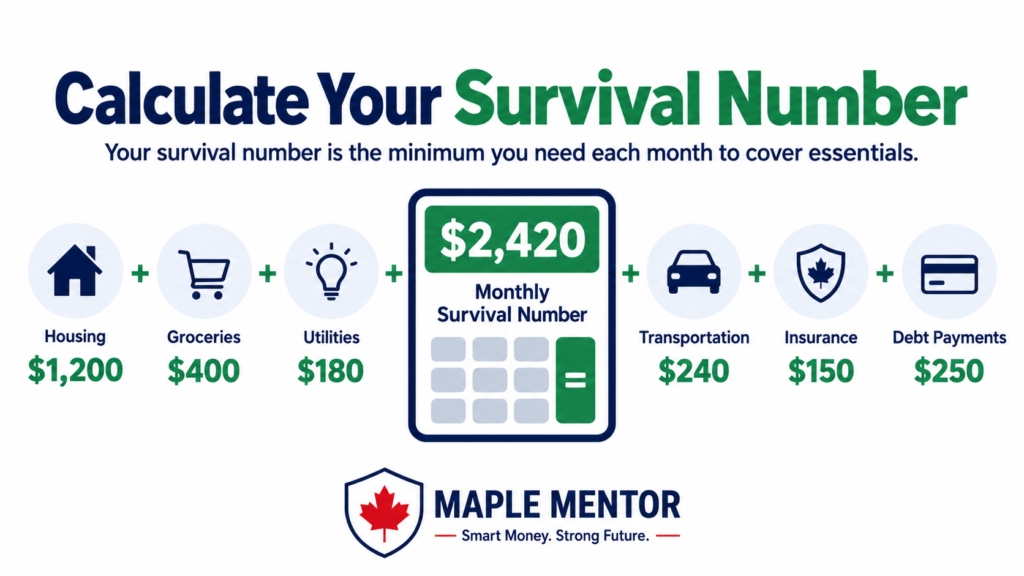
This gives you your approximate monthly survival number.
Suppose your bare-bones expenses total:
$2,420 per month
Now you know something important.
You need approximately $2,420 each month to maintain your essential obligations under your current assumptions.
This number can help you:
- Measure how long your emergency fund could last
- Determine how much income you need
- Prepare for job loss
- Evaluate reduced work hours
- Decide how aggressively you can repay debt
- Set an emergency-fund target
For example, if you had $10,000 in accessible emergency savings:
$10,000 ÷ $2,420 = approximately 4.1 months
That’s much more useful than simply knowing you have “$10,000 saved.”
It tells you approximately how much time that money could buy under your bare-bones assumptions.
Bare-Bones Budget Example
Here’s a simplified example:
| Category | Monthly Amount |
|---|---|
| Rent | $1,200 |
| Groceries | $400 |
| Utilities | $150 |
| Phone/Internet | $120 |
| Transportation | $250 |
| Insurance | $100 |
| Minimum debt payments | $200 |
| Total | $2,420 |
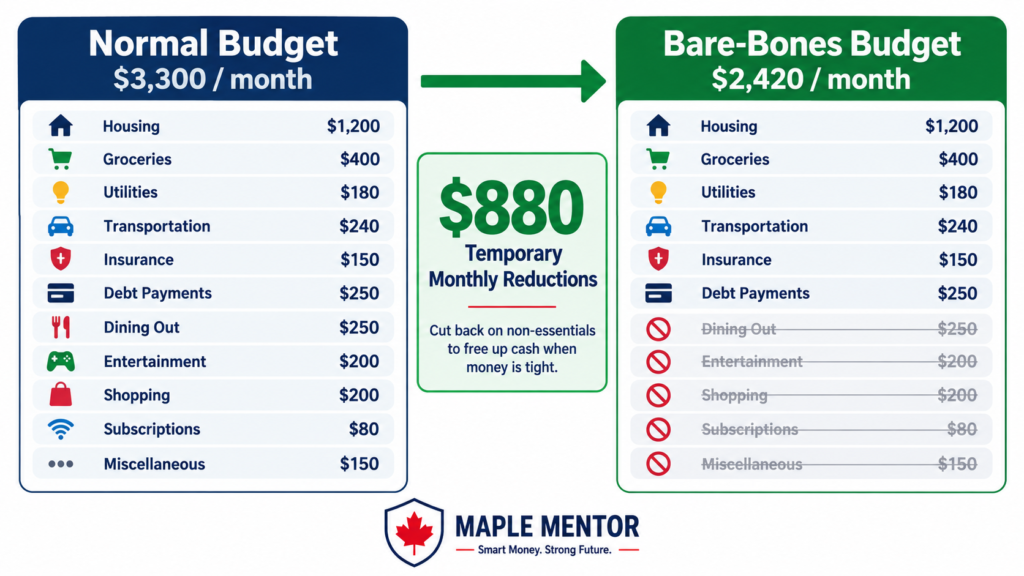
Now suppose this person’s normal monthly spending is $3,300.
Moving temporarily to the bare-bones budget would reduce planned spending by:
$3,300 – $2,420 = $880 per month
If their income suddenly dropped to $2,600, they’d still have very little margin, but the bare-bones plan would be considerably more manageable than continuing to spend $3,300.
Your numbers will obviously be different.
The purpose of the table isn’t to tell you what you should spend. It’s to show you how to calculate your own minimum budget.
What If Your Income Still Doesn’t Cover the Bare-Bones Budget?
This is an important possibility.
You can eliminate restaurants, subscriptions, entertainment, and shopping and still have expenses greater than your income.
If that happens, the problem isn’t necessarily that you’re budgeting badly.
Your fixed expenses may simply be too high relative to your available income.
At that point, focus on larger decisions.
That could mean exploring ways to:
- Increase income
- Reduce housing costs
- Change transportation costs
- Renegotiate or restructure certain obligations
- Apply for benefits you’re eligible for
- Contact creditors
- Seek reputable credit counselling
FCAC maintains resources for Canadians experiencing financial difficulty, including guidance on budgeting, dealing with creditors, credit counselling and other debt options.
Cutting another $15 from entertainment won’t solve a $700 monthly deficit.
Once discretionary spending has been reduced, focus on the expenses and income sources large enough to change the equation.
Common Mistakes to Avoid
Cutting Too Aggressively
Not every expense that isn’t food or rent is automatically unnecessary.
Your phone, internet connection, transportation, childcare, or other expenses may be essential to maintaining employment and income.
Ignoring Minimum Debt Payments
Removing debt payments from your spreadsheet doesn’t remove the debt.
Account for required payments when calculating your minimum monthly expenses.
Cancelling Important Insurance
Insurance can feel expensive when money is tight, but cancelling important coverage can expose you to much larger financial risks.
Review your coverage and pricing rather than automatically eliminating it.
Using Credit Cards to Cover Wants
A bare-bones budget loses much of its purpose if discretionary purchases simply move onto a credit card.
Avoid turning temporary lifestyle spending into high-interest debt.
Not Reviewing the Budget Weekly
Your initial numbers may be wrong.
Review your spending each week and adjust the budget based on reality.
Treating the Budget as Permanent
The purpose of a bare-bones budget Canada households use during financial stress is to stabilize cash flow.
Once your situation improves, rebuild a sustainable normal budget that includes savings, investing, entertainment, and other goals.
Should You Stop Investing During a Bare-Bones Budget?
This depends on why you’re using the budget.
If you’re facing a genuine cash-flow crisis and struggling to cover housing, food, required payments, or other essentials, temporarily reducing or pausing voluntary investment contributions may be reasonable.
You don’t want to invest $500 and then borrow $500 at high interest to pay your electricity bill.
However, the decision becomes more complicated if you receive an employer match through a workplace retirement plan. Giving up matching contributions can have a meaningful cost, so review the specific rules and your financial circumstances before making changes.
If the situation is temporary, you can resume or increase investing once your cash flow stabilizes.
The key is recognizing the difference between:
“I’m permanently abandoning investing”
and:
“I’m temporarily prioritizing financial stability.”
Final Answer
A bare-bones budget Canada residents can use gives you a temporary financial survival plan when money becomes tight.
Start by calculating the minimum amount required for housing, groceries, utilities, transportation, insurance, and debt payments.
Then temporarily reduce non-essential spending, review recurring bills, and protect your available cash.
Use emergency savings for genuine emergencies rather than maintaining discretionary spending. If you have debt, make required payments a priority and be careful about aggressively paying extra when doing so would leave you unable to cover necessities.
Finally, remember that this isn’t supposed to be your permanent lifestyle.
A bare-bones budget Canada plan is designed to help you get through a difficult period. Once your income and cash flow stabilize, gradually return to a normal budget that includes savings, investing, entertainment, and longer-term financial goals.
FAQ
What is a bare-bones budget?
A bare-bones budget is a temporary spending plan that focuses almost entirely on essential expenses.
It can be useful during job loss, reduced income, financial emergencies, or other periods when preserving cash becomes a priority.
What should I include in a bare-bones budget?
Include necessary expenses such as housing, groceries, utilities, basic communication, transportation, insurance, medical needs, and required debt payments.
The exact definition of an essential expense depends on your circumstances.
How long should I use a bare-bones budget?
Use it for as long as the financial situation that required it persists.
Once your income or cash flow improves, gradually transition toward a sustainable normal budget rather than maintaining unnecessary restrictions indefinitely.
Should I stop investing during a bare-bones budget?
If you’re struggling to cover essential expenses, emergency needs, or required debt payments, temporarily reducing or pausing voluntary investing may be appropriate.
However, consider factors such as employer matching programs before changing workplace contributions.
Can a bare-bones budget help during a recession?
Yes. Calculating your minimum monthly expenses can help you prepare for potential income disruption and determine how long your emergency savings could support your household.
You don’t need to wait for a recession to calculate this number.