
Groceries are one of the largest flexible expenses in many household budgets. Unlike rent or a car payment, however, grocery spending can change significantly from one week to the next.
Learning how to save money on groceries Canada households buy regularly doesn’t mean choosing the cheapest food possible or sacrificing nutrition. Instead, the goal is to become more intentional about what you buy, how much you buy, and how much food actually gets eaten.
A few repeatable habits, meal planning, comparing unit prices, reducing waste, and limiting convenience spending can make a noticeable difference over an entire year.
In this guide, we’ll look at practical ways to save money on groceries Canada shoppers can use without making grocery shopping unnecessarily complicated.
Quick Answer
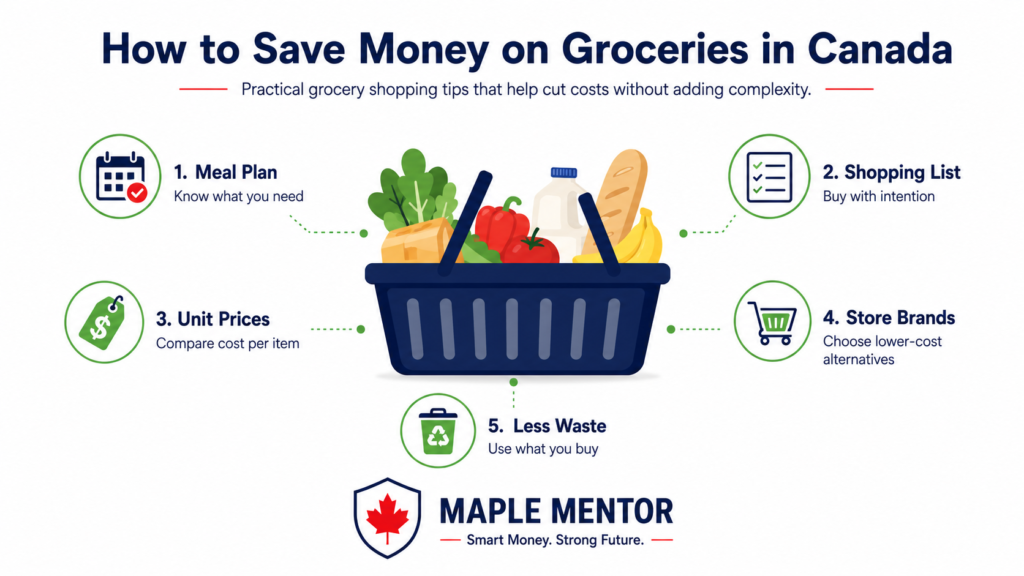
To save money on groceries Canada, plan meals before shopping, use a list, compare unit prices, buy store brands when they offer better value, reduce food waste, and limit takeout.
The goal is not to eat badly. The goal is to make grocery spending more intentional.
Start with these habits:
- Set a weekly grocery budget.
- Plan meals before shopping.
- Make a grocery list.
- Compare unit prices.
- Try lower-cost store brands.
- Reduce food waste.
- Use sales and loyalty programs strategically.
- Keep takeout separate from your grocery budget.
You don’t need to implement everything immediately. Even improving two or three habits can reduce your food spending.
Why Groceries Are Hard to Budget For
Groceries are harder to predict than many other expenses.
Your rent may stay the same every month, but your grocery bill can change because of:
- Food price increases
- Seasonal prices
- Household size
- Dietary needs
- Sales and promotions
- Holidays
- Guests
- Changing schedules
- How often you eat at home
Another problem is that people often underestimate their total food spending.
Suppose you spend $550 at grocery stores during the month.
That might look like your food budget.
But you also spent:
$120 on takeout
$60 on coffee and snacks
$75 on food delivery
Your actual food spending was $805, not $550.
When reviewing your budget, consider groceries, restaurants, takeout, delivery, snacks, drinks, and convenience meals separately. That gives you a much clearer picture of where your money is going.
Statistics Canada tracks changes in food prices through the Consumer Price Index, which can help explain why the same grocery basket may cost more over time.
Step 1 Set a Weekly Grocery Budget
Monthly grocery budgets can be difficult to manage because a month feels long.
A weekly target gives you faster feedback.
For example, suppose your grocery target is:
$600 per month
You could start with approximately:
$150 per week
This isn’t mathematically exact for every month because months aren’t exactly four weeks long, but it gives you a simple spending target while shopping.
If you spend $210 during the first week, you immediately know you need to adjust rather than discovering at the end of the month that you’ve gone significantly over budget.
Don’t choose an unrealistic number simply because you want to spend less.
Start by reviewing what you’re currently spending. Then look for a reasonable reduction.
For example:
Current spending: $750/month
First target: $675/month
Once that becomes comfortable, you can decide whether reducing it further makes sense.
A sustainable grocery budget is better than an aggressive budget you abandon after two weeks.
Step 2 Plan Meals Before You Shop
Meal planning doesn’t need to mean preparing 21 different meals every Sunday.
Keep it simple.
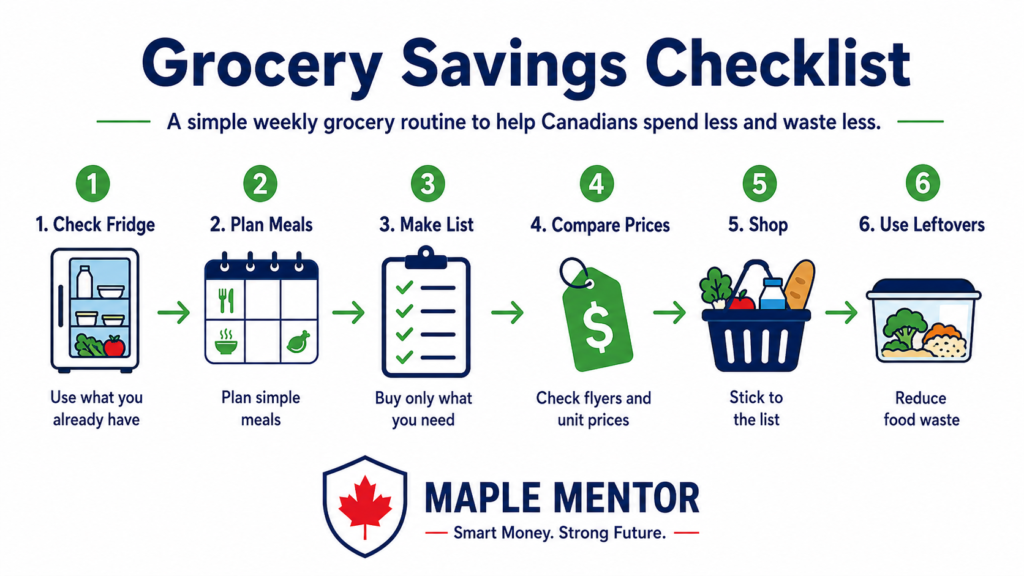
Before going to the grocery store:
- Check your refrigerator.
- Check your freezer.
- Look through your pantry.
- Identify food that needs to be used soon.
- Plan three to five main meals.
- Decide how you’ll use leftovers.
Suppose you already have rice, frozen vegetables, pasta, and chicken in your kitchen.
Instead of starting your meal plan from zero, build meals around those ingredients.
You might only need a few additional items to create several meals.
This prevents another common problem: buying random ingredients without knowing what you’re going to make with them.
You end up with half a bag of spinach, three sauces, vegetables, and miscellaneous ingredients, but nothing that easily becomes dinner.
Planning meals before shopping gives each purchase a purpose.
Step 3 Shop With a List
Once you’ve planned your meals, create a grocery list.
Then use it.
A list helps prevent two expensive habits:
Buying things you don’t need and forgetting things you do need.
Forgetting an ingredient can be particularly expensive if it results in another grocery trip or becomes the excuse for ordering takeout.
Your list doesn’t have to be complicated.
You can organize it into simple categories:
- Produce
- Meat and protein
- Dairy
- Frozen
- Pantry
- Household supplies
Before adding something, check whether you already have it.
This is especially useful for pantry products such as spices, sauces, pasta, rice, canned goods, and baking ingredients.
A grocery list also creates friction between seeing something attractive in the store and automatically putting it in your cart.
If unplanned purchases are affecting more than your grocery budget, read How to Stop Impulse Spending in Canada.
Shopping with a list is one of the simplest ways to save money on groceries Canada consumers can implement immediately.
Step 4 Compare Unit Prices
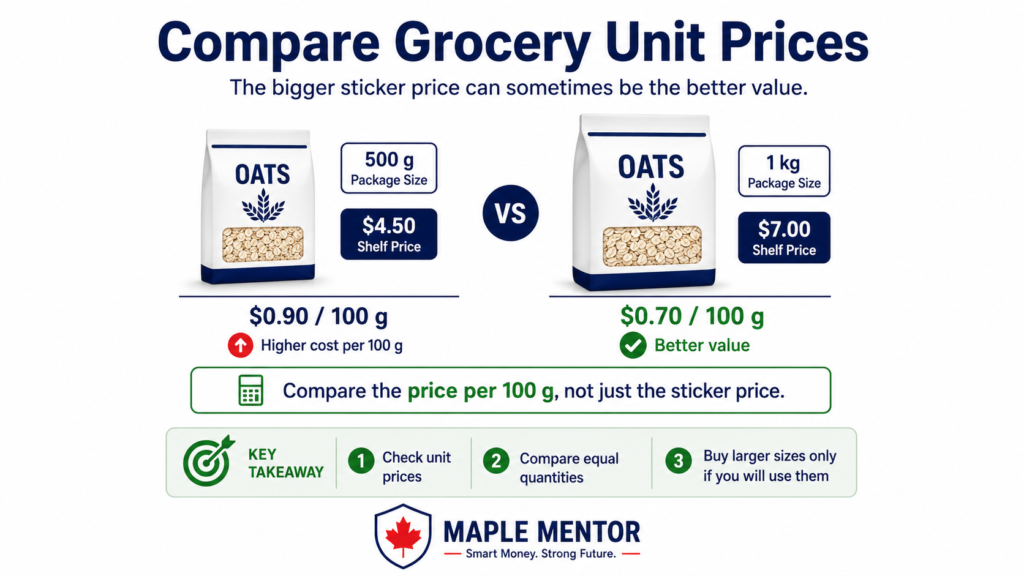
The product with the lowest sticker price isn’t necessarily the cheapest option.
Instead, compare the unit price.
Depending on the product, that might mean:
- Price per 100 grams
- Price per kilogram
- Price per litre
- Price per millilitre
- Price per individual unit
For example:
Product A: $4.00 for 500 g
Product B: $6.00 for 1 kg
Product A looks cheaper because it costs only $4.
But:
Product A = $0.80 per 100 g
Product B = $0.60 per 100 g
Product B provides better value.
Many grocery stores display unit prices on shelf labels, although you can also calculate them yourself when necessary.
However, don’t automatically buy the largest package.
A cheaper unit price doesn’t save money if half the product goes bad before you use it.
Value depends on both price and actual consumption.
Step 5 Buy Store Brands When It Makes Sense
Brand loyalty can make groceries more expensive than necessary.
For many basic products, store brands or generic alternatives may offer similar usefulness at a lower price.
Consider comparing store brands for:
- Rice
- Pasta
- Flour
- Oats
- Canned vegetables
- Beans
- Frozen vegetables
- Spices
- Baking ingredients
- Cleaning supplies
- Paper products
You don’t have to replace every brand you like.
Instead, experiment.
Try the store-brand version once.
If you can’t tell much difference or simply don’t care about the difference, you’ve found an easy recurring saving.
If you strongly prefer the branded version of a particular product, keep buying it and look for savings elsewhere.
The objective isn’t to always buy the cheapest product. It’s to avoid paying more when the difference doesn’t matter to you.
Step 6 Reduce Food Waste
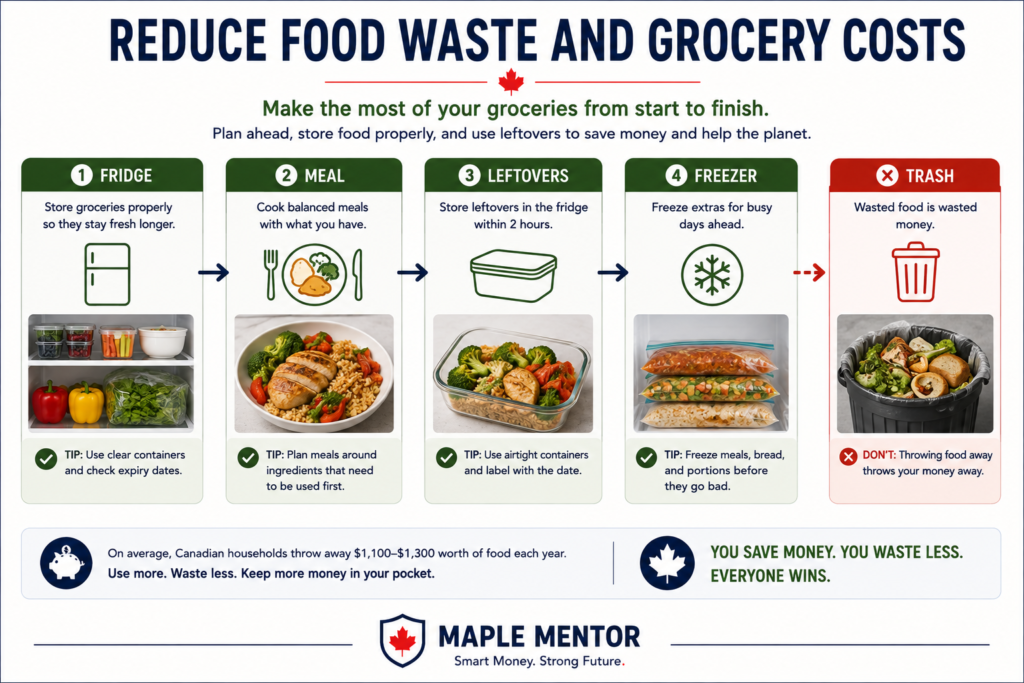
Food waste is essentially grocery spending that never provided any value.
You bought the food.
Then you threw it away.
Reducing waste can therefore help you save money on groceries Canada without requiring you to find cheaper prices.
Freeze Food Before It Goes Bad
Many foods can be frozen for later use, including:
- Meat
- Bread
- Some fruits
- Prepared meals
- Leftovers
- Soups and sauces
If you realize you won’t use something soon, freezing it can extend its useful life.
Use Leftovers
Plan at least one leftover meal each week.
Dinner tonight can become tomorrow’s lunch instead of another restaurant purchase.
Check Dates Regularly
Move food that needs to be eaten soon toward the front of your refrigerator.
Food hidden at the back is easy to forget.
Plan Around What You Already Own
Before buying new groceries, ask:
What needs to be eaten first?
Then build meals around those ingredients.
Buy Less Fresh Food If You’re Throwing It Away
Buying a refrigerator full of fresh produce sounds healthy.
Throwing away half of it every week isn’t.
Buy realistic quantities based on what your household actually eats.
The Government of Canada’s guidance on food safety and storage can also help you understand how to safely store, refrigerate, freeze, and handle food rather than relying only on best-before dates.
Step 7 Be Careful With Loyalty Points and Sales
Sales and loyalty programs can save money.
They can also encourage you to spend more.
The important question is:
Would I have bought this anyway?
Suppose a $10 product offers bonus points worth approximately $2.
If you already planned to buy the product, that’s useful.
If you bought something you didn’t need just to earn $2 in points, you didn’t save $2.
You spent $8 more than necessary.
The same principle applies to sales.
“Buy two and save $3” isn’t a bargain if you only needed one.
Sales work best for products that:
- You regularly buy.
- You can store safely.
- Won’t expire before you use them.
- Are genuinely cheaper than alternatives.
For non-perishable staples you regularly consume, buying extra during a legitimate sale can make sense.
For highly perishable food, buying too much can simply create more waste.
Don’t Ignore Takeout and Delivery
If your goal is to reduce food spending, grocery optimization only goes so far.
You also need to look at takeout.
Suppose you carefully reduce your grocery spending by $15 each week.
That’s approximately $60 per month.
But then you order $40 of food delivery twice per week.
Your grocery savings become almost irrelevant compared with your convenience spending.
You don’t necessarily need to eliminate restaurants.
Instead, decide how much takeout fits your budget.
For example:
Restaurant/takeout budget: $150 per month
Once you’ve reached that amount, cook at home until the next month.
Another strategy is keeping several extremely easy meals available for days when you don’t feel like cooking.
Examples include:
- Frozen meals
- Eggs and toast
- Pasta
- Sandwiches
- Soup
- Frozen pizza
- Simple stir-fry ingredients
A $7 convenience meal from your freezer can still be much cheaper than turning a tired evening into a $40 delivery order.
Grocery Savings Example Table
| Strategy | Example |
|---|---|
| Meal planning | Plan dinners before shopping |
| Grocery list | Buy only what you need |
| Unit pricing | Compare price per 100 g |
| Store brands | Buy generic pantry basics |
| Less waste | Freeze meat, bread, and leftovers |
| Fewer takeout meals | Keep simple meals available at home |
You don’t need every strategy to produce huge savings individually.
The power comes from combining several small improvements and repeating them every week.
Common Mistakes to Avoid
Shopping Without a List
Walking into a grocery store without knowing what you need makes impulse purchases much easier.
Plan first.
Buying Too Much Fresh Food
Fresh food only saves money if you eat it.
Purchase realistic quantities and replenish them when necessary.
Ignoring Unit Prices
Package sizes can make price comparisons misleading.
Compare the amount of product you’re actually getting.
Using Delivery Apps Too Often
Delivery fees, service fees, tips, and restaurant markups can make convenience expensive.
Keep easy meals at home for nights when you don’t want to cook.
Chasing Points Instead of Savings
Loyalty points are useful when attached to purchases you already intended to make.
Don’t spend $20 unnecessarily to earn $3 in rewards.
Shopping While Hungry
Shopping hungry can make snacks and convenience foods significantly more tempting.
When possible, shop after eating.
Not Checking What You Already Have
Buying duplicate food wastes money and storage space.
Check your fridge, freezer, and pantry before making your list.
Driving Everywhere for Small Discounts
Comparing stores can save money, but consider your time and transportation costs.
Driving 20 minutes to save $2 on chicken probably isn’t worthwhile.
Focus on meaningful savings.
Final Answer
Learning how to save money on groceries Canada households purchase every week comes down to repeatable habits rather than extreme cuts.
Start with a realistic weekly grocery budget. Check what you already own, plan several meals, and make a shopping list before leaving home.
At the store, compare unit prices instead of simply looking at sticker prices. Try store brands when the quality difference doesn’t matter to you, and use sales strategically rather than buying products simply because they’re discounted.
At home, focus on actually eating what you bought. Freeze food, use leftovers, and plan meals around ingredients that need to be used soon.
Finally, watch takeout and delivery spending. Saving $50 at the grocery store doesn’t accomplish much if convenience meals increase by $100.
The best strategy to save money on groceries Canada shoppers can follow isn’t about finding the absolute cheapest food. It’s about buying the food you’ll actually use at a reasonable price and wasting as little as possible.
FAQ
How can I save money on groceries in Canada?
To save money on groceries Canada, start by planning meals, shopping with a list, comparing unit prices, trying store brands, reducing food waste, and controlling takeout spending.
You can also compare flyers and use loyalty programs, provided they don’t encourage you to buy things you wouldn’t otherwise purchase.
What is a realistic grocery budget in Canada?
There isn’t one grocery budget that works for every Canadian household.
Your spending depends on household size, location, dietary requirements, food preferences, age, and how frequently you eat at restaurants.
Start by tracking your actual food spending for a month. Then set a realistic weekly target based on your current numbers rather than an arbitrary amount.
Are store brands worth buying?
Often, yes.
Store brands can provide better value for pantry staples, frozen foods, household products, and other basics. However, compare unit prices because a store brand isn’t automatically cheaper in every situation.
Does meal planning really save money?
It can.
Meal planning helps you decide what you’ll eat before shopping, which can reduce duplicate purchases, random ingredients, food waste, and last-minute takeout.
Is buying groceries in bulk always cheaper?
No.
Bulk purchases can provide a lower unit price, but only when you’ll actually use the product before it expires or deteriorates.
Buying twice as much food and throwing half away doesn’t save money.