
An unexpected car repair, vet bill, dental expense, or missed paycheque can quickly become credit card debt when you don’t have savings available.
That’s why learning how to build a $1,000 emergency fund in Canada can be an important first step toward improving your financial stability.
A full emergency fund may eventually contain several months of expenses, but you don’t need to reach that goal immediately. Starting with $1,000 gives you a realistic target that can protect you from many smaller financial surprises.
In this guide, we’ll look at how to build a $1,000 emergency fund in Canada, where to keep the money, how much to save each week, and what to do after reaching your first $1,000.
Quick Answer
To build a $1,000 emergency fund in Canada, open a separate savings account, set a small weekly savings goal, cut one or two expenses, and save extra cash before spending it.
The goal is not to build a perfect emergency fund right away. It is to create your first layer of financial protection.
A simple plan could look like this:
- Open a separate savings account.
- Choose a realistic weekly savings amount.
- Automate your contributions.
- Redirect savings from expenses you cut.
- Put some unexpected income toward the fund.
- Only use the money for genuine emergencies.
- Continue building the fund after reaching $1,000.
What Is a $1,000 Emergency Fund?
A $1,000 emergency fund is a starter cash reserve designed to cover smaller unexpected expenses.
It isn’t meant to replace a full emergency fund.
Instead, think of it as your first financial safety net.
You might use the money for an unexpected:
- Car repair
- Vet bill
- Urgent trip
- Medical or dental expense
- Missed shift or smaller paycheque
- Home repair
Without savings, a $500 car repair might end up on a credit card. You then have to repay the original expense plus interest if you carry the balance.
With $1,000 available, you may be able to handle the same expense without creating new debt.
That’s the main purpose of an emergency fund: giving yourself cash to deal with unexpected expenses.
Why Start With $1,000?
You’ve probably heard that you should have three to six months of expenses saved.
That’s a useful longer-term target, but it can also sound impossible when you’re starting from $0.
If your essential expenses are $2,500 per month, a six-month emergency fund would require $15,000.
Going directly from $0 to $15,000 is a major goal.
Going from $0 to $1,000 feels much more manageable.
A starter fund gives you some protection while you work on other financial priorities, particularly high-interest debt.
It also gives you an achievable milestone.
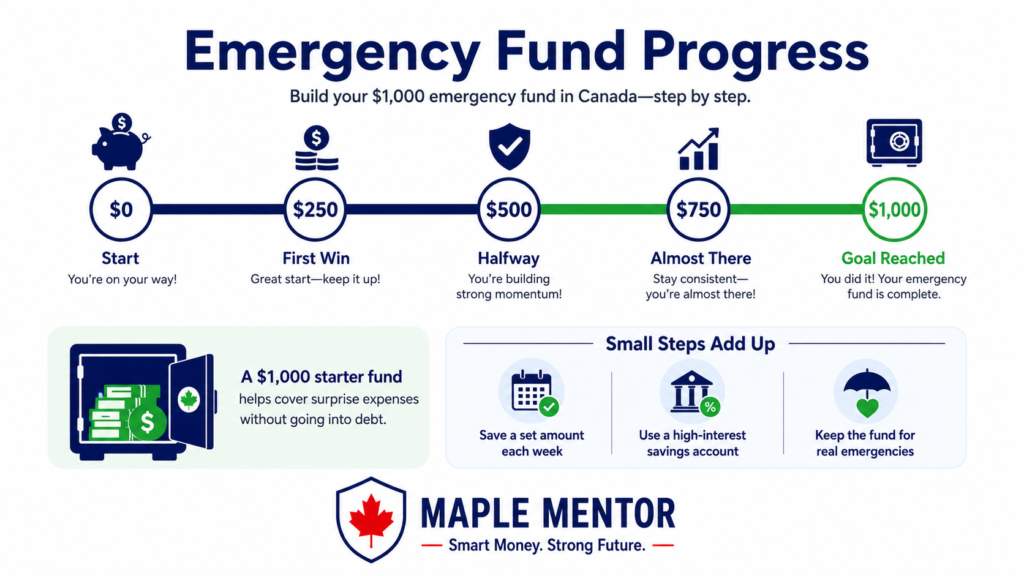
Your progression might eventually look like:
$0 → $500 → $1,000 → one month of expenses → three months → six months
You don’t need to complete every stage immediately.
When you’re learning how to build a $1,000 emergency fund in Canada, getting started matters more than reaching the final emergency savings target overnight.
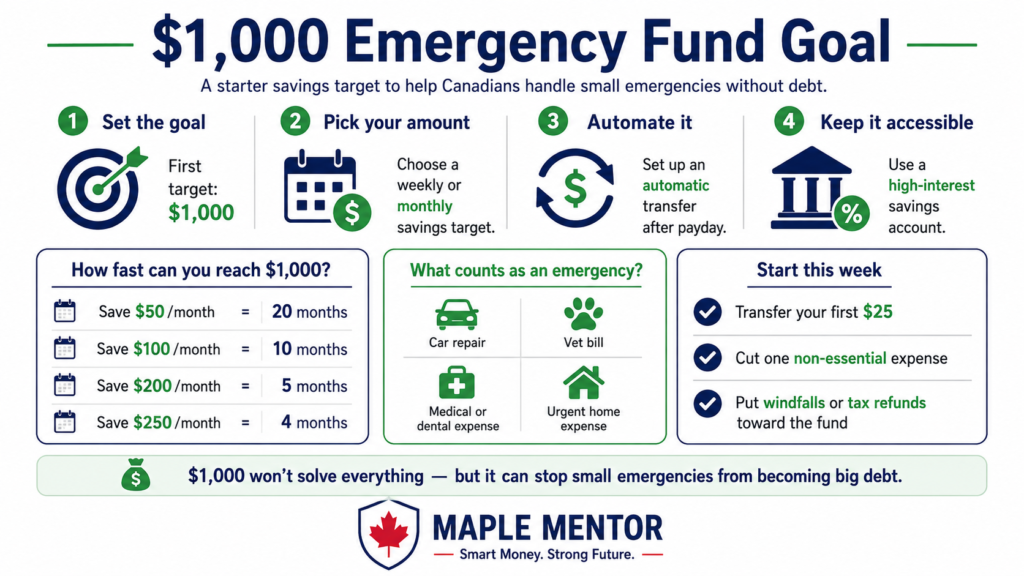
Step 1 Open a Separate Savings Account
Your emergency fund should generally be kept separate from your everyday spending money.
If your entire $1,000 sits in your main chequing account, it becomes difficult to distinguish between money available for spending and money reserved for emergencies.
Instead, consider using a separate savings account.
Ideally, your emergency savings should be:
- Safe
- Easily accessible
- Separate from everyday spending
- Free or inexpensive to maintain
- Earning some interest
A high-interest savings account can work well because your money remains accessible while earning interest.
Compare options in Best High-Interest Savings Accounts in Canada.
You can also see Best No-Fee Savings Accounts in Canada if avoiding account fees is your priority.
For eligible deposits, it’s also worth understanding how deposit protection works. The Canada Deposit Insurance Corporation explains what deposits may be covered and applicable limits at its member institutions.
The interest rate shouldn’t be your only consideration. Accessibility and safety matter more than squeezing every possible dollar of return from emergency savings.
Step 2 Set a Weekly Savings Target
You don’t need hundreds of dollars available immediately to build a $1,000 emergency fund in Canada.
Break the goal into smaller amounts.
| Timeline | Weekly Savings Needed |
|---|---|
| 10 weeks | $100 |
| 20 weeks | $50 |
| 40 weeks | $25 |
You can also save according to your pay schedule.
For example, if you’re paid every two weeks and save $50 from each paycheque, you’ll gradually move toward your goal without needing one large contribution.
Choose an amount you can realistically maintain.
Saving $25 consistently is better than deciding you’ll save $200 per week and quitting after a month because the target doesn’t fit your budget.
If money is extremely tight, start even smaller.
The important thing is creating the habit.
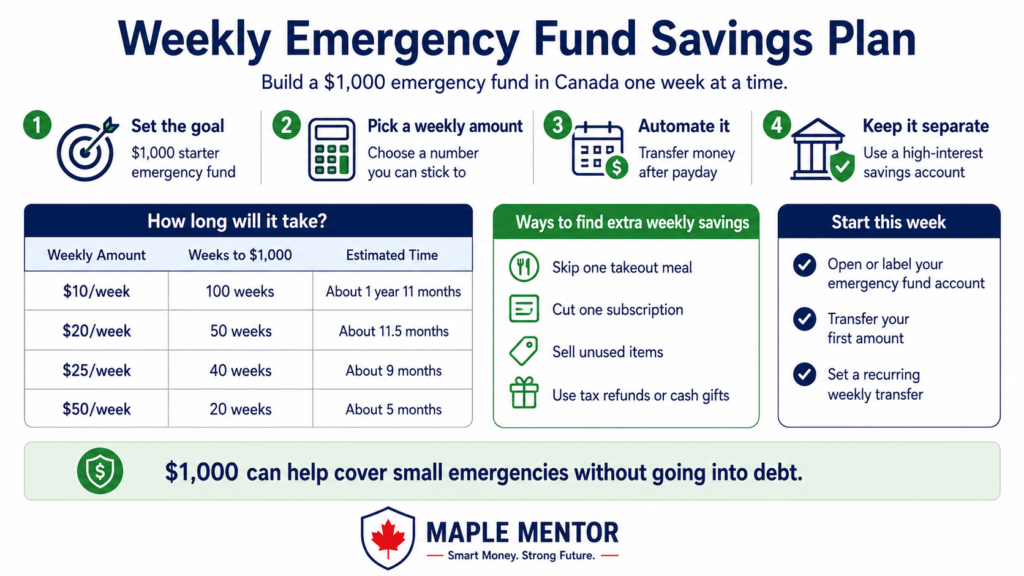
Step 3 Cut One Recurring Expense
You don’t necessarily need to completely change your lifestyle to find emergency fund money.
Start by finding one recurring expense you can reduce.
Look at:
- Streaming subscriptions
- Takeout
- Food delivery apps
- Unused memberships
- Banking fees
- Expensive phone plans
- Software subscriptions
Suppose you cancel a $15 subscription and switch to a phone plan that’s $20 cheaper.
You’ve freed up $35 per month.
Instead of letting that $35 disappear into everyday spending, automatically transfer it into your emergency fund.
Over a year, that’s $420.
Find another $50 per month and you’re already saving more than $1,000 per year.
Read How to Lower Your Monthly Bills in Canada for more recurring expenses you may be able to reduce.
Step 4 Use Extra Cash Before It Disappears
Regular savings aren’t the only way to build your emergency fund.
Unexpected or irregular income can accelerate your progress significantly.
Examples include:
- Tax refunds
- Work bonuses
- Overtime
- Cash gifts
- Side hustle income
- Selling unused belongings
You don’t necessarily need to save 100% of every extra dollar.
For example, suppose you receive an unexpected $600.
You could put $400 toward your emergency fund and keep $200 for something else.
You’ve immediately completed 40% of your $1,000 goal.
Tax refunds can be particularly useful, but remember that a refund isn’t necessarily “free money.” The Canada Revenue Agency provides information about tax refunds, assessments, and how refunds are issued.
The key is deciding what you’ll do with extra money before you spend it.
Step 5 Automate the Savings
Automation can make saving much easier.
Instead of deciding whether to save every payday, schedule a recurring transfer.
For example:
Friday: Paycheque arrives
Saturday: $50 automatically moves to emergency savings
The money leaves your spending account before you get used to having it available.
Your transfer doesn’t have to be large.
You could start with:
- $10 per week
- $25 per week
- $50 every two weeks
- $100 per month
Then increase the amount when your budget allows.
Read How to Automate Your Finances in Canada to create a more complete automated system for bills, savings, debt, and investing.
Automation is particularly useful when figuring out how to build a $1,000 emergency fund in Canada because progress continues without requiring you to make the same decision every payday.
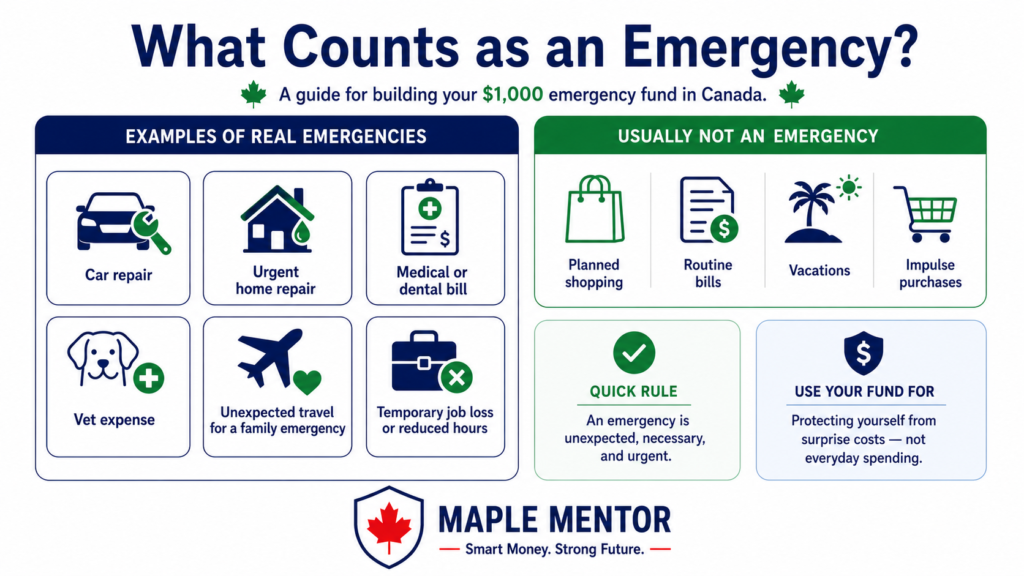
Step 6 Know What Counts as an Emergency
Building the fund is only half the challenge.
You also need to protect it.
An emergency is generally an expense that is necessary, unexpected, and difficult to postpone.
Potential emergencies include:
- Essential car repairs
- Urgent dental expenses
- Emergency travel
- Necessary home repairs
- Temporary income loss
- Unexpected veterinary expenses
Your emergency fund generally shouldn’t pay for:
- Vacations
- Christmas gifts
- New electronics
- Furniture you planned to buy
- Concert tickets
- Shopping
- Regular car maintenance
- Annual bills you knew were coming
Those expenses should have separate savings funds.
For planned expenses, read How to Save for Big Purchases in Canada Without Going Into Debt.
Keeping planned purchases and emergency savings separate makes it much less likely that your emergency fund will disappear before a real emergency happens.
Step 7 Keep Going After $1,000
Reaching $1,000 is a milestone, not the finish line.
Once you have your starter emergency fund, consider your other financial priorities.
If you’re carrying expensive credit card debt, for example, you might temporarily direct more money toward paying it down.
Eventually, you can continue increasing your emergency savings.
A simple progression is:
First Goal: $1,000
Enough to provide protection against some smaller unexpected expenses.
Second Goal: One Month of Essential Expenses
This provides more protection against temporary income disruptions.
Third Goal: Three Months of Expenses
This creates a more substantial financial buffer.
Fourth Goal: Six Months or More
A larger emergency fund may make sense if your income is irregular, you’re self-employed, you have dependants, or your employment situation is less predictable.
Read How Much Emergency Savings Do You Really Need in Canada? to determine a more appropriate long-term target.
The Financial Consumer Agency of Canada also provides guidance on establishing an emergency fund and recommends gradually building savings based on your financial situation.
Common Mistakes to Avoid
Keeping Everything in Chequing
A small chequing buffer is useful, but keeping your entire emergency fund mixed with spending money can make it easier to spend accidentally.
Keep the main fund separate.
Using It for Non-Emergencies
A sale isn’t an emergency.
Neither is a vacation, Christmas, or a planned furniture purchase.
Create separate savings goals for predictable expenses.
Waiting Until You Can Save a Large Amount
Don’t wait until you have $500 available.
Start with $10, $25, or whatever your budget allows.
Small amounts still build financial security.
Ignoring Credit Card Debt
You don’t necessarily need a massive emergency fund before addressing high-interest debt.
A common approach is to establish a starter cash buffer and then prioritize expensive debt while gradually improving your overall financial position.
Not Replacing the Money After Using It
Using your emergency fund for a legitimate emergency isn’t a failure. That’s exactly why the money exists.
Afterward, make rebuilding the fund a financial priority.
Trying to Invest Emergency Savings
Emergency savings and investments have different purposes.
Stocks and ETFs can decline precisely when you need your money.
Emergency savings should prioritize safety and liquidity rather than maximum returns.
Final Answer
Learning how to build a $1,000 emergency fund in Canada doesn’t require a massive income or hundreds of dollars of savings every week.
Start with a separate savings account and choose a realistic contribution.
Then look for recurring expenses you can reduce, automate your savings, and redirect some unexpected income toward your goal.
Once you’ve reached $1,000, keep going.
Eventually, you can work toward one month, three months, and potentially six months of essential expenses depending on your financial situation.
A $1,000 emergency fund won’t protect you from every financial problem. But it can prevent many smaller emergencies from immediately becoming debt.
That’s what makes learning how to build a $1,000 emergency fund in Canada a useful first step toward greater financial stability.
Frequently Asked Questions
Is $1,000 enough for an emergency fund?
No, $1,000 generally isn’t a complete emergency fund.
However, it’s a useful starter fund that can cover many smaller unexpected expenses. Over time, consider working toward three to six months of essential expenses depending on your circumstances.
Where should I keep a $1,000 emergency fund?
A separate high-interest savings account is usually a practical option because your money can remain safe, accessible, and separate from everyday spending.
Should I build an emergency fund or pay off debt first?
If you have no savings, building a small emergency buffer first can reduce the risk of immediately returning to debt when something unexpected happens.
After establishing that buffer, high-interest debt such as credit card balances often deserves priority.
How fast should I build a $1,000 emergency fund?
It depends on your income and expenses.
Saving $25 per week gets you to $1,000 in 40 weeks. Saving $50 per week takes 20 weeks, while $100 per week takes 10 weeks.
Don’t worry if your timeline is longer. Consistency matters more than reaching $1,000 by an arbitrary deadline.