
Wondering where to keep your emergency fund in Canada? Building an emergency fund is one of the smartest financial moves you can make, but choosing where to store that money is just as important. After all, emergency savings need to be safe, accessible, and available when life throws you a surprise expense. In this guide, you’ll learn where to keep your emergency fund in Canada and compare high-interest savings accounts, TFSAs, GICs, chequing accounts, and cash ETFs.
Quick Answer
Best Place to Keep an Emergency Fund
For most Canadians, the best place to keep an emergency fund is a high-interest savings account (HISA).
A good setup is:
- Keep a small buffer in your chequing account
- Keep your main emergency fund in a HISA
- Avoid investing emergency money in volatile assets
This approach provides safety, liquidity, and some interest while keeping your money accessible.
What Is an Emergency Fund?
An emergency fund is money set aside specifically for unexpected financial situations.
Examples include:
- Job loss
- Major car repairs
- Medical expenses
- Emergency travel
- Temporary income reductions
- Urgent home repairs
An emergency fund is not:
- Vacation money
- Christmas savings
- A down payment fund
- Investment capital
Instead, its purpose is to provide financial protection when life becomes unpredictable.
Why Where You Keep It Matters
Many Canadians focus on how much emergency savings they need. However, where you keep the money can be just as important.
Emergency money should be:
Safe
Your principal should not be exposed to significant market risk.
Liquid
You should be able to access the money quickly.
Easy to Access
Complicated withdrawal procedures defeat the purpose of an emergency fund.
Therefore, the goal is protection rather than maximum returns.
According to Financial Consumer Agency of Canada’s emergency fund guidance, emergency savings should remain accessible and available when unexpected expenses occur.
How Much Should You Keep?
The amount depends on your financial situation.
Starter Fund
A first goal of $1,000 can cover many common emergencies.
Basic Target
Three months of essential expenses is a common recommendation.
Safer Target
Six months or more may be appropriate for:
- self-employed individuals
- single-income households
- workers with unstable income
If you’re still determining your target, read How Much Emergency Savings Do You Really Need?
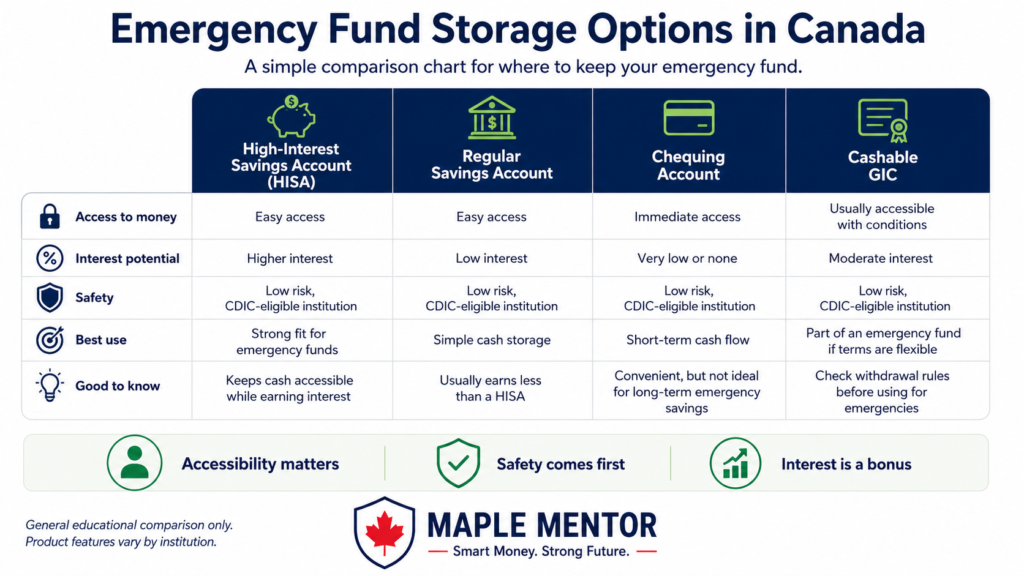
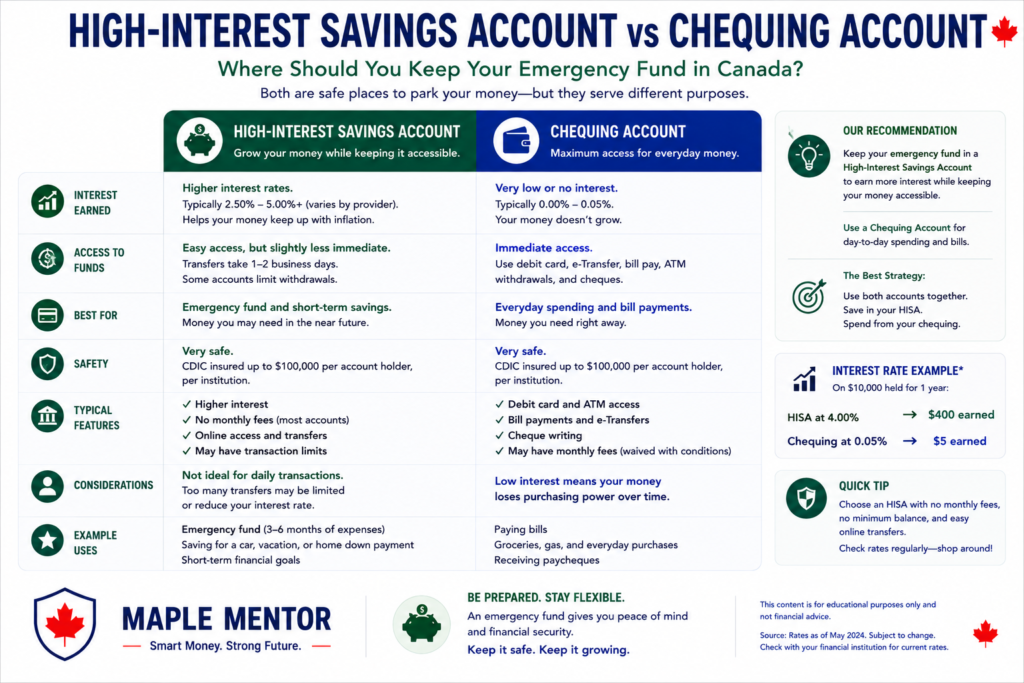
Option 1 Chequing Account
A chequing account provides immediate access to cash.
Advantages
- Instant access
- Easy bill payments
- No transfer delays
Drawbacks
- Usually earns little or no interest
- Emergency money can be mixed with spending money
- Easier to accidentally spend
For these reasons, a chequing account works best for a small emergency buffer rather than your entire fund.
Compare options in Best Chequing Accounts in Canada
Option 2 High-Interest Savings Account
For most Canadians, a high-interest savings account is the best solution.
Advantages
- Safe
- Separate from daily spending
- Easily accessible
- Earns more interest than chequing accounts
Drawbacks
- Interest rates can change
- Returns may not fully keep pace with inflation
Nevertheless, the combination of safety and accessibility makes HISAs the top choice for emergency savings.
Compare the top options in Best High-Interest Savings Accounts in Canada
According to EQ Bank’s savings account guide, high-interest savings accounts provide liquidity while earning interest on idle cash.
Option 3 TFSA Savings Account
A TFSA savings account can work in some situations.
Advantages
- Interest grows tax-free
- Withdrawals are tax-free
- Easy access to funds
Drawbacks
- Uses valuable TFSA contribution room
- May prevent you from using the TFSA for long-term investing
- Lower long-term growth potential if used only for cash
As a result, a TFSA savings account often makes sense only if you have significant unused contribution room.
Learn more in TFSA Investing Strategy for Beginners
You should also understand the rules in TFSA Taxes Explained
Option 4 GIC
Guaranteed Investment Certificates (GICs) offer safety and predictable returns.
Advantages
- Guaranteed rate of return
- No market risk
- CDIC protection in many cases
Drawbacks
- Funds may be locked
- Access restrictions can create problems during emergencies
Because of this, only cashable or redeemable GICs should be considered for emergency savings.
Learn about GIC basics through Investopedia’s GIC explanation
Option 5 Cash ETF or Investment Savings Account
More experienced investors sometimes use cash ETFs.
Advantages
- Competitive yields
- Relatively low risk
- Convenient within brokerage accounts
Drawbacks
- Requires a brokerage account
- Not as straightforward as a HISA
- Market trading considerations
Although cash ETFs can work well, they add complexity that many beginners don’t need.
If you’re considering brokerage-based options, compare platforms in Best Online Brokers Canada
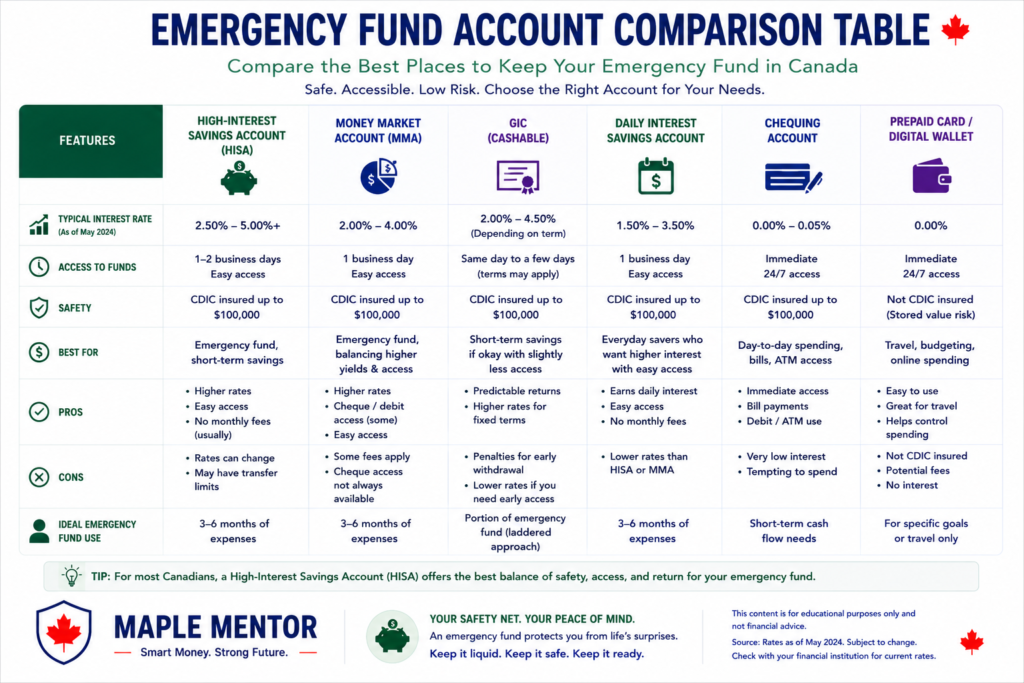
Emergency Fund Comparison Table
Best Setup for Most Canadians
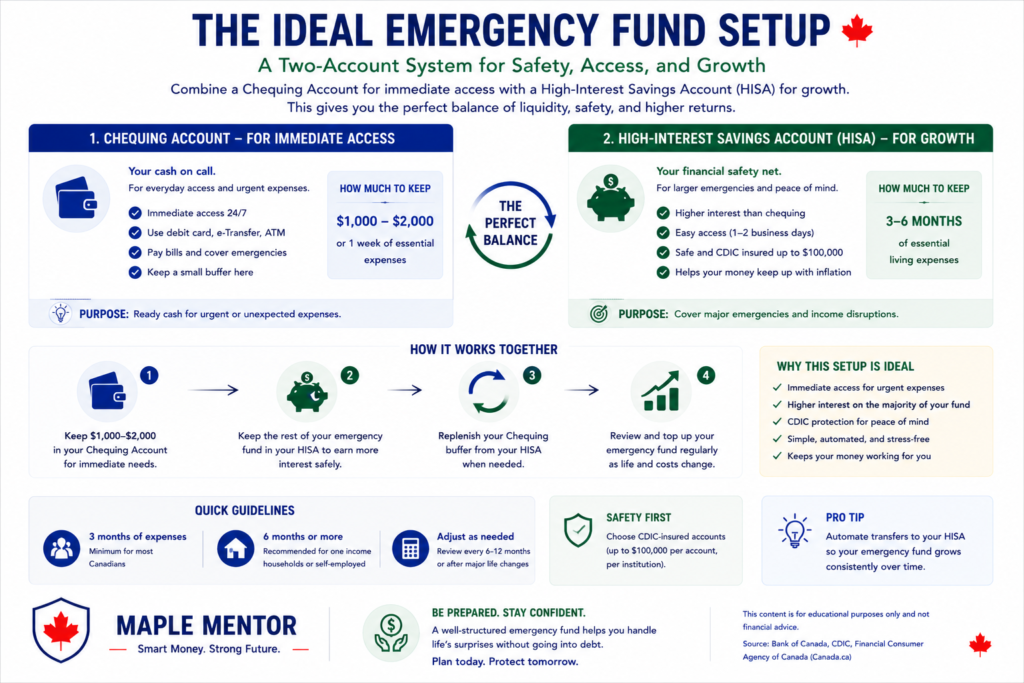
The simplest setup is often the best.
Suggested Structure
Chequing Account
- 1 month of expenses
High-Interest Savings Account
- 3–6 months of expenses
Avoid Investing Emergency Money
Stocks and equity ETFs can decline sharply when you need money most.
Therefore, emergency savings should remain separate from your long-term investment portfolio.
Common Mistakes to Avoid
Keeping Everything in Chequing
This sacrifices interest income unnecessarily.
Locking Money in a Non-Redeemable GIC
You may not be able to access funds when needed.
Investing the Emergency Fund
Market volatility creates risk.
Mixing Emergency Savings With Vacation Money
Separate savings goals improve clarity.
Using TFSA Room Without a Plan
Contribution room is valuable and should be used strategically.
If you’re building long-term wealth alongside emergency savings, read How Canadians Are Building $1M Portfolios
Final Answer
For most Canadians, the best place to keep an emergency fund is a high-interest savings account.
A practical approach is:
- Keep a small buffer in chequing
- Store the main emergency fund in a HISA
- Avoid investing emergency savings
- Use a TFSA savings account only if it fits your broader investing strategy
Ultimately, emergency money should prioritize safety and accessibility over maximum returns.
FAQ
Where should I keep my emergency fund in Canada?
For most Canadians, a high-interest savings account is the best option because it balances safety, accessibility, and interest earnings.
Should I keep my emergency fund in a TFSA?
You can, but it depends on your available TFSA contribution room and long-term investing plans.
Is a GIC good for an emergency fund?
Only if it’s a cashable or redeemable GIC. Otherwise, access restrictions may create problems during emergencies.
Should my emergency fund be invested?
Usually not. Emergency savings should be safe, stable, and readily available.
Is a chequing account good for emergency savings?
A chequing account works well for a small buffer, but it is generally not ideal for your full emergency fund because interest rates are typically very low.