
Have you ever wished you could stop worrying about retirement savings without needing millions of dollars today? That’s the idea behind Coast FIRE in Canada.
Unlike traditional early retirement strategies, Coast FIRE allows you to build enough investments early in life so that future growth does the heavy lifting. Once you reach your Coast FIRE number, you may no longer need to contribute significantly toward retirement, provided your investments continue growing over time.
In this guide, you’ll learn what Coast FIRE is, how it works, how much money Canadians may need, and whether it’s a realistic goal.
Coast FIRE in Canada (Quick Picks)
- Best for: Canadians who want flexibility without fully retiring early
- Main goal: Build enough investments early and let compound growth do the rest
- Ideal age: 20s, 30s, and early 40s
- Key advantage: Reduced retirement savings pressure later in life
- Key takeaway: Coast FIRE focuses on reaching a point where your retirement portfolio can grow on its own.
If you’re new to financial independence, start with The FIRE Movement in Canada
What Is Coast FIRE?
Coast FIRE is a variation of the Financial Independence, Retire Early (FIRE) movement.
The concept is simple:
Once you’ve accumulated enough invested assets, you can “coast” toward retirement without making additional retirement contributions.
Example
Imagine you’re 30 years old and have invested enough money that, if left untouched for 30 years, it would grow into your retirement target.
At that point, you may only need to earn enough income to cover your living expenses rather than aggressively investing for retirement.
Because of this, Coast FIRE appeals to people who want more flexibility without fully retiring early.
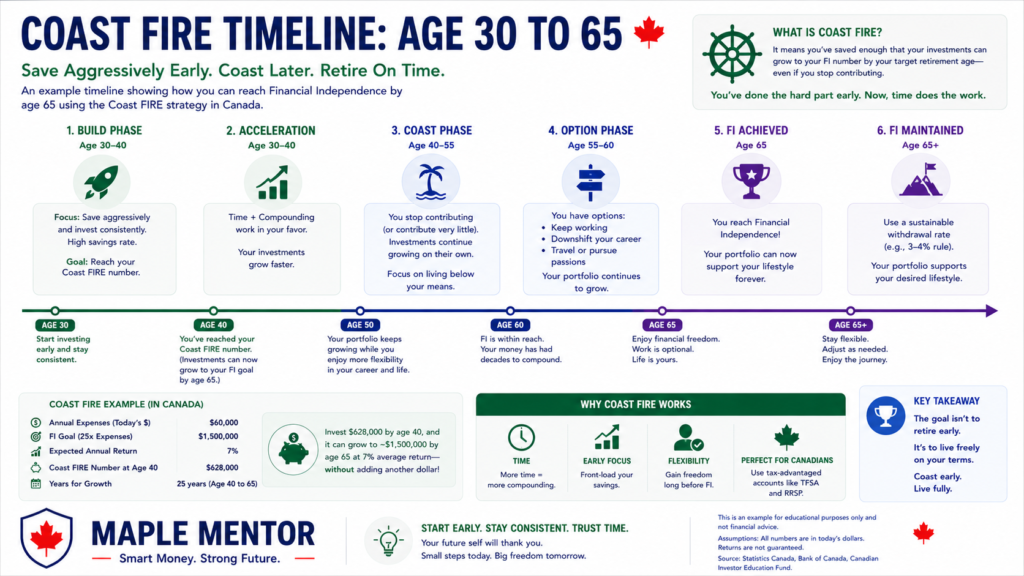
How Coast FIRE Works
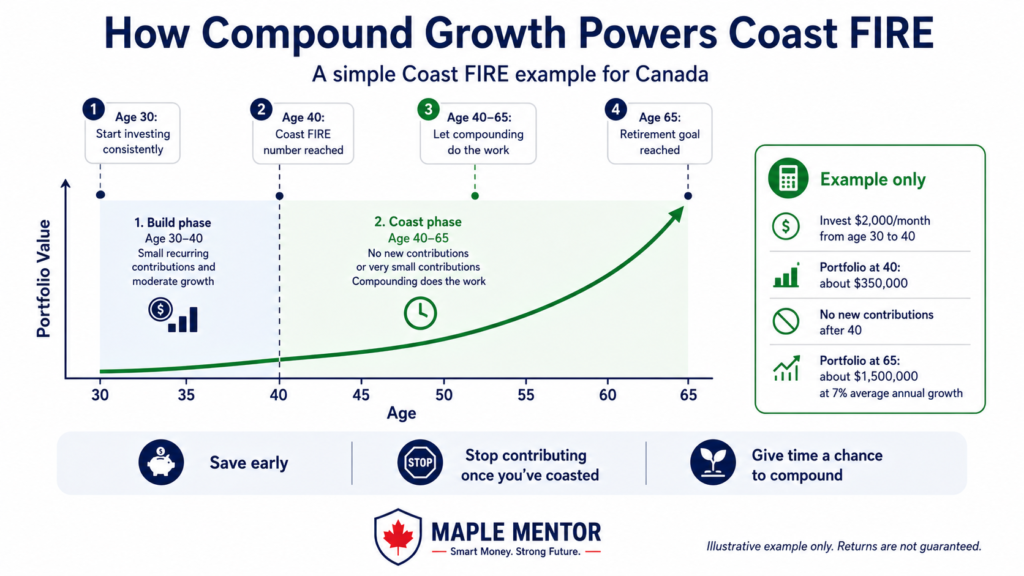
Coast FIRE relies on compound growth.
Step 1 Build a Large Investment Base
Save and invest aggressively during your early working years.
Step 2 Reach Your Coast FIRE Number
This is the amount needed today to eventually grow into your retirement target.
Step 3 Let Time Do the Work
Once your investments are large enough, future growth becomes the primary driver.
According to Investopedia’s compound interest guide, time is one of the most powerful factors in long-term wealth creation.
Therefore, starting early is critical.
Coast FIRE vs Traditional FIRE
Although both strategies pursue financial independence, they differ significantly.
| Feature | Coast FIRE | Traditional FIRE |
|---|---|---|
| Aggressive Saving | Early Years Only | Throughout Career |
| Full Early Retirement | Usually No | Yes |
| Work Requirement | Some Income Needed | Often None |
| Lifestyle Flexibility | High | Moderate |
| Retirement Funding | Compound Growth | Investments + Withdrawals |
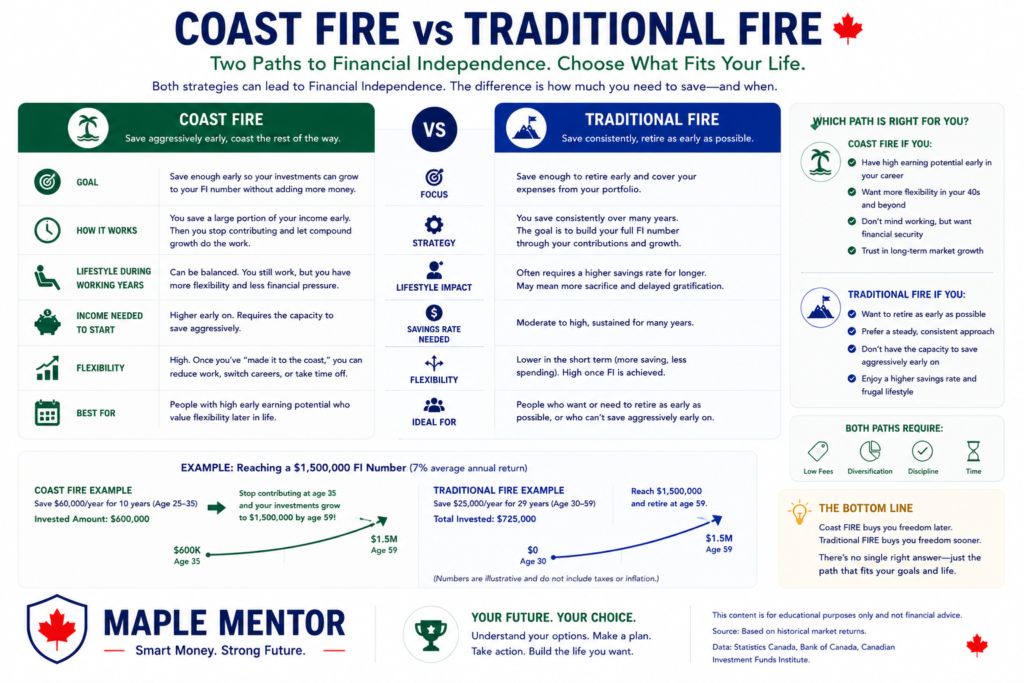
For a deeper comparison, read Early Retirement vs Traditional Retirement in Canada
Why Coast FIRE Is Becoming Popular
More Canadians are embracing Coast FIRE for several reasons.
Better Work-Life Balance
People want flexibility without leaving the workforce completely.
Reduced Burnout
Aggressive FIRE strategies can feel restrictive.
Rising Living Costs
Coast FIRE offers a more realistic middle ground.
Career Flexibility
Many people use Coast FIRE to:
- work part-time
- change careers
- start businesses
- pursue passion projects
As a result, Coast FIRE has become one of the fastest-growing FIRE variations.
How Much Money Do You Need for Coast FIRE?
The answer depends on:
- retirement age
- expected retirement spending
- investment returns
- current age
A common approach is to start with your retirement target.
Example
Desired retirement portfolio:
$1,000,000
Retirement age:
65
Current age:
35
Assuming a 7% annual return, you may only need approximately $130,000–$150,000 invested today to potentially reach $1 million by age 65.
However, these numbers vary significantly based on assumptions.
Coast FIRE Example for Canadians
Let’s consider a realistic scenario.
Sarah, Age 30
- TFSA: $60,000
- RRSP: $40,000
- Total invested: $100,000
If Sarah leaves her investments untouched and earns average long-term market returns, her portfolio could potentially grow substantially over the next 35 years.
At that point, she may focus on:
- covering expenses
- reducing work hours
- pursuing other goals
Rather than maximizing retirement contributions indefinitely.
See how Canadians build large portfolios over time How Canadians Are Building $1M Portfolios
Benefits of Coast FIRE
Less Financial Pressure
You no longer need to maximize every dollar invested.
Greater Career Flexibility
Work becomes more optional.
Better Work-Life Balance
Many people enjoy more freedom without fully retiring.
Compound Growth Advantage
Time becomes your greatest asset.
Consequently, Coast FIRE often feels more sustainable than aggressive early retirement plans.
Drawbacks of Coast FIRE
Market Risk
Future returns are never guaranteed.
Long Time Horizon
Coast FIRE works best when you start relatively early.
Inflation Uncertainty
Future living costs may be higher than expected.
Discipline Required
You must avoid withdrawing investments prematurely.
Therefore, Coast FIRE still requires careful planning.
Is Coast FIRE Realistic in Canada?
For many Canadians, yes.
However, success depends on several factors:
Starting Early
The earlier you begin investing, the easier Coast FIRE becomes.
Consistent Investing
Regular contributions matter more than perfect timing.
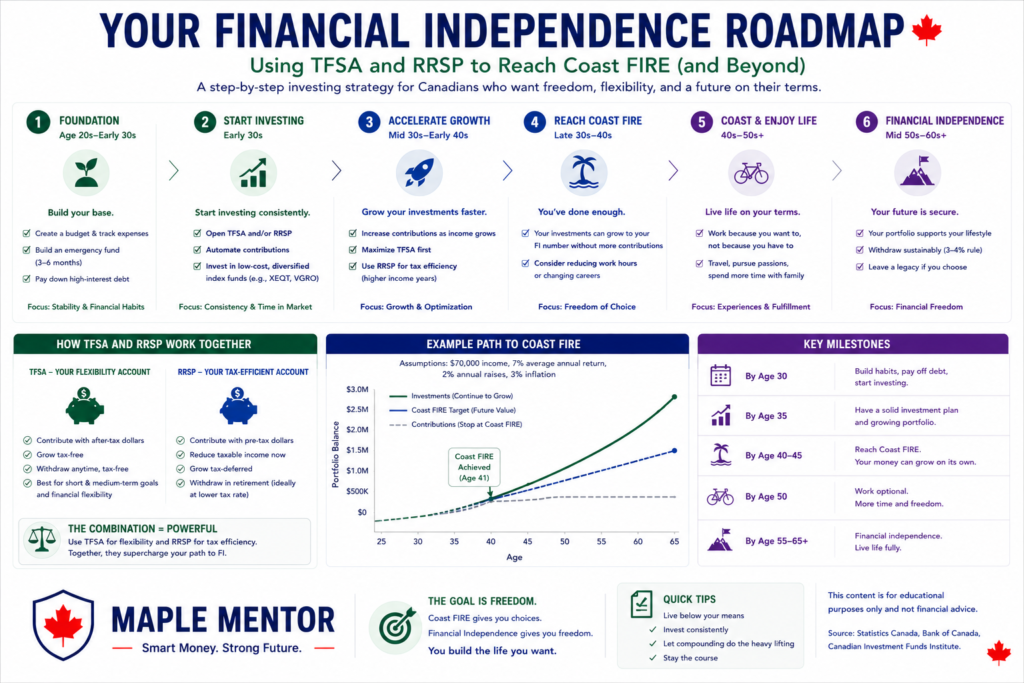
Using Tax-Advantaged Accounts
TFSAs and RRSPs can dramatically improve outcomes.
Learn more about retirement planning Retirement Planning for Canadians in Their 30s & 40s
According to Government of Canada retirement planning resources, retirement planning works best when started early and reviewed regularly.
How to Calculate Your Coast FIRE Number
A simplified process:
Step 1
Estimate annual retirement spending.
Step 2
Multiply by 25.
Example:
$40,000 annual spending × 25 = $1,000,000 target portfolio.
Step 3
Estimate future growth based on:
- current age
- retirement age
- expected return
Step 4
Determine how much you need invested today.
Steps to Reach Coast FIRE Faster
Maximize TFSA Contributions
Tax-free growth accelerates compounding.
Build your TFSA portfolio here Best ETFs for TFSA in Canada
Increase Your Savings Rate
Even small increases make a big difference.
Learn how here How to Increase Your Savings Rate in Canada
Invest Consistently
Avoid trying to time the market.
Focus on Low-Cost ETFs
Broad-market ETFs often provide strong diversification and low fees.
According to Vanguard’s investing principles, low costs and long-term discipline are key drivers of investment success.
Coast FIRE vs Barista FIRE vs Lean FIRE
| Type | Description |
|---|---|
| Coast FIRE | Investments grow independently while you continue working |
| Barista FIRE | Part-time work supplements investments |
| Lean FIRE | Extremely low retirement spending target |
| Traditional FIRE | Full financial independence and early retirement |
Each approach offers different tradeoffs between lifestyle and financial freedom.
Is Coast FIRE Right for You?
Coast FIRE may be a good fit if:
- you dislike extreme frugality
- you enjoy working but want flexibility
- you started investing relatively early
- you value work-life balance
On the other hand, traditional FIRE may be more appealing if full early retirement is your primary goal.
If you’re in your 20s, start here How to Build Wealth in Your 20s
Conclusion
Coast FIRE in Canada offers a practical middle ground between traditional retirement and aggressive early retirement.
Instead of trying to stop working completely, Coast FIRE focuses on building enough investments early so that future growth handles much of the work.
For many Canadians, this approach feels more realistic, sustainable, and enjoyable than extreme FIRE strategies.
Ultimately, the earlier you start investing and the higher your savings rate, the easier Coast FIRE becomes.
FAQ
What is Coast FIRE?
Coast FIRE is a financial independence strategy where you save enough early in life so your investments can grow to fund retirement without needing significant future contributions.
How much money do I need for Coast FIRE?
The amount varies based on your age, retirement goals, and expected investment returns.
Is Coast FIRE realistic in Canada?
Yes. Many Canadians can pursue Coast FIRE using a combination of TFSAs, RRSPs, and long-term investing.
What is the difference between Coast FIRE and FIRE?
Traditional FIRE aims for complete financial independence and early retirement, while Coast FIRE focuses on allowing investments to grow while continuing to work.
Can Canadians achieve Coast FIRE using a TFSA and RRSP?
Absolutely. TFSAs and RRSPs are often the primary accounts used to build a Coast FIRE portfolio.