
Many Canadians know they should invest, but they’re unsure where those investments should go.
Should you invest inside a TFSA? What happens when your TFSA is full? Is a non-registered account a bad idea because of taxes?
The truth is that both account types have a place in a long-term investing strategy. Understanding TFSA vs non-registered account in Canada can help you keep more of your investment returns and build wealth more efficiently.
In this guide, we’ll compare TFSAs and non-registered accounts and explain exactly when Canadians should use each one.
TFSA vs Non-Registered Account (Quick Picks)
- Best for most Canadians: TFSA
- Best after maxing registered accounts: Non-registered account
- Best for tax-free growth: TFSA
- Best for unlimited investing: Non-registered account
- Key takeaway: Max your TFSA first, then continue investing through a non-registered account if needed.
If you’re still deciding which registered account to prioritize, read TFSA vs RRSP vs FHSA in Canada
TFSA vs Non-Registered Account
| Feature | TFSA | Non-Registered Account |
|---|---|---|
| Tax on Growth | None | Yes |
| Tax on Dividends | None | Yes |
| Tax on Capital Gains | None | Yes |
| Contribution Limits | Yes | No |
| Withdrawal Flexibility | Very High | High |
| Best For | Most Canadians | Investors who have used TFSA room |
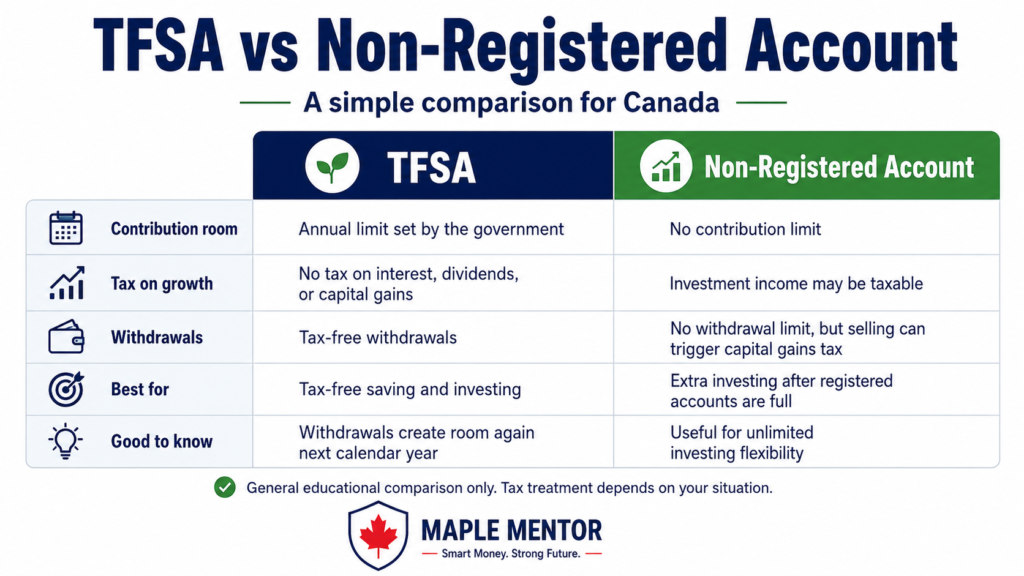
Quick Take
For most Canadians, maximizing a TFSA should be the priority before investing in a non-registered account.
However, once TFSA room is used, a non-registered account becomes the next logical place to continue investing.
What Is a TFSA?
A Tax-Free Savings Account (TFSA) is one of the most powerful investing tools available to Canadians.
Tax-Free Growth
Investment gains grow without taxation.
Tax-Free Withdrawals
Unlike many other accounts, withdrawals are not taxed.
Contribution Room
The government sets annual contribution limits, which accumulate over time.
Why Investors Love TFSAs
The combination of tax-free growth and tax-free withdrawals makes TFSAs extremely flexible.
If you’re just getting started, read TFSA Investing Strategy for Beginners
According to Canada Revenue Agency TFSA rules, investment income earned inside a TFSA is generally tax-free.
What Is a Non-Registered Investment Account?
A non-registered account is a standard investment account without government contribution limits.
No Contribution Limits
You can invest as much as you want.
Fully Taxable
Investment income may be subject to taxation.
Available Through Most Brokers
Banks and brokerage platforms typically offer non-registered accounts.
Investments You Can Hold
- ETFs
- Stocks
- Mutual funds
- Bonds
Tax Considerations
Investors may owe taxes on:
- Capital gains
- Dividend income
- Interest income
Because of this, tax planning becomes much more important.
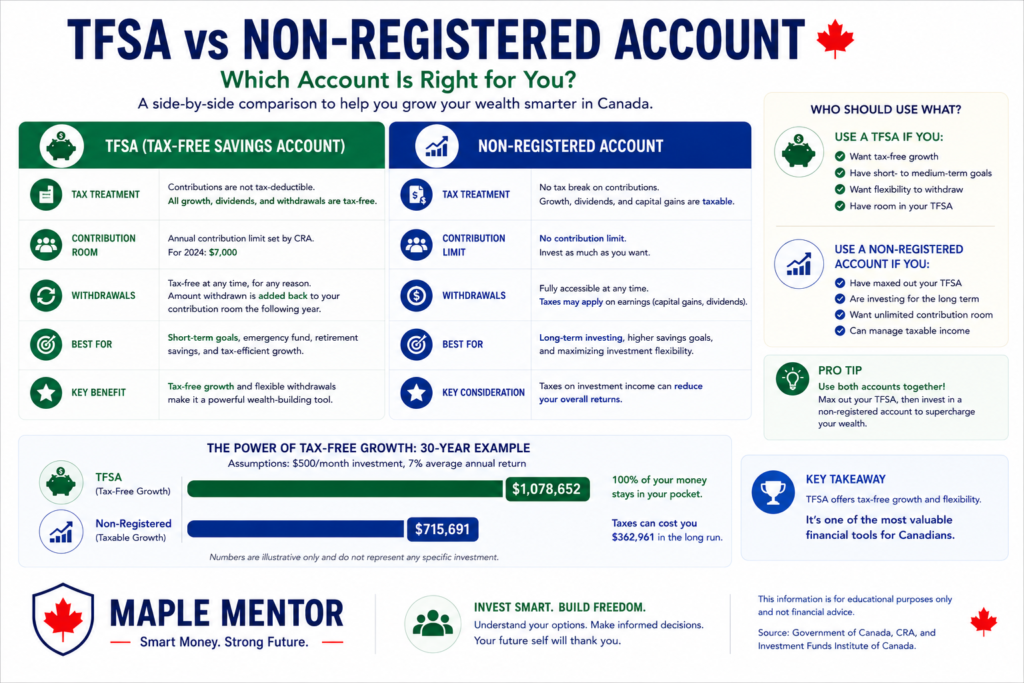
TFSA vs Non-Registered Account: Key Differences
Taxes
TFSA
No taxes on:
- Dividends
- Capital gains
- Interest income
Non-Registered Account
Taxes may apply on:
- Dividends
- Capital gains
- Interest income
According to Investopedia’s capital gains tax guide, taxes can significantly reduce long-term investment returns when not managed properly.
Contribution Limits
TFSA
Limited by annual contribution room.
Non-Registered Account
No contribution limits.
Withdrawals
TFSA
Withdrawals create future contribution room.
Non-Registered Account
No contribution rules apply.
Therefore, the biggest difference in the TFSA vs non-registered account comparison is usually taxation.
When Should Canadians Use a TFSA?
For most investors, a TFSA should come first.
You Have Available Contribution Room
Unused TFSA room is often the most valuable investing opportunity available.
Long-Term Investing
Tax-free compounding becomes extremely powerful over decades.
Dividend Investing
Canadian dividend income grows tax-free inside the account.
Growth Investing
Capital gains remain completely tax-free.
Retirement Savings
TFSAs complement RRSPs effectively.
Financial Independence Goals
Tax-free withdrawals provide flexibility later in life.
Looking for investment ideas? Read Best ETFs for TFSA in Canada
Learn the tax advantages here TFSA Taxes Explained for Canadians
When Should Canadians Use a Non-Registered Account?
Non-registered accounts become valuable once registered accounts are maximized.
You’ve Maxed Out Your TFSA
Additional investments need another home.
You’ve Maxed Out Your RRSP
Many high savers eventually reach this point.
You Want Unlimited Investing Capacity
There are no contribution restrictions.
You Have Significant Investments Beyond Registered Accounts
Wealthier investors often require additional account capacity.
Business Owners and High-Income Earners
These investors frequently use non-registered accounts extensively.
As a result, non-registered accounts often become essential for long-term wealth accumulation.
Example Scenario
Investor A
- $20,000 available to invest
- $20,000 TFSA room available
Best choice: TFSA
Investor B
- TFSA maxed out
- RRSP maxed out
- Wants to invest another $30,000
Best choice: Non-registered account
This simple example highlights how contribution room often determines the correct choice.
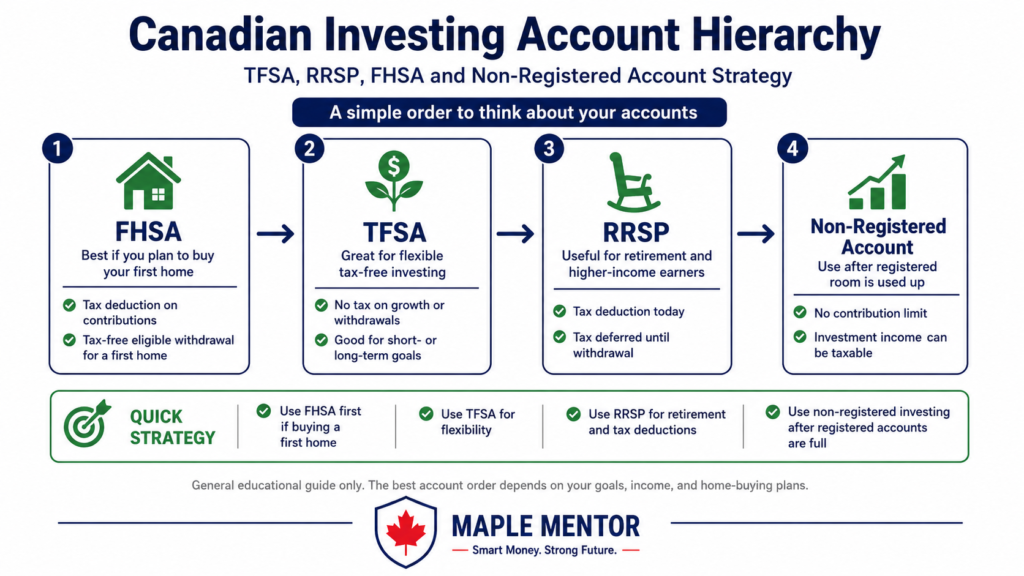
Should You Use Both?
In many cases, yes.
Successful Canadian investors often use:
- TFSA
- RRSP
- FHSA (if eligible)
- Non-registered account
As wealth grows, relying on a single account becomes increasingly difficult.
Learn how these accounts work together in TFSA vs RRSP vs FHSA in Canada
See how long-term investors structure their finances in How Canadians Are Building $1M Portfolios
Common Mistakes Canadians Make
Leaving TFSA Room Unused
This is one of the biggest missed opportunities.
Holding Excess Cash Instead of Investing
Inflation slowly erodes purchasing power.
Avoiding Non-Registered Accounts Entirely
Taxes shouldn’t prevent investing.
Ignoring Tax Efficiency
Account location matters.
Not Tracking Adjusted Cost Base
Poor record-keeping can create tax complications later.
According to Canada Revenue Agency adjusted cost base guidance, maintaining accurate records is important when calculating capital gains.
Best Investments for a Non-Registered Account
Certain investments tend to work particularly well.
Broad-Market ETFs
Diversified and tax-efficient.
Canadian Dividend Stocks
Benefit from favourable dividend tax treatment.
Tax-Efficient Investments
Lower turnover often means fewer taxable events.
Long-Term Buy-and-Hold Strategies
Reducing trading can improve tax efficiency.
Learn more here Tax-Efficient Investing for Canadians
For portfolio construction ideas, read How to Build a Diversified Portfolio in Canada
TFSA vs Non-Registered Account: Which Is Better?
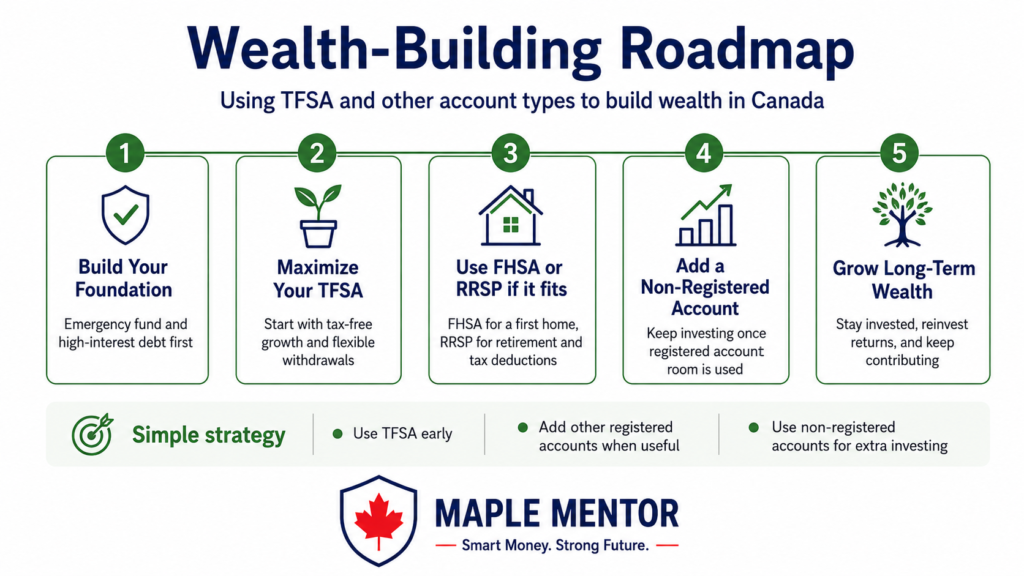
For most Canadians, the answer is straightforward:
- Max your TFSA first
- Use your RRSP when appropriate
- Invest additional money in a non-registered account
The best account is often determined by available contribution room and long-term goals.
Therefore, the question is rarely TFSA or non-registered account. Instead, it’s usually when should you use each one?
Conclusion
A TFSA is usually the best place for Canadians to start investing because growth and withdrawals are completely tax-free.
However, once your TFSA is maxed out, a non-registered account can help you continue building wealth without contribution limits.
The goal isn’t choosing one account forever—it’s understanding when each account makes sense and using both strategically as your wealth grows.
FAQ
Is a TFSA better than a non-registered account?
For most Canadians, yes. A TFSA offers tax-free growth and tax-free withdrawals.
Should I invest in a non-registered account if my TFSA isn’t full?
Generally, no. Most investors should use available TFSA room first.
Do I pay taxes on a non-registered account?
Yes. Dividends, interest income, and capital gains may be taxable.
Can I have both a TFSA and a non-registered account?
Yes. Many Canadians use both as their investment portfolios grow.