
The best options trading platform Canada has to offer depends on your trading experience, the strategies you want to use, and how much you’re willing to pay in commissions. With several Canadian brokerages changing their options pricing in 2026, choosing the right platform is no longer as simple as comparing contract fees.
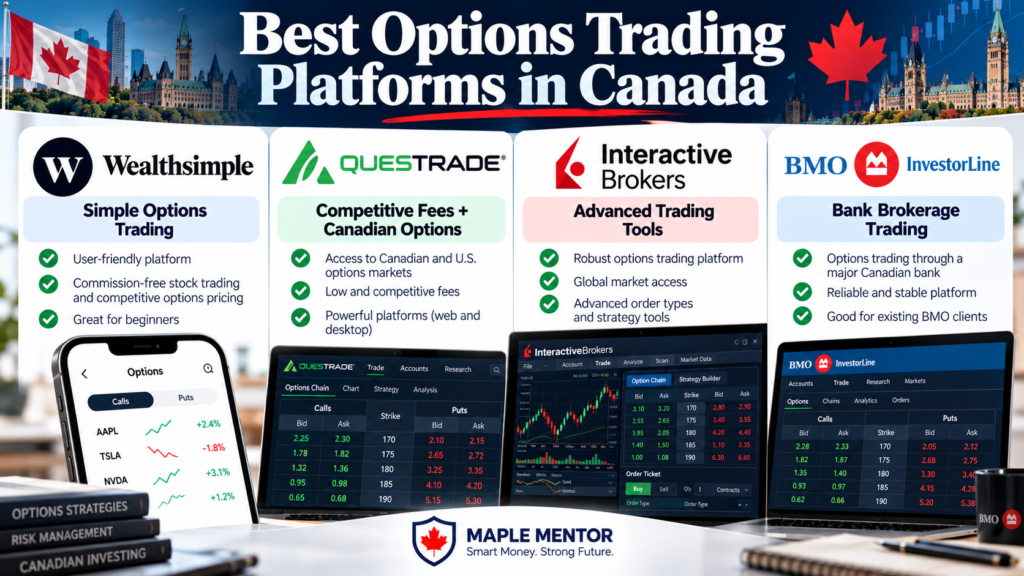
Wealthsimple, Questrade, Interactive Brokers (IBKR), and BMO InvestorLine all offer options trading, but they serve different types of investors.
Wealthsimple has become an attractive choice for Canadians looking for a straightforward trading experience and $0 contract fees on eligible U.S. equity options.
Questrade now offers $0 contract fees on U.S. equity options while supporting Canadian options and more traditional brokerage tools.
Interactive Brokers remains particularly competitive for experienced traders who need sophisticated analytics, advanced strategies, and international market access.
BMO InvestorLine provides another alternative for investors who prefer trading through an established Canadian bank brokerage.
But here’s what matters: The cheapest options trading platform isn’t necessarily the best one.
A brokerage might offer commission-free contracts while charging substantial exercise fees or providing limited trading tools. Another might charge per contract but offer better analytics, execution controls, and access to complex strategies.
In this guide, we’ll compare the best options trading platforms in Canada across commissions, available strategies, Canadian and U.S. options, trading tools, registered accounts, and overall usability.
Risk warning: Options are complex financial instruments. Buyers can lose their entire premium, while certain options-selling strategies can result in losses exceeding the initial investment. This article is educational and does not constitute personalized investment advice.
Quick Answer: What Is the Best Options Trading Platform in Canada?
There isn’t one brokerage that’s best for every Canadian options trader.
Each of the four platforms has different strengths.
| Platform | Best For | Main Advantage |
|---|---|---|
| Wealthsimple | Newer options traders | Simple interface and $0 eligible U.S. equity-options contract fees |
| Questrade | Canadian options and intermediate traders | Competitive options pricing and traditional brokerage features |
| Interactive Brokers | Advanced and active traders | Professional-grade options analytics and global markets |
| BMO InvestorLine | Existing BMO clients | Options trading within a major Canadian bank brokerage |
My overall assessment:
For someone who wants a relatively simple introduction to eligible U.S. equity options, I’d start by comparing Wealthsimple and Questrade.
For someone who needs access to Canadian options, Questrade becomes more attractive because Wealthsimple’s standard options offering focuses on U.S. securities.
Experienced options traders, Interactive Brokers deserves serious consideration because of its trading tools, analytics, and broader market access.
For investors who already manage their investments through BMO, InvestorLine may be worth considering despite its different pricing structure.
The important thing is to choose a platform that supports your strategies and trading requirements, not simply the one advertising the lowest contract commission.
Best Options Trading Platforms in Canada at a Glance
Here’s how the four brokerages compare.
| Feature | Wealthsimple | Questrade | Interactive Brokers | BMO InvestorLine |
|---|---|---|---|---|
| U.S. equity-options contract fee | $0 | $0 | Generally USD $0.25–$0.65 at lower volumes | $0.90 |
| Canadian equity options | Not currently supported | Yes | Yes | Yes |
| Canadian options pricing | N/A | CAD $0.99/contract | From CAD $1.25/contract | Check applicable schedule |
| U.S. index options | Limited availability; verify eligibility | USD $0.99/contract | Available | Available, subject to eligibility |
| Multi-leg strategies | Supported strategies available | Yes | Extensive | Yes |
| Advanced options analytics | Developing | Available | Extensive | Available |
| Paper trading | Verify current availability | Platform-dependent | Yes | Yes |
| Registered-account options | Eligible strategies only | Eligible strategies only | Eligible strategies only | Eligible strategies only |
| Beginner friendliness | High | Moderate | Lower | Moderate |
| Best fit | Simplicity | Balance of pricing and tools | Advanced trading | Bank brokerage users |
Fees shown are headline contract commissions, not necessarily the total cost of an options order. Minimum commissions, exchange fees, regulatory charges, exercise fees, and assignment fees may apply. Availability also depends on account approval and trading permissions.
One important development is that both Wealthsimple and Questrade now offer $0 contract fees on eligible U.S. equity options.
That makes many older Canadian brokerage comparisons outdated.
However, Interactive Brokers still offers extensive functionality that may justify its commissions for sophisticated traders.
1. Wealthsimple Options Trading Best for Simplicity
Wealthsimple has expanded significantly beyond its original commission-free stock-trading platform.
It now supports options trading, including several strategies that previously required more traditional brokerages.
Its main advantage is making options trading relatively accessible through a straightforward interface.
Wealthsimple Options Trading Fees
Wealthsimple currently lists $0 contract fees for eligible equity and ETF options.
This applies to supported options purchases and sales.
However, other charges can still apply.
For example, certain index options and early-exercise transactions may have separate fees.
Its current pricing is available through Wealthsimple’s official trading fee schedule.
Which Options Strategies Does Wealthsimple Support?
Wealthsimple supports several options strategies, subject to account eligibility and trading approval.
These include:
- Long calls
- Long puts
- Covered calls
- Cash-secured puts
- Vertical spreads
- Calendar spreads
- Other eligible multi-leg strategies
The availability of individual strategies depends on the account type and the investor’s approved options level.
For example, a covered call involves selling a call option against shares you already own.
A vertical spread involves combining options with different strike prices but the same expiration date.
Although some multi-leg strategies can define or limit maximum losses, they still require an understanding of expiration, assignment, and execution risk.
Where Wealthsimple Stands Out
Wealthsimple’s biggest advantage is its user experience.
Its interface is relatively approachable compared with traditional professional trading platforms.
For someone already using Wealthsimple to purchase stocks and ETFs, adding options trading may be more convenient than opening another brokerage account.
The $0 contract fee is another major advantage.
However, options traders should evaluate the total cost of their strategies, including any applicable exercise or transaction fees.
Wealthsimple’s Main Limitation
Wealthsimple’s standard options offering focuses on U.S.-listed securities.
Options on Canadian-listed securities are not currently supported through its regular options offering.
This is an important limitation for Canadians who want to trade options on Canadian banks, Canadian-listed ETFs, or other securities listed on Canadian exchanges.
You can review its current options offering through Wealthsimple’s options trading page.
Verdict: Wealthsimple is an attractive option for investors who prioritize simplicity and low contract fees on eligible U.S. options.
However, it isn’t necessarily the best platform for Canadian-listed options or sophisticated international trading.
For a broader comparison of the two brokerages, see our Wealthsimple vs Questrade article.
2. Questrade Options Trading Best Balance of Fees and Features
Questrade has become considerably more competitive for options traders following changes to its pricing structure.
Previously, options commissions could be a meaningful expense for investors placing frequent trades.
Its newer pricing offers a different value proposition.
Questrade now combines competitive contract fees with access to Canadian and U.S. options and more traditional brokerage functionality.
Questrade Options Trading Fees
Questrade’s current published pricing includes:
| Options Transaction | Contract Fee |
|---|---|
| U.S. equity options | $0 |
| Canadian equity options | CAD $0.99 |
| U.S. index options | USD $0.99 |
| Options exercise | $24.95 |
| Options assignment | $0 |
These figures reflect Questrade’s published options schedule. Additional fees or conditions may apply.
One important distinction is that a $0 contract fee doesn’t mean exercising an option is free.
For example, Questrade lists a separate exercise fee of $24.95.
Investors who frequently exercise options should account for that expense.
You can review the latest details through Questrade’s official options FAQ.
Questrade Plus and Options Cashback
Questrade has also introduced additional benefits for eligible Questrade Plus subscribers.
Its published options information describes cashback of CAD $0.05 per qualifying U.S. equity-options contract.
However, subscription costs, eligibility conditions, and applicable transaction rules should be reviewed before assuming this creates a net savings.
For someone trading only occasionally, a paid subscription may not be worthwhile.
For a more active trader, additional benefits could potentially offset part of the subscription cost.
Questrade Trading Tools
Questrade offers a more traditional brokerage experience than a simplified investing application.
Its trading environment includes options chains, order-entry functionality, and tools for monitoring securities and managing positions.
Depending on the platform, account type, and subscription, additional market data and trading functionality may be available.
This can make Questrade attractive to investors who want more control over their options orders.
Where Questrade Stands Out
Questrade’s strongest advantages include:
- Access to both Canadian and U.S. equity options.
- $0 contract fees for eligible U.S. equity options.
- Competitive Canadian options pricing.
- Traditional brokerage order functionality.
- Options support within eligible registered and non-registered accounts.
This combination makes Questrade particularly interesting for investors who want more flexibility than a beginner-oriented trading app without immediately moving to a highly complex professional platform.
Questrade’s Main Limitations
Although Questrade offers competitive pricing and useful tools, it doesn’t necessarily match Interactive Brokers’ depth of options analytics.
Advanced traders who rely heavily on sophisticated volatility analysis, global options markets, and professional execution tools may prefer IBKR.
Questrade’s exercise fees are also worth considering.
Verdict: Questrade offers a compelling balance between low contract fees, Canadian options availability, and traditional brokerage functionality.
For a direct comparison with IBKR, see our Questrade vs Interactive Brokers Canada guide.
3. Interactive Brokers Options Trading Best for Advanced Traders
Interactive Brokers Canada is one of the strongest choices for sophisticated options traders.
Its main advantage isn’t necessarily having the lowest headline contract fees.
Instead, it offers extensive analytical tools, advanced order functionality, and access to international markets.
For someone trading options regularly, these features can be more important than saving a small amount on each contract.
Interactive Brokers Options Trading Fees
Interactive Brokers uses a tiered pricing structure for options.
For U.S. options, commissions generally depend on factors such as the option premium and monthly trading volume.
For traders executing up to 10,000 contracts per month, published tiered pricing includes:
| U.S. Option Premium | Approximate Commission |
|---|---|
| Below USD $0.05 | USD $0.25/contract |
| USD $0.05 to below $0.10 | USD $0.50/contract |
| USD $0.10 or higher | USD $0.65/contract |
A minimum commission of approximately USD $1 per order generally applies.
Canadian options commissions begin at approximately CAD $1.25 per contract at the first volume tier, with a minimum order commission of approximately CAD $1.50.
Other exchange, regulatory, or third-party fees may apply.
For current pricing, consult Interactive Brokers Canada’s official options commission schedule.
Interactive Brokers Trading Tools
Interactive Brokers offers several advanced options-trading tools through its trading platforms.
These include:
OptionTrader: Tools for monitoring options chains, evaluating contracts, and managing options orders.
Strategy Builder: Functionality for constructing multi-leg options strategies.
Option Strategy Lab: Tools designed to evaluate potential strategies under different market assumptions.
Volatility analytics: Features that help traders analyze implied volatility and other options-related metrics.
Options Greeks: Information about an option’s sensitivity to factors such as price movements, time decay, and volatility.
Advanced order types: Greater control over order execution and position management.
IBKR also supports paper trading, allowing users to practise strategies with simulated funds.
However, simulated trading does not fully reproduce live execution conditions, liquidity constraints, or emotional decision-making.
Why Options Greeks Matter
Options pricing depends on several variables.
Example:
- Delta measures sensitivity to changes in the underlying security’s price.
- Gamma measures how quickly delta changes.
- Theta measures sensitivity to the passage of time.
- Vega measures sensitivity to implied volatility.
For simple options purchases, investors may only need a basic understanding of these measures.
For complex multi-leg strategies or active options trading, detailed Greeks and volatility analysis can become essential.
Interactive Brokers provides more extensive functionality in this area than many beginner-oriented platforms.
International Options Markets
Another important IBKR advantage is international market access.
Interactive Brokers offers access to numerous exchanges and investment products across global markets.
This can be valuable for investors who trade options on securities outside North America.
However, specific products and markets depend on account permissions, residency, and regulatory requirements.
Where Interactive Brokers Stands Out
IBKR is particularly attractive for traders who need sophisticated analytics, complex multi-leg orders, international markets, and detailed execution controls.
Its commissions can be competitive, but investors should evaluate the full pricing schedule.
Interactive Brokers’ Main Limitations
The biggest drawback for newer investors is complexity.
IBKR offers extensive functionality, but learning to use it effectively takes time.
Its fee schedules can also be more complicated than the $0 contract pricing advertised by Wealthsimple and Questrade.
Verdict: Interactive Brokers is my preferred choice among these four for experienced options traders who prioritize advanced tools and market access.
For investors comparing IBKR with a simpler brokerage, our Interactive Brokers vs Wealthsimple Canada article explores their differences.
4. BMO InvestorLine Options Trading Best for Bank Brokerage Users
BMO InvestorLine provides a different alternative from the three brokerages above.
Rather than operating primarily as a fintech or independent online brokerage, InvestorLine is part of a major Canadian banking group.
That may appeal to investors who prefer keeping their investments within an established bank brokerage.
BMO InvestorLine Options Trading Fees
BMO InvestorLine advertises options trading commissions of approximately $0.90 per contract under its current self-directed pricing.
However, investors should verify whether minimum charges, transaction-specific fees, or other conditions apply.
BMO also lists a minimum commission of $43 for certain options exercise or assignment transactions, with different treatment potentially available to qualifying 5 Star clients.
This is important because exercise and assignment fees can materially affect the total cost of an options strategy.
For example, an investor who trades inexpensive options contracts may find that exercise-related fees are much larger than the original contract commission.
BMO’s current information is available through its official InvestorLine self-directed investing FAQ.
BMO InvestorLine Trading Tools
InvestorLine offers several options-related features, including:
- Options chains.
- Multi-leg options functionality.
- Strategy-building tools.
- Options analysis.
- Real-time streaming quotes.
- Paper trading functionality.
The availability of individual features may depend on the platform and account permissions.
These capabilities make InvestorLine a legitimate option for investors who prefer a bank-affiliated brokerage.
Where BMO InvestorLine Stands Out
The main appeal is the broader banking relationship.
An investor who already uses BMO for everyday banking or investing may prefer managing options positions through InvestorLine rather than opening an account elsewhere.
BMO also offers research and trading tools that may suit investors who prefer traditional brokerage services.
BMO InvestorLine’s Main Limitations
BMO’s headline contract pricing may not be the lowest among the four platforms.
Exercise and assignment fees also deserve particular attention.
Investors should compare the total cost of their expected trading activity rather than focusing only on the advertised $0.90 contract commission.
Verdict: BMO InvestorLine is worth considering for investors who value a traditional bank brokerage and want options trading alongside their existing financial accounts.
However, traders prioritizing the lowest contract fees or the most extensive advanced analytics may prefer another platform.
Which Platform Has the Lowest Options Trading Fees in Canada?
The cheapest platform depends on the type of options you’re trading and what happens after you open the position.
Let’s compare some common situations.
U.S. Equity Options
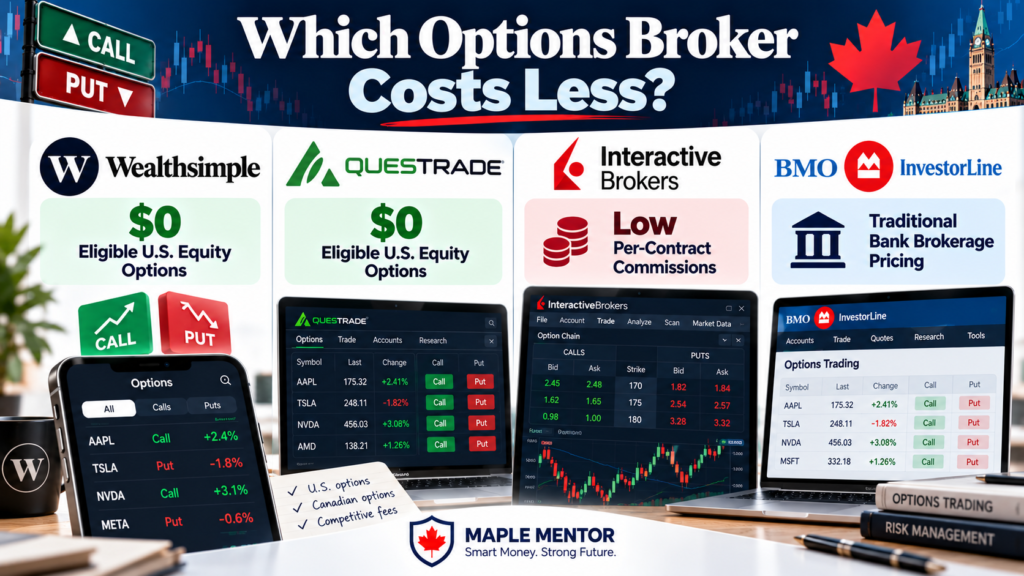
For eligible U.S. equity options, the advertised contract fees are:
| Platform | Contract Fee |
|---|---|
| Wealthsimple | $0 |
| Questrade | $0 |
| Interactive Brokers | Generally USD $0.25–$0.65 |
| BMO InvestorLine | Approximately $0.90 |
Wealthsimple and Questrade have the lowest advertised contract fees in this category.
However, this doesn’t necessarily mean every options transaction costs exactly $0.
Exchange, regulatory, exercise, assignment, or other applicable fees can affect total costs.
Canadian Equity Options
The comparison changes for Canadian-listed options.
| Platform | Canadian Options |
|---|---|
| Wealthsimple | Not currently supported |
| Questrade | CAD $0.99/contract |
| Interactive Brokers | From CAD $1.25/contract |
| BMO InvestorLine | Supported; confirm applicable pricing |
Questrade is particularly competitive for Canadian options based on its advertised contract pricing.
Interactive Brokers may still appeal to traders who need its more advanced analytics and execution tools.
Example: Buying 10 U.S. Options Contracts
Suppose you purchase 10 U.S. equity-options contracts in one order.
Assume the contracts have premiums of at least USD $0.10 and qualify for each platform’s standard advertised pricing.
| Platform | Illustrative Contract Commission |
|---|---|
| Wealthsimple | $0 |
| Questrade | $0 |
| Interactive Brokers | Approximately USD $6.50 |
| BMO InvestorLine | Approximately $9.00 |
This example compares advertised contract commissions only. It excludes any applicable minimums, exchange fees, regulatory fees, currency conversion, and exercise or assignment charges.
If you open and later close a similar position, contract commissions may apply to both transactions.
Why Exercise and Assignment Fees Matter
An options contract doesn’t always end with a simple buy or sell transaction.
Depending on the contract and strategy, an option may be exercised or assigned.
This can trigger additional charges and potentially create a stock position.
For example, Questrade lists a $24.95 exercise fee.
BMO InvestorLine lists a $43 minimum commission for certain exercise or assignment transactions.
A trader who frequently holds options through expiration should consider these charges.
The lowest advertised contract commission doesn’t always produce the lowest total trading cost.
Best Options Trading Platform Canada for Beginners
For someone new to options, Wealthsimple and Questrade are reasonable platforms to compare first.
However, an important distinction is necessary.
A beginner-friendly platform doesn’t make options trading a beginner-friendly investment strategy.
Options can expire worthless, and some strategies can expose investors to substantial losses.
Before trading, investors should understand the relationship between the underlying security, strike price, expiration date, and option premium.
Why Wealthsimple May Be Easier
Wealthsimple’s interface is designed to be approachable.
Its options functionality is integrated into the broader investing platform.
For someone who already owns stocks and ETFs through Wealthsimple, learning the platform may be relatively straightforward.
The $0 contract fee also simplifies part of the pricing comparison.
Why Questrade May Be Better for Learning More Advanced Trading
Questrade provides access to Canadian and U.S. options alongside more traditional brokerage tools.
For someone interested in learning about options chains, order types, and more complex trading functionality, Questrade may provide additional flexibility.
However, investors should avoid using advanced features before understanding their risks.
My Recommendation for Newer Options Traders
If your priority is a straightforward platform for eligible U.S. equity options, Wealthsimple is worth considering.
If you want Canadian options and a more traditional brokerage experience, Questrade may be more suitable.
Before placing real trades, consider studying options mechanics and practising with a paper-trading account where available.
Best Options Trading Platform Canada for Active Traders
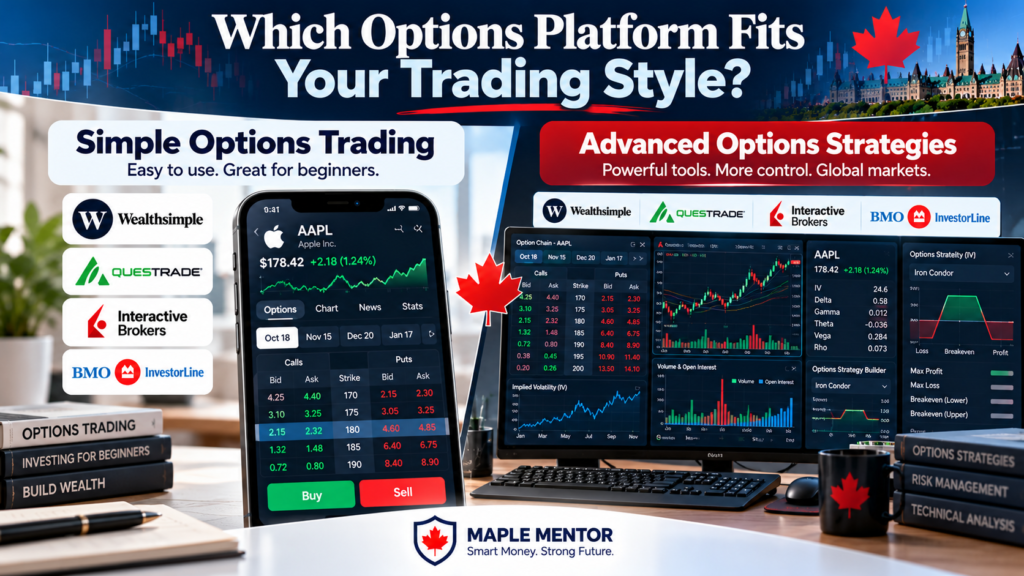
For active options traders, Interactive Brokers deserves particular attention.
The reason isn’t simply commissions.
It’s the combination of sophisticated tools, execution functionality, and market access.
Why Advanced Tools Matter
Imagine two investors trading options.
The first occasionally buys a call option on a company they follow.
The second manages several multi-leg positions, monitors implied volatility, and adjusts exposure as market conditions change.
These investors need different platforms.
The first may prioritize simplicity and low commissions.
The second may prioritize advanced options analytics, real-time data, detailed Greeks, and sophisticated order types.
Interactive Brokers is better positioned for the second type of trader.
When Questrade May Be Enough
Not every active trader needs IBKR’s full range of capabilities.
Someone primarily trading Canadian and U.S. options may find Questrade’s pricing and tools sufficient.
Its commission structure can also be attractive for frequent U.S. equity-options transactions.
When BMO InvestorLine Makes Sense
BMO may be suitable for investors who prefer trading through an established bank brokerage.
However, active traders should pay close attention to total transaction costs, especially exercise and assignment fees.
For a broader comparison of investing platforms, see our Best Online Brokers in Canada guide.
Wealthsimple vs Questrade for Options Trading
Wealthsimple and Questrade are two of the most interesting options trading platforms in Canada because both now advertise $0 contract fees for eligible U.S. equity options.
However, their platforms have meaningful differences.
Wealthsimple: Better for Simplicity
It may be more attractive if you:
- Primarily trade eligible U.S. equity and ETF options.
- Prefer a straightforward mobile or desktop interface.
- Already use Wealthsimple for stocks and ETFs.
- Want $0 eligible equity-options contract fees.
- Don’t need access to Canadian-listed options.
Wealthsimple has expanded its supported options strategies, making it more capable than it was when options trading first launched on the platform.
However, Canadian-listed options remain an important limitation.
Questrade: Better for Canadian Options and Trading Flexibility
Questrade may be more suitable if you:
- Want to trade Canadian-listed options.
- Want access to eligible U.S. index options.
- Prefer a traditional brokerage environment.
- Need additional trading controls.
- Want competitive options pricing without moving to a more complex platform.
Its current contract fees make it particularly attractive for investors trading both Canadian and U.S. options.
Wealthsimple vs Questrade: Which Wins?
For simple U.S. equity-options trading, Wealthsimple is appealing because of its interface and $0 contract fees.
For investors who want broader options availability and more traditional trading tools, Questrade has an advantage.
My preference would be Wealthsimple for simplicity and Questrade for flexibility.
Questrade vs Interactive Brokers for Options Trading
Questrade and Interactive Brokers appeal to somewhat different types of options traders.
Both provide access to Canadian and U.S. options, but their trading infrastructure and pricing structures differ.
Why Choose Questrade?
Questrade’s main advantages include competitive contract pricing, Canadian options availability, and a relatively accessible brokerage experience.
Its $0 contract fees for eligible U.S. equity options are particularly attractive.
For investors who don’t need sophisticated international trading capabilities, Questrade may provide everything necessary.
Why Choose Interactive Brokers?
Interactive Brokers offers more extensive options analytics, advanced order types, global market access, and sophisticated strategy-building functionality.
For experienced traders, these features can be valuable.
IBKR also supports paper trading and detailed analysis of options Greeks and implied volatility.
However, it generally charges contract commissions.
Questrade vs IBKR: Which Is Better?
For investors prioritizing low advertised commissions on U.S. equity options, Questrade has an advantage.
For sophisticated traders who need professional-grade tools, Interactive Brokers is likely the stronger choice.
The decision depends on whether advanced capabilities justify the additional complexity and transaction costs.
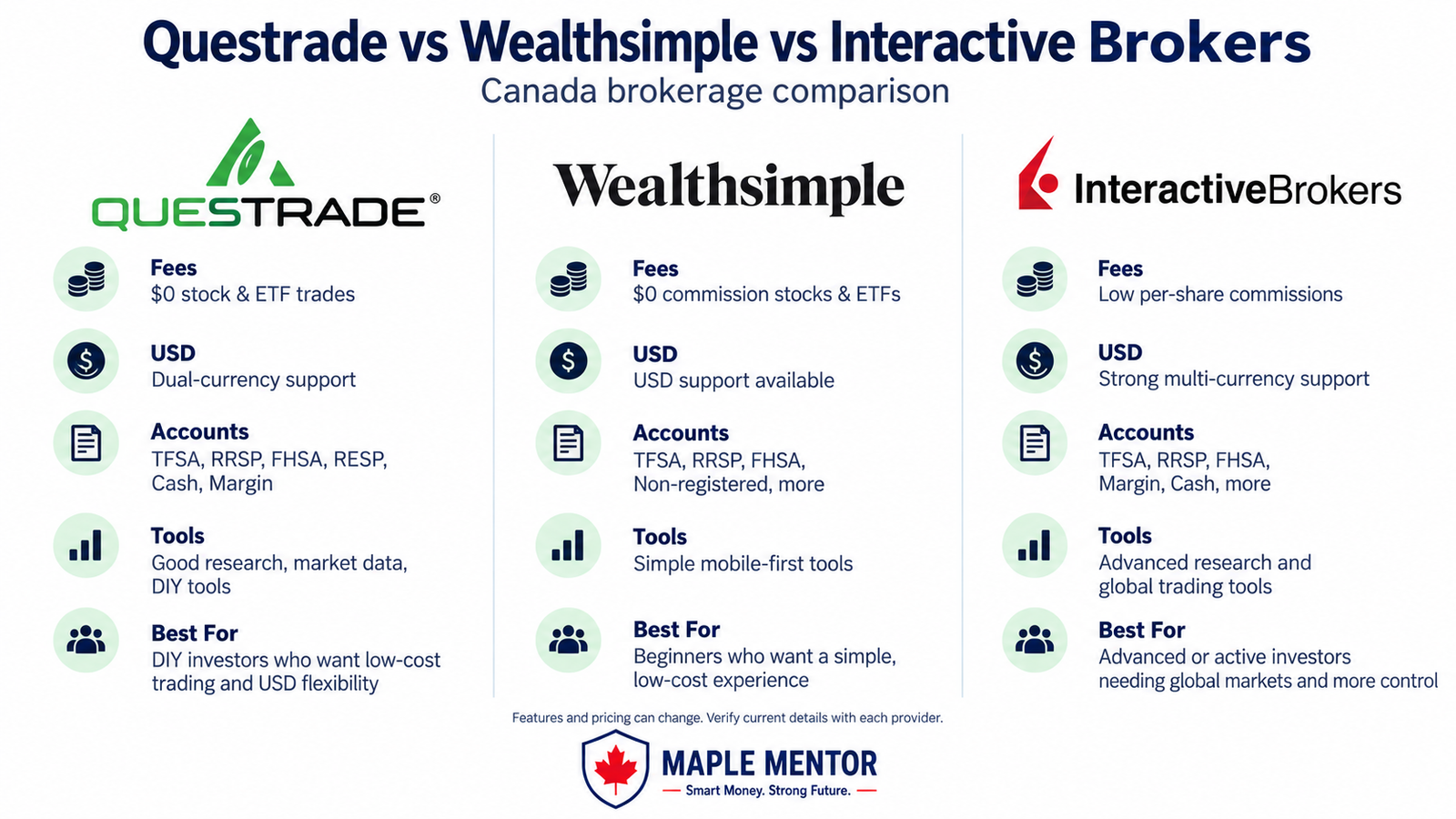
Investors comparing all three major independent brokerages can also read our Questrade vs Wealthsimple vs Interactive Brokers comparison.
Can You Trade Options in a TFSA or RRSP in Canada?
Yes, certain options strategies can be permitted in Canadian registered accounts, including TFSAs and RRSPs.
However, not every options strategy is allowed in a registered account.
This is an important consideration when choosing an options trading platform in Canada.
Options Strategies That May Be Permitted
Depending on the registered account, brokerage, and applicable tax rules, permitted strategies may include:
- Purchasing call options.
- Purchasing put options.
- Writing covered calls against eligible securities already held in the account.
Additional restrictions can apply.
For example, an option must meet the applicable qualified-investment requirements, and the brokerage must permit the transaction.
Options Strategies That May Be Restricted
Registered accounts generally face restrictions involving borrowing, margin, and certain options-writing strategies.
For example, uncovered options writing and strategies requiring margin are generally unsuitable or unavailable in TFSAs and RRSPs.
Cash-secured puts should not be assumed permissible simply because sufficient cash is available. Registered-account rules can prohibit put writing even when the position is cash-secured.
Some advanced multi-leg strategies may also be restricted.
Why Brokerage Approval Matters
Even if a particular strategy is permitted under Canadian tax rules, your brokerage may impose additional restrictions.
Options trading typically requires an approval process.
Your permitted strategies may depend on:
- Account type.
- Trading experience.
- Financial circumstances.
- Options approval level.
- Brokerage-specific policies.
For official guidance on qualified investments and registered accounts, consult the Canada Revenue Agency.
Important: Don’t assume that a strategy available in a margin account is also permitted in your TFSA or RRSP.
What to Look for in an Options Trading Platform in Canada
Choosing an options brokerage involves more than finding the lowest advertised commission.
Here are the most important factors to evaluate.
1. Contract Commissions
Compare the fees charged when opening and closing options positions.
Remember that some platforms charge minimum commissions per order.
For traders placing small orders, minimum commissions can significantly affect costs.
2. Exercise and Assignment Fees
These fees can become important when options are exercised or assigned.
A platform with low contract commissions may still charge substantial fees when a position reaches expiration.
3. Canadian and U.S. Options Availability
Not every brokerage supports options on Canadian-listed securities.
If you want to trade options on Canadian companies or ETFs, verify availability before opening an account.
4. Supported Options Strategies
Some platforms focus on basic calls and puts.
Others support complex multi-leg strategies, spreads, and advanced order types.
Choose a platform that supports your intended strategies.
5. Options Analytics
Experienced traders may benefit from detailed options chains, Greeks, implied-volatility analysis, and probability-based tools.
Interactive Brokers is particularly strong in this category.
6. Paper Trading
Paper trading allows investors to practise strategies without risking real money.
However, simulated trading cannot perfectly reproduce live market conditions.
7. Currency Conversion
Canadian investors trading U.S. options should understand how their brokerage handles CAD/USD conversion.
Currency-conversion charges can affect total profitability.
8. Registered-Account Support
If you intend to trade options in a TFSA or RRSP, confirm which strategies are permitted.
Brokerage approval and Canadian tax rules both matter.
9. Platform Usability
A sophisticated platform isn’t necessarily better if you find it difficult to navigate.
Choose a brokerage whose tools match your experience and trading requirements.
Best Options Trading Platform Canada: Which Should You Choose?
The best choice depends on your experience, trading style, and preferred options markets.
| Type of Investor | Platform to Consider | Main Reason |
|---|---|---|
| Newer options trader | Wealthsimple | Simpler interface |
| Wants $0 U.S. equity-options contract fees | Wealthsimple or Questrade | Competitive headline pricing |
| Wants Canadian-listed options | Questrade, IBKR, or BMO | Canadian options availability |
| Wants U.S. index options | Questrade or IBKR | Broader index-options support |
| Advanced options trader | Interactive Brokers | Sophisticated trading tools |
| Wants detailed options analytics | Interactive Brokers | Greeks, volatility tools, and strategy analysis |
| Wants traditional brokerage functionality | Questrade | Balance of pricing and features |
| Already invests through BMO | BMO InvestorLine | Existing bank brokerage relationship |
| Wants international options markets | Interactive Brokers | Extensive global access |
| Wants the simplest experience | Wealthsimple | Straightforward platform design |
These recommendations aren’t absolute.
For example, a newer trader who specifically wants Canadian-listed options may prefer Questrade over Wealthsimple.
An experienced trader who only uses straightforward U.S. equity-options strategies may find Wealthsimple’s low fees appealing.
Someone trading complex strategies regularly may value Interactive Brokers’ analytical capabilities enough to justify its commissions.
The best approach is to identify the strategies you intend to trade, calculate your expected total costs, and compare the available tools.
Final Verdict: Best Options Trading Platforms in Canada
Finding the best options trading platform Canada offers requires looking beyond advertised contract fees.
Wealthsimple, Questrade, Interactive Brokers, and BMO InvestorLine each serve different investor needs.
Wealthsimple is my preferred choice for investors who prioritize simplicity.
Its straightforward interface and $0 eligible U.S. equity-options contract fees make it attractive for people who want to trade supported options without navigating a complex professional platform.
However, its lack of Canadian-listed options is an important limitation.
Questrade offers one of the strongest balances between pricing and functionality.
Its $0 U.S. equity-options contract fees, competitive Canadian options pricing, and traditional brokerage tools make it appealing to investors who want more flexibility.
Interactive Brokers is my preferred choice for sophisticated options traders.
Its advanced analytics, options strategy tools, international market access, and professional trading functionality make it particularly attractive for experienced investors.
BMO InvestorLine is worth considering for investors who prefer a major Canadian bank brokerage.
However, its exercise and assignment fees deserve careful attention.
If I had to summarize the comparison:
- Best for simplicity: Wealthsimple.
- Best balance of fees and features: Questrade.
- Best for advanced traders: Interactive Brokers.
- Best for existing bank brokerage users: BMO InvestorLine.
Ultimately, the right brokerage depends on your trading experience, strategies, and total transaction costs.
And regardless of which platform you choose, understanding options risk is far more important than saving a few dollars in commissions.
Frequently Asked Questions
What Is the Best Options Trading Platform in Canada?
The best options trading platform depends on your needs.
Wealthsimple is attractive for simpler U.S. options trading, Questrade offers competitive pricing and Canadian options, Interactive Brokers provides advanced tools, and BMO InvestorLine offers options trading through a traditional bank brokerage.
For experienced options traders, Interactive Brokers is particularly compelling.
Does Wealthsimple Charge Fees for Options?
Wealthsimple currently advertises $0 contract fees for eligible equity and ETF options.
However, other charges may apply, including certain index-options fees and early-exercise fees.
Investors should review the current fee schedule before trading.
Are Options Free on Questrade?
Questrade currently lists $0 contract fees for eligible U.S. equity options.
Canadian options generally cost CAD $0.99 per contract, while U.S. index options cost USD $0.99 per contract.
Exercise fees and other charges may still apply.
Is Interactive Brokers Good for Options Trading?
Yes.
Interactive Brokers offers extensive options analytics, advanced order types, strategy-building tools, and access to international markets.
It is particularly attractive for experienced traders who need sophisticated functionality.
However, it generally charges options commissions.
Does BMO InvestorLine Offer Options Trading?
Yes.
BMO InvestorLine supports options trading through its self-directed investing platform.
Its advertised options pricing includes approximately $0.90 per contract, but investors should review applicable minimum commissions and exercise or assignment charges.
Can Canadians Trade Options in a TFSA?
Certain options strategies can be permitted in a TFSA, including eligible long calls, long puts, and covered calls.
However, restrictions apply, and many strategies involving margin or uncovered options writing are prohibited or unavailable.
Investors should verify CRA rules and their brokerage’s account-specific permissions.
Which Canadian Brokerage Is Cheapest for Options Trading?
For eligible U.S. equity options, Wealthsimple and Questrade currently advertise $0 contract fees.
For Canadian-listed options, Questrade’s advertised CAD $0.99 contract pricing is competitive.
However, total costs depend on order minimums, currency conversion, exercise and assignment fees, and other applicable charges.