
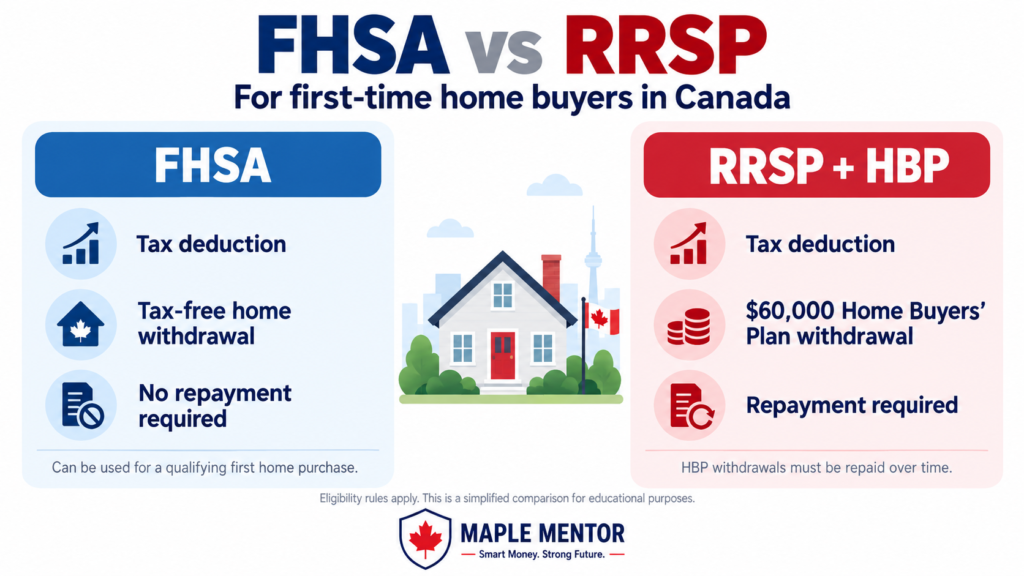
Saving for a first home in Canada creates an important question: should you prioritize your First Home Savings Account (FHSA), your Registered Retirement Savings Plan (RRSP), or both?
For many eligible first-time home buyers comparing FHSA vs RRSP, the FHSA is the logical account to consider first.
It combines two major tax advantages: eligible contributions are generally tax-deductible, while qualifying withdrawals used to buy a first home are tax-free. Unlike money withdrawn from an RRSP through the Home Buyers’ Plan (HBP), a qualifying FHSA withdrawal doesn’t need to be repaid.
That doesn’t make the RRSP irrelevant.
The HBP currently allows eligible participants to withdraw up to $60,000 from their RRSP toward a qualifying home. Even better, eligible buyers can combine an HBP withdrawal with a qualifying FHSA withdrawal for the same home.
For many first-time buyers, the question therefore isn’t necessarily FHSA or RRSP.
It may be FHSA first, then RRSP.
Quick Answer
For many eligible Canadians comparing FHSA vs RRSP for a first home, consider prioritizing the FHSA first.
The FHSA currently provides:
- $8,000 of participation room in the year you open your first FHSA
- A $40,000 lifetime FHSA limit
- Generally deductible contributions
- Tax-free qualifying withdrawals
- No repayment requirement on qualifying withdrawals
CRA: First Home Savings Account (FHSA)
The RRSP can complement the FHSA through the Home Buyers’ Plan.
The HBP currently lets an eligible participant withdraw up to $60,000 from RRSPs. Unlike an FHSA qualifying withdrawal, however, HBP withdrawals generally create a repayment obligation.
One important exception to the “FHSA first” approach is an employer RRSP match. If your employer matches part of your RRSP contribution, capturing that match before directing additional savings toward your FHSA can make sense.
Your income, available contribution room, existing RRSP balance, employer benefits, and home-buying timeline all matter.
FHSA vs RRSP at a Glance
| Feature | FHSA | RRSP / Home Buyers’ Plan |
|---|---|---|
| Contributions tax-deductible? | Generally, yes | Generally, yes, subject to available deduction room |
| New annual room | Generally $8,000 after opening, subject to FHSA rules | Based largely on earned income and available RRSP room |
| Lifetime FHSA contribution/transfer limit | $40,000 | No equivalent lifetime RRSP contribution limit |
| First-home withdrawal | Qualifying withdrawal can be tax-free | HBP withdrawal can be made without immediate tax |
| Current home withdrawal limit | No separate withdrawal cap beyond eligible FHSA property | $60,000 per eligible HBP participant |
| Repayment required? | No for qualifying withdrawal | Generally yes |
| Standard repayment period | N/A | 15 years |
| If you don’t buy | Can generally transfer directly to RRSP/RRIF under applicable conditions | Remains retirement savings |
| Investment options | Depends on provider | Depends on provider |
The FHSA’s $40,000 lifetime limit relates to contributions and transfers into the FHSA. Investment growth inside the account can mean the amount eventually available for a qualifying withdrawal is higher than $40,000.
How the FHSA Works for First-Time Buyers
The FHSA was specifically designed to help eligible Canadians save for a first home.
That gives it an unusual combination of characteristics normally associated separately with RRSPs and TFSAs.
$8,000 of Initial Participation Room
Your FHSA participation room in the year you open your first account is currently $8,000.
One detail is particularly important:
FHSA room doesn’t begin accumulating simply because you’re old enough to open one.
Your participation period starts when you actually open your first FHSA.
Unused participation room can be carried forward subject to the FHSA rules, but the carryforward mechanics aren’t the same as a TFSA.
$40,000 Lifetime Limit
The current lifetime FHSA limit is $40,000.
Opening multiple FHSAs doesn’t multiply your available room. Your participation room applies across your FHSAs.
Contributions Can Generally Be Deducted
Eligible FHSA contributions can generally be deducted from income.
For example, someone contributing $8,000 may potentially claim an $8,000 FHSA deduction, subject to the applicable rules.
The value of that deduction depends on your taxable income and marginal tax rate.
Also note that transferring money from an RRSP directly into an FHSA does not create another tax deduction. CRA specifically states that RRSP-to-FHSA transfers cannot be claimed as FHSA deductions.
Qualifying Withdrawals Are Tax-Free
If you meet the conditions for a qualifying withdrawal, CRA says you can withdraw property from your FHSA without including that withdrawal in taxable income.
That means you potentially receive:
Tax deduction going in + tax-free qualifying withdrawal coming out.
That’s the central attraction of the FHSA.
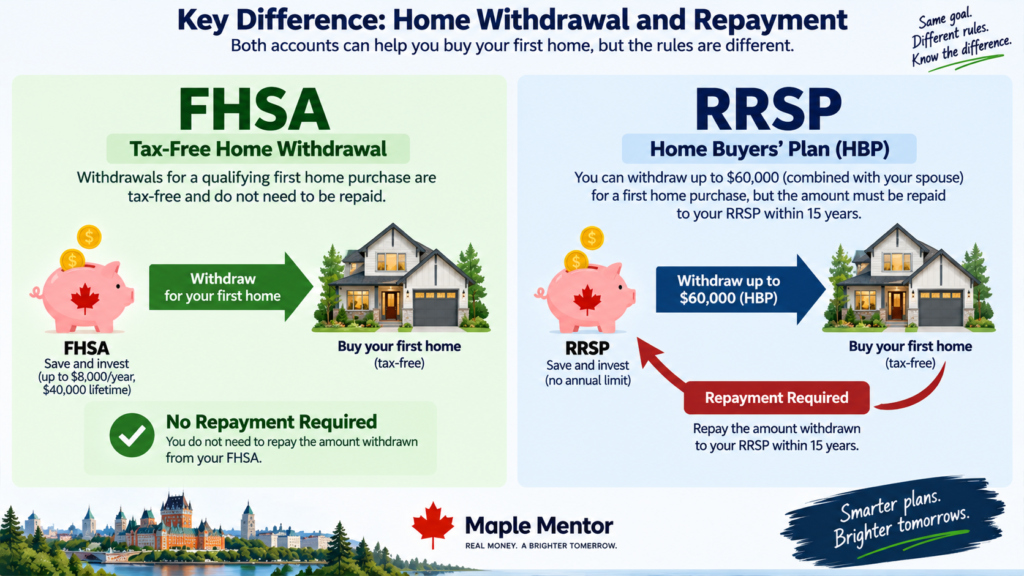
You Don’t Repay a Qualifying FHSA Withdrawal
This is a major distinction in the FHSA vs RRSP comparison.
CRA explicitly states that qualifying FHSA withdrawals do not need to be repaid.
Once you’ve used the money toward your qualifying first home and met the requirements, you don’t spend the next 15 years rebuilding an FHSA balance.
For more on choosing investments and managing your timeline, read FHSA Investing Strategy for First-Time Buyers.
How the RRSP Home Buyers’ Plan Works
The RRSP wasn’t designed primarily for buying a house.
Its primary purpose is retirement savings.
However, the Home Buyers’ Plan provides an exception that allows eligible participants to withdraw money from their RRSPs toward buying or building a qualifying home.
Current HBP Limit: $60,000
The current HBP withdrawal limit is $60,000 per eligible participant.
That’s substantially more than the FHSA’s $40,000 lifetime contribution/transfer limit.
But remember: the two numbers don’t mean the same thing.
The FHSA’s $40,000 figure is a lifetime contribution/transfer limit. The $60,000 HBP figure is the maximum amount you can currently withdraw under the HBP.
HBP Withdrawals Generally Have to Be Repaid
Here’s the major trade-off.
HBP withdrawals create a balance that generally must be repaid over a 15-year repayment period.
Amounts designated as HBP repayments aren’t deductible RRSP contributions. CRA also notes that repayments don’t affect your RRSP deduction limit.
So if you’re required to repay $3,000 toward your HBP and contribute $3,000 to your RRSP for that purpose, you don’t receive another RRSP deduction on that designated repayment.
Current Temporary Repayment Relief
There’s an important current rule that older articles may not reflect.
CRA says that for individuals making their first HBP withdrawal between January 1, 2026 and December 31, 2028, the start of the 15-year repayment period is temporarily deferred until the fifth year following the year of the first withdrawal.
For example, someone making their first HBP withdrawal in 2026 would begin repayments in 2031.
Because HBP rules have changed several times, check the CRA’s current guidance when you’re actually preparing to buy.
FHSA vs RRSP Tax Benefits
This is where the comparison gets interesting.
Both accounts can potentially provide an income-tax deduction when you make eligible contributions.
But what happens when the money comes out is different.
FHSA
With an eligible FHSA contribution:
Contribution → potentially deductible
Investment growth → sheltered inside the account
Qualifying home withdrawal → tax-free
Repayment → none
RRSP + HBP
With an eligible RRSP contribution:
Contribution → potentially deductible
Investment growth → tax-deferred inside the RRSP
Eligible HBP withdrawal → no immediate tax
Repayment → generally required
That last line is the key distinction.
Suppose you withdraw $40,000 from your FHSA through a qualifying withdrawal.
You don’t have to put $40,000 back.
If you withdraw $40,000 from your RRSP through the HBP, you’re generally creating a $40,000 HBP balance that will eventually need to be dealt with under the repayment rules.
That’s one reason the FHSA can be particularly attractive for eligible first-time buyers.
Which Should You Contribute to First?
There’s no rule requiring you to prioritize one account over the other.
But several scenarios can make the decision easier.
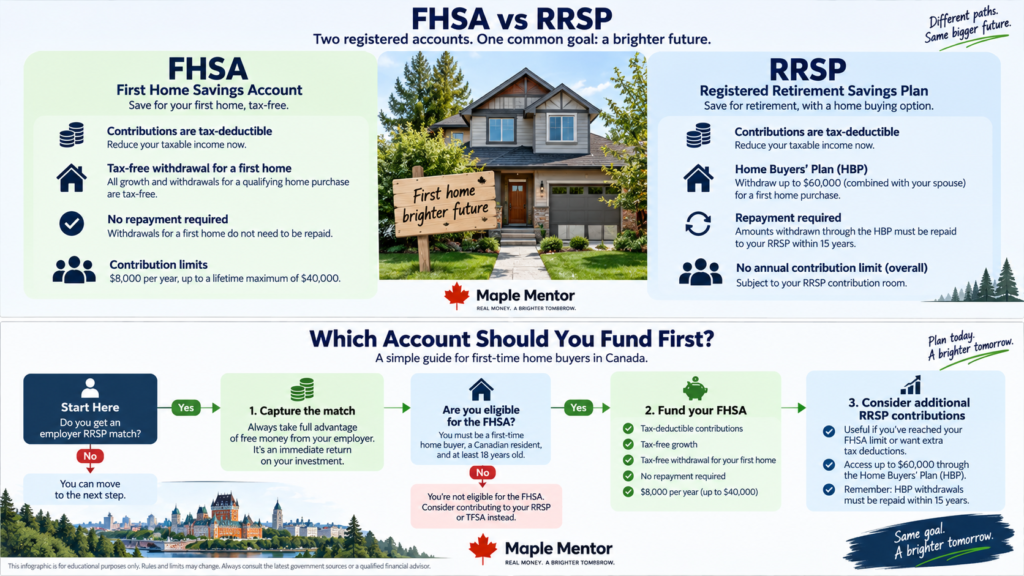
FHSA May Make More Sense First If:
You:
- Qualify to open an FHSA
- Have FHSA participation room
- Are genuinely planning to buy your first home
- Don’t have an employer RRSP match that you’re giving up
- Want the combination of a potential deduction and qualifying tax-free withdrawal
- Want to avoid an HBP repayment obligation
For many first-time buyers, these features make the FHSA the natural starting point.
RRSP May Matter More If:
You:
- Already have substantial RRSP savings
- Receive an employer RRSP match
- Have already maximized your FHSA
- Have additional money available after funding your FHSA
- Are also prioritizing retirement savings
Employer matching deserves special attention.
Suppose your employer will match $2,000 of RRSP contributions.
Skipping that match solely because you’re trying to maximize your FHSA may mean giving up employer compensation.
A possible priority could therefore look like:
1. Capture available employer RRSP match
2. Fund FHSA
3. Consider additional RRSP contributions
That’s not universally optimal, but it illustrates why “always max the FHSA before contributing $1 to an RRSP” is too simplistic.
Can You Use Both an FHSA and RRSP?
Yes.
This is one of the most important facts for Canadians comparing FHSA vs RRSP.
CRA explicitly permits an eligible buyer to make a qualifying FHSA withdrawal and an HBP withdrawal for the same qualifying home, provided all requirements for both are satisfied.
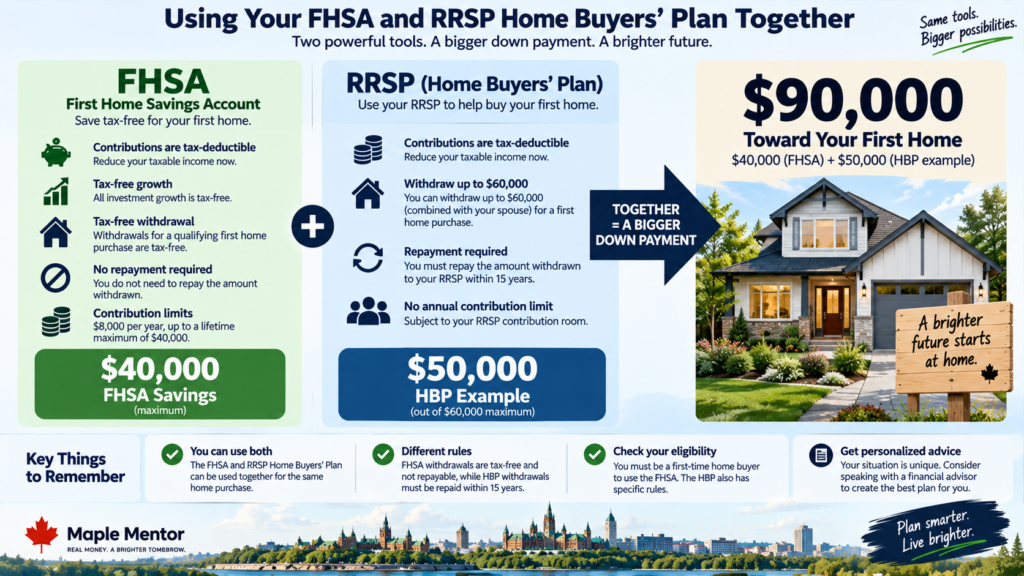
FHSA + HBP Example
Suppose you’ve accumulated:
FHSA: $40,000
and:
RRSP available through HBP: $50,000
Assuming you satisfy all applicable requirements, you could potentially use:
$40,000 FHSA qualifying withdrawal
+ $50,000 HBP withdrawal
= $90,000
toward your home purchase.
The $40,000 FHSA withdrawal would not require repayment.
The $50,000 HBP withdrawal would generally create an HBP balance subject to its repayment rules.
And if your FHSA investments had grown beyond your contributions, a qualifying withdrawal could potentially exceed the amount you originally contributed because CRA allows all property in the FHSA to be withdrawn when the qualifying conditions are satisfied.
For a couple where both people independently qualify for the programs, the potential combined resources can be larger still.
What Happens If You Never Buy a Home?
This is another major advantage of the FHSA.
Opening one doesn’t necessarily leave you with a useless account if your plans change.
Your maximum FHSA participation period generally ends on December 31 of the year in which the earliest applicable event occurs, including the 15th anniversary of opening your first FHSA or the year you turn 71. Different timing applies after a qualifying withdrawal.
Before the account must close, remaining FHSA property can generally be directly transferred to your RRSP or RRIF on a tax-deferred basis when the applicable conditions are satisfied.
Importantly, a qualifying direct transfer from your FHSA to your RRSP or RRIF generally doesn’t require you to have corresponding unused RRSP deduction room.
That creates an interesting fallback.
Imagine you contribute to an FHSA for several years but ultimately decide to rent permanently.
Instead of withdrawing the balance as taxable income, you may be able to transfer it directly into an RRSP and continue using it for retirement.
Be careful with the word directly, though.
CRA distinguishes a direct institution-to-institution transfer from withdrawing the FHSA money yourself and then contributing it to another account. The latter can create tax consequences.
CRA: FHSA withdrawals and transfers
FHSA vs RRSP Example
Here’s a simplified way to think about different situations:
| Scenario | Account to Consider First |
|---|---|
| First home in 2–5 years | FHSA |
| Employer offers RRSP match | RRSP match, then consider FHSA |
| FHSA already maximized | RRSP |
| Already have a large RRSP | Consider FHSA + HBP |
| Unsure you’ll ever buy | FHSA can still retain retirement flexibility |
| Frequent U.S. investing | Account choice and investment choice should be considered separately |
| Home purchase very soon | Prioritize capital preservation over chasing returns |
This is a framework, not a universal contribution order.
Your income matters because tax deductions are worth different amounts at different marginal tax rates.
Your timeline also matters.
Someone buying a house in 15 years can generally tolerate more investment volatility than someone who needs their down payment next summer.
Don’t Ignore Your Home-Buying Timeline
Choosing the right account is only half of the decision.
You also have to decide what to hold inside it.
An FHSA is an account type, not an investment.
Depending on your provider, you may be able to hold investments such as:
- Cash
- High-interest savings products
- GICs
- ETFs
- Stocks
- Bonds
The same principle applies to an RRSP.
If your home purchase is potentially only one or two years away, putting your entire down payment into volatile equities can create a serious problem.
Imagine saving $50,000 and needing it next spring.
If the market falls 25%, your portfolio could temporarily drop to roughly:
$37,500
You may not have enough time to wait for a recovery.
Where to Invest Your Monthly bills in Canada can help you match your investment risk with your home-buying timeline.
The RRSP 89-Day Rule Matters
This is an easy mistake to make.
You might think:
“I’m buying a house soon. I’ll put $20,000 into my RRSP, claim the deduction, and immediately withdraw the $20,000 through the HBP.”
It isn’t necessarily that simple.
CRA has special rules for RRSP contributions made during the 89-day period immediately before an HBP withdrawal.
Depending on the value remaining in the RRSP after the HBP withdrawal, some or all of contributions made during that 89-day period may not be deductible.
CRA: Making withdrawals under the Home Buyers’ Plan
If you’re considering making a large RRSP contribution specifically because you intend to use the HBP shortly afterward, check this rule carefully before moving the money.
The FHSA doesn’t have an equivalent minimum holding period for a qualifying withdrawal. CRA states there is no minimum number of days that FHSA contributions or transfers must remain in the account before being used as part of a qualifying withdrawal, assuming all qualifying conditions are met.
Don’t Forget Contribution Limits
Tax advantages don’t eliminate contribution limits.
For an FHSA, your participation room applies across all FHSAs you own.
Opening:
FHSA #1 at Bank A
and:
FHSA #2 at Brokerage B
doesn’t give you twice the room.
CRA says the participation room applies across all of your FHSAs.
The same general concept matters for RRSPs: opening multiple RRSP accounts doesn’t multiply your personal contribution room.
Before making large contributions, verify your available room through your CRA records rather than estimating it.
Common Mistakes to Avoid
Ignoring FHSA Eligibility
The FHSA isn’t simply another general-purpose savings account.
You must satisfy the applicable eligibility conditions to open one and the qualifying withdrawal requirements to withdraw funds tax-free for a home.
Check the CRA’s current FHSA requirements before contributing.
Assuming HBP Withdrawals Never Need Repayment
An HBP withdrawal isn’t the same as an FHSA qualifying withdrawal.
HBP amounts generally need to be repaid according to the applicable schedule.
If you don’t make the required HBP repayment, the required amount can generally become taxable income for that year.
Making a Last-Minute RRSP Contribution Without Checking the 89-Day Rule
RRSP contributions made in the 89 days immediately before an HBP withdrawal can be subject to deduction restrictions.
Check before contributing.
Exceeding Your Contribution Room
Don’t assume opening another FHSA or RRSP creates additional room.
It doesn’t.
Investing Near-Term Down-Payment Money Too Aggressively
A 20% stock market decline is unpleasant for a retirement portfolio with a 30-year horizon.
It can be devastating for money you need to close on a home in six months.
Match risk to your timeline.
Forgetting That FHSA and RRSP Serve Different Primary Purposes
The FHSA is specifically designed around first-home saving.
The RRSP is primarily a retirement account that happens to provide eligible home buyers access through the HBP.
That distinction matters when deciding where long-term retirement assets should sit.
Transferring an RRSP to an FHSA and Expecting Another Deduction
A direct RRSP-to-FHSA transfer may be permitted when you have FHSA participation room, but CRA says the transferred amount isn’t deductible as an FHSA contribution.
You don’t get a second deduction on money that was already inside your RRSP.
Final Answer
When comparing FHSA vs RRSP for a first home, the FHSA has particularly attractive features for eligible buyers.
You can generally deduct eligible contributions, investments can grow inside the registered account, and qualifying withdrawals can be taken tax-free without repayment.
That makes the FHSA a logical account for many first-time buyers to consider prioritizing.
But that doesn’t mean you should ignore your RRSP.
An employer RRSP match may deserve priority. Existing RRSP savings can provide up to $60,000 per eligible participant through the current HBP rules, and CRA permits eligible buyers to combine an HBP withdrawal with an FHSA qualifying withdrawal toward the same qualifying home.
A reasonable framework for many buyers is:
Employer RRSP match → FHSA → additional RRSP/HBP savings
But your personal order should depend on your income, contribution room, existing investments, employer benefits, and expected purchase date.
The most important takeaway from FHSA vs RRSP is that these accounts don’t necessarily compete.
Used correctly, they can complement each other.
FAQ
Is an FHSA better than an RRSP for buying a first home?
For many eligible first-time buyers, an FHSA has particularly useful features because eligible contributions are generally deductible and qualifying withdrawals can be tax-free without repayment.
An RRSP can still provide additional down-payment funds through the HBP, particularly if you already have substantial RRSP savings.
Can I use an FHSA and the RRSP Home Buyers’ Plan together?
Yes.
CRA specifically states that you can make an HBP withdrawal and an FHSA qualifying withdrawal for the same qualifying home, provided you meet the conditions for both.
How much can I withdraw from my RRSP under the Home Buyers’ Plan?
The current HBP withdrawal limit is $60,000 per eligible participant.
Because government limits can change, verify the current amount with CRA before making a withdrawal.
Do I have to repay an FHSA withdrawal?
A qualifying FHSA withdrawal used for a qualifying home does not have to be repaid.
This is one of the biggest differences between the FHSA and an RRSP HBP withdrawal.
What happens to my FHSA if I never buy a home?
Eligible FHSA property can generally be transferred directly to an RRSP or RRIF on a tax-deferred basis before your maximum FHSA participation period ends.
Alternatively, a non-qualifying withdrawal can generally be made, but it would normally be taxable.
Can I transfer my RRSP to my FHSA?
A direct RRSP-to-FHSA transfer can be made subject to available FHSA participation room and the applicable rules.
However, the transfer does not create an FHSA tax deduction.