
Choosing an online brokerage in Canada has become more difficult, in a good way.
Competition has pushed trading costs lower while platforms have added better automation, registered accounts, U.S. dollar functionality, advanced trading tools, and access to more investments.
In the Questrade vs Wealthsimple vs Interactive Brokers comparison, there isn’t one brokerage that is automatically best for everyone.
For most beginners, Wealthsimple is likely the easiest option.
If you are more of along-term self-directed investors who want commission-free Canadian and U.S. stock and ETF trading combined with direct USD holding and a broad selection of Canadian account types, Questrade is a strong middle ground.
For active traders and investors who care heavily about foreign exchange costs, options, sophisticated trading tools, and global market access, Interactive Brokers (IBKR) is usually the most powerful of the three.
The right choice depends much more on how you invest than which brokerage has the most features.
Quick Answer
Here’s the simplest breakdown of Questrade vs Wealthsimple vs Interactive Brokers:
Best for most beginners: Wealthsimple
Wealthsimple offers $0 commissions on listed Canadian and U.S. securities, fractional investing, recurring investments, and a relatively straightforward platform. Its biggest consideration for U.S. investors is currency conversion. Wealthsimple currently charges a 1.5% FX fee for smaller CAD/USD conversions, although USD accounts can prevent repeated conversions once you hold USD.
Best middle ground: Questrade
Questrade now advertises $0 commissions to buy and sell Canadian- and U.S.-listed stocks and ETFs. It also allows investors to hold USD directly in registered accounts, which can be useful for Canadians regularly investing in U.S. securities.
Best for advanced and global investors: Interactive Brokers
Interactive Brokers charges commissions rather than offering blanket $0 Canadian stock trading. However, its commissions are low, its currency conversion costs are highly competitive, and clients can access more than 160 global markets.
Interactive Brokers Canada pricing
If you’re simply buying a diversified Canadian ETF every payday, you probably don’t need everything Interactive Brokers offers.
If you’re trading options, converting currencies frequently, or investing internationally, those additional capabilities can become much more valuable.
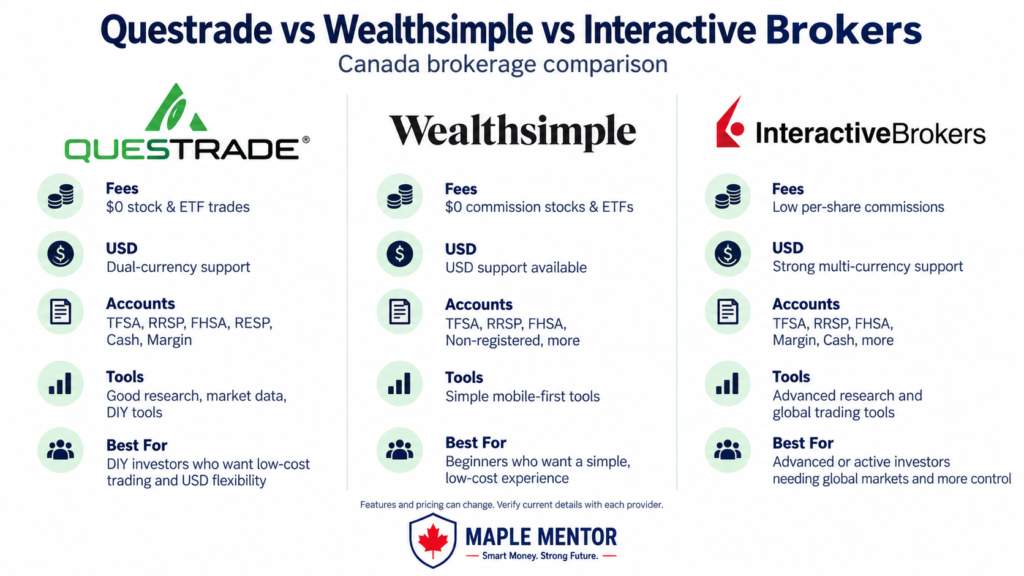
Questrade vs Wealthsimple vs Interactive Brokers at a Glance
| Feature | Questrade | Wealthsimple | Interactive Brokers |
|---|---|---|---|
| Canadian stock commissions | $0 | $0 | From CAD $0.008/share tiered |
| Canadian ETF commissions | $0 | $0 | From CAD $0.008/share tiered |
| U.S. stock/ETF commissions | $0 | $0 | Low per-share commissions |
| Account minimum | $0 | $0 | $0 |
| TFSA | Yes | Yes | Yes |
| RRSP | Yes | Yes | Yes |
| FHSA | Yes | Yes | Yes |
| Non-registered | Yes | Yes | Yes |
| USD holding | Yes | Available | Yes |
| FX | Conversion costs apply; USD can be held | 1.5% on smaller CAD/USD conversions | Particularly low-cost |
| Recurring investing | Automation available | Excellent | Available, but not the main attraction |
| Fractional investing | Available for eligible investments | Yes | Yes for eligible securities |
| Options | Yes | Yes | Excellent |
| Margin | Yes | Yes | Excellent |
| International markets | Some international capabilities | Primarily Canada/U.S. focused | 160+ markets |
| Research/tools | Strong middle ground | Simpler, but expanding | Most advanced |
| Beginner friendliness | Good | Excellent | Fair/Good |
| Advanced trading | Good | Improving | Excellent |
Current pricing can change, so always verify the brokerage’s latest fee schedule before opening or transferring an account.
Trading Fees
Trading commissions used to make this comparison much easier.
That’s no longer the case.
Questrade Trading Fees
Questrade currently charges $0 commissions to buy and sell Canadian- and U.S.-listed stocks and ETFs through its online platforms.
This is an important change from Questrade’s older pricing structure, under which ETF purchases were inexpensive or free while stock trades and ETF sales could carry commissions.
Today, a long-term ETF investor can make regular purchases without paying a standard trading commission.
Questrade also currently offers $0 commissions on U.S. equity options contracts, while Canadian options are listed at $0 commission plus CAD $0.99 per contract. Other fees can still apply.
Wealthsimple Trading Fees
Wealthsimple also charges:
$0 commission for listed Canadian securities
and:
$0 commission for listed U.S. securities
There are no standard commissions for buying and selling eligible Canadian or U.S. stocks and ETFs through self-directed investing.
Wealthsimple also supports fractional shares and recurring investments, making the $0 commission structure particularly useful for investors making small, frequent contributions.
Interactive Brokers Trading Fees
Interactive Brokers takes a different approach.
Canadian clients don’t receive the U.S.-resident IBKR Lite $0 commission structure.
Under IBKR’s Canadian tiered stock pricing, the first tier currently starts at:
CAD $0.008 per share
with a:
CAD $1 minimum per order
for Canadian stocks.
Fixed pricing begins at CAD $0.01 per share with the same CAD $1 minimum.
For U.S. securities, IBKR Pro tiered pricing starts at USD $0.0035 per share with a USD $0.35 minimum, while fixed pricing is USD $0.005 per share with a USD $1 minimum. Third-party fees can apply depending on the pricing model and transaction.
So if your only goal is zero commissions, Questrade and Wealthsimple have the advantage.
But trading commissions are only one cost.
For investors regularly converting Canadian dollars into U.S. dollars, FX costs can become more important.
U.S. Stocks and Currency Conversion
This is one of the most important sections of the Questrade vs Wealthsimple vs Interactive Brokers comparison.
Imagine you want to invest $20,000 in U.S. securities.
Saving a few dollars in commissions matters much less if converting the currency costs hundreds of dollars.
Wealthsimple and U.S. Dollars
Wealthsimple currently charges a currency conversion fee when converting between CAD and USD.
For conversions below $10,000, that fee is:
1.5%
The fee decreases for larger conversions, reaching 0% on individual conversions of $100,000 or more.
For example, ignoring changes in the underlying exchange rate:
$5,000 × 1.5% = $75
Once you have a USD account, you can trade U.S.-listed securities from your USD balance without converting the currency on every trade.
Core clients currently pay $10 per month for USD accounts after the free trial, while the feature is included for Premium and Generation clients.
This makes Wealthsimple much better for U.S. investing than a system that automatically converts your money every time you buy and sell.
But investors still need to consider the initial conversion cost.
Questrade and U.S. Dollars
Questrade allows investors to hold USD directly in registered accounts.
Once you hold U.S. dollars, you can use them to buy and sell U.S. securities without forcing a CAD/USD conversion every time you trade.
That’s a significant advantage for Canadians who regularly own U.S.-listed ETFs or stocks.
Questrade also supports journaling securities between their Canadian- and U.S.-dollar versions, which is relevant to investors using Norbert’s Gambit as an alternative method of converting larger amounts between CAD and USD. Questrade currently charges $9.95 for an online journaling request, while Questrade Plus includes free unlimited journaling.
That doesn’t mean Norbert’s Gambit is always cheaper or worthwhile. Bid-ask spreads, market movements, timing, subscription costs, and the amount being converted all matter.
But Questrade gives investors considerably more currency flexibility than a basic CAD-only investing account.
Interactive Brokers and U.S. Dollars
Currency conversion is one of Interactive Brokers’ strongest advantages.
IBKR GlobalTrader currently lists FX Auto Conversion at 3 basis points of trade value for new GlobalTrader clients.
Three basis points equals:
0.03%
For illustration:
$10,000 × 0.03% = $3
That’s dramatically different from a 1.5% conversion fee on the same amount.
However, IBKR offers multiple platforms and pricing structures, so don’t assume every currency transaction under every IBKR setup works identically. Check the pricing that applies to your specific account and transaction.
For Canadians frequently converting currencies, Interactive Brokers deserves serious consideration even if another brokerage offers “$0 commissions.”
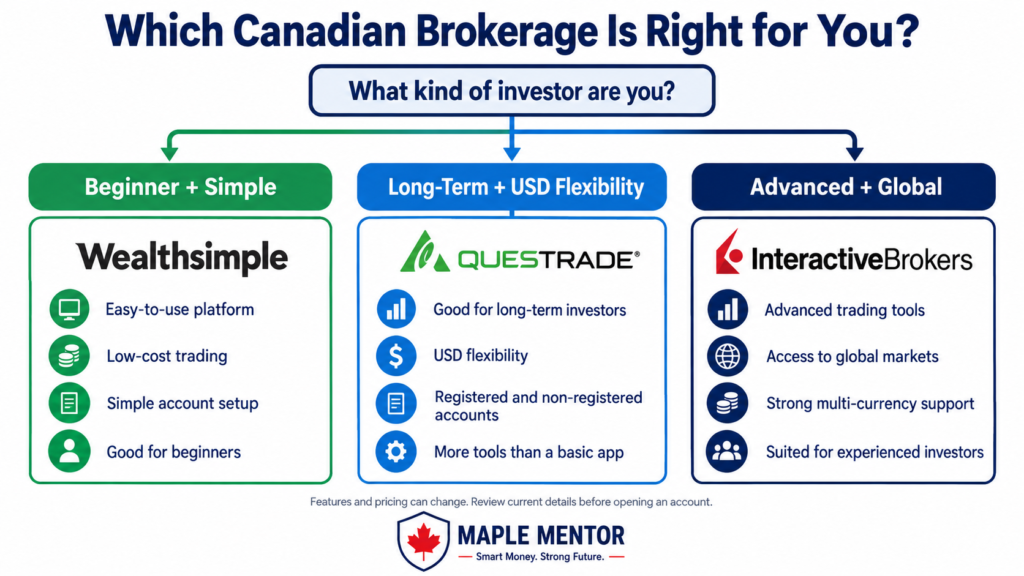
Which Is Best for Beginners?
For most beginners, Wealthsimple is probably the winner.
Its main advantages are straightforward.
Simple Investing Experience
The platform is designed to make self-directed investing relatively approachable.
You don’t need to understand a professional trading workstation just to buy an ETF.
$0 Stock and ETF Commissions
Small purchases don’t get eaten up by trading commissions.
Recurring Investing
Wealthsimple lets investors automatically purchase eligible stocks and ETFs on schedules including daily, weekly, biweekly, and monthly.
For example:
Every payday → $250 → XEQT
That can happen automatically.
Fractional Shares
Eligible investments can be purchased fractionally, allowing investors to start with small amounts. Wealthsimple advertises ETF investing starting from as little as $1.
For a beginner who wants to buy one diversified ETF regularly and leave it alone, that’s difficult to beat.
Before opening an account, read Is Wealthsimple Safe?
You can compare additional alternatives in Best Online Brokers in Canada.
If you’re still deciding what to invest in, start with Best ETFs for Beginners in Canada.
Questrade is still beginner-friendly. But its main advantages become more relevant once you want greater control over currencies, accounts, or trading tools.
Interactive Brokers can also be used by beginners, particularly through GlobalTrader, but its broader ecosystem is built to accommodate considerably more sophisticated investors.
Which Is Best for Long-Term ETF Investors?
This comparison is much closer than it used to be.
Previously, Questrade’s free ETF purchases made it particularly attractive for long-term ETF investors.
Now both Questrade and Wealthsimple offer $0 buying and selling commissions on eligible Canadian- and U.S.-listed ETFs.
So you need to look beyond commissions.
Wealthsimple Is Strong If You Want:
- Maximum simplicity
- Recurring ETF purchases
- Fractional ETF investing
- Small regular contributions
- A clean mobile experience
- Primarily Canadian-listed ETFs
Questrade Is Strong If You Want:
- Direct CAD and USD holding
- Strong registered-account selection
- More control over currency conversion
- A more traditional self-directed brokerage
- More advanced market data options
- Norbert’s Gambit functionality
For someone buying a Canadian-listed all-in-one ETF such as XEQT or VGRO every month, Wealthsimple’s simplicity is difficult to beat.
For someone who expects to own U.S.-listed ETFs, manage both CAD and USD, or eventually use more sophisticated brokerage features, Questrade becomes more compelling.
If you’re building a simple portfolio from scratch, Beginner Investment Portfolio Examples (Canada) can help you decide what that portfolio could actually look like.
Which Is Best for Active Traders?
Interactive Brokers is the strongest choice of these three for many serious active traders.
Why?
Advanced Order Types and Execution Tools
IBKR’s platforms are designed for much more sophisticated trading than simply placing market and limit orders.
Global Markets
Interactive Brokers provides access to stocks, options, futures, currencies, bonds, funds, and other products across more than 160 markets.
Options
Interactive Brokers has extensive options functionality and low per-contract pricing.
Margin
Margin trading is a core part of the platform, with tools designed for investors who actively manage leveraged positions.
Professional-Grade Platforms
IBKR offers mobile, web, GlobalTrader, Desktop, and Trader Workstation environments for different levels of sophistication.
Its newer IBKR Desktop platform includes functionality such as one-click order transmission while retaining access to its global product lineup.
That doesn’t automatically make it the right platform for you.
If your “trading” consists of buying XEQT twice per month, much of this functionality is unnecessary.
But if you’re actively trading stocks, options, currencies, or international securities, IBKR is operating in a different category.
Which Is Best for U.S. Stocks?
For occasional U.S. stock purchases, all three can work.
For frequent or substantial U.S. investing, I’d pay particularly close attention to Questrade and Interactive Brokers.
Wealthsimple
Pros:
- $0 stock commissions
- USD accounts available
- Easy interface
- Fractional investing
Main consideration:
- Currency conversion costs
Questrade
Pros:
- $0 commissions on Canadian/U.S.-listed stocks
- Hold USD directly
- No forced conversion once USD is held
- Norbert’s Gambit is practical
- Broader traditional brokerage functionality
Interactive Brokers
Pros:
- Very inexpensive FX
- Low trading commissions
- Direct currency functionality
- Global market access
- Advanced execution tools
For someone converting thousands of dollars between CAD and USD regularly, Interactive Brokers’ FX pricing can outweigh the appeal of commission-free trades elsewhere.
For a Canadian long-term investor who wants $0 trades while maintaining separate CAD and USD balances, Questrade provides an attractive compromise.
And for a beginner making occasional U.S. purchases, Wealthsimple may still be perfectly adequate.
The important point is this:
Don’t compare U.S. investing using commissions alone.
Compare commission + FX + USD account costs + your trading frequency.
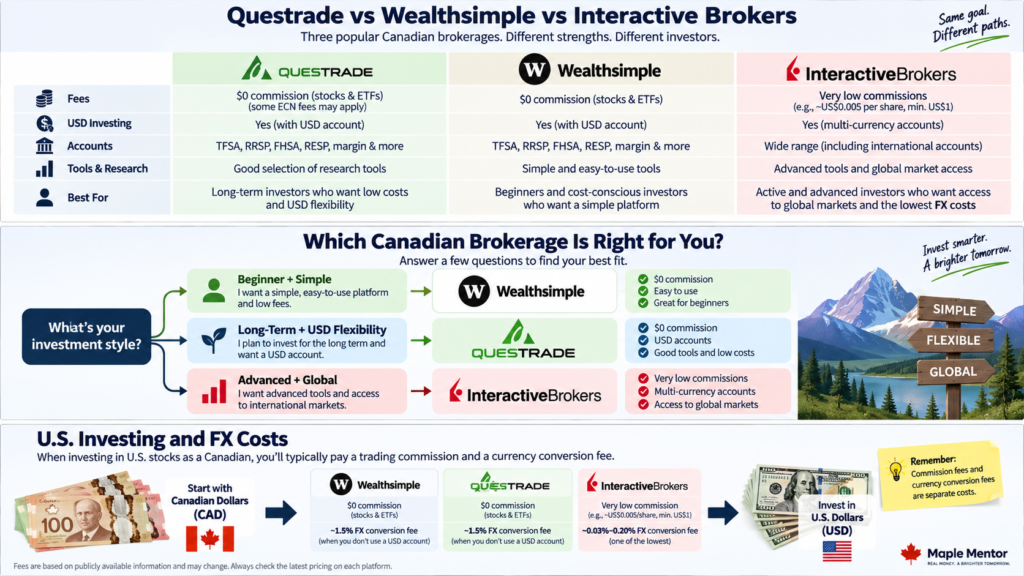
Account Types
All three platforms now cover the major registered accounts used by Canadian investors.
Questrade
Questrade offers account types including:
- TFSA
- RRSP
- FHSA
- RESP
- LIRA
- Cash
- Margin
and additional specialized accounts.
Wealthsimple
Wealthsimple offers the major accounts most individual investors need, including TFSA, RRSP, FHSA and non-registered investing, along with additional account types.
For many beginners, there won’t be a meaningful account-type disadvantage.
Interactive Brokers
Interactive Brokers Canada currently supports:
- Individual accounts
- Joint accounts
- Trust accounts
- RRSP
- Spousal RRSP
- RRIF
- TFSA
- FHSA
among its Canadian offerings.
Interactive Brokers Canada account information
Account availability can change, and specialized accounts may have restrictions, so verify your specific account before transferring assets.
Research and Trading Tools
If we rank these platforms primarily on advanced investing capabilities, I’d put them in this order:
1. Interactive Brokers
2. Questrade
3. Wealthsimple
But that ranking needs context.
Interactive Brokers Strongest Advanced Tools
IBKR offers sophisticated order types, trading platforms, global products, market data, research, screeners, options tools, and professional-grade functionality.
It’s the clear choice if advanced trading capabilities are the priority.
Questrade Strong Middle Ground
Questrade bridges the gap.
Its standard platform can accommodate beginners while offering additional tools for investors who want to become more sophisticated.
Real-time quotes are available for free, while additional market-data packages can add streaming U.S. data and Level 2 Canadian/U.S. market depth.
Wealthsimple Simplest Experience
Wealthsimple deliberately prioritizes ease of use.
However, “simple” shouldn’t be confused with “no tools.”
The platform has added features including real-time fractional trading, recurring investments, dividend reinvestment, 24/5 trading on eligible U.S. securities, options, margin, and additional active-trading functionality.
For many investors, that’s already enough.
More sophisticated isn’t automatically better.
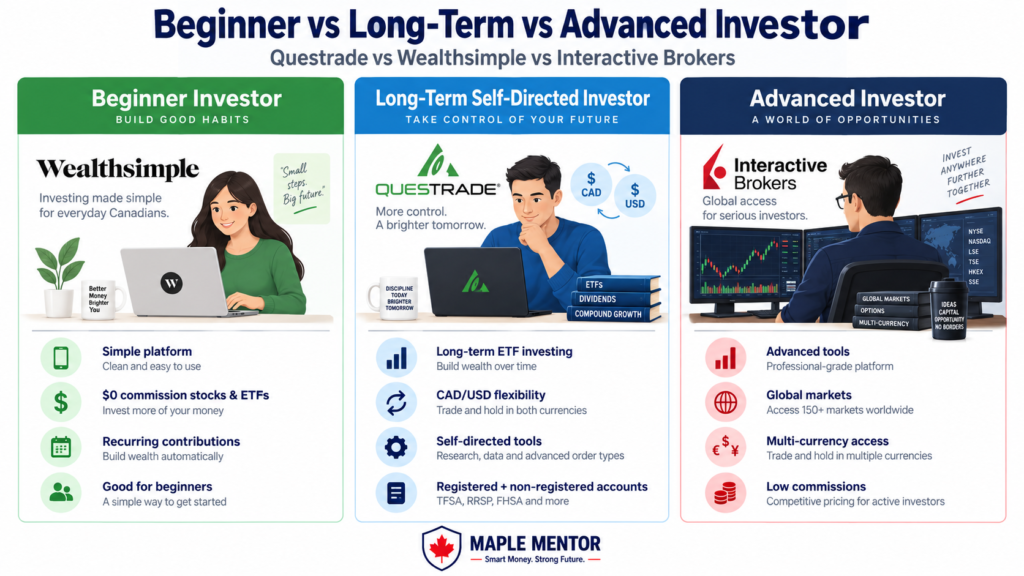
Questrade Pros and Cons
Pros
- $0 commissions on Canadian/U.S.-listed stocks and ETFs
- Hold CAD and USD
- Strong Canadian registered-account selection
- No minimum balance to open an account
- Norbert’s Gambit functionality
- More sophisticated than a basic investing app
- Good balance between beginner and advanced features
Cons
- Currency conversion still has costs
- Advanced market data can cost extra
- More complicated than Wealthsimple for someone who wants maximum simplicity
- International equity trading outside Canada/U.S. can be expensive
Questrade currently lists international equity trades at 1% of trade value with a USD $195 minimum, making it very different from IBKR for someone who wants extensive direct international-market access.
Wealthsimple Pros and Cons
Pros
- $0 Canadian/U.S. stock and ETF commissions
- Beginner-friendly
- Fractional investing
- Excellent recurring investment functionality
- Major Canadian registered accounts
- Increasing number of advanced features
- Easy fit for simple ETF portfolios
Cons
- Currency conversion can be expensive for smaller CAD/USD conversions
- Core USD accounts have a monthly cost
- Less global market access than IBKR
- Serious traders may prefer more specialized tools
For investors primarily buying Canadian-listed ETFs, many of these disadvantages may not matter.
Interactive Brokers Pros and Cons
Pros
- Extremely competitive FX
- Low stock commissions
- Advanced trading tools
- Excellent options functionality
- Broad currency support
- 160+ global markets
- Professional-grade execution capabilities
- Strong choice for active and international investors
Cons
- Not commission-free for Canadian clients
- More complicated pricing
- Steeper learning curve
- Many features are unnecessary for basic investors
- Interface can feel more intimidating than Wealthsimple
Interactive Brokers is a good example of why the “best” brokerage depends on the investor.
Its complexity can be a disadvantage for a beginner and an advantage for an experienced trader.
Which Broker Should You Choose?
After comparing Questrade vs Wealthsimple vs Interactive Brokers, I’d separate investors into three broad groups.
Choose Wealthsimple If:
You want:
- Maximum simplicity
- $0 stock and ETF commissions
- Automatic recurring investments
- Fractional shares
- A beginner-friendly experience
- A straightforward Canadian ETF portfolio
It’s probably the strongest default recommendation for someone opening their first self-directed investment account.
Choose Questrade If:
You want:
- $0 Canadian/U.S. stock and ETF commissions
- Easy CAD and USD holding
- More control over currency
- Strong Canadian registered-account support
- A traditional self-directed brokerage
- More tools without moving all the way to IBKR
- The ability to use Norbert’s Gambit
Questrade occupies a particularly attractive middle ground now that stock and ETF commissions have fallen to $0.
Choose Interactive Brokers If:
You:
- Trade frequently
- Convert currencies regularly
- Trade options
- Use margin
- Want advanced order types
- Invest directly in international markets
- Want professional-grade trading tools
- Care heavily about minimizing FX costs
IBKR isn’t necessarily the cheapest brokerage for every transaction.
But for sophisticated investors using multiple currencies and markets, its overall cost structure and capabilities can be extremely competitive.
What About Using More Than One Brokerage?
You don’t have to choose exactly one.
For example, someone could use:
Wealthsimple for a simple Canadian TFSA portfolio
and:
Interactive Brokers for active trading and international investments.
Or:
Questrade for registered USD investments
and another platform for a different purpose.
However, using multiple brokerages adds complexity.
You’ll have more:
- Statements
- Tax documents
- Accounts
- Passwords
- Portfolios to track
Registered contribution limits also don’t multiply because you opened accounts at different institutions.
For example, opening three TFSAs doesn’t give you three times the TFSA contribution room.
The Canada Revenue Agency explains TFSA contribution room and the consequences of overcontributing.
For more on using registered accounts strategically, read TFSA Investing Strategy for Beginners (Canada).
Final Verdict
There isn’t a universal winner in Questrade vs Wealthsimple vs Interactive Brokers.
For most beginners, my pick is:
Wealthsimple
Its combination of $0 commissions, fractional investing, recurring purchases, and a relatively simple interface makes it an excellent starting point.
For long-term self-directed investors who want greater flexibility, particularly around USD:
Questrade
Its move to $0 Canadian/U.S. stock and ETF commissions makes it significantly more competitive, while dual-currency accounts and broader traditional brokerage functionality give investors room to expand.
For active, advanced, or internationally focused investors:
Interactive Brokers
Its low FX costs, sophisticated trading platforms, advanced order types, options functionality, and access to more than 160 global markets are difficult to match.
So instead of asking which brokerage is objectively best, ask:
What kind of investor am I?
For Questrade vs Wealthsimple vs Interactive Brokers, that’s ultimately what determines the winner.
FAQ
Is Questrade cheaper than Wealthsimple?
For Canadian- and U.S.-listed stocks and ETFs, both currently advertise $0 standard trading commissions.
That means the better choice increasingly depends on other costs and features, particularly currency conversion, USD accounts, market data, and the investments you use.
Is Interactive Brokers good for beginners?
It can be.
IBKR GlobalTrader provides a simpler entry point than some of Interactive Brokers’ professional platforms and has no account minimum or platform fee.
However, Wealthsimple generally has a lower learning curve for someone who simply wants to make regular long-term ETF investments.
Which broker is best for U.S. stocks in Canada?
Interactive Brokers and Questrade are particularly attractive for Canadians who frequently invest in U.S. securities.
IBKR stands out for inexpensive currency conversion, while Questrade combines $0 Canadian/U.S. stock commissions with direct USD holding.
Wealthsimple also supports U.S. investing and USD accounts, but investors should pay attention to its CAD/USD conversion fees.
Can I have accounts with more than one broker?
Yes.
Canadians can use multiple brokerages simultaneously.
However, contribution limits for registered accounts such as TFSAs, RRSPs, and FHSAs apply across your accounts. Opening the same account type at multiple brokerages doesn’t create additional contribution room.
Is Questrade still good for ETF investing?
Yes.
Questrade currently charges $0 commissions to both buy and sell Canadian- and U.S.-listed ETFs.
That makes it considerably more competitive for long-term ETF investing than comparisons based on its older commission structure may suggest.