
How to Manage Irregular Income in Canada
Trying to manage irregular income Canada workers often experience? Whether you’re self-employed, freelancing, earning commissions, or working seasonally, inconsistent income can make budgeting feel overwhelming. Fortunately, you don’t need a perfectly predictable paycheque to build financial stability. In this guide, you’ll learn how to manage irregular income in Canada using a practical system for budgeting, saving, paying taxes, and investing with confidence.
Quick Picks
How to Manage Irregular Income in Canada
For most Canadians with variable income:
- Budget using your lowest realistic monthly income.
- Build a larger emergency fund.
- Set aside tax money immediately.
- Pay yourself a consistent monthly amount.
- Save extra income during strong months.
- Invest only after building financial stability.
The goal is to make unpredictable income feel predictable.
Why Irregular Income Is Hard to Manage
When your income changes every month, planning becomes much more difficult.
Unlike someone receiving the same paycheque every two weeks, variable-income workers often don’t know exactly how much they’ll earn next month.
This uncertainty can make it harder to:
- Budget accurately
- Pay bills on time
- Build savings
- Invest consistently
- Avoid debt
Irregular income is common among:
- Freelancers
- Business owners
- Gig workers
- Real estate agents
- Commission-based employees
- Restaurant servers
- Seasonal workers
- Independent contractors
Although unpredictable income creates challenges, a structured money system can remove much of the stress.
According to the Financial Consumer Agency of Canada, creating a realistic budget and emergency savings plan is especially important for Canadians with changing income.
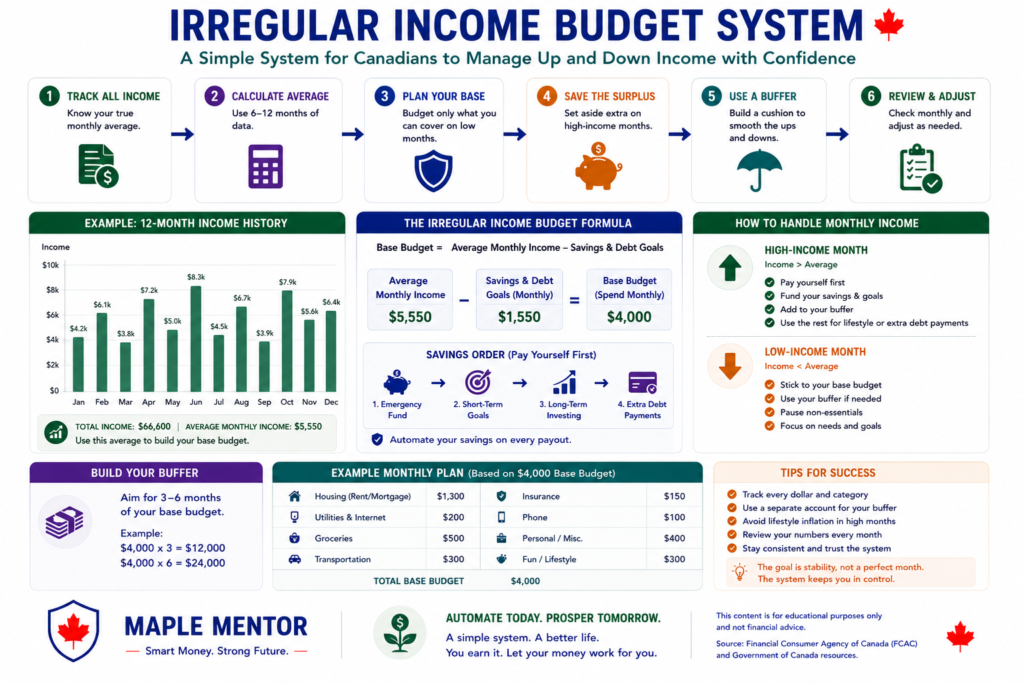
Start With Your Minimum Monthly Expenses
The first step isn’t estimating your income.
Instead, calculate the minimum amount you need to survive every month.
Include only essential expenses such as:
- Rent or mortgage
- Groceries
- Insurance
- Phone
- Utilities
- Debt payments
- Transportation
Ignore optional spending for now.
Once you know your monthly survival number, you’ll have a realistic income target every month.
Build a Bigger Emergency Fund
Emergency savings become even more important when your income changes regularly.
While many Canadians aim for three months of expenses, workers with irregular income often benefit from saving more.
A reasonable target is:
- Minimum: 3 months of essential expenses
- Better: 6 months
- Very unstable income: 9–12 months
A larger emergency fund gives you breathing room during slow periods without relying on credit cards.
Learn how much to save in How Much Emergency Savings Do You Really Need in Canada.
Find the best place to keep it in Where to Keep Your Emergency Fund in Canada.
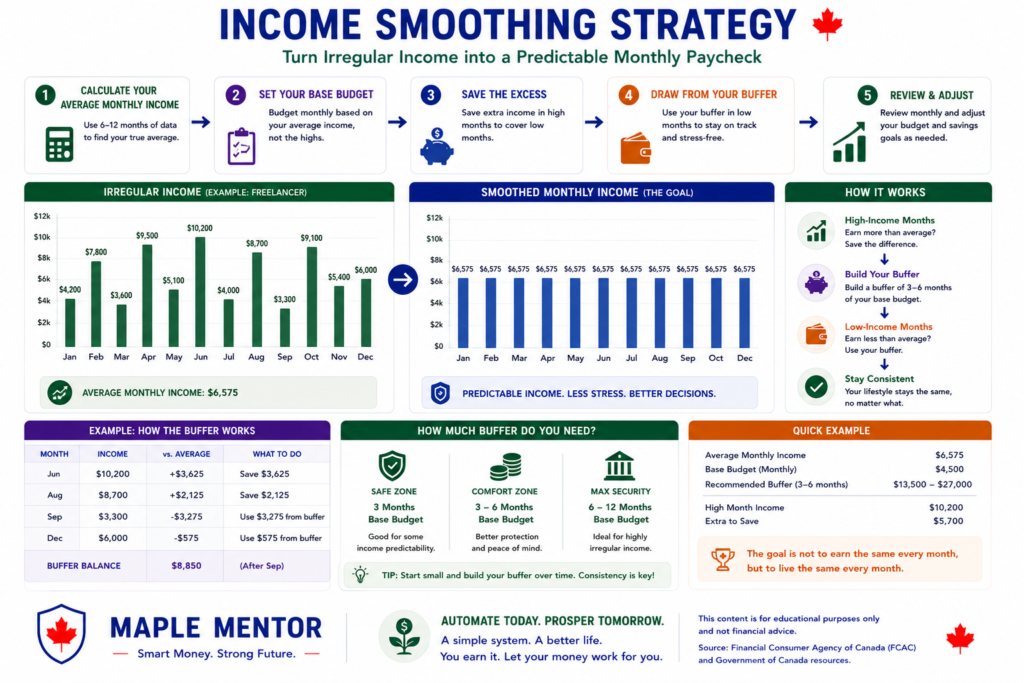
Pay Yourself a Steady Monthly Amount
One of the best habits for self-employed Canadians is paying yourself like an employee.
Instead of spending every dollar as it arrives, allow income to build inside your business or primary account.
Then transfer yourself a consistent monthly amount.
For example:
Your monthly income varies between:
- $2,500
- $4,000
- $6,000
Instead of spending $6,000 during good months, you might pay yourself $3,000 every month.
The remaining money stays available for future slow months.
As a result, your lifestyle becomes much more stable.
Separate Tax Money Right Away
This habit can prevent one of the biggest financial surprises facing self-employed Canadians.
Every time income arrives, immediately transfer a percentage into a separate tax account.
That money isn’t yours to spend.
Although the exact amount depends on your situation, setting aside money early makes future tax bills much easier to handle.
This isn’t tax advice.
Instead, it’s simply a practical money habit that helps reduce financial stress.
The Canada Revenue Agency provides information for self-employed Canadians and tax instalments.
Use Good Months to Prepare for Bad Months
Higher income doesn’t automatically mean higher spending.
Instead, strong months should strengthen your financial position.
Extra income can be used for:
- Growing your emergency fund
- Saving for taxes
- Paying off debt
- Saving for upcoming expenses
- Investing for retirement
Doing this creates stability during slower months.
Avoid Lifestyle Inflation
One of the biggest risks with variable income is increasing your spending after a strong month.
Unfortunately, that higher income may not continue.
Instead of basing your lifestyle on your best month, build it around your average or conservative income.
That approach reduces financial stress significantly.
Learn more in How to Avoid Lifestyle Inflation in Canada.
Automate What You Can
Automation still works when your income changes.
However, your system may need to be more flexible.
Examples include:
- Automatic minimum debt payments
- Automatic bill payments
- Scheduled savings transfers
- Manual investing after strong income months
The objective is consistency rather than perfection.
Build your system with How to Automate Your Finances in Canada.
When Should You Invest With Irregular Income?
Investing is important, but stability comes first.
You’re generally ready to invest when:
- Bills are consistently covered.
- Emergency savings are established.
- Tax money is separated.
- High-interest debt is under control.
- You won’t need the investment money soon.
Once those conditions are met, investing regularly—even small amounts—can help build long-term wealth.
If you’re wondering how much to invest, read How Much Should You Invest Each Month in Canada.
Beginners can also start with How to Invest $100 Per Month in Canada.
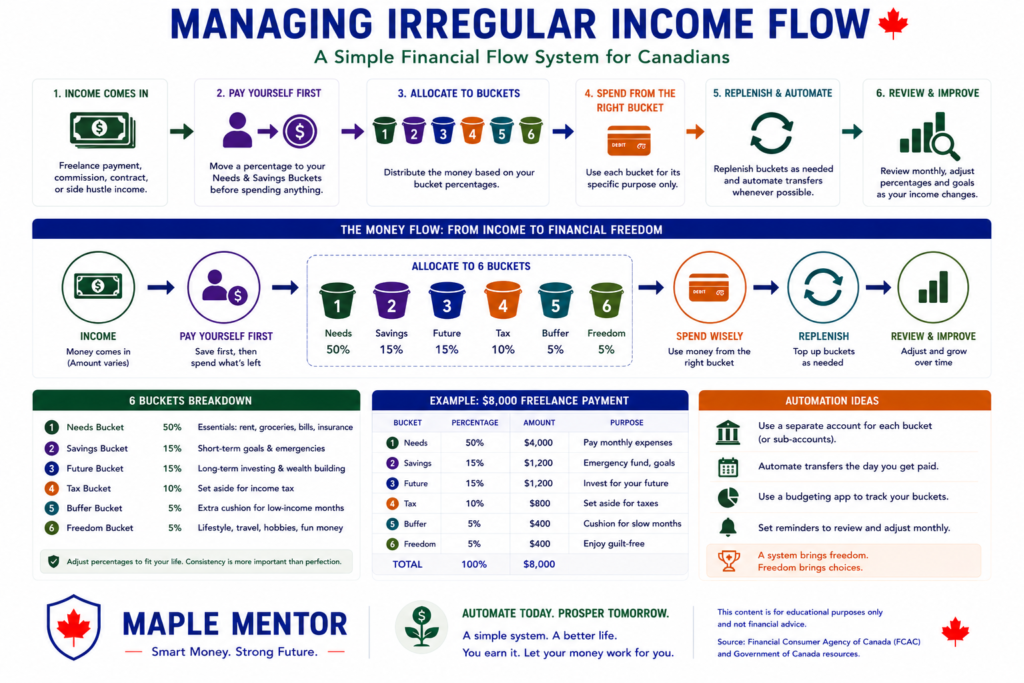
Simple Irregular Income System
| Money Bucket | Purpose |
|---|---|
| Bills Account | Monthly essential expenses |
| Tax Account | Income tax and CPP/QPP |
| Emergency Fund | Slow months and emergencies |
| Debt Payments | Credit cards and loans |
| Investing | Long-term wealth building |
| Spending Money | Flexible personal spending |
Giving every dollar a job makes irregular income much easier to manage.
Common Mistakes to Avoid
Avoid these common traps:
- Budgeting based on your best month
- Forgetting to save for taxes
- Spending every extra dollar
- Keeping too little emergency savings
- Investing before building stability
- Using credit cards to survive slow months
Each of these mistakes can make variable income feel even more unpredictable.
Final Answer
Learning to manage irregular income Canada workers earn isn’t about predicting every paycheque.
Instead, it’s about creating your own stability.
Base your lifestyle on a conservative monthly income, build a larger emergency fund, separate tax money immediately, automate what you can, and save aggressively during good months.
Over time, those habits can make irregular income feel almost as predictable as a regular salary.
Frequently Asked Questions
How do I budget with irregular income?
Base your budget on your lowest realistic monthly income instead of your highest earning month.
How much emergency savings do I need with irregular income?
Many Canadians with irregular income should aim for at least six months of essential expenses, although the exact amount depends on how unpredictable their income is.
Should I invest if my income changes every month?
Yes, but only after your bills are covered, your emergency fund is established, tax money is set aside, and high-interest debt is under control.
How do I handle taxes with irregular income?
A simple habit is to transfer part of every payment into a separate tax account as soon as you receive it.