Affiliate Disclosure: This post may contain affiliate links. We may earn a commission if you sign up through our links, at no extra cost to you.

Introduction
Saving $10,000 in 2025 might sound intimidating, but the best way to save $10,000 in 2025 is to break it down into small, automatic steps that fit your lifestyle. Most Canadians underestimate how simple it gets once your budget, banking, and habits start working together. And yes, anyone can do this, even on a modest income.
If you want deeper support with money tracking, tools like the budgeting apps I reviewed in my guide on Best Budgeting Apps in Canada can make this entire process effortless.
Step 1 Set a Realistic Saving Target
A big number feels overwhelming, so break it down:
- $10,000 per year → $833/month
- $5,000 per year → $416/month
- $2,500 per year → $208/month
Most people find weekly or bi-weekly targets easier to follow. Personally, I like weekly goals because they create momentum, it feels like a win every 7 days.
Step 2 Cut 5–7 Expenses (You Won’t Miss These)
Here are real, sustainable cuts that save Canadians $250–$500/month:
- Cancel one subscription bundle (save $30–$60)
- Cut food delivery by half (save $80–$150)
- Switch your phone plan to a low-cost provider like Public Mobile or Fizz (save $20–$40)
- Use cash-back rewards apps (save $10–$30)
- Cook 3–4 meals at home weekly (save $50–$100)
If you’re not sure where you overspend, syncing your accounts with a budgeting app (like the ones I break down in my guide on those same apps) gives you instant clarity.
Step 3 Automate Savings Into a HISA
Automation is the backbone of saving $10,000 in 2025.
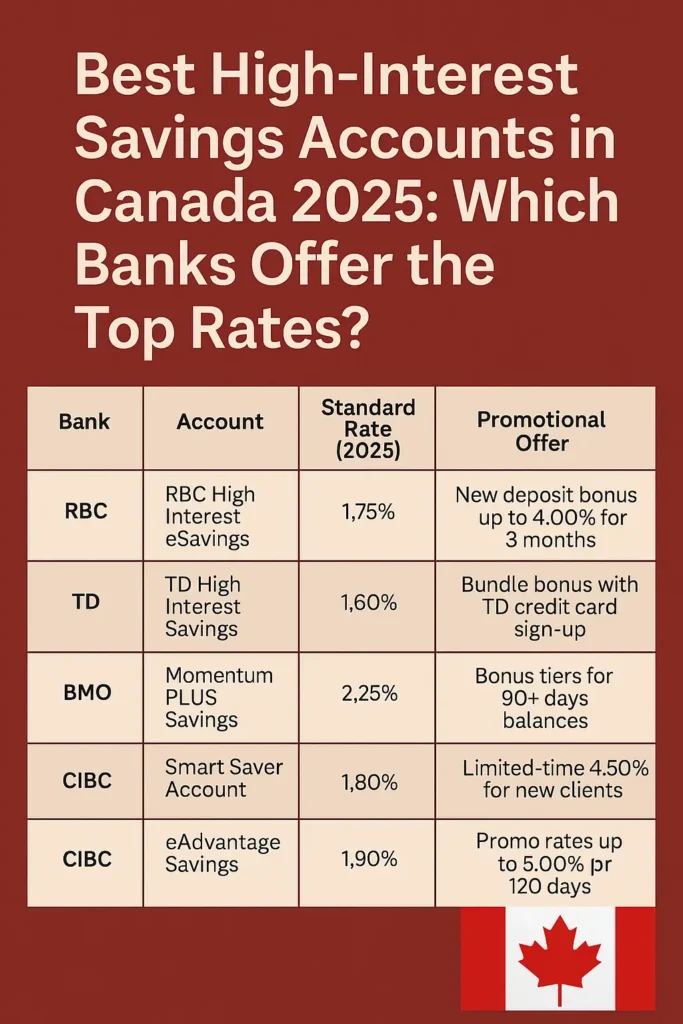
Send money automatically every payday to a high-interest savings account. Banks like EQ Bank, Tangerine, or Wealthsimple Cash typically offer 2%–4% interest.
If you want help choosing the best account, check my breakdown of the top High-Interest Savings Accounts in Canada.
Pro tip: Treat savings like rent, non-negotiable.
Step 4 Boost Your Income With Simple Canadian Side Hustles
Small boosts add up fast:
- Sell unused items
- Offer neighbourhood services (snow removal, lawn care, dog walking)
- Freelance on Fiverr or Upwork
- Deliver with Uber Eats or SkipTheDishes (1–2 nights/week)
- Use AI tools to create simple digital products
If you want a full breakdown of side income ideas, I’ll be covering them soon in my Canadian side-hustles guide.
Step 5 Use Cash-Back Credit Cards Strategically
Cash-back cards don’t just save money, they create money.
A good card gives you 2%–4% back on groceries, dining, transit, and recurring bills. If used properly, that can add $300–$600 a year toward your saving goal.
To pick the right card for your lifestyle, check my review of the Best Cash-Back Credit Cards in Canada.
Important: You never need to carry a balance. That’s a myth.
Step 6 Track Your Progress Monthly
Monthly check-ins keep you honest and motivated:
- Review your budget
- Adjust your spending limits
- Check your savings rate
- Compare your progress with your yearly goal
Apps like Mint, YNAB, or Wealthsimple Cash make this frictionless.

Step 7 Put Your Savings to Work (Optional but Smart)
Once you’ve saved a few thousand, consider growing it:
- Broad ETFs like VEQT, XEQT, VGRO, XGRO
- Simple automated options through Canadian robo-advisors
You can find more ETF breakdowns in my Best ETFs in Canada 2025 guide.
Example: How a Canadian Making $45k Can Save $10,000
- $300/mo saved from reduced expenses
- $250/mo earned from side income
- $300/mo automated into a HISA
Total = $850/month
Result → $10,000 in ~12 months
Common Mistakes That Stop Canadians From Saving
- Not tracking spending
- Relying on willpower alone
- Keeping money in checking instead of a HISA
- Trying to save without automation
- Carrying high-interest credit card debt
- Ignoring financial habits
If you’re working on credit repair, the techniques I covered in How to Improve Your Credit Score in Canada can speed things up.
Final Thoughts
The best way to save $10,000 in 2025 is a simple mix of automation, smarter spending, and small boosts to your income. Saving isn’t about perfection, it’s about consistency. Most Canadians who hit the $10k mark didn’t do anything extraordinary… they just started.
Start with one step today:
Automate your first transfer to your HISA.
Tomorrow, cut one expense.
Next week, add one side hustle.
By the end of the month, you’ll already feel like a different person financially.
If you want to level up your financial habits next, check out my breakdowns on
Best Budgeting Apps in Canada
How to Build Wealth in Your 20s.

FAQ (2025 Edition)
1. Can I save $10,000 in 2025 if I make under $50k?
Yes. It just requires mixing small savings with small income boost, not extreme budgeting.
2. Should I invest while saving for $10k?
If you don’t have an emergency fund yet, save first. Once you have $2k–$3k, you can start investing gradually.
3. How much should I automate monthly?
Set your automated transfer to the amount that meets your yearly target: $208, $416, or $833 per month.
4. What bank account should I use?
A high-interest savings account usually works best. Choose one with no fees and a decent rate.
5. Is cash-back a real way to save money?
Yes, used properly, it can add hundreds a year to your savings total.